The thumb on the microphone sign, the red seconds tick by, and the child who spent half an hour talking about the ball on the roof of the sports hall at dinner writes to his grandmother «hello… uh… well… I’m fine… well, until then,» listens, frowns, and deletes. If the parent needs comfort, it’s there, and rather unexpected. A hundred years ago in Yasnaya Polyana, Lev Tolstoy dealt with the same task; he had a phonograph on his desk, and there seemed to be enough words to get by.
Moscow, 1895
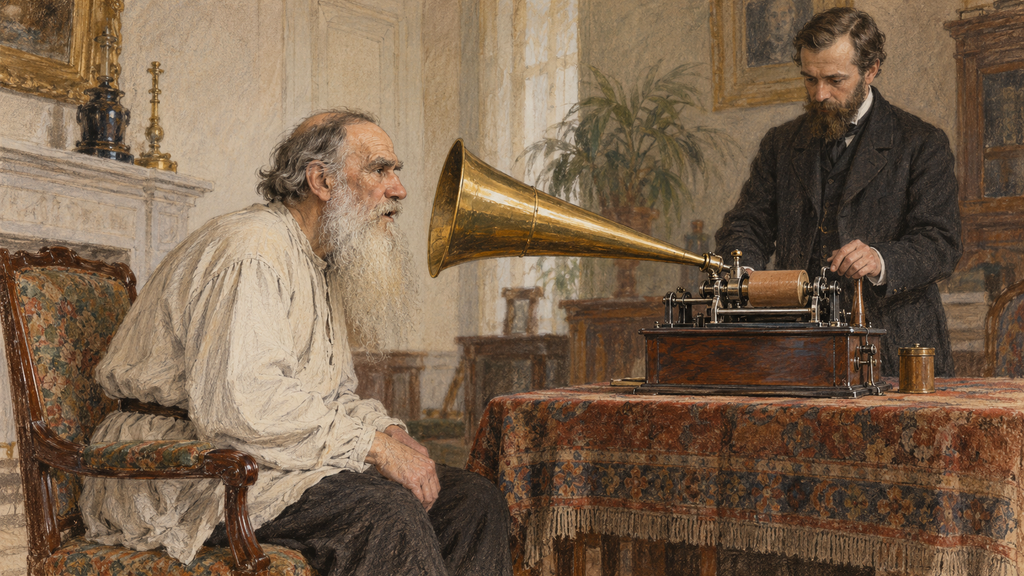
For the first time, Tolstoy spoke in phonograph at the home of Yulia Blok, a man who brought Edison's devices to Moscow and recorded famous acquaintances on them. Tolstoy read one of his short parables in the phonograph. And at the very end, when the parable was over, he added another phrase of his own: «I spoke in Moscow on February 14, 1895.».
This is a signature, only spoken out loud. On the paper, the name and date are written at the bottom of the sheet, and no one ever thinks to skip them. Tolstoy carried this habit into his writing, and the wax cylinder ended up just like a letter, with the name of the one who spoke, the place, and the day.
Yasnaya Polyana, early 1908
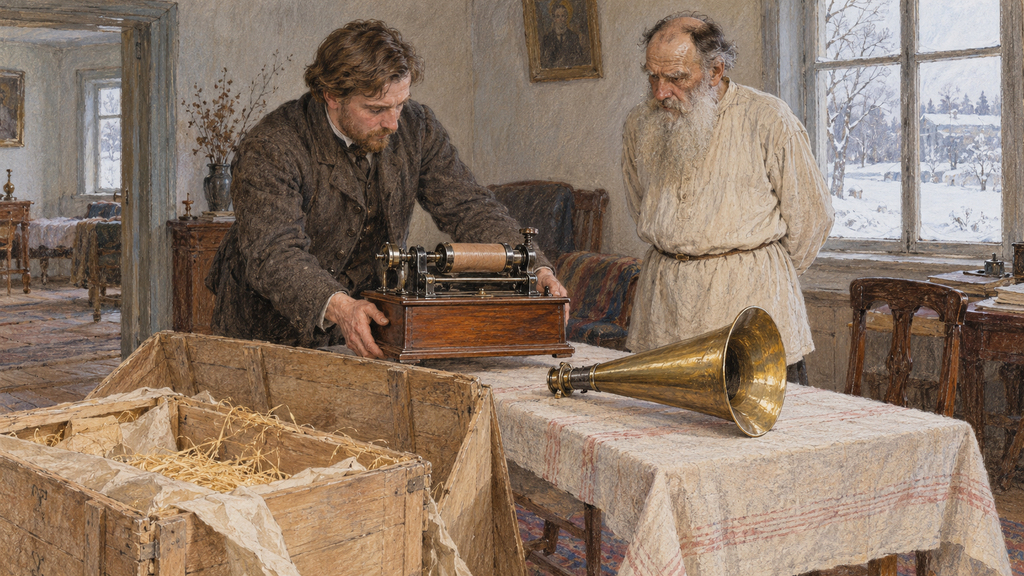
Thirteen years later, a phonograph appeared in his home. Edison himself sent the device, refusing to pay for it as a gift for his 80th birthday, and in early January 1908 the package was delivered to Yasnaya Polyana. The phonograph took about ten minutes to spin, maybe twelve, and the batteries were not very long-lasting, so at first Tolstoy did not dictate his long compositions into the phonograph. He began to dictate short letters, a few minutes each.
In a letter to Ivan Nazhivin dated February 6, 1908, one such attempt has been preserved. In the middle of it, Tolstoy said «I am writing this letter while speaking on a phonograph…» and stopped. He finished writing the letter the next day, using ordinary pen. The man who wrote «War and Peace» stopped in the middle of the voice message at the words about the device itself.
In other recordings from that year, it is heard that he feels a little uncomfortable. To one of the recipients, he apologizes directly in the phonograph for writing to him in that way, and to the other he says that he would like to at least say a few words to him in the phonograph, dear friend. The recordings are filled with pauses, corrections, and coughing. They sound like a conversation between a person who has no one to answer to.
February 1908
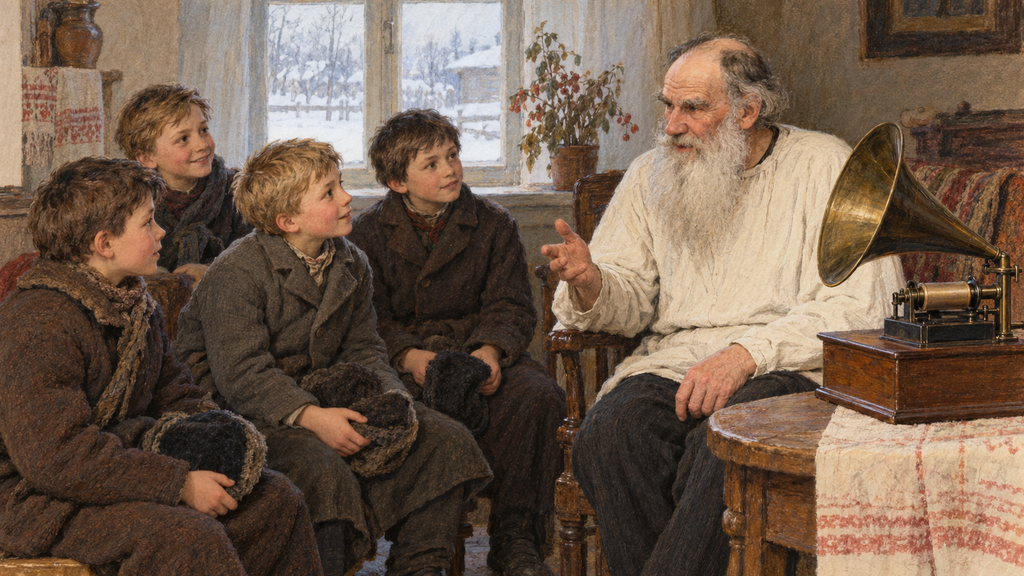
The boys from the Chaynopol school came to see Tolstoy, and in February he decided to write them a letter. It starts simply: «Thank you, guys, for coming to see me.» No preamble about what he’s going to say right away, and right away what he wanted to say.
The address is recorded on this tape twice. The first version is difficult to decipher; there are some interruptions in it. The second version sounds clearer. Both versions remain on the tape, and the second one sounds more distinct.
May 1908
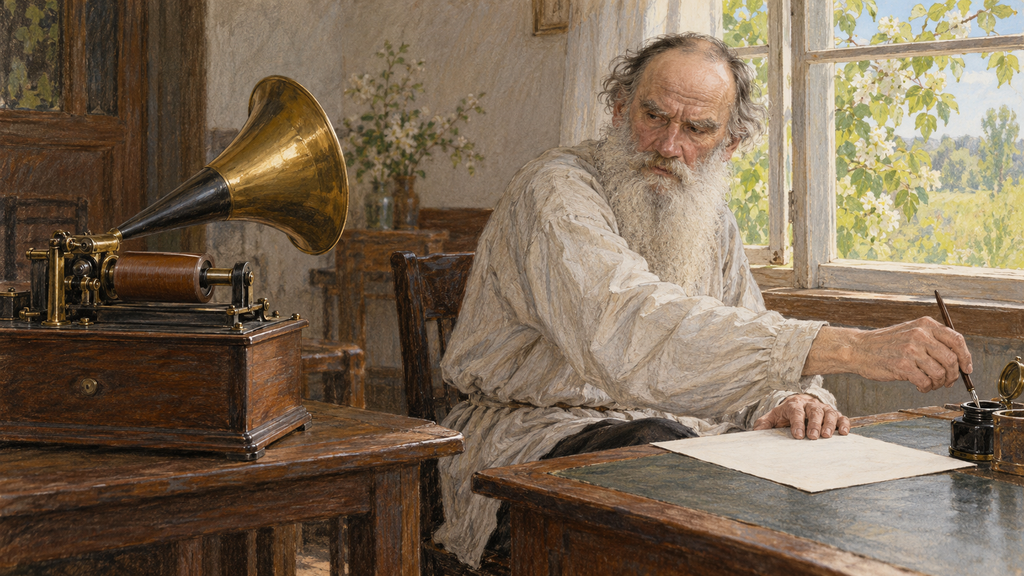
On May 11, Tolstoy began to speak in a phonograph recording, from which the article «I Can’t Keep Silent» grew. You can hear «No, that’s impossible! You can’t live like that!» on the tape, but then the tape ran out in the middle of the recording, and Tolstoy continued in pen.
He continued to use the phonograph. Researchers counted several dozen recordings for 1908, and some of them are now kept in Tolstoy's museum; it's just about an hour of his voice.
Divan, evening
If you put these rolls together, you get almost a manual for a voice-activated grandmother, only written not by the rules but by someone else's attempts.
You can start the conversation the way Tolstoy started with schoolchildren: with who you are talking to first. «Grandma, hello!» or «Grandma, it's me.» Choosing a familiar start is convenient to do in advance so that you don't have to come up with the first words after pressing the button.
Then there's the other thing. Tolstoy's letters to his son were short, the scroll didn't allow for anything else. For the first attempt, a child also needs one piece of news: a ball on the roof of the sports hall or a new music teacher. If he talks about the ball for a minute and he's interested, let him talk. If he's done in ten seconds, that's fine too.
If you suddenly want to say «I’m recording your voice» in the middle of a recording, that’s okay; Tolstoy did the same thing. The main thing is to get back to the point after saying that.
And you can end the recording by asking the grandmother a question. «Have you ever thrown anything onto the roof?» Then the grandmother has a starting point from which to begin the answer. And if the child likes it, after the question you can add a signature, just like in 1895. «I told you, Mishka, from home, on Tuesday,» the grandmother will most likely listen to that part of the story again.
It is possible to rewrite it if the child himself wants to; as Tolstoy wrote in his second appeal to schoolchildren. Only the third attempt is not necessary for perfection; the recording already has a beginning and an end.
Voice as writing
Before pressing the microphone, you can think about three places in the recording together. You don't need to write full sentences; two or three words are enough to remember them. Sound is not recorded here; the recording is made by the child on their phone.
How do you usually greet your grandmother?
What happened today that you would like to talk about?
What is it that you really want to ask Grandma about?
Like Tolstoy in 1895, the name and where you are from matter.
Sound letter
To whom to send
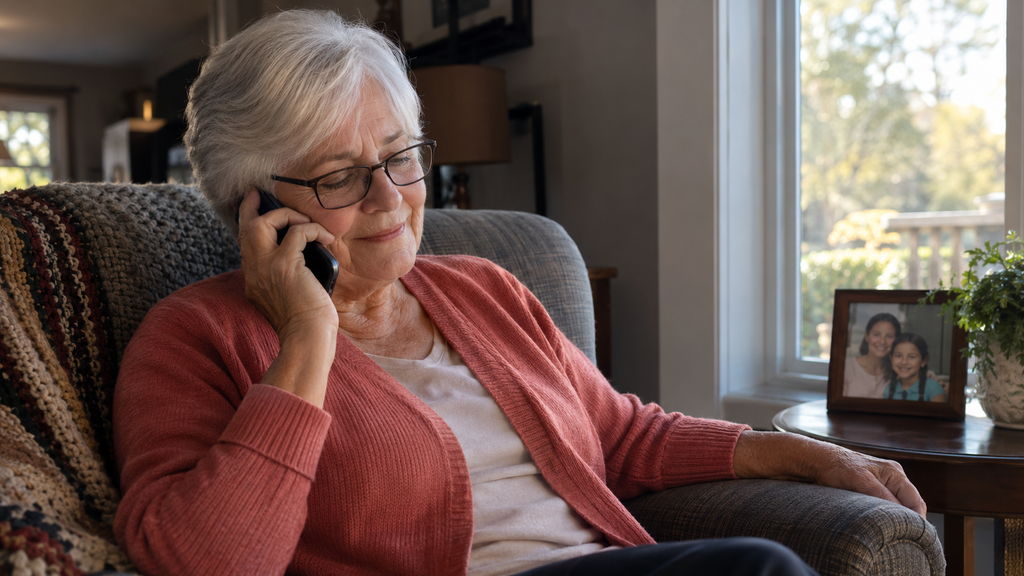
To Grandma. She can also be answered with a voice, with a greeting, one news and a question to her grandson. If she ever signs her voice, like Tolstoy, her grandson will surely repeat it.
For the second parent, so that they don't have to look over their shoulder while pressing the button. It's better to think about the beginning and the question in advance, together.
If the child can tell the news, but it’s difficult to write it down in letters, we have an article about that., Why a child speaks Russian fluently but cannot write a message. And if you want a real paper letter, there is an article about it, How to help him write a letter to his grandmother with his own hands.
Hour of votes
From Tolstoy's phonograph recordings, we have about an hour of sound. In them, Tolstoy thanks the boys, apologizes to the addressee for the phonograph, and starts over again. Listening to them is interesting precisely because we can hear how a person chooses words for someone who is not present.
Grandma probably keeps her grandson’s voice recordings too—everything, and «for now.» One day, among them will be the place where he first greeted them, then told about the ball, then asked if she had thrown anything onto the roof, and then signed it.
Starting a story, holding on to one thought, and finishing it when no one is picking up the pace—this is how children learn gradually. In the «Speech Development» course at Palme School, children aged four and up learn online, practicing building coherent stories and retelling them through games, scenes, and discussions.
At first you can free to talk with a methodologist, He will find out the goals and choose a teacher, and then come to a free lesson with the teacher.
Make an appointment for a consultationFrequently asked questions about voting for grandma
How long should the voice voting take for grandma?
There are no rules. For the first attempt, it’s convenient to take one piece of news and that usually results in a short recording. If the child gets carried away and talks for longer, there’s no need to stop them.
Is it possible to rewrite the voice recording until it is ready?
It is possible if the child wants to do it themselves. Tolstoy also recorded a letter to schoolchildren twice, and the second attempt turned out clearer than the first. There is no need to achieve a perfect recording; it is enough that it has a beginning and an end.
Is it possible to tell a child what to say?
You can discuss the beginning, news, and the question together before recording. During recording, it’s best not to give hints from the side because your words will end up being heard instead of his own.
Where can one listen to Tolstoy's voice?
Most of the surviving recordings are stored in the State Museum of L. N. Tolstoy; they have been released on compact discs. According to the audio archivist Lev Shilov, the surviving phonograph recordings of Tolstoy last just over an hour.