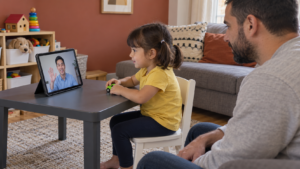

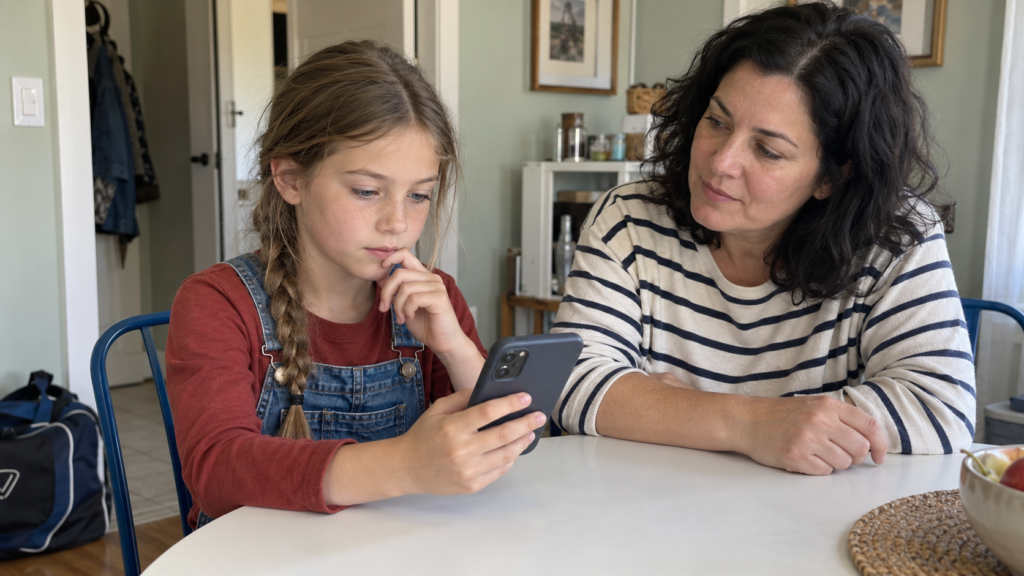

«Grandma, I’ll come on Saturday.
It takes two seconds to utter this phrase out loud. The child says it naturally, without hesitation or mistakes.
Now ask your grandmother to write the same thing in the chat.
In a minute, the screen shows «Grandma I.» Or the word «Saturday.» Or the finger is already on the microphone because you have to say more quickly.
He has a phrase. There are no messages.
Try to say this phrase again, slowly.
For which child is this method suitable?
For those who already know the Russian alphabet. He can write the familiar words by hand or type them on his phone, but he got stuck on how to create the message himself.
If the child doesn’t yet know how to write down familiar words, one oral training session won’t be enough.
If only the keyboard is an issue, you can start with a handwritten note.
How the child is doing with speech and reading will be shown test of Russian language proficiency in the blog. There are no questions in the letter.
Where does a minute go?
The phrase comes out in one piece. He said it, and it ended.
The child is looking for «b», then «a», then again «b». While he is looking for the letters, he may forget part of the sentence.
Because of this, the recording may be interrupted.
If the child already writes in English, they already have experience with written communication. In Russian, such practice may be less common.
There are no gaps in the voice recording
There is also a second thing, which is literally not audible.
Say the phrase about Saturday at a normal pace and listen to the end.
«On Saturday» sounds like one word. Moreover, the «s» before the «v» is pronounced softly, closer to «f».
A child who knows this phrase only by hearing it may not realize that there are actually two words involved.
There are five of them in the letter. Grandma. Me. I'll come. On Saturday.
The hyphen with the word is not considered.
If the child doesn’t yet know that «on Saturday» is written separately, show it to him/her just once.
A voice message that no one sent
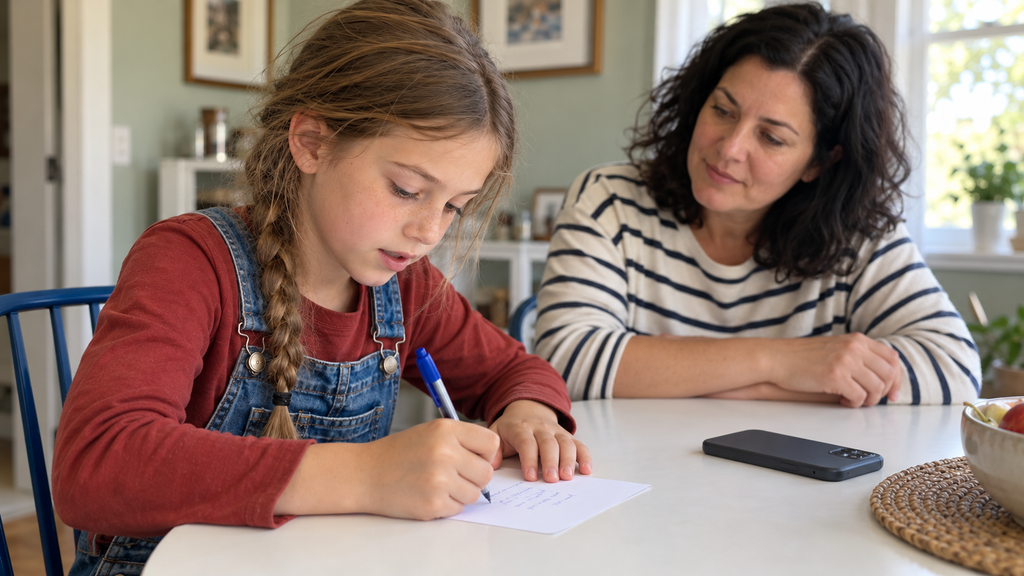
If the child sends voice messages, the beginning is already familiar to them.
First, choose who he writes to and what the topic is. You need a real reason for today. You are going to a friend’s house. The training session is over. You have a toothache.
One news story, one person.
Then ask him what he wants to tell you.
Let him say it out loud, in his own words, just as he would have said in a voice recording. There is no need to record and send the audio.
Start with a short phrase.
Now he is recording it. If the phrase breaks down, have him repeat it out loud in parts.
«Grandma, I'll come.» I wrote it down.
«On Saturday.» I wrote it down.
Don't write a message for the child. If he or she asks for help with a single word, help them.
Saturday is just an example here. Your child will have their own news and their own words. The page layout is different; there is a handwritten letter to grandma on the blog. separate article.
Five fingers for five words
Some children find counting helpful.
The child says the phrase slowly and curls his or her finger over every word. The same goes for the «v».
After recording the word, it can be counted on the screen.
Did you get four?
That doesn't mean anything yet. Maybe on the way the child said more briefly, «Grandma, I'll come on Saturday.» Let him/her read it again and decide if everything is clear.
Did you get five?
That also doesn't prove anything. The score serves as a guide; it doesn't make any evaluations.
If the phrase holds up like this, you can skip the fingers.
The grandmother did not hear what he was saying.
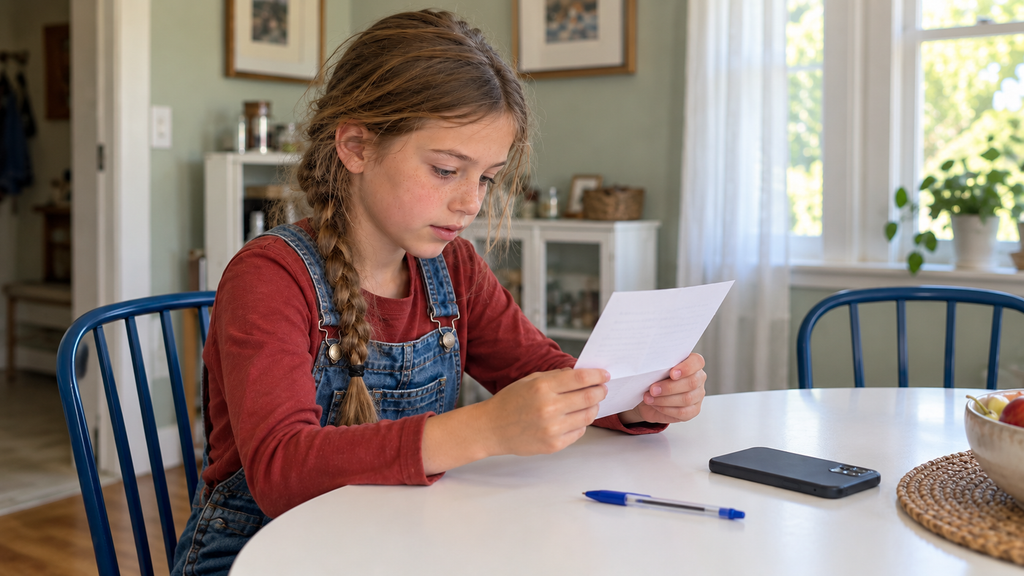
Before sending the child, they read the written text. Grandma will only have letters.
Let’s say that on the screen it says «I’ll come».
It’s clear that you want to report something?
What I will come to.
Does Grandma need anything else to understand you?
When.
«On Saturday» he will finish it himself.
The details needed depend on the news. The day of arrival is important for the trip. The day of a missing tooth is of no importance. A referral is also not necessary; in the chat with Grandma, it is clear who is being written to.
It’s also worth checking whether the phone has replaced any words. It’s not necessary to turn off auto-replacing for this purpose.
Saturday with one «b»
There may be errors in the first message.
«Grandma, I’ll come on Saturday.».
There are no commas; there is only one «b». Grandma will understand everything.
With «I'll come» it was different; there was no day when grandma didn't need the word, and it was worth writing it down.
Here’s the order: First, the meaning—that is, the important word that was left out, the unclear «who» or «when.» Then you can help with one of the spelling mistakes the child asked about himself or that he has already corrected.
Let the rest go as it is. There is no need to rewrite the message for the child.
The check for clarity does not replace spelling. The child will work on spelling another time and on another material.
The same phrase in English letters
«Babushka, I'm going to the forest on Saturday.».
If the addressee reads such a message, the news has reached them. As a temporary measure, this is acceptable.
The child composed and sent the message. But the Latin notation does not allow for the practice of writing in Russian letters.
If Russian letters are needed specifically, turn on the Russian keyboard on the phone. Show the unfamiliar letter or difficult word separately; leave the child to complete the sentence. Do not require them to rewrite everything all at once.
Sometimes the keys themselves get in the way. Then a handwritten note comes in handy. This way, searching for a letter on the screen doesn't interfere with composing a message. You can take a photo of the sheet and send it.
Say it, write it down, check it
One news for one person. There are no ratings here; no one considers mistakes.
To whom
What is it about
1. Say it out loud
Say your phrase out loud, in your own words. Just like in a voice message; you don't have to send anything else.
Do you lose your words while writing? Say the phrase again slowly and press the button on each word. Short words like «in», «on», and «at» are also counted. You can skip this step.
In the gym, the child chooses who to write to and what to write about, or takes their own news. They speak the sentence out loud, record it, and read it over again.
The orthography checker does not check the spelling; the word counter serves as a guide. The finished message is copied with a single button.
Saying the phrase out loud is one way to start a conversation.
Next time the news will be different; the order will remain the same. To say it, to write it down, to read it again through the eyes of the person you are writing to.
A one-sentence message helps to get started, but regular writing practice won’t replace it. At the «Russian for Bilinguals» course at Palme School, certified teachers work with children aged four and up. According to the program, children write in print, read and discuss what they have read in Russian.
The course can be tried out for free at two free lessons. They will help you get to know the teacher and understand whether the format is suitable for the child.
Sign up for free lessonsFrequently asked questions about messages in Russian
From what age can one try this method?
There are no age limits; what matters are the skills. A child can form a short sentence, write down familiar words and read what they have written, if necessary with the help of an adult. One hour of free oral speech is not enough for this.
Is it necessary to fix all the errors before sending?
No. First, check whether the news is understandable, and don't turn one message into an analysis of all the errors. If a child asks how a word is spelled, help them. Checking for understanding does not replace learning spelling; spelling and grammar are taught separately.
Is it possible to use word suggestions and auto-replacements?
It is not necessary to turn them off. Hints are acceptable if the child reads the selected word and understands it. After recording, it is worth checking whether the phone has replaced the correct word with another one.
What to do if a child is looking for Russian letters on the keyboard for a long time?
Searching for letters on the keyboard can interfere with writing down an already-made phrase. You can write the message by hand, take a photo of it, and send it. You can also practice the Russian keyboard layout separately.
There are ways to apply for a job on the blog Typing tutor and the instruction, How to set up the Russian keyboard.