

The Kupchynsky courtyard explained the voiceless consonants in the root of the word better than any textbook, although no one spoke those words there.
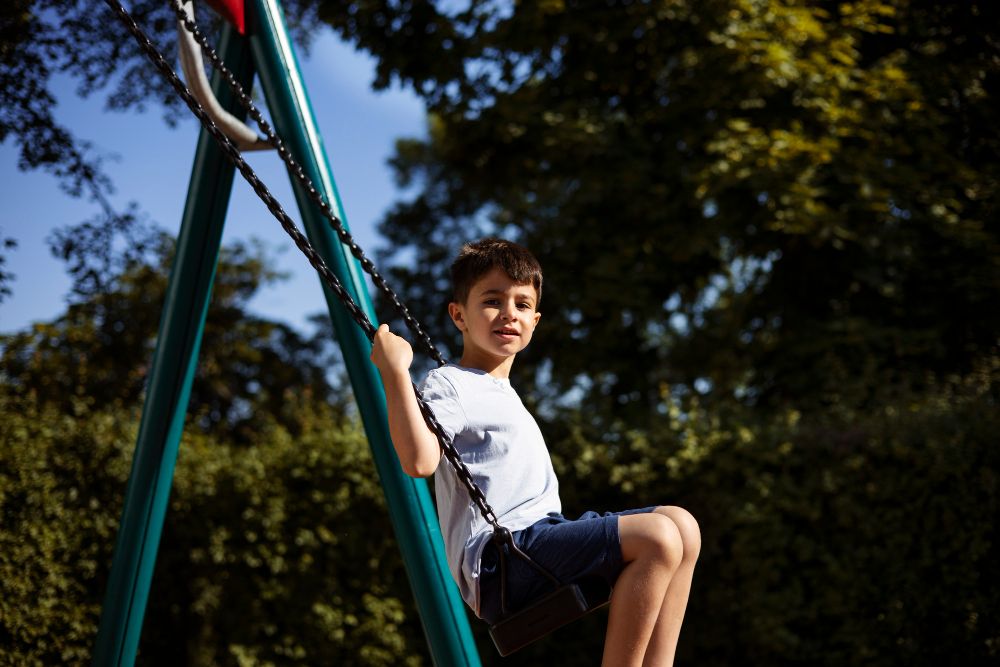
Evening. The nine-story building is marked with the letter «P»; swings squeak on the playground, and someone is chasing a ball against the wall of the transformer substation. From the window on the fourth floor, someone’s mother peeps out and pulls at the whole yard: «Mi-i-sha-a, do-o-oy!» The voice itself elongates the correct syllable. It’s awkward to shout «Mi-i-sha-a-a» with the long final sound; the tongue resists. The striking syllable in such a scream is heard over three blocks away, and the unstriking one is swallowed up, and no amount of loudness can save it.
From this small observation a whole theme emerges. The vowel sounds clear when it is stressed. The vowel without stress mumbles, and it is impossible to believe it in writing.
For a child growing up in Toronto or San Diego, Chinatown is very far away. At home, Russian sounds very distant; all day long, English is the dominant language around. With this accent, the child may hear words with an uncertain intonation; they often know fewer words than their peers in St. Petersburg, and the famous rule «pick a test word» becomes a spell with no power for them. Sometimes they just nod, write «vadah,» get a red circle, and conclude that the conclusion is hard to refute: Russian is a curse invented by fate.
The rule works if you know how to use it correctly. Next, we explain why we write not as we hear it, how to find the verification word that really checks, where the rule is ineffective, how alternating roots differ from ordinary ones, and what children with two languages stumble upon more often. At the end, we list exercises that don't even require a notebook. If a grandmother is helping a child with learning English, she should read it too: many techniques are designed for two people.
What is a voiceless consonant and why do we write it differently than we hear it?
Say the word «water» out loud, as in ordinary conversation. The first sound after «v» in «o» is not like «a». It is closer to "a", short and blurred. The vowel that does not receive stress loses its strength and sounds indistinctly. It is also called a voiceless vowel.
In Russian speech, the sounds «o» and «a» are especially often merged. Linguists call this a kanji, and literary pronunciation is structured exactly like this: «vada», «sassa», «garoh». With «e» and «y» after soft consonants, a similar story occurs; they tend to end up with the sound «i». Hence, «in the forest» instead of «in the forest» and «pituh» instead of «peacock». The child hears it honestly. It is not the ear that is mistaken; it is the expectation that the letter repeats the sound.
Why, then, does Russian spelling not transcribe speech as it is? Because Russian orthography has a different goal. Its main principle is called morphological: the same part of a word is written the same way, regardless of how it sounds in different words. The root «vod» remains the same in «vod» and «vodnaya», as well as in «vodnaya lozhka», although the «o» in it sometimes vibrates and almost disappears. It’s more convenient for the reader to recognize the familiar root at once and not stumble over it.
Here, an unexpected ally comes to the rescue: the English language. The child who attends an American or Canadian school has already encountered the same principle; it just wasn't called that. Take it photograph and photography. In the first word, the first «o» is clearly audible; in the second, the stress is further away, and it becomes fainter. But it is written the same way because the root is one. That's exactly how Russian writing works too. You can tell a child: you already know that, just in English.
Verifiable silent consonants in the root of a word and how to find the verification word

The unpronounced, interrogative vowel root behaves like a witness who mumbles during the first interrogation. If we ask the question differently—that is, find a form or a related word where this vowel takes on the accent—the testimony will be clearer. «Water» and «waters.» «Pine» and «pines.» «Forest» and «forest.».
It starts with the root. A child who doesn’t see the root will check what he or she has found. In the word «green», the first «e» is a question mark, and it is in the root «green».
Then the word begins to change. The shortest path leads through the form of the same word: placing the noun in the plural, the verb in another tense, the adjective in a short form. «Wall» and «walls.» «Walked» and «walks.» If forms are not helpful, they look for a related word with the same root and the same meaning. «To grow green» and «greenness.».
And at the end, they check the very test itself. The stress should fall on the vowel in which there was doubt, and the word should be related in meaning, not in sound. This is where the trickiest trap of the topic lies.
She is well represented in the imaginary postcard. Let’s say an eight-year-old grandson from Chicago writes to his grandmother in St. Petersburg: «Grandma, come to St. Petersburg in the summer! I want to sit on the porch with you.» Grandma laughs until tears come to her eyes, then she calls and says: «I can sit without you too. But I really want to sit with you on the porch.» One letter in the root turned the invitation into a joke about gray hair. «Sit» is checked with the word «sit,» and «sit» comes from «gray.» He got the family wrong and got a different story.
There are many such pairs in the language. Friends reconcile, and the test word is «peace.» A dress is tried on, and the test is another one, «measure.» The flag waves in the wind because the wind «blows it.» A child develops, and help comes in the form of «development.» They ask, imploring, because they «beg.» And they diminish the merits by making things «small.».
Similar words with different verification
| Word | What does it mean | Check word |
|---|---|---|
| to sit down | to sit still | sitting |
| to go gray | become gray | gray-haired |
| to reconcile | to reconcile friends | world |
| to try on | to put on to check the size | measure |
| is waving | fluttering in the wind | the wind is blowing |
| is developing | It grows, changes | development |
| begging | to ask very much | They beg |
| to belittle | do less, minimize | small |
Another trap concerns verbs. The words «to delay» and «to delay» are not suitable for verification. «To be late» cannot be verified with the word «to be late,» because the sound changes according to its own rules. The correct verification here is «late.» And the root in the word «to burn out» does not need to be verified by stress at all: it belongs to a special group that will be discussed below.
Have the child write the check word in brackets right next to the answer: «pine (pine).» At first it seems like extra work. But instead, each letter in the notebook gets a proof.
Unverified unvocalic consonants and what this has to do with lexical words
Sometimes there are no suitable words at all. In «lopatka», the first «o» does not fall under stress in either «lopatka», «lopaty», or any other related word. The same applies to «kapusta», «ovoshok», and «raketa». These are unaccented vowels that cannot be verified, and they must be memorized. In school, such words are compiled into an orthographic dictionary, and the words themselves are called "slovarnymi".
Details about how to teach them without rote learning and which words are used in each grade of elementary school are described in our article about lexical words. Here, another important point is involved. The child must learn to distinguish between two cases: when a verification word is present but it needs to be searched for, and when searching for it is useless.
How do you know that the word is not there, and not just that it was not remembered? It is worth honestly going through everything that comes to mind: the forms of the word itself, its affectionate and diminutive variants, words from other parts of speech. If none of the attempts put the questionable vowel in the right accent, then we have a lexical word, and there is no need to argue with it. We just need to open the dictionary and memorize it.
Sometimes the test is hidden in an unexpected place. The «window sill» is tested with «windows,» and that’s obvious once you remember where it lives: right under the window. Many children enjoy such finds. It turns out that the word holds a small story; you just have to notice it, and together with the story it’s easier to remember the letter as well.
Here children are faced with false relatives. The word «veterinarian» is tempting to check with the wind. But the wind has no relation to veterinarians: the word comes from Latin and is associated with working livestock. A similar sound does not make the words relatives. A good question that should be asked every time: are these words related in meaning? If a connection has to be made, it most likely does not exist.
Alternating vowels in the root, which obey their own laws

There are roots that behave completely differently. Testing them with a strike does not just be useless; it actually harms them. The «zhar» under a strike is written with an «a», and the «zhar» is written with an «o». Try testing one with the other, and you will get an error. An unpronounced alternating vowel root does not obey the verification word, but a special rule applies, and the rule is different for each group. In school, these roots usually start from the fifth grade, although the exact grade depends on the curriculum. It is useful for parents to know them in advance so that they do not prompt the child to make the wrong check. Below are the roots broken down by groups, depending on what determines the choice of letter.
Alternating vowels in the root
| Roots | The rule | Examples | Exceptions |
|---|---|---|---|
| Determines the accent | |||
| gar / ghor | without an accent, «o» is written» | sunbathing, sunburned (from the sun's rays) | shirt, shirt, shirt |
| zar / zor | without an accent, the letter «a» is written» | charge, spark, enlightenment | to shine |
| clan / branch | without an accent, «o» is written» | to lean forward | No |
| creature / creation | without an accent, «o» is written» | to create | utensils |
| Decides the letter after the vowel | |||
| lag / lies | Before «g», «a» is written; before «j», «o» is written.» | to offer, but to offer | plough |
| rise / increase / growth | The letter «a» is written before «st» and «sh», and the letter «o» is written before «s».» | grow, grow, but grow up | rostock, lender, industry, Rostov, Rostislav |
| skak / skoczenie | Before «к» the letter «а» is written, before «ч» the letter «о» is written.» | to jump, but to spring out | leap, galloping |
| Decides the meaning | |||
| mac / mok | «To »soak« means to immerse in liquid; to »get wet” means to let moisture pass through. | soak bread in milk; the jacket gets wet | No |
| equal / even | «equal» means the same, «level» means smooth | equation to level the track | No |
| Resolves the suffix «a» after the root | |||
| ber / bir, der / dir, mer / mir, ter / tir, blist / blist, stel / stil | it is written «и» if the suffix «а» follows immediately after the root.» | to gather, but to gather; to die, but to die; to shine, but to shine; to spread out, but to lay out | combine, combination |
The lists of exceptions in different textbooks vary slightly, so check with the textbook your child is studying.
In some roots, the stress decides everything. Without the stress in the root, «gar» and «gor» are written with a «o»: to tan, to burn, although there is also the spelling «tanning» under stress. There are three exceptions: «yargiki», «izargi» and «prigari». In the root «zar» and «zor» without the stress, on the contrary, is written with an «a»: to sunbathe, to burn, to be enlightened. There is only one exception: to «star». In the roots «klan» and «klon», «tvar» and «tvor» without the stress are written with an «o»: to lean forward, to create. The last rule leaves out «utvarka».
In other roots, the letter that follows the vowel decides the meaning. If the letter «g» is at the end of the root, it is written «a», and if it is «j», it is written «o»: to suggest, but to offer. The word «polog» is probably only known to those who have slept under a canopy. Before «st» and «щ» it is written «a», before «s» it is written «o»: to grow, to cultivate, but to grow up. There are more exceptions here, and they should be learned separately: sprout, rother, branch, Rostov and Rostislav. In the pair «skak» and «skoc» before «k» it is written «a», before «ch» it is written «o»: to jump, but to spring out. Exceptions are «skak» and «skoc».
Sometimes the meaning chooses the letter. Bread is dipped in milk, and a jacket gets wet in the rain because «to dip» means to submerge in liquid, and «to get wet» means to let the moisture pass through. Equations are solved when we are talking about the same «equal» thing, and the path is leveled when we are talking about a smooth «equal» thing. Do not confuse these roots with the «world» and «measure» from the section on verification: there is a normal verification by hitting.
The roots with the «e» and «i» remain. In «ber» and «bir», «der» and «dir», «mer» and «mir», «ter» and «tir», «blist» and «blist», «stel» and «stil» are written with «i», if immediately after the root there is a suffix «a»: to gather, but to gather up; to die, but to die; to shine, but to shine; to spread out, but to lay out. Exceptions are «combine» and «combination».
Does that sound like a lot? For a younger child, yes. So the first step is simple. Let the child remember the very existence of such roots. Upon encountering «gar», «zar», «lag», «rast», stop and don’t check the pronunciation. The rest will come in middle school.
Where do bilinguals go wrong and why?

Pronunciation is hard to master with a bilingual child. A child who speaks English most of the day may find it harder to hear the stressed syllable than a peer in Russia. He or she may stress the first syllable in the word «call» in one conversation and not notice the difference in the other. words whose accents confuse even native speakers, There is a separate article on our blog, and it will be useful for training your hearing. impact training machine.
The cry from the Kupchynsky courtyard is helpful here. Ask the child to «call out» the word as loudly and forcefully as if you were calling him from the window. «So-o-sun!» The silent syllable is awkward to pull out, and the consonant usually gives itself away.
It’s not easier with a shortage of words either. To find a check word, you need to know it. It’s often easier for a peer in Russia to find the «fungal» word «fungus,» whereas a child abroad can spend more time trying out different options. Especially with roots from rural life or old customs that don’t sound familiar at home. Checking spelling here also doubles as a lesson in vocabulary: let the child first name all the relatives by the words they remember, and only then chooses the check word.
The English spelling adds its own nuance. In English, one letter is often read differently, and perhaps that is why the child trusts his ear more than his eyes. Then the Russian notebook shows what is heard: «vada» instead of «water», «mista» instead of «place», «sansa» instead of «pine». First graders in St. Petersburg also make such mistakes, but there are usually fewer clues around the child in a foreign-language text, which means there are fewer opportunities for the eye to pick up on them. However, with one mistake, the cause cannot be established.
False relatives also lurk. When there are fewer words available, it is easier to grasp the first similar ones. Therefore, the question «are the words related in meaning» is doubly important for bilinguals.
Exercises for home training

Start with a verbal bet. Write on a sheet of paper a pair of words that sound the same but are written differently: reconcile and try on, waving and developing, begging and belittling. The child comes up with a sentence for each word and calls out the verification word. Funny sentences are only to the benefit. The flag that «develops» in the wind will surely soon go to school.
The family tree of words works very well. At the center of the leaf is the root, from which branches branch out to the relatives. «Forest» means forest, forester, forest, and so on. The more sprawling the tree is, the easier it is to find among the branches the one whose vowel is next to the sound you need. At the same time, a reserve of words grows, and for a bilingual person, the double benefit is a win.
Organize a hunt in your favorite book. The task is simple: find three words with an unvowelated consonant in the root on one page and for each of them find a verification. If the verification is not found, the word is sent to a separate list, to the vocabulary list. After a few pages you can count together how many words with an unvowelated consonant in the root were found, how many verifications were found and how many words went to the vocabulary list.
The oral game «call a word» is suitable for the road and the queue. An adult says a word, the child repeats it, calls the stressed syllable, and then checks the word. Without a notebook and without a pen, the hearing works even in the car.
And another exercise, the opposite of a lesson. Let the child explain the rule to someone else: his younger brother, the teddy bear, his grandmother over video chat. To explain, you need to understand, and gaps in understanding often become noticeable in the process. The grandmother, by the way, is a very good student. She asks awkward questions and is very good at surprising people.
Nowadays, children are probably called home more often by a phone call than by a scream from the window. And the reception from that neighborhood has remained the same. You can take it with you, whether to Toronto or Seattle. Just say the word. It will respond.
You can also look for the test words together with your teacher; the first steps are free. The school has been working with children since the age of four, online, in small groups; the classes last 40 minutes. The methodologist will test the child’s level for free, listen to how they speak and write, and notice where they lose their accent. In the groups, the first two lessons are free: the child will get acquainted with the program and the teacher and will try to find the test words during the actual class. How the group program works is explained on the course page. «Russian for bilinguals». Those who need a one-on-one tutor will be suited. Private lessons, where the first free lesson is for determining the level, and daily practice provides Russian language training program.