

One day, linguist Lev Shcherba, who would later become an academician, proposed a strange phrase to his students. In the most famous version, it goes like this.
«The golden crane has plucked the bud of the borkha and is chirping with its beak.».
Not a single real word, except for the conjunction «and.» Not a single familiar root. And yet, anyone who grew up with the Russian language sees a whole story behind this nonsense. Some kind of creature, a female being, did something drastic and all at once with the bull. And now it has taken up residence with its offspring and will not leave it alone.
Where does such confidence come from? From the evidence.
The ending in the word «golkaya» indicates a characteristic, namely a female character trait. The suffix -nu in «budulana» indicates that the action took place in one stroke. The suffix -l suggests that it has already happened, while the ending -a indicates that the heroine performed it. «Kurdychat» sounds like a process that is currently underway. And «bokrenok» is clearly a small animal, like a calf or kitten. Later, Lev Uspensky picked up this phrase in the book «The Word About Words,» and the koudra went out to walk around the school classrooms of the whole country.
Shcherba’s focus reveals the main secret of the topic. Parts of speech in the Russian language are recognized not only by their meaning. Every word carries the characteristics of its profession, even when there is no meaning at all in it. A child who has learned to notice these characteristics stops guessing. He begins to investigate.
That’s how we suggest approaching the topic at home. As a matter where there are evidence, versions, and verification.
What is a part of speech and why should a child know it?
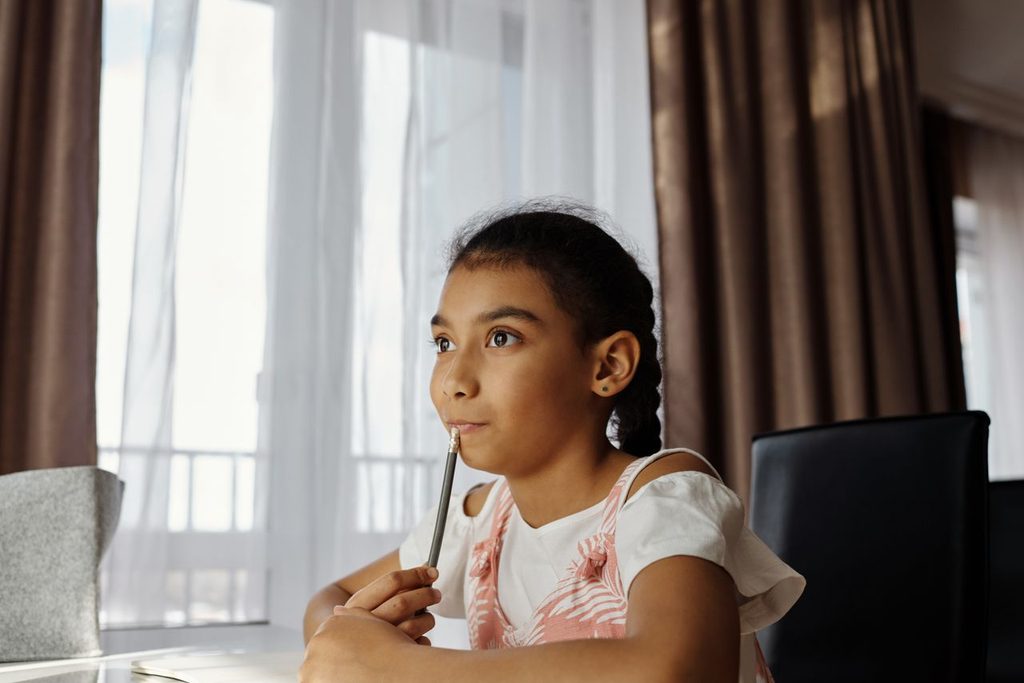
Imagine eight-year-old Vera. She lives in Toronto, goes to a Canadian school, and on Saturdays she studies Russian. When she does her homework, Vera looks like someone who has been wronged.
«Why should I know that a cat is a noun? I already know that it’s a cat.
The question is honest. And the answer to it should be honest, without references to «the way it should be done.».
Part of a speech is a large group of words with common features. They share a common meaning, a set of grammatical features, and a typical role in a sentence. All words that denote an object and answer the questions «who?» or «what?» behave similarly. Most of them change in number and gender. There are exceptions: «jacket» does not undergo inflection, and «scissors» are used only in the plural and have no gender. Still, the words in this group are written in many cases according to general rules.
This is where the practical benefit lies. Many spelling rules only work when part of a sentence is known. The words «cry» and «weep» sound the same. But the first one names the object—the bitter, childish cry—and the soft sign is not needed. The second commands something to be done, and after a whistling sound the soft sign is written after the verb. Without defining the part of speech, the child guesses. He knows it with him.
The same goes for the particle «not». With verbs, it is almost always written separately: «didn’t know», «didn’t see». With nouns and adjectives, the situation is more complicated; there are also «not true» and «not tall» words. To choose, you first need to understand who you are dealing with.
How many parts of speech are there? In the Russian school curriculum, it is usually called ten. Six are independent parts of speech, three are auxiliary parts of speech, and there is a separate interjection. If a child needs to learn all the parts of speech at once, it is convenient to keep in mind this formula: six, three, and one separately.
True, the formula does have a footnote. In some textbooks, the participle and the subordinate clause are considered special forms of the verb; in others, they are separated into separate parts of speech. Scientists have been arguing about this for a long time, and the debate is not over yet. In some curricula, a category of states is also introduced, with words like «cold», «sorry», and «maybe». Parents shouldn't worry. In elementary school, children will encounter the main parts of speech, and the intricacies of classification will be left until the middle grades.
Independent parts of speech and questions for which they are recognized

Independent parts of speech are called objects, characteristics, actions, or indicate them. It is these words that form the meaning of a sentence. If we remove them, we will be left with a handful of small words like «in,» «and,» «not,» from which we will not be able to make any sense.
It is convenient to group them into a table, where one column contains parts of speech, another contains questions, a third contains meanings, and a fourth contains examples. Let's go through them in turn.
Independent parts of speech and their questions
| Part of the speech | Questions | What it means | Examples |
|---|---|---|---|
| Noun | Who? What? | object | cat, house, rain, joy |
| Adjective | Which one? Which one? Whose? | sign of the object | reddish, warm, foxlike |
| Verb | what to do? what to do? | action or state | sleeping, drawing, drawing |
| Numeral | How much? Which one? | the number or order in a calculation | twelve, fifth |
| Pronoun | the question of which word to replace it with | Indicates an object, a sign, or a quantity without naming them | He is mine, this one, someone, no one |
| Adjective | How? Where? When? Where? Why? | a sign of action or another characteristic | Quickly, at home, yesterday, left, on fire |
The fifth in school grammar is considered a ordinal numeral, although the question and the ending are like those of an adjective.
The noun answers the questions «who?» and «what?» and names the object in the broadest sense: a cat, a house, rain, joy. noun gender We have a detailed article written, so I’ll keep it short here. Nouns usually have gender and change according to numbers and cases, and the exceptions like «jacket» have already been mentioned above.
The adjective is recognized by questions like «what kind?» and «whose?»; it indicates the characteristic of the object: red-haired, warm, and foxlike. It adapts to the noun in gender, number, and case. And how did adjectives acquire such a formidable reputation that even advanced students are afraid of them? This is told in our article. Article about adjectives.
There is always something happening in a house with a verb. The cat sleeps, Vera draws, and by evening she has already finished drawing. Knowing it is helped by the questions «what to do?» and «what to do?» and it indicates an action or state. A verb has a tense, a form, and a conjugation. Straightening and the form of the verb Two more of our articles are dedicated to this topic.
Now there are three parts of speech that parents mention less often.
The numeral appears on the stage when it’s time to count. How many pencils does Vera have? Twelve. Which one broke? The fifth. Hence the two questions of this part of speech and its two aspects: quantity and order. With the word «fifth,» the child may stumble. The question is almost like an adjective; the ending is the same, and the hand just won’t stop typing it in the wrong column. In school grammar, it is considered a ordinal numeral, although some linguists disagree with this.
The pronoun is more cunning than anyone else. It does not say anything; it only indicates. «He,» «mine,» «this one,» «somebody,» «no one.» Most pronouns have no permanent question of their own, like other parts of speech. They «borrow» the question from the word in whose place they stand: «he» answers «who?» as a noun, and «mine» answers «whose?» as an adjective. That is why a pronoun often becomes a clue that leads the investigation astray.
The adverb indicates a sign of action or another characteristic. It has its own questions: «how?», «where?», «when?», «where?», «why?». Fast, at home, yesterday, left, on fire. The main characteristic of an adverb is that it does not change case or conjugation. No case, no gender, no number. The word «fast» can never become «faster» or «fasterer». It is allowed to it only one thing: to form the comparative degree «faster».
You can play this game at the kitchen table. The adult asks a question, and the child, in three seconds, says the word that corresponds to it. «Where?» «Home!» «What?» «Sour!» «How many?» «Forty!» There are no stakes, but you don’t want to lose, for some reason. The game is simple, and the child repeatedly connects the question to the word.
Functional parts of speech and small words with a lot of work

The subordinate clauses resemble staples and glue. By themselves, they do nothing; they do not answer questions and do not form a sentence. However, without them the sentence falls apart.
Prepositions connect words and show the relationships between them: where, where from, from what, because of what. «In,» «on,» «from,» «because of,» «around,» «for,» «instead of.» Compare «a cat on the shelf,» «a cat under the shelf,» and “a cat instead of a shelf.” The nouns are the same, but the scene is always new. The preposition works in pairs with a noun, pronoun, or numeral and requires a certain form of the verb.
«Vera went for a walk because the rain had stopped.» «Vera went for a walk even though the rain hadn't stopped.» A new relationship formed, a tiny piece was added, and the heroine from the rational girl turned into a stubborn one. These switch words are called conjunctions. They connect words and entire parts of sentences, and in this group of «and,» «but,» «or,» «so,» «if,» and «that.» A conjunction is like a conductor who explains how two thoughts are connected.
Particles add shades of meaning or help form the word form. «Not,» «no,» «li,» «ye,» «by,» «even,» «only,» «just,» «well.» The particle «by» transforms a fact into a dream: «I went» and «I would go.» The particle «even» adds surprise. “Not” turns the meaning around. It is these little words that set the tone.
Separately from the two large groups are the interjections. «Ah,» «oy,» «ur,» «eh,» «tss.» It does not name a feeling; it directly expresses it. Next to the interjections, school textbooks usually include sound-like words like «meow» or «tuck-tuck.».
You can find such a story in the speeches of children who grew up in an English-speaking environment. The preposition is in place, and the verb after it is lost: «I am going to school,» «the book is on the table.» Here, there may be an influence of English, where there is no such system of verb endings, but it is not possible to determine the reason for the error based on a single sentence. More details about this are provided below, in the section about the two languages.
How to determine the part of speech of a word step by step

Let’s return to the investigator’s method. We are faced with an unfamiliar word, and the task is to determine its identity. It is convenient to proceed according to a single scheme, adjusted to the type of word.
To start with a self-standing word, you can ask a question. You don’t ask it at random, but from the word to which the suspect is related by meaning. In the sentence «Vera quickly drew a brown cat,» we ask for the verb. How did she draw it? Quickly. The question «how?» immediately suggests a possible answer, and the answer points to a demonstrative adjective. There is no demonstrative word in a possessive adjective, so we look at the relationship or nuance of meaning it expresses.
One question is not enough; the investigator needs confirmation. Therefore, they look at the meaning further. What does the word denote: an object, a characteristic, an action, a quantity? «Quickly» describes what the action was like. The version holds up.
Then they try to change the word. To put it in a different tense, a different number, at a different time. The «quickly» has no tense, number, or time; it stubbornly remains the same. Another clue in favor of the adjective.
And finally, they check what the word is used for in the sentence. An adverb usually serves as an adverbial clause, and here everything comes together.
The case is closed. But the real interest begins where the evidence contradicts each other.
Let’s take the word «my.» In the phrase «my backpack,» it answers the question «whose?» and points to the owner. It is a possessive pronoun. Now, the phrase «My hands before dinner.» Here, «my» commands something to be done, and this is the form of the verb «to wash» in the imperative mood. On the surface, the word is the same, but the part of speech is different. Such coincidences are called homomorphs, a special type of homonyms, and Russian has plenty of them. «Bake pies» and «Russian oven.» «Glass broke» and «milk splattered on the wall of the glass.» Without a question and without checking the meaning, it’s easy to get a finger in the air here.
When the child becomes proficient, already in the end of elementary school, and then in the middle grades, he or she is faced with a complete analysis of the word as a part of speech, which in textbooks is called morphological analysis. The order is strict. First, the part of speech and its general meaning are named. Then the word is placed in its initial form. Then the permanent characteristics that do not change are listed, and the non-permanent ones that depend on the context are listed. At the end, the role of the word in the sentence is indicated.
For the verb «painted», it looks like this. In front of us is a verb that indicates an action and answers the question «what did she do?». In its initial form it sounds like «painted». The constant characteristics include the perfect tense, the transition, and the first conjugation. But the demonstrative case, the past tense, the singular number and the feminine gender only appeared in our sentence, because Vera was the one who painted. In the sentence, the verb serves as the predicate.
It sounds cumbersome, but in reality the analysis is the same as questioning the witness with a transcript. It is useful for the parent to remember that every step builds on the previous one. If the child made a mistake with a part of speech at the very beginning, the entire transcript will be sent. Therefore, it is worth training the first two steps first: the question and the meaning.
Parts of speech in Russian and English where bilinguals get confused
The Canadian or American school also teaches children to group words, and there are usually eight groups in each class. From the Russian set in this list, the numerals and the particle have disappeared, but the rest are still there, from nouns to interjections. The child may think that he has already covered the topic. A misleading feeling.
Russian school list and English list of eight groups
| Part of the speech | Group | At the English school |
|---|---|---|
| Noun | independent | noun |
| Adjective | independent | adjective |
| Verb | independent | verb |
| Numeral | independent | There is no separate group in the list of eight |
| Pronoun | independent | pronoun |
| Adjective | independent | adverb |
| preposition | official | preposition |
| Union | official | conjunction |
| Particle | official | There is no separate group in the list of eight |
| Intercommunication | a separate building | interjection |
In different textbooks, the set of words may differ: the participle and the adverb are sometimes presented separately, while in English programs there are also articles and determiners.
The noticeable difference lies in the endings. In English, a word often changes its profession without changing its appearance. Run It can also mean «to run» and «to run away.». Fast It is also translated as «fast» and «quickly». The context of the word and its role in the sentence are particularly important here. In Russian, endings and suffixes often provide additional clues: run, to run, running, running. But context is also needed here: remember «my backpack» and «my hands».
Mistakes can arise from this. The child might say, «he runs fast,» but in his head, a different sound might be playing. he runs fast. The clue is clear: the sign of action is formulated as a sign of the object. This confusion is resolved by asking a question. How is it running? Fast. What kind of boy is it? Fast.
The endings also solve another problem that the English language sets for word order. Compare «Faith drew a cat» and «Cat was drawn by Faith.» The meaning is the same because the endings tell who drew what and who was drawn by whom. In English, word order turns everything upside down: the artist and the model change places. A bilingual child, accustomed to the strict English order, may not pay attention to endings. Perhaps this is partly why the book is on the table.
There is also a very practical trap. A child might say «I'm good» when they want to tell everyone that everything is fine. Perhaps in their mind, this is what is being said. I’m fine. But the Russian word «dobro» means «good»; the «good» in this context refers to a state of being, which some textbooks separate out as a separate category, while others consider it a colloquial term. For a child, classification is not important; what matters is to feel that «I am good» and «I am good» tell different stories.
There is also a reverse effect, quite amusing. English words, when used in Russian, immediately acquire Russian suffixes. In a mixed language, you can encounter «skit», «check», «shred». The English root and the suffix and ending are Russian, and part of the sentence is immediately clear. The glagoloy is in action, only in the opposite way: the meaning is clear, but the wording is its own.
Finally, articles. Sometimes a child, out of habit, looks for something to replace the English words. a and the. There is no Russian article, but the words «one» and «this one» may be needed in context: «one boy» could quite well mean «some boy». It is not necessary to remove them just because there was an article in the English phrase. It is better to ask the child what he or she wanted to say.
Games and exercises for home
The textbook provides the rules, and it’s easy to practice them at home during games. Here are a few ways that don’t require any store-bought cards or an hour of free time.
Start with the word puzzle. Read the Scherby sentence to the child and ask them who hurt whom. Then offer them to make up their own sentence. «The ugly mutt got really bored and started barking.» Let the child decide for themselves who is the subject, who is the signifier, who is the action, and explain why. In this game, the child learns parts of speech even in words that do not exist, and relies on endings and suffixes.
Next comes the hunt for work-related words. Open your favorite book on a random page and give yourself the task of finding all the prepositions. Or all the parts of the word «not.» Each discovery earns you a point. The child has to look for the small words that usually pass by unnoticed, while also paying attention to the prepositions after the words.
You can also play with transformations. The adult calls out a word, and the child transforms it into other parts of speech. Forest, forestly, forestly way. Run, run, running, running. For each transformation, the child asks a question: «what?», «what to do?», «what?», «how?».
For a road trip in a car, for example to a training session or to the store, the same game with questions works just as well as at the kitchen table. The question is three seconds long, and the answer is given immediately. You can switch roles, and then the child comes up with the questions for the adult. And if the adult makes a mistake, the child has a legitimate reason to correct it.
And the last exercise, the shortest one. One sentence at dinner. Someone in the family says a phrase about the previous day, and the rest of the family determine the part of speech of each word. Five minutes, no more. From time to time, return to the familiar sentence and see which words the child already understands on their own.
If the investigation at home is stalled or there is simply no time for it, it can be continued with us. At Palme School, children from the age of four have been learning Russian online in small groups. The lesson lasts 40 minutes. You can start for free. The methodist listens to what the child says, assesses their level, and suggests where to start, which is more of an introduction than an exam. In the groups, the first two lessons are free: the child gets acquainted with the program and the teacher, and solving language puzzles together with the teacher is much more fun than doing it alone. How group classes are organized is explained on the course page. «Russian for bilinguals». If the child finds it easier to open up alone, without any screen partners, these would be suitable. Private lessons, Where the first lesson with a level assessment will be free.