

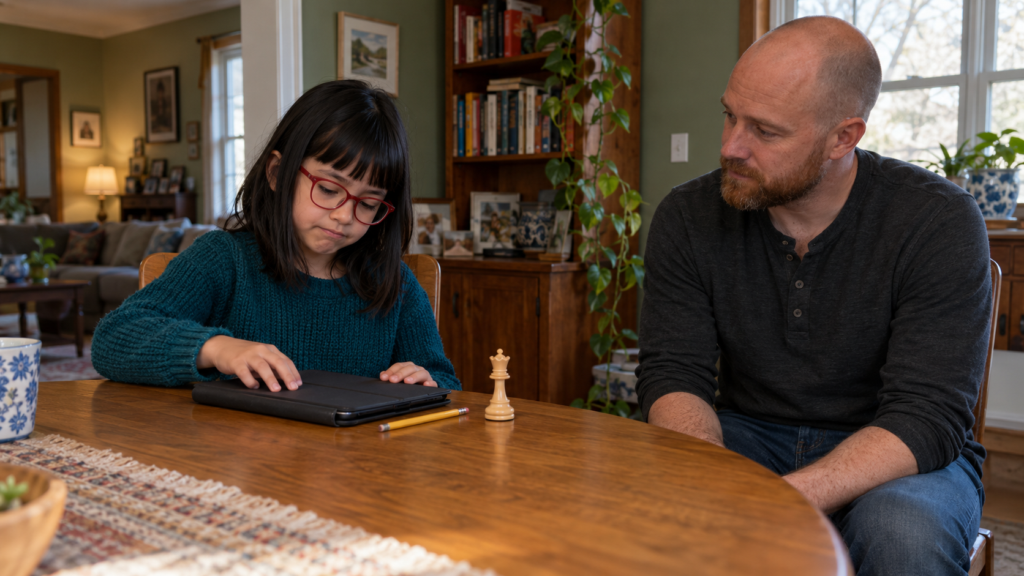
After a game, there remains a pawn on the board. In the club, it is written on a sheet of paper; in the online game, it is displayed to the right of the board, and the lines in it are identical: white move, black move. The sixth line stands out from the others, although it is on it that the knight left the board. The child closes the tablet and says, «I just lost.» After that, there is usually silence because there is no one to ask questions, and there is no one to comfort.
There is a way to return to this party without having to undergo questioning. One line of recording and one sign are all that are needed.
The sign after the move
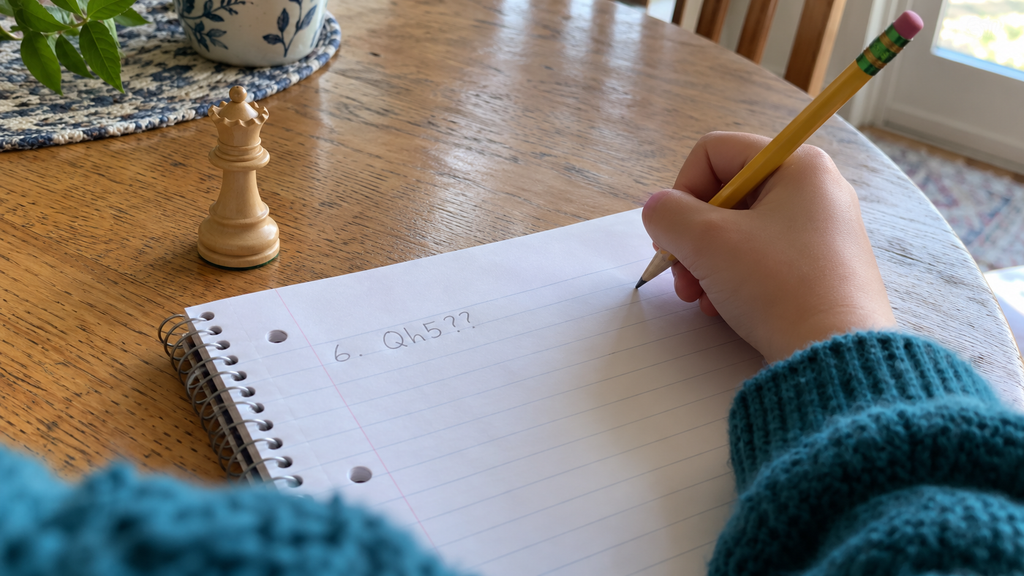
Chess players who comment on games use short marks to evaluate the moves. In the PGN specification, which is used by chess programs to store and transmit games, a «?» indicates a weak move, a «??» is very weak, and a «?!» is questionable. The mark is placed immediately after the move, close to it, and refers to the move played.
The question mark in the recording is attached to the action; no one attributes it to the player's surname. The conversation that begins with the action proceeds differently than the conversation that begins with «how did you do that?».
Which move in the party earned a question mark?
Training Party
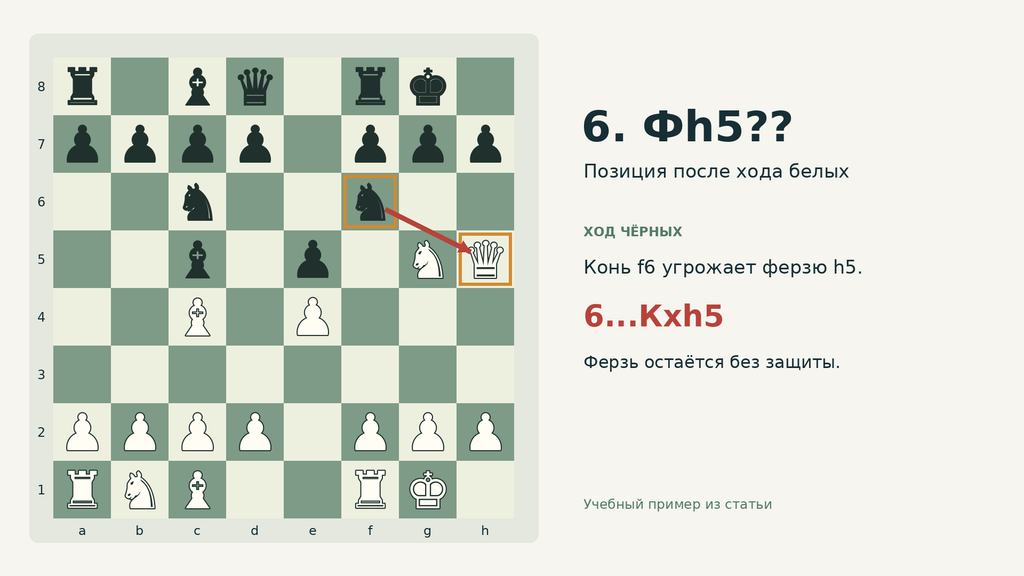
Let’s take an example, invented for this article. The moves in it have been tested by a chess program, but none of our students have played the game, and we will further assume that the participant’s thoughts are based on that.
1.e4 e5 2.Kf3 Kf6 3.Sc4 Sc5 4.0-0 Kf6 5.Dg5 0-0
The white pieces are immediately targeted by the pawn f7, the elephant with c4 and the knight with g5. The black rook f8 and king protect it. The white want to add a third attacker and take out the pawn.
6.Ph5
Now three players are watching the f7 position: the elephant, the horse, and the knight; there are still two defenders. Let’s say the white players expected the black players to be scared of the f7 and cover it with the knight, 6…f7. Such a move in the position is possible. But the black players respond differently: the knight with f6 jumps to h5 and takes the white knight. There is no way for the white player to play the knight.
In the comments section, this can be fit into one line. We put a mark after the move, and the answer that was expected is in brackets after the move that it was supposed to replace.
- Ph5?? Khxh5 (expected 6…Fe7)
The brackets in the chess notation indicate a variant, another possible continuation. The word «expected» within them is already our explanation for the reader; in this record of the game it is not present.
Two answers next to each other
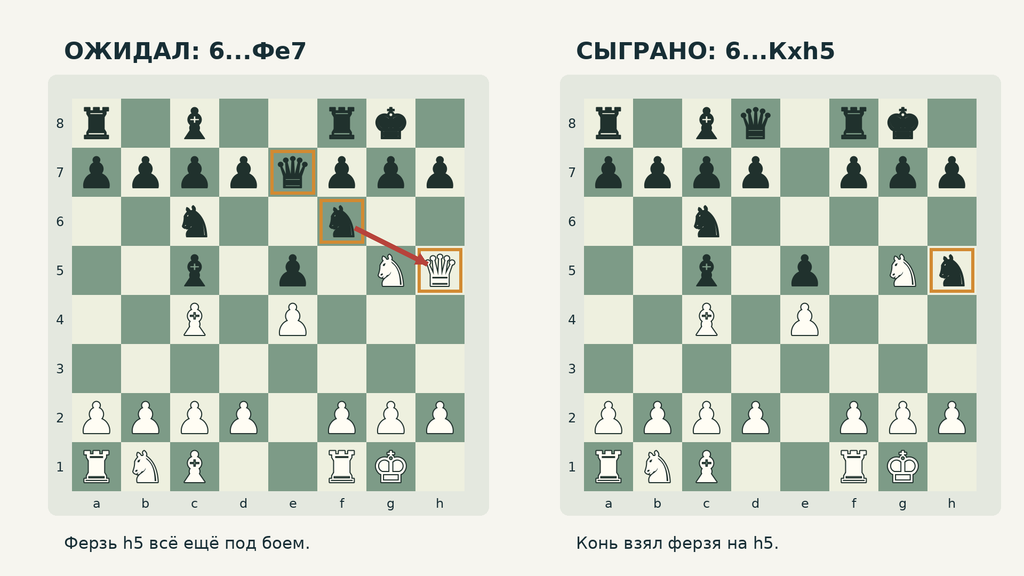
The move is ready, and now we can check it on the board. After 6.Ph5, we place the pieces and play both responses in turn.
First the one they were waiting for. After 6...f7 the pawn f7 has three defenders, a rook, a king and a black knight, against three attackers. But the knight f6 still attacks the h5 square. The move f7 added a defender to the pawn, and the white knight remained under attack.
Then what happened happened. After 6...Kxh5 there is no pawn on the board, and there is no way to return it. The same piece is involved in both lines.
From which field did the horse threaten the farmer?
The f6 knight was on the board before the move by the knight; it remained in the version with Fe7 and was played in a real game. If the child finds it in both lines on their own, he will solve the question «why the knight could be taken» without any help. About that, How to spot a threat and understand that a figure is hanging, We have a separate article, and this time we are not going to cover it here.
Fersh and Queen
A child who plays in English will write the same move in other letters. 6. Qh5??Nxh5 (6…Qe7). There is a Q, a knight N, not K, because K is occupied by the king. He will probably verbally call the figure queen; in English it is queen.
In Russian, the word is «on». According to Fassmer, the word came from the Persian ferz, «colonel». The word has its own family, grammatical structure, and its etymology does not explain it, but the picture is expressive. The colonel went on the attack on f7 and did not notice the horse f6.
My own party
With a training example, everything is clear; with a child's own game, it's more difficult. Online platforms usually keep the moves, while in a club you have a blank sheet. Then you can find a move after which the knight left, and ask what the child expected from the opponent. We record the expectation in the brackets using the child's own words.
In our training example, such a replie could sound like this: «I thought he would defend.» There is a calculation in this phrase. In our example, we assume that the player saw three attackers on f7 but missed the threat from the horse on f6. «I just lost» about the entire game and «I thought he would defend» about one move indicate a different situation, and the latter is much closer to chess.
If the child doesn’t remember what he was expecting, there’s no need to invent it for him. You can simply position the question and compare the two possible answers of the opponent, without saying «you probably thought that.».
If the moves are not preserved, there is one difficulty. According to one final arrangement, it is usually not possible to unambiguously reconstruct the previous moves. When the desired position could not be reliably reconstructed, it is better to analyze the situation using a training example.
One line for the evening
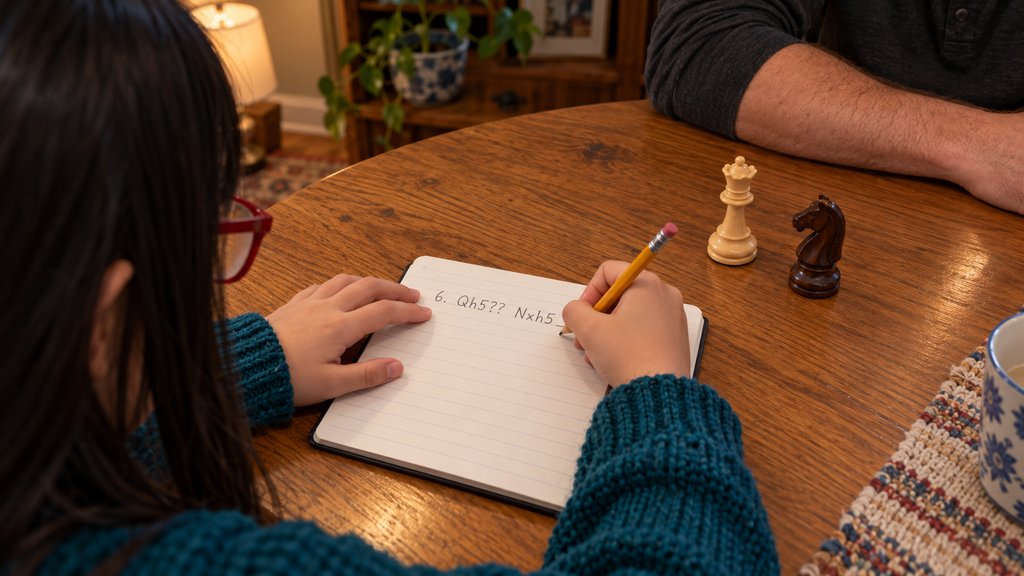
Without a clear explanation, «I just lost» remains the final result of the game, in which the child saw a lot but didn't notice one thing. Five minutes and one line are enough to analyze the situation. The move number, the move itself, the sign after it, or no sign if the quality of the move is still unclear, and the answer in parentheses that the child was waiting for in their own words. Then both answers are played out on the board in turn. The card below helps to assemble such a line from the training game or from one's own.
The training move from the article, devised for example. Position after 1.e4 e5 2.Kf3 Kf6 3.Sc4 Sc5 4.0-0 Kf6 5.Kg5 0-0, white's move. Click the buttons in order and compare the two black answers.
The yellow frame shows the pawn f7, the attacking pieces in blue, the new defender in green, the knight f6 in red, and the field it is attacking.
Recording of this episode: 6. Qh5??Nh5 (expected 6…Qe7). In English:6. Qh5??Nh5 (6…Qe7).
Record the wait in the child's own words. If the child doesn't remember what answer he was expecting, the field can be left blank and the opponent's two answers can simply be compared on the board. You can choose not to mark the answer until it is clear how weak the move was.
Figures in Russian: K is a king, F is a knight, L is a ship, S is an elephant, K is a horse, the pawn without a letter; the capture is written with x. The records are saved in this browser.
Q and F
A father who speaks English will read the same line with Q and N and explain it together with the child, without translating anything. The grandfather, who once taught his grandson to walk on horseback, uses the line as a pretext to start a conversation about the loss of the move.
The sign is after the move, with brackets next to it. The ferz is the same in every language, and the horse that took it is the same.
At the Palme School, children aged 5 and up are learning online with Russian-speaking coaches, 40 minutes twice a week in groups of up to eight people or individually. The program includes chess notation and the played games are reviewed together with the coach.
Getting acquainted with the Palme School begins at two free lessons. In the first session, the methodologist determines the child's level and helps choose the program; in the second session, the family meets the trainer. If a line with a question mark already appears at home, it can be shown at the very first meeting.
Book a Free TrialFrequently asked questions about playing a chess game with a child
What do the «?» and «??» marks in a chess game notation mean?
These are estimates of the move. In the PGN specification, «?» means weak move, «??» very weak, «?!» questionable. The sign is placed immediately after the move to which it refers.
How to record the answer the child was waiting for?
In brackets after the move of the opponent, which this option replaces, for example 6. Fh5?? Khxh5 (6…Fe7). The word «expected» in brackets can be added as an explanation for yourself; it is not present in this record of the game.
Is it necessary to evaluate every move in your own game?
No. The move can be selected for the conversation and left without a mark for now if it is unclear how weak it was. It is more convenient to make a rating after both the opponent's answers have been played on the board.
What to do if the party's records have not been preserved?
If the game was recently played, you can try to rearrange the pieces in memory with your child and see if it still works according to the rules. If you are unsure, it is better to use the game board from the article.
How are figures denoted in Russian and English notation?
King K and K, knight F and Q, rook L and R, elephant S and B, horse K and N. The pawn in the move notation is indicated without a letter, for example e4 or exd5, and the capture is written with x.