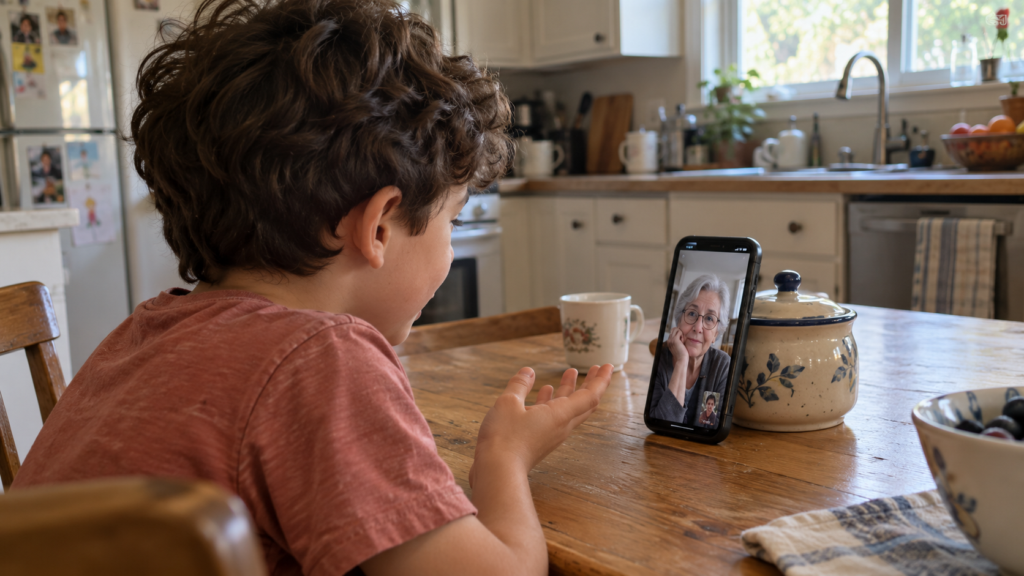

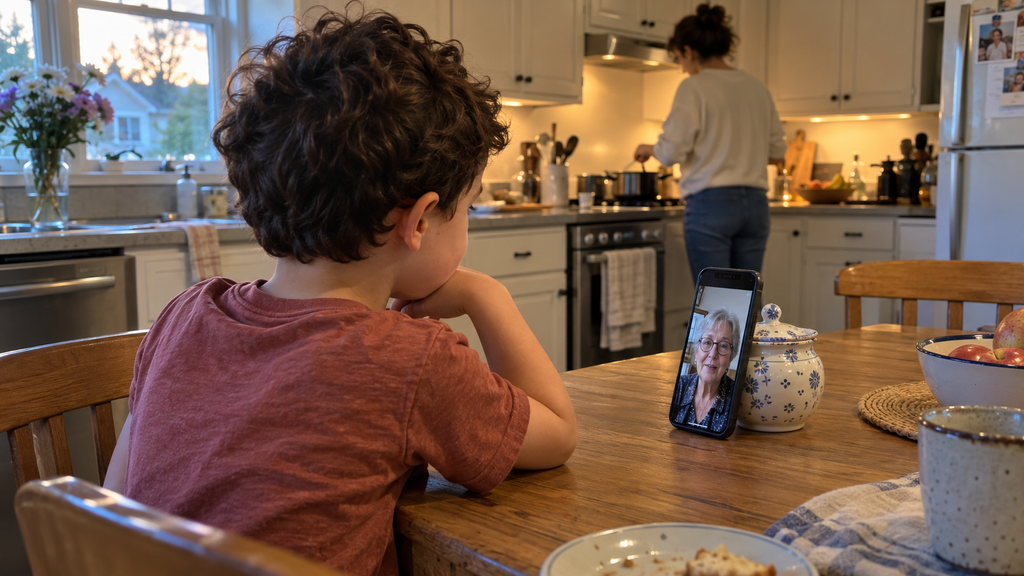
Sunday evening. The phone is on the kitchen table, propped against the sugar bowl, and Grandma is on the screen. She’s already in the middle of the night, but she’s not in a hurry to say goodbye because she has news about the neighbor’s house, and the further away the news gets, the faster it comes. You stand at the stove two steps away and hear the child answer «ah» to her. Then again. On the third «ah,» his eyes leave the screen and look at you, at the stove, as if the right word could be found there.
After the call, he asks you about it.
«And what did Grandma say?»
There is a way out of this scene, and it can be summed up in one short question that you have almost certainly heard in your own childhood. But first, let’s look at one oddity in it.
A word that Grandma didn't say
Let’s say Grandma said that.
«…and on Saturday we went to Sosnovka.».
The child heard «on Saturday» and «let's go,» but the name flew by. He asks.
«Where to?»
«To Sosnovka. Well, remember where we picked raspberries together?»
There was no «where» in the grandmother's phrase. The child asked for the word she hadn't said, and the grandmother understood without difficulty that the name was exactly what was needed to be returned, and there was no need to repeat Saturday and the trip.
How did this happen?
The question returns to the place where the lost word was
If you put Grandma’s phrase and the child’s question next to each other, you can see that «where» took exactly the same place as Grandma’s «in Sosnovka.» We went to Sosnovka. Where did we go? The rest of the phrase remained the same; only one part changed, and that was the part that was missing.
Therefore, the grandmother doesn't have to guess. The question word itself indicates which part of what was said needs to be repeated. Linguists call such questions rephrasing, and all its power lies in precision.
For a child, it is not necessary to know the missing word for this question. It is enough to understand what the missing fragment was about, the place, person, time, or quantity. The gap in the sentence is visible from the edges, even if its middle part is not heard.
The right word is suggested by the neighbors.

What the hole was about is suggested by what is around it.
In our example, the direction of the trip was lost, so the question will be «where?» If the grandmother says that the neighbor’s cottage in Sosnovka is empty and there is no traffic, then you need to ask «where?» In Sosnovka and in Sosnovka, the letters are different, and the questions to them are different.
The same thing happens with people; only it’s more subtle. «I met Aunt Valya» gives «Who-whom?» «The house was given to Petrovs» gives «To whom?» «We drank tea with Aunt Valya» gives «With whom?» In all three examples, the people are the focus, but the questions are different: who we met, who was given the house, who drank the tea with Aunt Valya. The word «met» helps to formulate the question «who?» If the child has difficulty, an adult can show them this by example.
You can try to formulate the question out loud without mentioning the different forms of the verb and without understanding the rule.
The preposition remains in place
Another detail emerges with the numbers. The grandmother says that the neighbor sold the house for half the price, and the price is lost. It is possible to simply ask «How much?» but the phrase itself suggests a more accurate answer.
«For how much?»
The preposition «for» stood before the price and remained before the question. The same goes for Aunt Valey: «with» doesn’t go anywhere; it turns into «with whom?» In our example, «to Sosnovka» completely replaces the question «where?».
If the child misspoke, nothing terrible happened. If the grandmother didn’t answer the question, you can ask again, «I meant the place. Where is it?».
Why the word is repeated twice
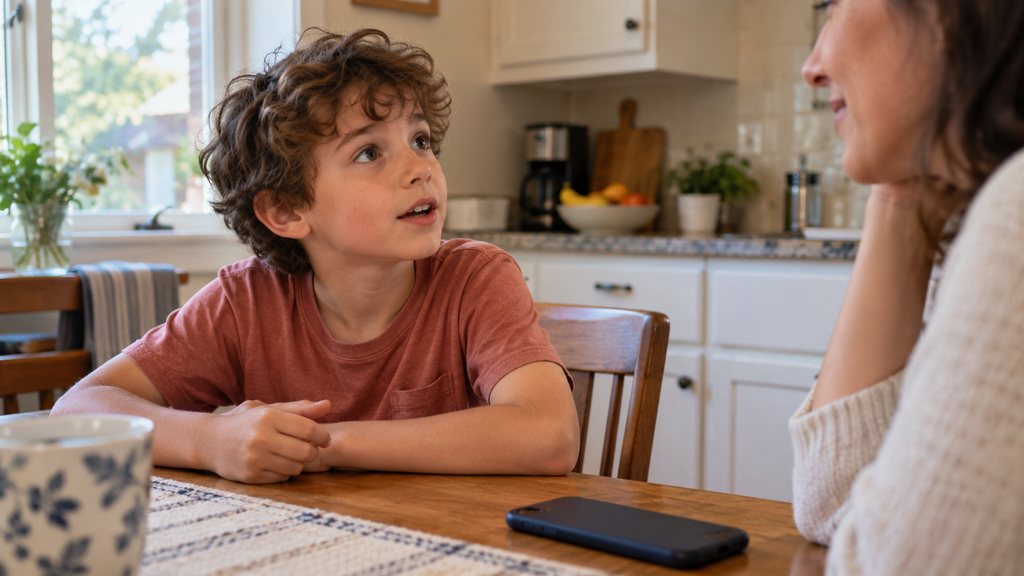
In colloquial speech, the question word is often repeated when asked again: «Where?,» «To whom?,» «How many?» One can also simply ask «Where?» The repetition is one of the colloquial variants of asking a question. How it sounds, as a request to repeat or as a surprise, depends on the intonation and the situation.
The same person might say «How many?» because they didn’t hear the number, and because they were surprised, «That can’t be that cheap!» On paper, this difference is not obvious. If it’s important to the child that they not be misunderstood as distrust, there’s always a calm option nearby: «Grandma, how many?» You can’t always put the «What did you say?» option in place; without the necessary intonation, it’s easy to hear it as an objection.
What Grandma hears in an «agah»

Now you can return to the sugar bowl. For Grandma, «agah» means that she is being listened to and that you can continue talking. She sees a attentive face and with relief adds details, names, and the price—who said what to whom on the stairs.
A child with the same «agah» has a completely different reaction. He is somewhere else with a different surname, but he doesn't dare stop the grandmother; they taught him not to interrupt adults. A strange thing happens: the child's politeness itself speeds up the story, which he has already gotten bored of.
It’s easy to tell yourself that you can at least listen to her, but interrupting grandma is not nice. Asking her about her hometown brings the child back to that very story. For those who are telling the story, the question about their own history usually sounds like a sign of interest.
Age alone won't solve the problem. The vocabulary grows with age, but the habit of nodding when you don't understand can become ingrained if no one bothers to correct it.
When the hole is more than one word long

The question mark works when a piece is missing. Sometimes a grandmother speaks so quickly that not just one word is lost, but an entire flow; there’s no way to put a «where» marker; the edges of the hole are also inaudible. Then a request for a slower pace is needed, «Slower please,» and it’s better to keep the «please» in it; without it, a short phrase sounds easy as an order.
It happens the other way around too. The word is heard perfectly, just not familiar. Grandma says «around the corner». On «where-where?» she might just repeat «around the corner». If the word itself is unclear, it’s better to ask directly, «Grandma, what does »around the corner” mean?”.
«Repeat, please» also works; only it doesn't explain what exactly was missed. Grandma can repeat everything in its entirety, the last words, or say it differently, and the child will have to pick up the correct place again.
A voice recording with a hole visible
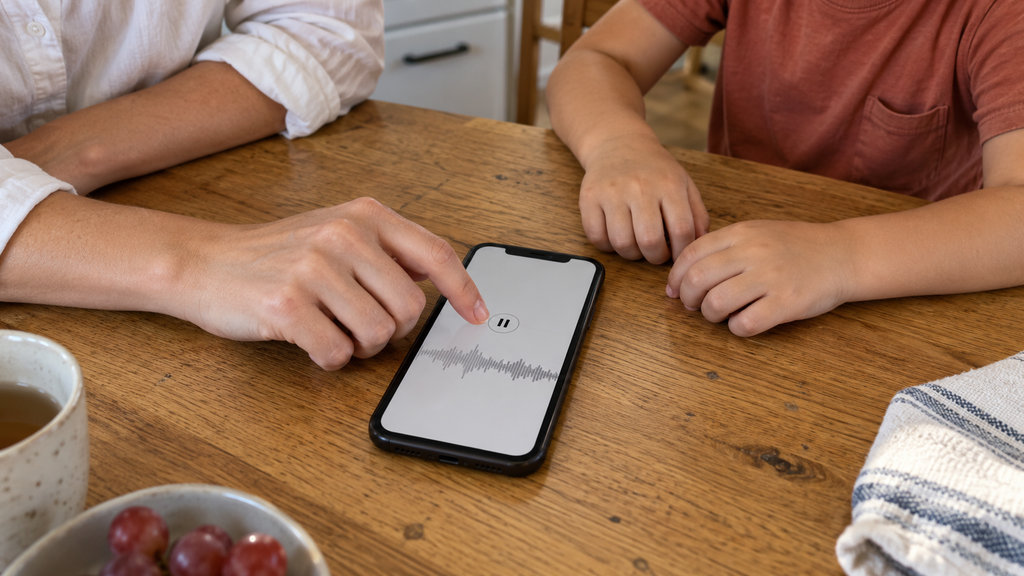
If after the calls the child regularly asks you what the grandmother said, you have to reconstruct the conversation without her being there. You repeat what the grandmother told him to you, and the question that he had for her comes to you.
You can pause the recording and together choose a question. Ask the grandmother to send a voice message for a minute and listen to it together with the child. For a start, show yourself how it looks. For example, if the grandmother said «I met Aunt Valya», pause the recording and explain that you didn’t hear who she met; therefore, you are asking «Who?». The grandmother doesn’t hear where you pressed the pause button, so in the answer the child first reminds you what they are asking about, «Grandma, did you meet anyone?».
Where did the word go?
The grandmother talks quickly, and one topic passes by. Choose the question that will bring you back to that topic. The clues are the words around the question. This is a written model of the conversation.
The question can be asked even without repeating it; simply say «Where?» or «Who?» Repetition is one of the conversational ways of asking for more information.
You can also forward this article to your grandmother. When your grandchild asks, «Where?» first repeat the name of the place more slowly. If it still remains unclear, explain it more simply in Russian and wait for him to respond. If that still isn’t enough, you can briefly explain in a familiar child-friendly language and return to the conversation.
The same hole in English
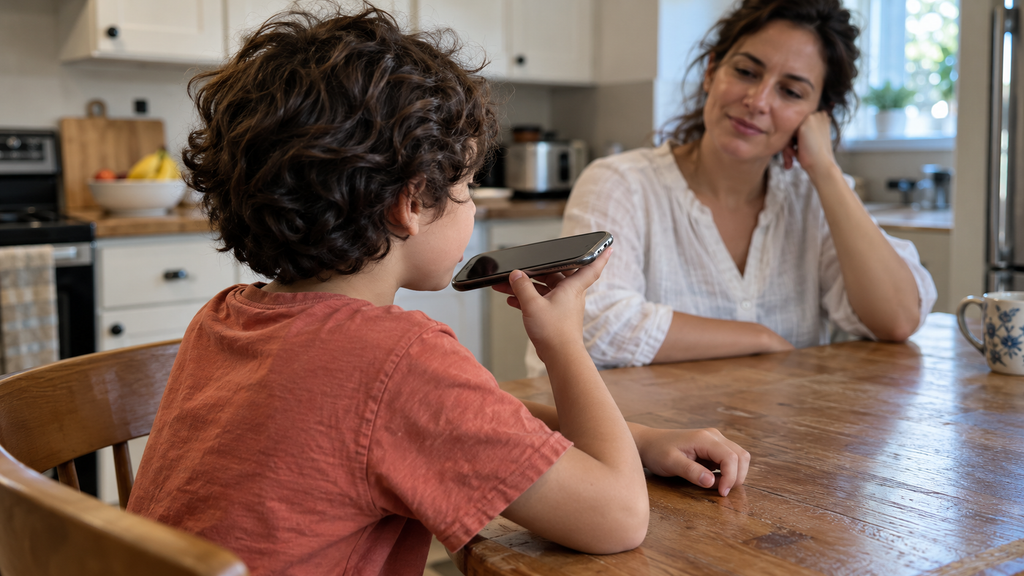
In English, you can also ask only for the lost part; with a short «Where?» or a full sentence with a question mark in its place, «You went where?» is the example of an English echo question. The question «You went where?» is an example of an English echo question. «Sorry, what?» indicates that what was said needs to be repeated or clarified without specifying a specific fragment.
If the child is already asking the question in English, you can show them how to do it in Russian. The device is the same: the question word goes where it was lost.
Next Sunday the phone will be ringing again at the grandmother's house, and grandma will be rushing off to someone else's cottage again. When the child asks what she said after the call, you can answer with a question, and if necessary, together find the missing part.
«And what can I ask my grandmother about?»
Understanding fast speech helps the habit of listening in Russian not only to grandma. At the «Russian for Bilinguals» course at Palme School, children aged four to seventeen are engaged online in small groups, talking with the teacher and with each other, and asking questions in class is just as normal as in the kitchen.
You can start with two free lessons. In the first method, the educator determines the child’s level and helps to choose a program; in the second method, the family gets acquainted with the teacher.
Sign up for free lessonsFrequently asked questions about how to ask grandma about a child
How to ask a child to repeat something in Russian?
If one place in a phrase is missing, it is most convenient to ask a question word that will fill the gap: «Where?» or «To whom?» In colloquial speech, it is often «Where-where?» If you don’t hear the whole question, you can say «Repeat, please,» and if the grandmother speaks too quickly, «More slowly, please.».
Doesn't «How many?» sound rude?
This kind of question is common in everyday conversation. The tone of the question can vary depending on the intonation: if the child is afraid that they will interpret it as distrust, they can ask more calmly, «Grandma, how much?» It's better to ask in a quieter tone.
What to do if a child heard a word but doesn’t know it?
Grandma might just repeat an unfamiliar word. So it’s better to ask the meaning directly, «Grandma, what does »okolitsa’ mean?”.
Is it possible for an elderly person to switch to English if the child has not understood?
First, it is better to repeat in Russian more slowly or explain more simply. If that is not enough, you can briefly explain in the child's native language and return to the conversation.
How to ask a question in English that only covers the part of the sentence that is unclear?
With a short «Where?» or a question mark in the place of the passage, «You went where?» is called an echo question in English. «Sorry, what?» indicates that what was said needs to be repeated or clarified without specifying a specific fragment.