
End of 1924, provincial administration. Alexander Zubkov, secretary of the new factory, brings the charter of the factory for approval.
Officials are looking with suspicion. The applicants from Palekh, a village of skilled icon painters, and the officials understand what they are actually going to do: they will paint the same icons, cloaked in the guise of a guild.
Zubkov brings with him items made of papier-mache. Black lacquered cabinets, with horses and trees on them in a fine gold line—everything is like a painting, only the themes are more secular.
This is how they recorded what the whole world knows today under the term «palekh».
A venture born out of a disaster

This story is quite common. Folk crafts rarely have a continuous thread that stretches back to the deepest antiquity. Much more often, they have died out, been reborn, and been revived all at once, quite recently.
With the palet, things got the most out of hand. After the revolution, demand for icons disappeared, and the craft itself became unsafe, leaving an entire village of artisans without a livelihood that had sustained generations for centuries. Ivan Golikov, who worked in Alexander Glazunov’s workshop in Moscow, was the first to discover this path: there, they painted models in papermache that they bought from Fedoskin; it turned out that the icon-painting technique could be transferred to them. The rest soon followed, and art historian Anatoly Bakushinsky helped establish the technique.
In December 1924, seven artists formed the «Arther of Ancient Painting». They registered the association when the Palekh cabinets had already won a diploma at the 1923 exhibition in Moscow and had already made an impression in Venice. In 1925, the works traveled to Paris, where they caused a sensation.
Gjel, which was reconstructed in the 1940s
It turned out even more unexpectedly with the lady.
Ceramics were made in these suburban villages long ago, and in the nineteenth century the local tableware was multicolored. Then large porcelain factories came, small workshops closed down, and by the end of the century the craft almost disappeared.
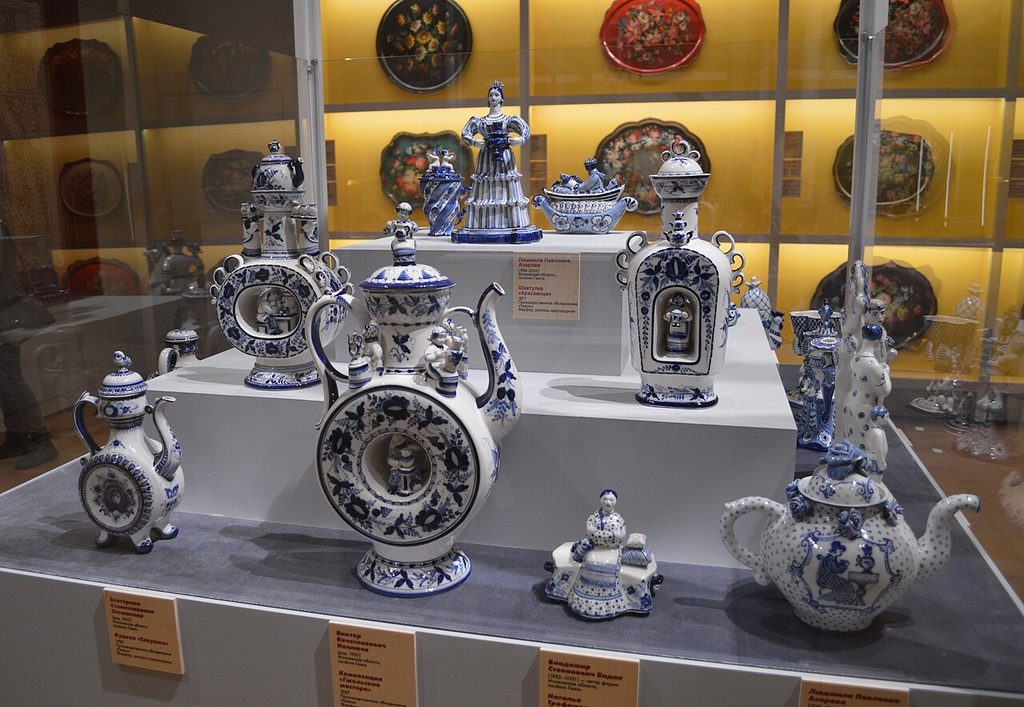
The blue enamel painting with cobalt on white was also known in the nineteenth century, on semi-finished porcelain. But the familiar appearance of Gjel's porcelain only took shape in the 1940s, when art historian Alexander Saltykov and artist Natalia Besasrabova took as a model the very same old semi-finished porcelain, disassembled the techniques of brushwork and created what is called the alphabet of Gjel's brushstrokes. Besasrabova re-taught the artisans the forgotten technique.
That is, the ancient ceramics here are from before the Second World War, while the typical appearance of Gjel porcelain is younger than that. The cobalt oxide used for the painting itself is black; it is only made black in a kiln.
Khokhloma and gold without gold
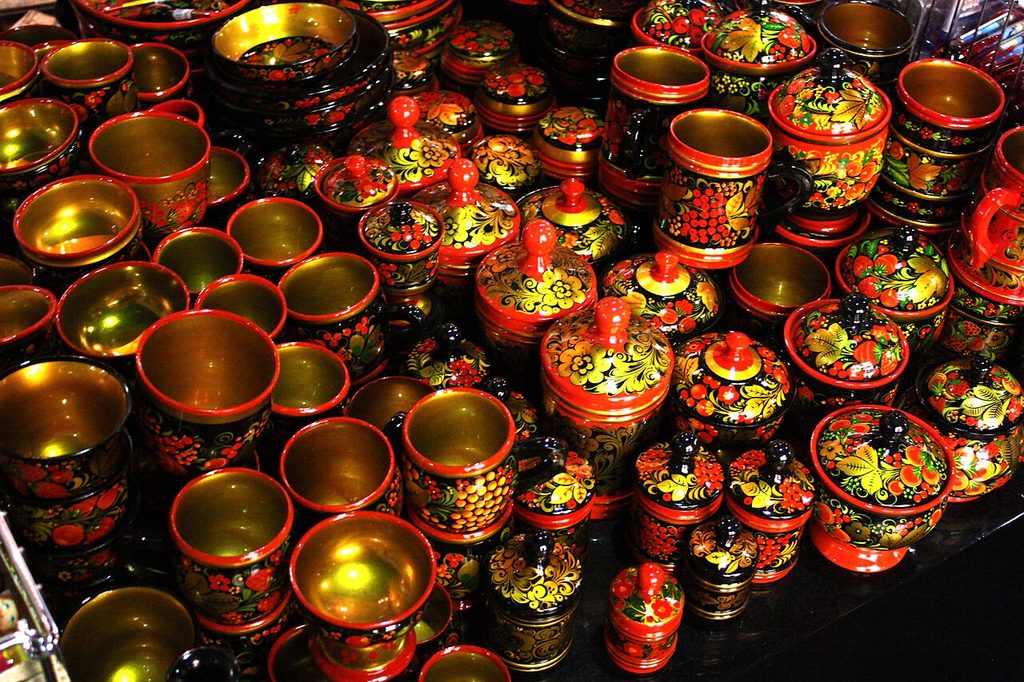
The roots are deeper here, but the beginning is also related to the icon.
According to one version, the development of the craft was associated with Old Believers who left for the Zaolga forests after the church reforms of the seventeenth century. Moreover, the technique of gold-plating was already known to the craftsmen of Nizhny Novgorod before that. The finished products were sold in the trading village of Khokhloma in the Nizhny Novgorod province, and the name of the village gave the craft its name, and the main center of production became the city of Semenov.
The secret of the hlohoma is that it doesn’t contain gold. The product is primed, rubbed with metallic powder, coated with varnish, and put in an oven where the varnish yellows and the silvery color turns golden.
The pattern is also looped. No matter how you turn the cup, you won’t find any beginning or end in the decoration.
The jug and tray for the samovar
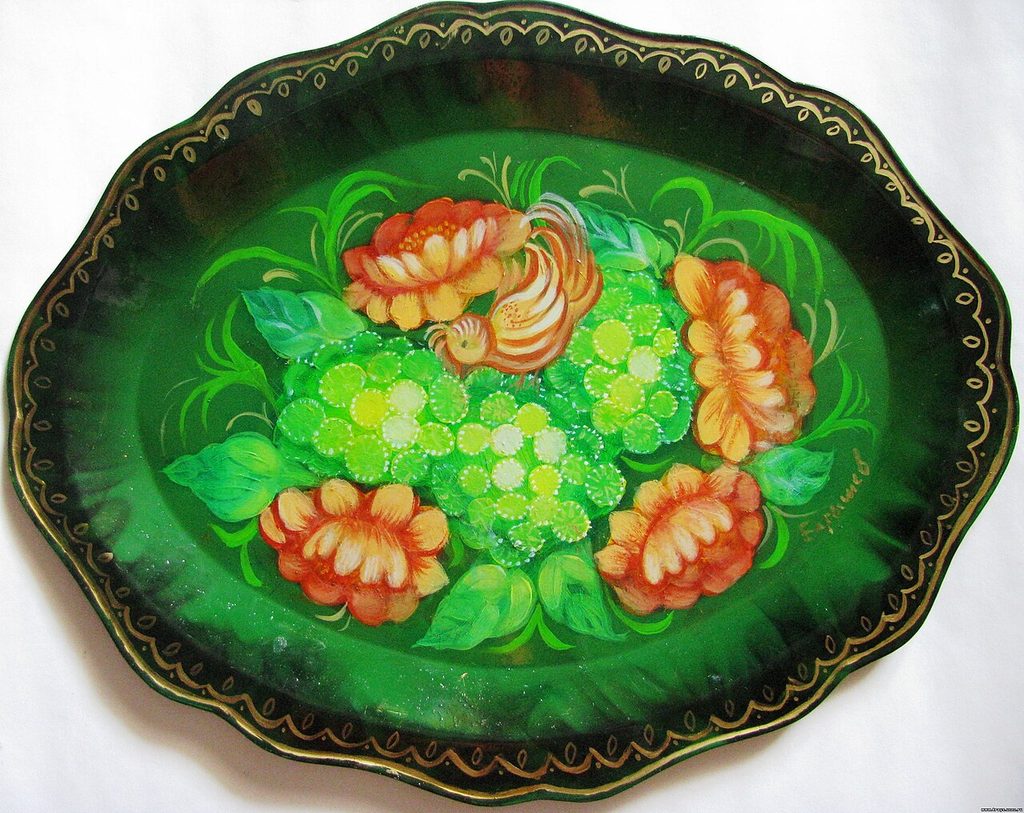
The Zhostovsky craft was started as an alien idea, translated into another material.
The trade has been in operation since 1825, and it is associated with the Vishnyakov dynasty, the serf peasants of Count Sheremetev. The first products made here were lacquered items made from papyrus, as in the neighboring Fedoskine.
Then the story took a turn for the worse. By that time, metal trays with patterns had been made in the Ural region for half a century; the craftsmen from the suburbs combined the Ural form with the Fedoskino lacquer. Osip Vishnyakov, Philip’s son, eventually started his own business and transported the goods himself to the Moscow shopping districts.
The calculation turned out to be correct. Tea was consumed everywhere in Russia; the samovar was found in almost every house, and a tray for it was provided, so the demand grew naturally.
The paintings are applied in several layers of oil paint, which makes the bouquet look voluminous and as if it glows from within. The early Josaphat vases are now kept in museum collections, including the Hermitage and the Russian Museum.
Finnyft, who went beyond the church
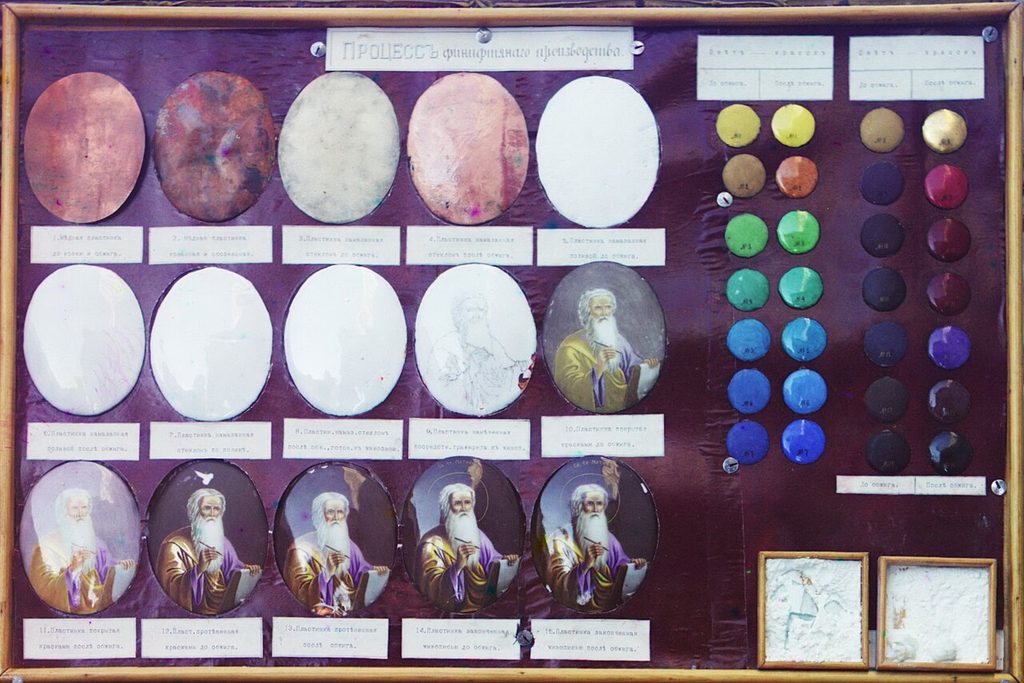
The Rostov Philharmonic began with a church commission and expanded beyond it, just more slowly than the others.
Fininftiu is called enamel painting: enamel is applied to a metal plate, then painted and fired. In Rostov-on-Don, from the eighteenth century onwards, entire families lived here, and wrote images for icons and church utensils; in other words, the craft was tied to the church just as closely as in Palekh.
The technique remained the same, the same records and the same burn, only next to the models there were brooches, cabinets and portraits. We promised to disassemble the finnifitty separately back then. material about the Golden Ring, where it is mentioned in passing.
Fedoskino, from whom it all began
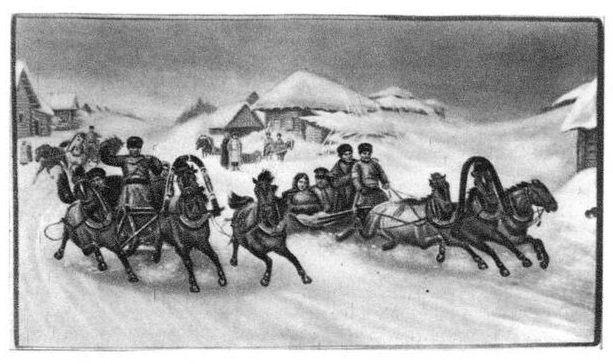
Fedoskino became the first of the listed lacquered miniature centers. It didn’t start with art at all: in 1795, the merchant Korobov opened a factory in Danilkovo, Moscow region, to make lacquered army caps and tobacco pipes from papyrus, and the cabinets arrived later. They are painted with oil on papyrus, adding mineral gold or pearl powder under the paint, which makes the paint work like stained glass.
Fedoskinsky preparations lay at the palashan's hand. The trade started out for the sake of the army's advantages and gave the palashans material for a new craft that emerged from adversity.
The same thing all over again, but in a single glance: where things are being done, from what time, and how they are organized.
Where they are doing what and how it is organized
| The plot | Where | Since when | How they do it |
|---|---|---|---|
| Khokhloma | Nizhny Novgorod region, center in Semenov | According to one version, from the seventeenth century | The wood is primed, rubbed with metal powder, coated with varnish, and then fired. |
| Gjel | Moscow Region, the Jelgalski grove of villages | Ceramics are old; the current appearance dates back to the 1940s. | painting with cobalt oxide on porcelain, the blue color is revealed in the kiln |
| Violent | Moscow Region, the village of Zhostovo | Since 1825 | oil painting in several layers on a tin tray |
| Palek | Ivanovskaya Oblast', Palek village | since 1924 | Temper and gold on papyrus, the technique comes from icon painting |
| Fedoskino | Moscow Region, Danilkovo and Fedoskino | since 1795 | The oil is applied on a papermache base; fine gold or pearl powder is added under the paint. |
| Finneft | Yaroslavl Oblast, Rostov Veliky | from the eighteenth century | Embossing on metal plate with burnishing, sometimes multiple times |
What are the differences between khokhloma, gjel, jostovo, palech and fedoskin?
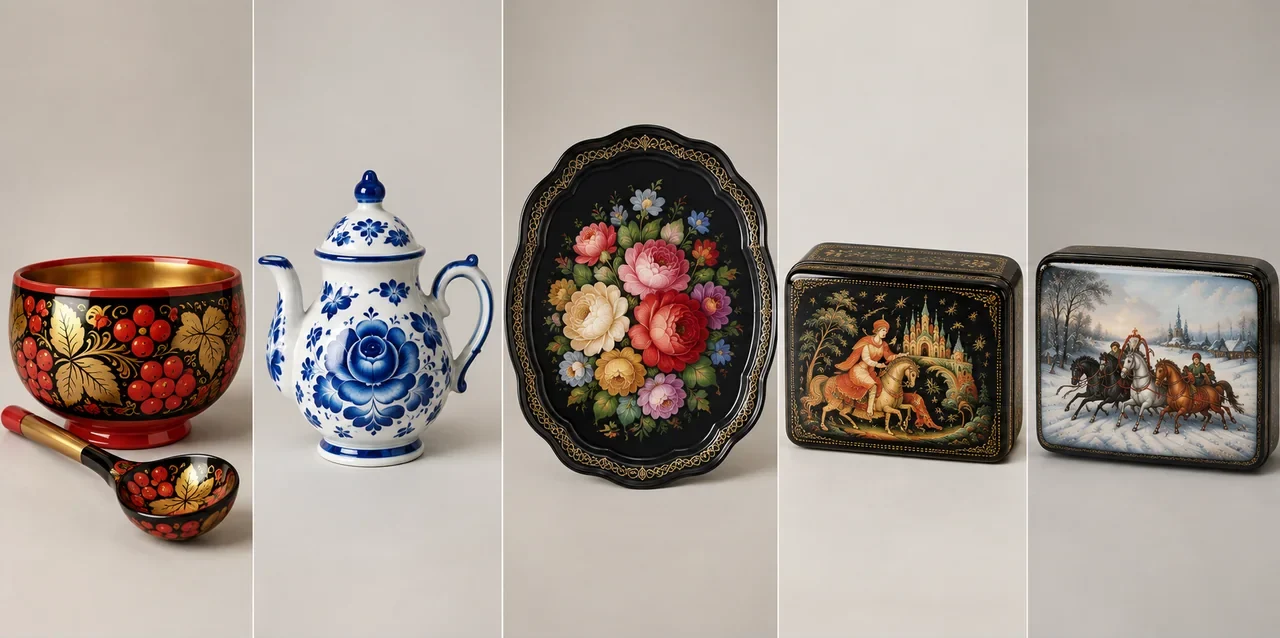
These five are usually confused; they are easier to distinguish than they seem.
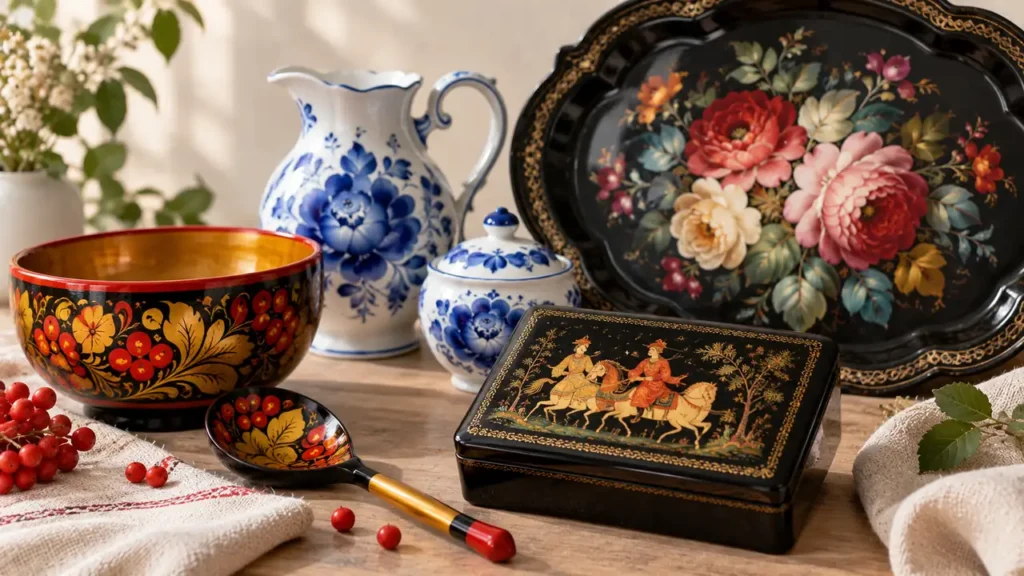
Khokhloma lives on the tree: tableware, floral patterns with berries and swirls, gold, red and black colors. Zhegel lives on porcelain and faience: white background, blue cobalt, often recognizable in the decoration as a rose. The material of the Zhosto is metallic, and the main item is a tray with a voluminous bouquet on a black or colored background. Palek and Fedoskin produce lacquered cabinets on a black background, but the Palek has a thin gold pattern and elongated figures that extend from the icon, and the Fedoskin is painted with oil, more dense and realistic.
The material won't deceive you: you won't mistake wood, porcelain, metal, or papier-mâché even in a photograph. The English-language captions for museum items simply read "khokhloma" and "gzhel.".
What should a parent do about this?
In museum catalogs abroad, these items are described as Russian folk art, and on the labels of souvenir shops they are labeled as Russian crafts. Usually, that’s how the child sees them: beautiful, old, unrelated to him.
Conversation comes alive when people appear. The village of icon painters, left without work. An art historian who helped to re-gather the forgotten style of writing. A peasant son who carried trays in Moscow’s ranks. Behind this no longer lies ornament; behind this lie stories about how people managed to get by.
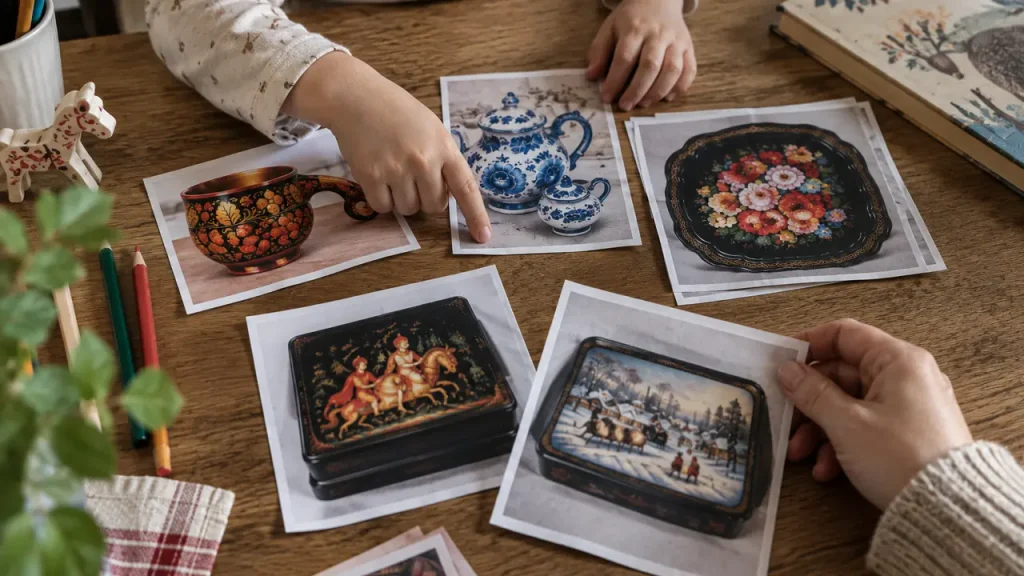
We should now move from the narrative to the task at hand, and that takes about ten minutes. Open several photos without signatures and ask them to sort them by category. Then ask the main question: why did you decide that? The answer «because it’s a geel» only shows memory, while the answer «because it’s a geel because the porcelain is white and the painting is blue» shows that the child saw a sign and was able to name it.
You can complicate things from here. Find the extra elements among the four pictures, three of which are of the same motif. Come up with your own mug in the spirit of cloisonné and explain the choice of colors. The little ones will have enough of color, shape, and material; older schoolchildren will be curious to know why the artisans had to change their work, and the teenager can ask the very same question about the tradition that has been recreated and still remains a tradition. On this spectrum, from four years old to seventeen, one theme holds true.
This leads to a question that is more interesting than it seems: how does pottery manage to be both old and new at the same time? Gzhel ceramics has existed for centuries, but its conventional white-and-blue appearance only took shape in the twentieth century. Palekha miniature art was born in the twentieth century, but the language in which it is written is centuries older.
Popular crafts are a set of artistic traditions that have developed in a specific place with their materials, techniques, and motifs, and which are continued by artisans of subsequent generations. At the same time, these traditions are capable of changing and never cease to be traditions. For a teenager, this is already a reason to talk not only about crafts, but also about what makes a tradition a tradition.
You can test yourself right here. There are no photos here; just words, so this is a warm-up before talking about pictures, not a replacement for it.
Guess the catch by the signs
What do they take from this for classes?
The child, who once figured out what gjel differs from khokhloma, learned it for himself, without any help, in a shop window and in a stranger's house. The task here is not to memorize a list, but to learn to recognize the craft by its characteristics. A similar story was told with violin, which is also taken for one, but turns out to be another.
This is where the language comes from that is not found in everyday speech. Glaze, enamel, ornamentation, the product, the workshop. And then there are the structures on which the coherent answer rests: unlike, as is typical for, I recognized them from. This is how a cultural topic ceases to sit alongside the language and begins to work on it, which is how we at Palme School use it.
You can find out if this is right for your child at two free lessons. The first one is held with a methodologist, who gets to know the child, determines their level, and talks about the program. The second one takes place like a real group lesson, with a teacher and other children.
Frequently Asked Questions
What are folk art crafts?
Local artistic traditions with their set of materials, techniques, and motifs are passed on by the masters of subsequent generations. The name usually comes from the village or city where the craft was established.
How is chokhloma different from ghelja?
Material and color. The hlohkom is painted on wood in gold, red, and black, with a floral pattern. The glaze is applied to porcelain and faience, with a white background and a blue cobalt. You can only confuse them by looking at the description, not with your eyes.
Why is the gold halberd gold if there is no gold in it?
Because of the technology. The product is primed, rubbed with metallic powder, then coated with varnish and fired in an oven. The varnish yellows, and the silver-colored surface becomes golden.
Is the gel ancient?
Ceramics in Gelya have been made for a long time, but the familiar appearance of white and blue porcelain only took shape in the twentieth century. In the 1940s, art historian Alexander Saltykov and artist Natalya Besasarbova restored it, drawing on examples from the nineteenth century.
How did the palek appear?
Out of despair. After the revolution, the icon painters of Palekh were left without work and switched to working in lacquered boxes made of papier-mâché. The «Workshop of Ancient Painting» was founded in December 1924, and by 1925 their works were exhibited in Paris.
What is finnifth?
Painting on enamel. Enamel is applied to a metal plate, then painted with paints and fired; sometimes several times. The main center of enamel production was Rostov Veliky, where church icons and eventually cabinet decorations were made.