Online preparation for the Unified State Exam and Basic State Exam
🎯 Sign up for a free trial lessonLearn More
Skip to main content

Palme School

Online Russian Language School in the USA and Canada
Online school in Russian for bilingual children and teenagers
💡 Get bonuses with us! Referral program rewards

Leshy, Baba Yaga, and Vodyanoy. The Denizens of the Russian Folktale Forest

Names and identifying details of every student here are changed, as they are everywhere on the blog.

I told a class that Baba Yaga was the villain
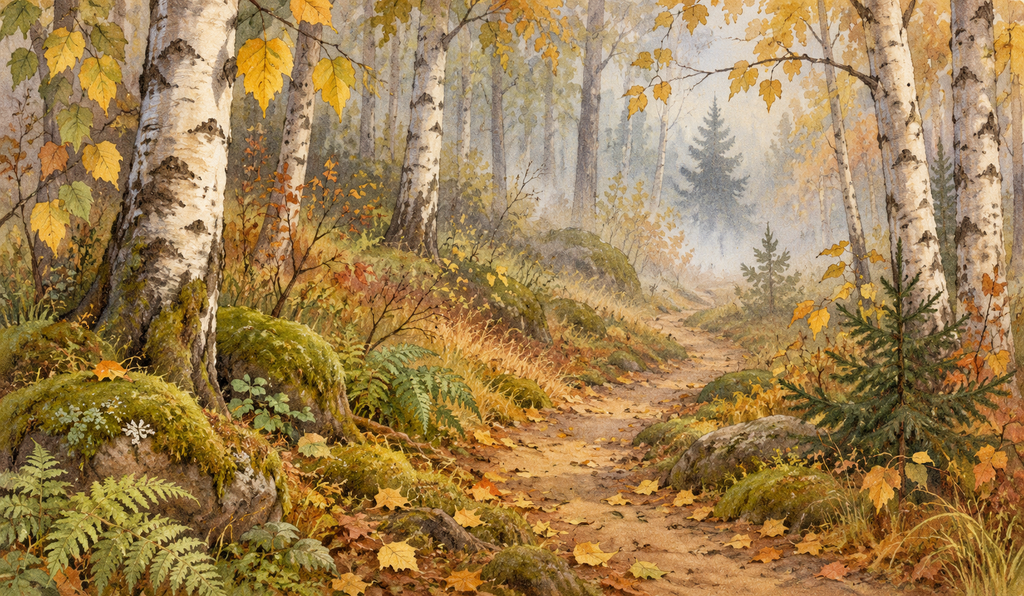
An illustrated forest path winding between birch trees in soft afternoon mist.
Palme School AI generated

A nine-year-old put up his hand to say she had been of assistance to the girl in the story we were done with. He was right. I had put forward an untruth in the kind of confident voice teachers have when they have not bothered to check.

What I had done was to bring in a category from another context. The boy had been raised on stories where the cast is identified for you: the wolf is the problem, the fairy godmother the solution and there are no side switches.

Why the error was easy to make

It is easy to see why the error was made. One does not find labels on the characters of the Russian forest; a child looking for one will misread any folktale. In four years of teaching these tales no one set me straight. Had I given it any thought I would have taken their silence as proof I was correct. The parents did not do so since the picture book version they know has a witch who is just a witch. And the children do not because they think the teacher has read more than them. Nor do the English translations help. Call her a witch and you have settled the matter before the tale is underway.

So I went on with my labels and the labels left the children in confusion, which I put down to the difficulty of the language rather than my own words.

Two things should have put me on notice. The children would ask why the witch was being helpful and I would make it a question of translation. My best readers were the ones most unsure at the end of a story, which I took as a sign of struggle. They were not struggling but were the only ones taking note of what the character did.

The scholarship has its own difficulties in this regard

My only solace after four years of getting it wrong is that the discipline took longer to arrive at the same place. Vladimir Propp put together the standard means of sorting out folktale characters in 1928, but it was not until thirty years later that English speakers came to it in translation. He gave each a function, seven in total, of which two are relevant: the donor gives the hero what is required, the villain puts up resistance.

Baba Yaga would not be contained in either. Propp made her both, as the tale dictated, and that should have been a signal the system was not holding. Andreas Johns examined the East Slavic material in a way no one had before and could not fit her into those two roles. He created a third, an ambiguous donor, and put the word in his title. She is the same character performing both within a story.

If a classification requires a new box for a single character, that character is making a statement about the system. Propp was blunter about it than I would be. He wrote that if you take pictures of Baba Yaga from here and there you do not get a coherent figure. What she is is a function of the hero’s conduct at her door. Be polite and prepared and the story takes one course, be rude and careless and it is quite another. She can give a gift in one telling and lay down an impossible task in the next without either being incorrect.

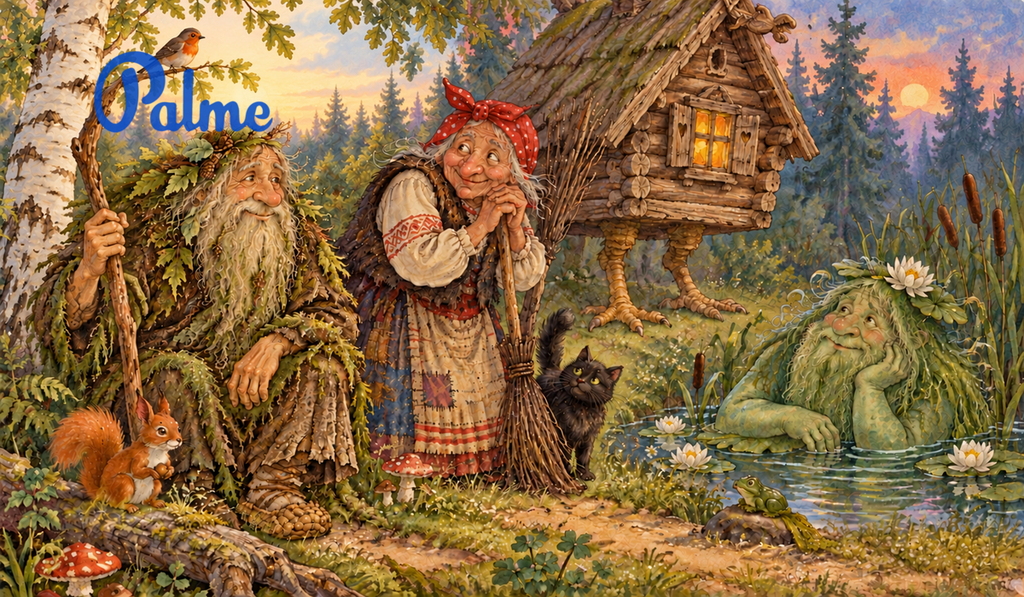
The three of them

The Lychoy

Leshiy

The forest itself, more or less. Not evil, but it will walk you in circles if you take wood from it without asking.

Baba Yaga

Baba-Yaga

Lived in the hut on chicken legs. Helps or hinders depending on manners

Watery

Vodyanoy

Lives in the water, under mills and in deep pools. The one you negotiate with before fishing

And then there are the three of them. They are not on anyone’s side. They are owners of a place and good behavior is what makes the arrangement work. It is strange to American children at first, but they come to prefer it once it has been put down.

The source of the grammar
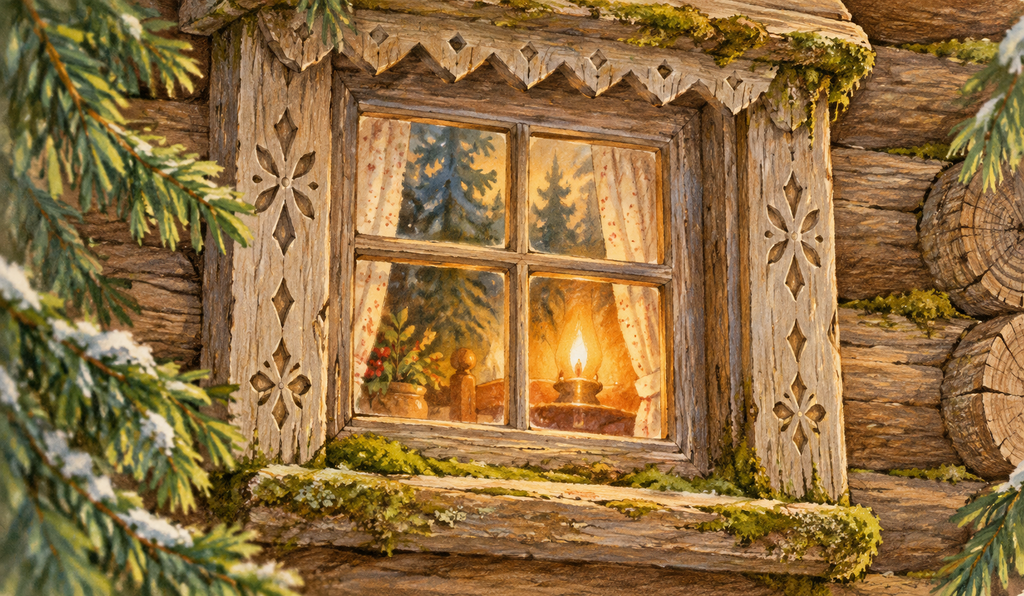
An illustrated wooden cottage window with a moss-covered carved frame and warm light inside.
Palme School AI generated

There are two consequences for the language in these stories, and both can be found on almost any page a child reads. The first is ownership. The characters are made out of what is theirs, and Russian will make a point of it: a wooden cabin (lesnaya izbushka) for the forest hut; a magical object (volshebnyy predmet), a magical object; or Babys-Yagin cat (Baby-Yagin kot, with the first part being the genitive of Grandma), the cat of Baba Yaga.

Then there is the second matter. Russian can form a possessive adjective from the name itself, something English is not able to do. One gets Babys-Yagin as one would get Grandmother’s, only it is an adjective and varies with the noun.

Comparison is the other thing and where the learner is rewarded for the effort. You cannot have it that Baba Yaga is kind or wicked; in half the stories you would be wrong. What you can say is she is better (dobreye), kinder, in this fairy tale (in the first story) than in the one after. That the The Lychoy (Leshiy) is More frightening (strashneye), scarier, at night (noch’yu) than During the day (days). Or that one of them proves stronger, Stronger (sil’neye), than the hero had any expectation of. It is not so much an exercise in grammar as the only truthful way to put it when someone is not on a side.

At the door of the hut

The hero Hello, grandmother. (Zdravstvuyte, babushka.) Hello, grandmother. The polite form, and it matters more than anything else he says.

Baba Yaga Fu, russkim duhom pakhnet! (Fu, russkim dukhom pakhnet!) The famous line. She knows somebody has come.

The hero Feed me first, then ask your questions. (Snachala nakormite, potom sprashivayte.) Feed me first, then ask your questions. He keeps the polite form all the way through, and she respects it.

Nothing in that exchange is about magic. It is about whether the boy knows how to behave at somebody’s door.

Have a child read it out loud and put to him what the hero did right. They will have it in short order and the answer is manners, an unlikely place for a folktale to end up.

The boy who put me to the test

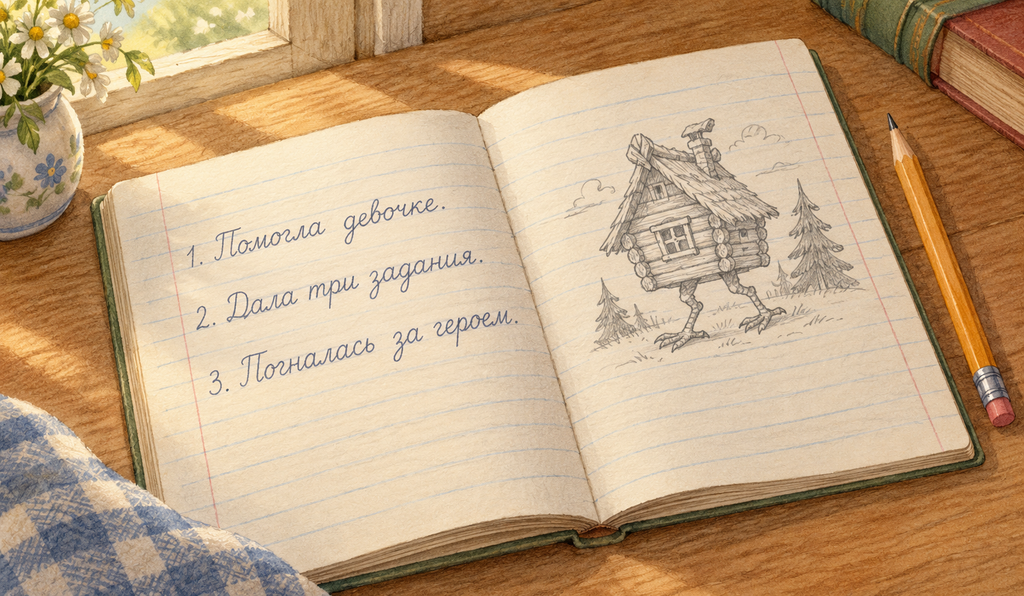
An open lined notebook with a handwritten Russian list, a drawing of a hut on chicken legs and a pencil beside it.
Palme School AI generated

He was not done with it. He went home of his own accord and put in two more tales, then returned the week after with a handwritten account on lined paper of her doings in each. In one she gave the girl a light for the way home. Another had her set three tasks no one could have been expected to finish, and the girl finished them. A third saw her in hot pursuit of the hero until he flung a comb behind him and it became a forest and he was off.

And then he put to me the question that justified the hour of the lesson. Is she the same in all three?

I had no ready answer and told him as much. We used the rest of the time to put together sentences with better (dobreye) and More frightening (strashneye) since there was no other way for either of us to put what he had come by. At twelve he is still correcting me before the group and I am not bothered by it anymore.

Watery (Vodyanoy) is the least asked about and yet the clearest example of the pattern. He is to be found in deep water and under mills. The terms with him are the most straightforward of the three: ask before fishing and do not take more than you put in for. If you do not abide by that he is not going to mete out any moral punishment. The fish will just not come, which is a consequence of a different order and what the stories are based on.

Try it yourself

Put the word into the comparative, or fill in the possessive adjective.

  1. In this fairy tale (v etoy skazke), Baba-Yaga is a [good] ________, unlike in the one.
  2. At night (noch’yu) the Wolf (Leshiy) is [terrifying] than during the day (dnyom).
  3. This [forest] is a ________ hut (izbushka).
  4. In this fairy tale, Vodyanoy is a [strong] ________ than in the other one.
Show answers

1. better (dobreye)
2. more frightening (strashneye)
3. forest (lesnaya)
4. stronger (sil’neye)

Courses at Palme School

Russian for bilingual children
When the language is at home and starting to slip

Conversation school
For children who understand more than they will say

Free materials
Printable activities for families to use at home

At Palme School we teach children online, in groups of up to eight, two forty-minute classes a week, and the first two lessons are free. Both courses above take bookings the same way, and the printable material is free whether or not you ever book anything.

Frequently asked questions

Is Baba-Yaga a villain?

Sometimes. Folklore researchers classify her as a donor, an ambiguous donor, or a villain, and which one she is depends on the tale and on how the hero treats her.

Who is Леший (Leshiy)?

The spirit of the forest in East Slavic folklore. He is not evil, but he guards what is his, and taking from his wood without asking has consequences.

For what age is this material intended?

Around A2 to B1, which usually means seven and up. The comparative forms come easily because children already want to argue about which character is scarier.

Why does Russian have a special adjective made from a name?

Babys-Yagin (Baby-Yagin) is a possessive adjective, built from the name and behaving like any other adjective. English handles the same job with an apostrophe instead.

Sources

  • Johns, A. (2004). Baba Yaga: The Ambiguous Mother and Witch of the Russian Folktale. International Folkloristics, vol. 3. New York: Peter Lang.
  • Propp, V. (1968). Morphology of the Folktale (L. Scott, Trans.; 2nd ed.). Austin: University of Texas Press. The original in Russian dates to 1928.

Palme School: Conversation school · Russian for bilingual children · Free materials for learners

Lily Rozberg has been teaching for sixteen years, first English in Russia and now Russian to bilingual children across the US and Canada. She writes for Palme School about heritage language, reading, and the things report cards do not measure.

Do you want to support child's successes In studies?
Helping to develop knowledge, confidence, and a love for learning through modern Russian language classes and beyond.

Do you want your child to love learning?

At Palme School, classes are held online in live groups with experienced teachers. Choose a subject and sign up for a free first lesson.

get expert tips, parenting insights, and exclusive resources for raising kids delivered straight to your inbox

Leave a request for a free call

Sign up for a free lesson.
Apply for a free introductory lesson to get acquainted, determine your goals, and find a suitable group.
Sign up for a free lesson
Submit a request for a free first session with a guidance counselor to get to know each other, determine your goals, and match your child with an educator
Sign up for a free lesson
Submit a request for a free first session with a guidance counselor to get to know each other, determine your goals, and match your child with an educator
Sign up for Russian Dictation
Sign up for a free lesson
Submit a request for a free first session with a guidance counselor to get to know each other, determine your goals, and match your child with an educator
Sign up for a free lesson
Submit a request for a free first session with a guidance counselor to get to know each other, determine your goals, and match your child with an educator
Sign up for a free lesson
Submit a request for a free first session with a guidance counselor to get to know each other, determine your goals, and match your child with an educator
Sign up for a free lesson
Submit a request for a free first session with a guidance counselor to get to know each other, determine your goals, and match your child with an educator
Sign up for a free lesson
Submit a request for a free first session with a guidance counselor to get to know each other, determine your goals, and match your child with an educator
Sign up for a free lesson
Submit a request for a free first session with a guidance counselor to get to know each other, determine your goals, and match your child with an educator
Sign up for a free lesson
Submit a request for a free first session with a guidance counselor to get to know each other, determine your goals, and match your child with an educator
Sign up for a free lesson
Submit a request for a free first session with a guidance counselor to get to know each other, determine your goals, and match your child with an educator
Sign up for a free lesson
Submit a request for a free first session with a guidance counselor to get to know each other, determine your goals, and match your child with an educator