If you go from a cart on a New York street to a refrigerator in today’s supermarket, you’ll encounter different cucumbers with similar names along the way, and at some point vinegar will appear in the bottle. It’s easiest to figure out where the cucumber is salty, where it’s salty-sweet, and where it’s marinated; the easiest way to do this is along this route, and at the end you’ll also have a label that the child can read for themselves.
Trolleys on the Lower East Side
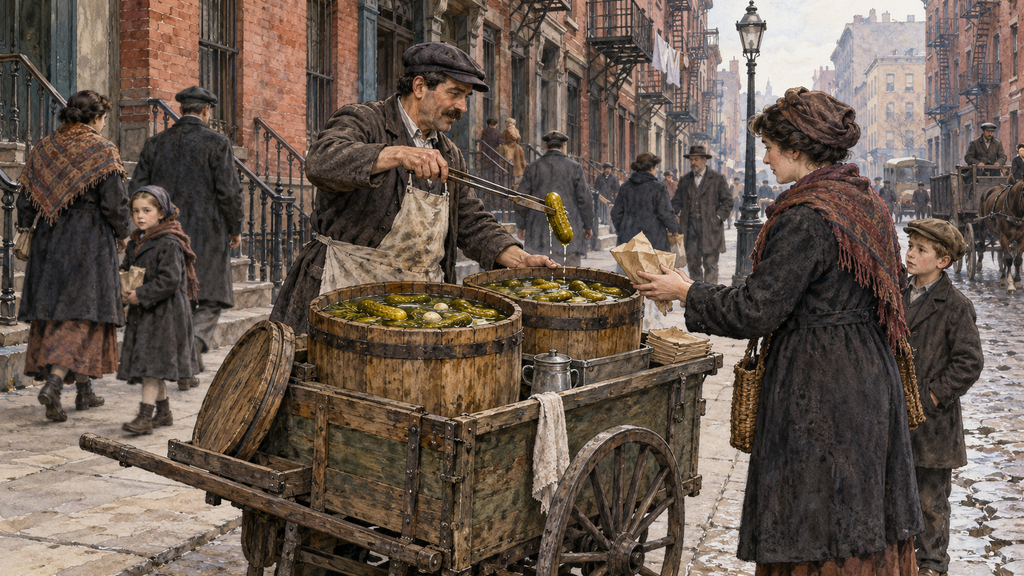
The Tenement Museum on the Lower East Side tells us that many Jewish immigrants who came to New York traded with carts, as they did in the open markets of Eastern Europe, and cucumbers were among the most common items. According to the museum’s account of the merchants of this area, by the 1940s police and sanitation restrictions had replaced the cart trade with shops, and cucumbers moved indoors along with the vendors.
The museum collection includes a photograph of the L. Hollander and Son shop on Essex Street, where barrels lined the sidewalk. Hollander and Guss’s shop was among the first cucumber vendors in the area, lasting for decades, and in the 1980s merged into Essex Street Pickles.
In a barrel, the cucumber is placed in a solution of water and salt, and the acid appears on its own as fermentation proceeds. This is exactly how the Russian standard, GOST 34220-2017, describes salty vegetables—vegetables with salt, spices, and seasonings that have undergone lactic acid fermentation. If a grandmother seasonizes cucumbers in a barrel on her summer cottage, she is essentially doing the same thing that was done in the barrels on Essex Street.
How many days in a row
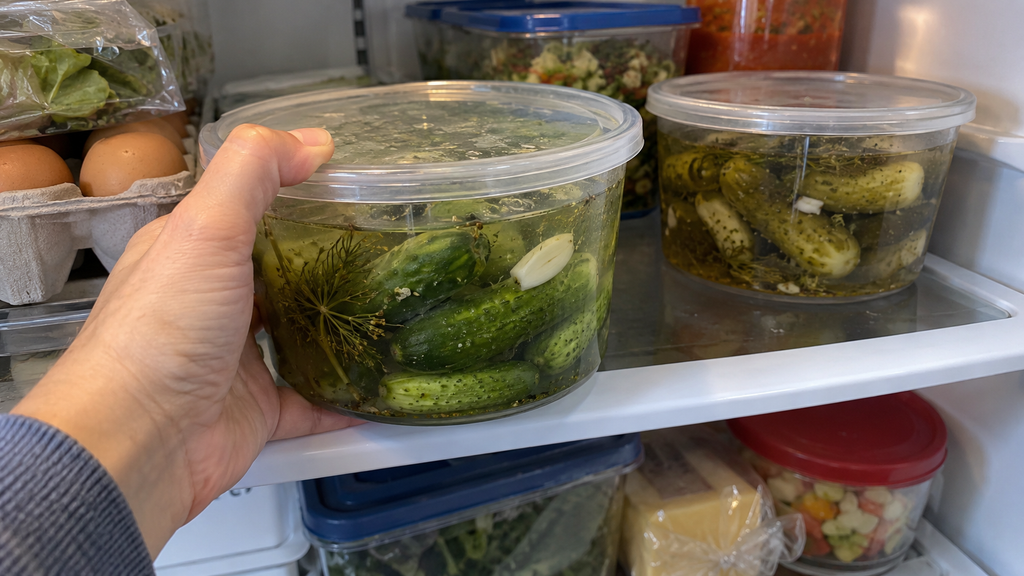
Pickles that have fermented in America have two names, half-sour and full-sour, and the difference between them is in days and in salt. In the Oregon State University Food Science Laboratory’s material, half-sour is aged for between four and six days in a brine with a concentration of about three and a half percent, while full-sour is aged for two to three weeks in a brine with a higher concentration, about four and a half percent.
In Russian, there is a word for cucumbers that have been left in brine for a short time: «malo-sour.» In Ushakov's dictionary, it means «a little, not very salted.» How many days have passed is not stated by this word, so half-sour can only be roughly compared with salty cucumbers. This is not an exact translation and does not guarantee the same method of preparation, but the meaning of the two words is the same: the cucumber has not yet reached its full maturity.
Bank with vinegar
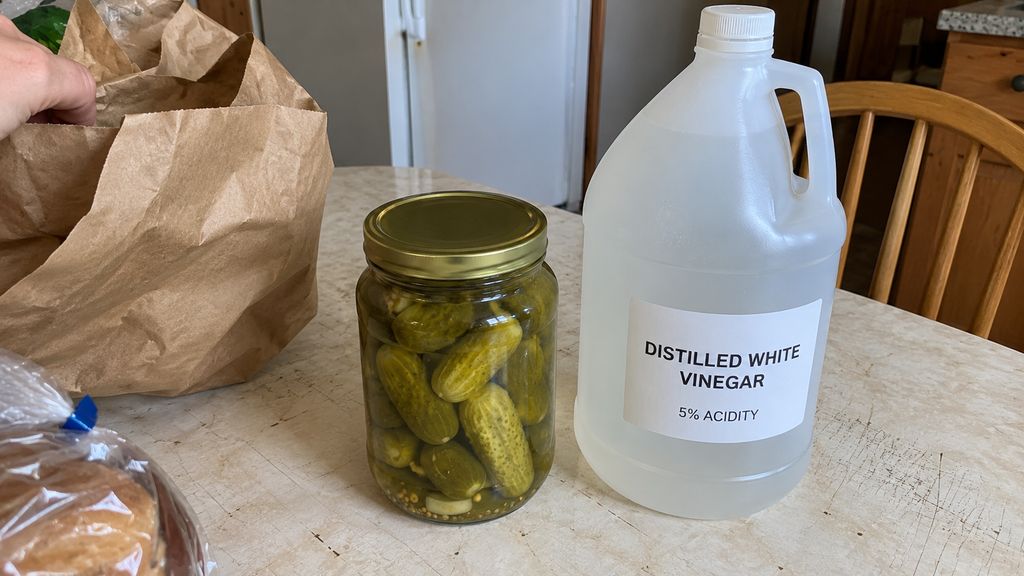
The third stop is the shelf or refrigerator of a modern supermarket. Here cucumbers are still called pickles in English, and both the canned and the vinegar-based varieties are different things in Russian. Pickled cucumbers are described by another standard, GOST R 52477-2005, and it talks about the marinade filling, for which the raw materials are listed as vinegar, acetic acid, and lemon juice. The acid is added during the marination, most often in the form of vinegar. At the same time, the same standard allows for marinades made from pre-salted cucumbers, so at the factory the boundary between the two methods is not as sharp as in grandma's kitchen.
So, a bank with the inscription "half-sour" on the front side can contain vinegar, and its composition is different from that of cucumbers from a barrel. Why one English word "pickled" covers several Russian words at once, more details in the article «Food and products in Russian».
At the shelf with the child
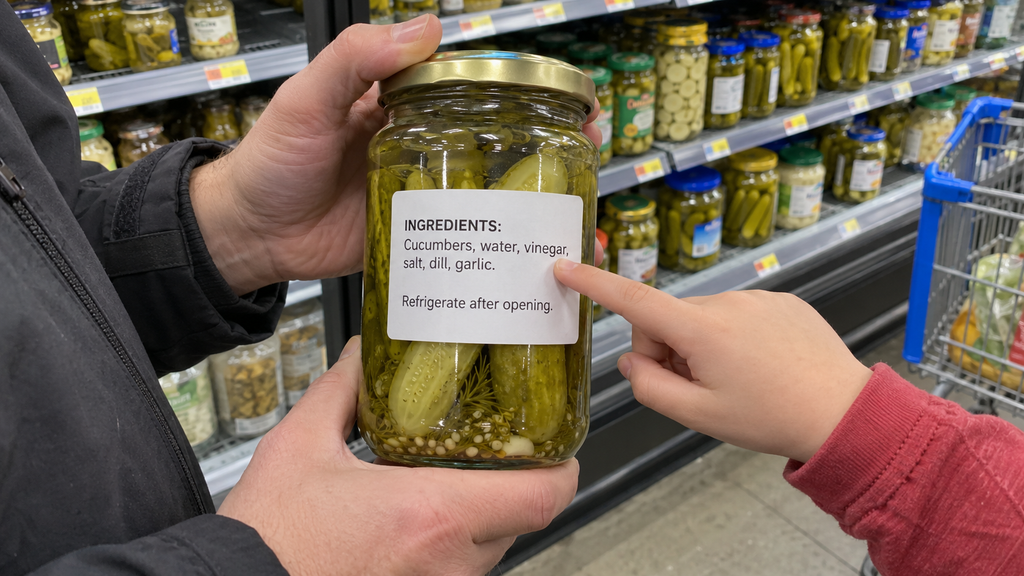
The label can be read together. Is there vinegar in it? What is said about fermentation, fermented? Where is it instructed to store the jar? Each label answers only to its own question, and below you can practice on several practice jars.
What the label says
Click on any label on the jar to find out what it says. Then decide whether the label can tell you whether the cucumbers are salty or pickled.
Bank 1
Can you tell from the label what kind of cucumbers these are?
Bank 2
Can you tell from the label what kind of cucumbers these are?
Bank 3
Can you tell from the label what kind of cucumbers these are?
Bank 4
Can you tell from the label what kind of cucumbers these are?
Bank 5
Can you tell from the label what kind of cucumbers these are?
Banks are educational; the inscriptions are made according to the model of actual labels. The salty cucumbers undergo fermentation in brine; acid is added to the marinade, most often in the form of vinegar.
Sometimes after all the labeling, the honest answer sounds like this: there isn’t enough information to tell whether the cucumber is salty or marinated. At home, you can ask your grandmother if she put vinegar in her jar, and then your child will have a complete story about one cucumber, from the jar to its storage container.
At Palme School, children aged four to seventeen take courses in «Russian for Bilinguals». Understanding what is written on the label and explaining it in Russian to their grandmother is also a language skill, and these kinds of tasks can be mastered not only in a store shelf.
You can start with two free lessons. In the first method, the educator determines the child’s level and helps to choose a program; in the second method, the family gets acquainted with the teacher.
Sign up for free lessonsFrequently asked questions about salted and pickled cucumbers
How are salty cucumbers different from marinated ones?
In traditional pickling, the acid in cucumbers appears during lactic acid fermentation in brine. When marinated, cucumbers are poured with a marinade containing added acid, most often in the form of vinegar.
What do low-salt cucumbers mean?
Slightly salted. Ushakov’s «slightly salted» means «a little, not very salted.» The exact time of preparation is not specified by the word itself.
Half-sour pickles are salty cucumbers?
They can be roughly compared, but this is not an exact translation and does not guarantee the same method. Half-sour is aged in brine less than full-sour, and on some bottles with this name, vinegar is listed as an ingredient.
How can you tell from the label whether there is vinegar in the cucumbers?
Check the ingredients list. If there is vinegar, vinegar has been added. Whether fermentation occurred during this process is not clear from this line; the “keep refrigerated” label only indicates that the product should be stored in a refrigerator.
What does "naturally fermented" on a jar of cucumbers mean?
The manufacturer mentions natural fermentation. Is there also vinegar in the bottle? You should check the composition.