


Here is a typical vacation letter. It is rarely written, and every time you have to remember the wording.
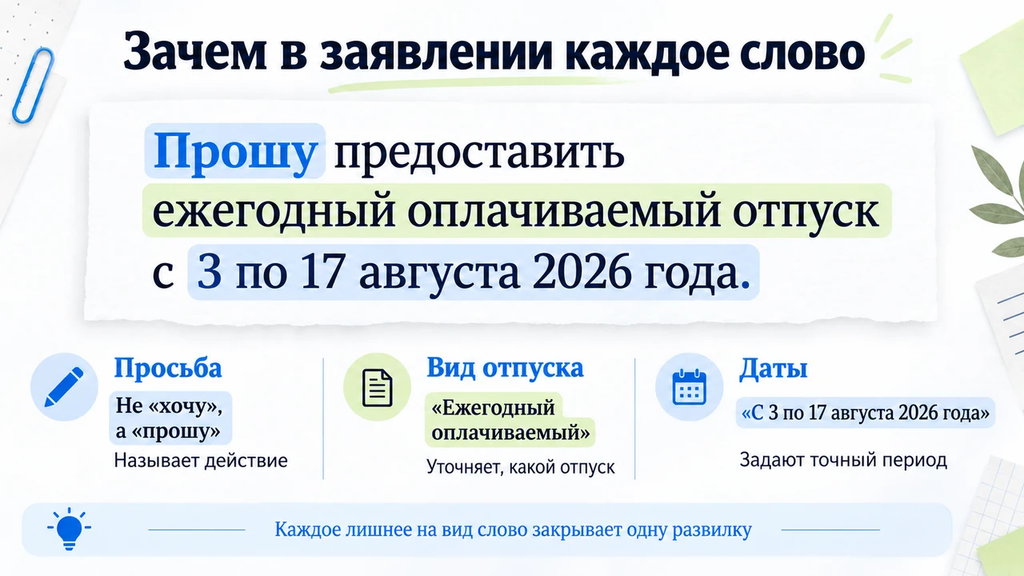
«I request that you grant me annual paid leave from August 3 to 17, 2026.»
Now say the same thing to your wife. «Please provide me with a cup of tea.» Funny.
Not a single word in this phrase has changed. Only the place where it appears has changed. Let’s break down the statement in its entirety and see why each part is written exactly that way.
«Please» instead of «I want»
The first thing that tends to be fixed is the verb. Why not «I want to take a vacation,» as real people would say?.
Because «I want» reports your state of mind, and «I ask» calls for action. A request is submitted not to share a desire, but to have it decided upon and formalized further, and the recipient must understand this from the very first line.
At the same time, the «please» removes the question of politeness. This is a typical formula of the genre, and it doesn't need to be softened.
«Provide an annual paid leave»
Three words that in conversation sound like mockery.
Take them away, and you’ll be left with «please take a leave.» From there, the guessing begins. Leave can be paid annual leave or unpaid leave, and it can be for educational purposes, childcare, or for personal reasons. The personnel officer who receives your paperwork is obligated to choose one and has no right to guess.
Every superfluous word here closes a branch of development.
«From August 3 to 17, 2026»
Compare that to «somewhere in the first half of August».
The second wording leaves several questions open. From what date, for how many days in total? And it’s useful to specify the year, because the paper may still be needed in a few years.
The same HR employee won't call you and ask for clarification. He or she will read what is written and will make it exactly the same, so the document should minimize any discrepancies.
What is not in the statement
But this is more interesting than what’s in it.
It doesn’t have «I think,» «I think so,» or «if you can.» There’s no explanation that you’re tired and haven’t had a break in a long time. There’s no apology for the worry.
The formula does not remove the author; he is not going anywhere; it is the style that is being removed. There should be no trace of irritation or hesitation in the document. Personal emotions usually interfere here.
Why all statements start the same way
Another thing that seems like poverty of imagination.
«Based on,» «in connection with,» «in accordance with this notification» are ready-made details. They are valuable for their speed. The writer does not invent the beginning; the reader understands from the first words that what lies ahead is what is in front of him. Not one single document passes through the hands of the recipient in a day, and the same opening sentences save him hours of time.
Where the same speech becomes a disease

Now take that phrase off the page and out into the world, and everything falls apart.
Chukovsky coined the term for this in the book «Living Like Life» in 1962. The office, modeled after cholera and diphtheria, that is, the name of the disease. He also called it verbal gangrene.
«I was late because of the rain» and «the delay occurred due to adverse weather conditions.» There is not a single error in the second sentence. It just doesn't belong there.
In the same illness, Chukovsky describes a second symptom: the simple word «palki» is inflated to a scientific level. He points to a shop where the sign for «sticks» was replaced with «stickware,» and around the corner he found «bread products» instead of a bakery and “sock-and-shoe products” instead of stockings.
The office is not a set of bad words. It starts where office jargon, without any need, is transferred into colloquial and literary speech and makes it difficult to understand.
Why I would like to doesn’t always become «I would like to»
A separate trap for those who live in an English-speaking environment.
In English requests, conventional indirectness often works better. A direct «Please provide» is also fine there; it all depends on the genre and the relationship, but the habit of softening becomes ingrained quickly. In a Russian statement, a shorter «Please provide» is more standard; "I would like to ask you to provide me with the opportunity" does not add any formality.
The opposite works the same way. The literal I request that you provide in the English letter can sound harsher than the usual local formulas.
The same mechanism is evident in everyday politeness, where bilingual children automatically adopt the position of the other. You are welcome instead of «please». It’s not a word that gets transferred; it’s a habit.
So the convention should be carried over, not the words, and that is perhaps the most important thing to understand about business Russian for those who already know how to write business letters in English. We have a breakdown of specific sentences, from Dear and Best regards to Could you please, here. in a separate article about letters.
Translate the note into an application and back again
Take a household phrase and do the same thing with it that we did on vacation.
«I have to pick up my son early on Thursday; he has a toothache.».
Now, step by step. We change «should» to «please». We specify who exactly to pick up, because the teacher has twenty students. We set the date instead of Thursday. We name the reason neutrally. It turns out «Please let my son, a 5th grade student, be dismissed from the last class on March 12 due to a doctor’s appointment.».
And then back to the live phrase you will say to the teacher in the hallway. The student will see that these are two registers of one language, and that switching between them is a skill. The same mechanism works on the other end, too, in youth slang, Only there the register is not raised, but lowered.
Three questions before sending
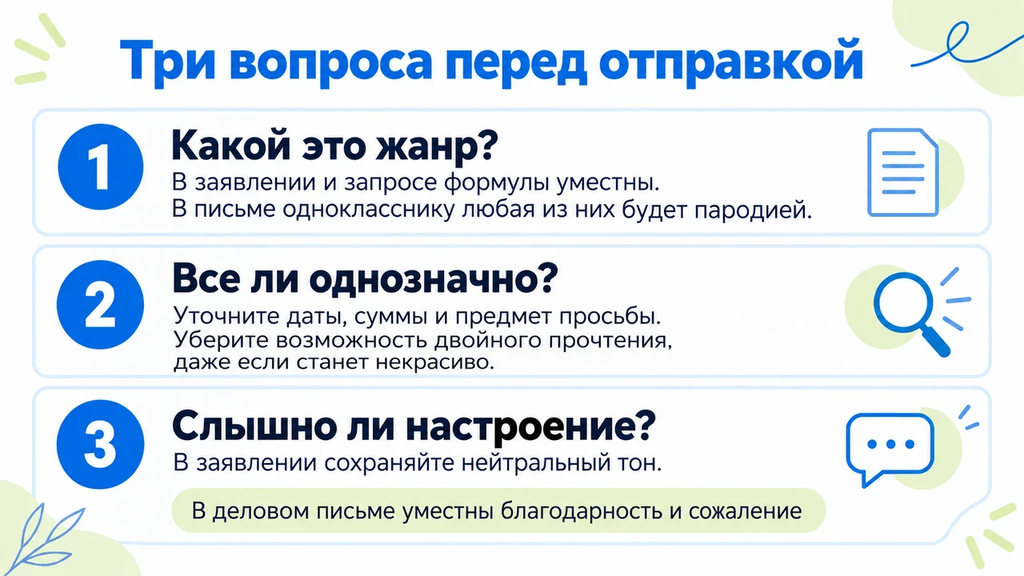
Is this a document or a letter? The formulas are appropriate in a statement, power of attorney, and request, but in a letter to a classmate, any of them would be a parody.
Is it possible to read the written information in two ways? The dates, amounts, and subject of the request must be unambiguous, even if it becomes unsightly.
Can you hear the mood? In a formal document, that shouldn’t be apparent. In a business letter, the rules are more relaxed; there are both gratitude and regret.
Who really needs this?
In the school, the official business style is studied among the functional varieties of the language, along with a statement, a receipt, and an explanatory note.
And for an adult who lives abroad, it comes up constantly and suddenly. Power of attorney for a child. Application to the consulate. A reference that they ask to translate. A request to the school, where they need to explain the situation without any discrepancies. And then it turns out that the person knows how to speak Russian perfectly, but can’t put together a short document. A similar story with Russian toast, It's a place where all the words are familiar, and it's hard to explain how it's organized.
At Palme School we teach online to children aged four to seventeen, in small groups, and Adults work separately. You can start at two free lessons. First, the methodologist will determine the level and select a group, and then a regular lesson with the teacher will take place.
Frequently Asked Questions
What is an official business style?
This is a variety of language that serves official relations and is used to accurately convey information. Hence its characteristics. Predefined formulas like «please provide» and «in accordance with» precise dates and amounts, neutrality, and the absence of evaluations. Beauty here is not the goal; the goal is clarity.
Why are clichés needed in business documents?
The ready-made formula saves time for both parties. The writer doesn’t invent the beginning; the reader immediately understands what is ahead and what will happen next. Plus, the formula doesn’t take away from the author; he doesn’t disappear into the statement, but remains in his style. There should be no trace of irritation or hesitation in the document.
What is a clerkship?
The word was coined by Kornei Chukovsky in the book «Living Like Life» in 1962, modeled after the names of diseases like colitis. The office is not a particularly fancy set of bad words. It starts where office jargon unnecessarily transfers into colloquial and literary speech and makes it difficult to understand. «The delay was due to adverse weather conditions» instead of «I was late because of the rain.».
Why are office jargon terms acceptable in a document, but not in a conversation?
Because in a document they perform the necessary work, but in ordinary conversational speech they often just get in the way unnecessarily. In a «please provide» statement, the discrepancy is resolved, but in a request to a close person, the same construction sounds like a parody. The problem is not the phrase itself, but where it ended up.
How to write a Russian application if you are used to English business letters?
Don’t translate the English strategy of politeness directly. In English requests, conventional indirectness often works better; in Russian, a short «please provide» is more standard. Adding «I would like to ask you» does not add any formality; it is simply longer and less typical for the genre.
How to check that the document is written correctly?
Ask yourself three questions. Is it really a document or just an ordinary letter? Can the text be read in two ways, especially the dates, deadlines, and the subject of the request? And is your mood heard in the text, because in a formal document it should not be obvious.
What documents may be required in Russian abroad?
Power of attorney, a statement to the consulate, a request to the school, a request for a certificate, an explanation for transferring documents. This is exactly the case when a person speaks Russian perfectly but cannot put together a short document.
Is an official business style necessary for a child?
In school, the formal-business style is studied among the functional varieties of language. In practice, the child will need it later, with the first application, but it is useful to show in advance that this is not a different language, but just another register of the same language.