


In November 1877, Dostoyevsky gave a whole chapter of his «The Writer's Diary» to one verb. The verb was «to fade away,» and at the end of the chapter the author himself called it a comprehensive account of the history of a minor character.
It wasn't important, at least for him. He wanted a record of where it came from.
A class where everyone drew with ink
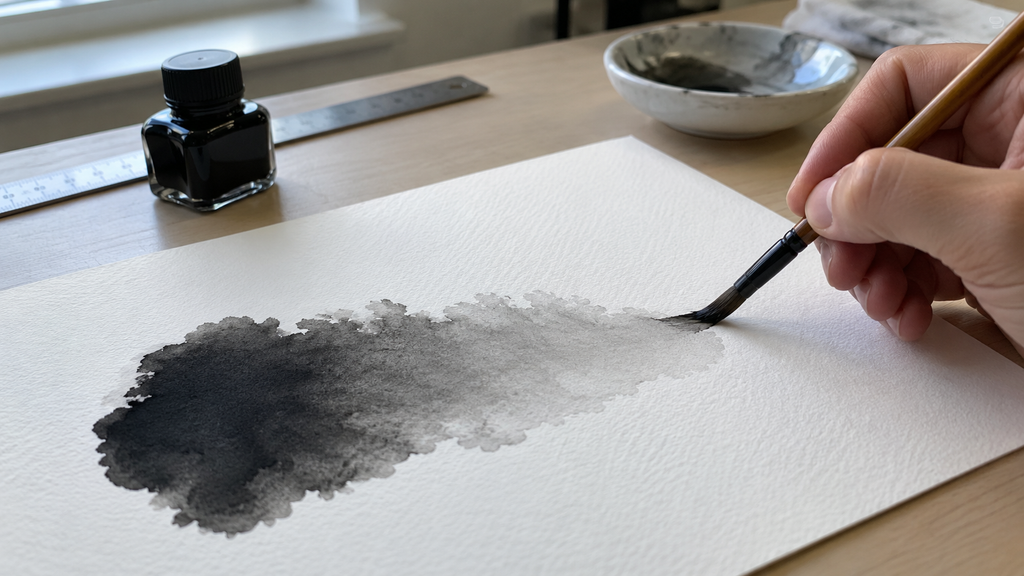
The word appeared in the class of the Main Engineering School in St. Petersburg, where Dostoyevsky himself studied. The future military engineers drew plans and shaded them with ink, that is, they placed the shadow so that the dark area gradually transitioned into the light and faded away at the edge of the sheet. From this drawing movement, their classmates created a verb for a person.
Someone was missing from class, and they asked about him.
«Where is that someone?»
«Oh, he was hiding somewhere!»
That meant it was gone unnoticed, disappeared like a shadow on a drawing. A stranger wouldn't have understood this phrase, but everyone in the classroom understood it because everyone was holding the same eyeliner in their hands.
Who invented it and who brought it
A few years later, Dostoyevsky inserted a phrase into the novel «The Double», and on February 1, 1846 it first appeared in print in «The Russian Notes». Even before it was published, he read the novel to a friend, and, as he recalls, Belinsky praised precisely that expression.
Thirty years later, the word was everywhere, and Dostoyevsky decided to record what had happened. He proudly says that he was the first to introduce it into literature. And he immediately adds that he didn’t actually invent it.
This division is the most valuable thing in the head office. One thing is who came up with the word in the books; another is who said it first. Dostoyevsky knew the answer to the first question exactly; it was he himself. As for the second question, he could only say that the word originated in his class and that he did not want to claim it for himself.
He recorded it, as he himself admits, for a future collector of the Russian dictionary, for some future Dal.
Almost every family has its own «shyness»

The engineering school class was a small world with its own rules. So was the family. Everyone understood some kind of word there, because everyone remembered where it came from, and the guest had to explain it to them.
If a child says such a word in a social setting and it is not understood, it is a reason to ask about it. In and of itself, not understanding something does not prove anything; the word may just be rare.
The names of relatives and affectionate nicknames are not appropriate here; there is a separate article about them., «Russian words about the family». Here we need one word that is accompanied by a specific event.
The same questions that Dostoyevsky asked himself

Ask the child to ask their grandmother. There are only a few questions, and they are all already in that section.
When and where did they start saying that?
Where did you hear that word from?
What did it mean then?
Do you know who said it first?
The last question is the most honest. Grandma may firmly remember that Grandpa said that, and not know if he came up with it herself. Then it is written in the card as such: «heard from Grandpa,» just like in Dostoevsky, who introduced the idea but did not invent it.
If there are two versions, write down both and next to each one, indicate who told it. If no one remembers, write down «no one remembers.» There is no need to add details about the origin, even when it is self-evident.
The dictionary knows the word, but not the history

«Today, »to squint« is included in any dictionary definition. The meaning is described there, but there are no classes for squinting and phrases like »I squinted somewhere.".
The family word may have different meanings. It may not even be in the dictionary at all. It may be found, but with a different meaning. It may be found with the prefix «conversational».
Write down which dictionaries you looked in and what you found. If you checked the spelling in the «Grammata» dictionary, you need to look up the meaning in a dictionary. If the words are not found anywhere else where you looked, that doesn't mean that they were invented by you specifically.
To explain to someone outside the family

The last line of the card is the most difficult. Dostoevsky needed an entire chapter to «fade away.» A family word can be summed up in one or two sentences, but without a context from which it grew, it usually can't be done.
Ask the child to explain the word in Russian so that a friend or teacher can understand it.
If a word cannot be explained without a story, it means that it is related to a family event or a joke. The same applies to proverbs; there is an article about that. about why it is difficult to translate them literally.
Card
Below is a card with one word on it. You can fill it out together with your child right during the conversation with Grandma and print it out.
Family dictionary
One card for one word. Ask your grandmother or another adult for the answer and write it down. If there are two versions, write down both.
The recorded information is stored only in this browser. To print the card for the next word, clean it.
Dostoevsky recorded his word thirty years after it appeared. A family word doesn't have to wait that long.
At Palme School, children aged four to seventeen learn Russian online in the Russian for Bilinguals course. Explaining a family word in Russian in a way that a person outside the family understands is also a skill that can be trained, and it can be practiced not only at home.
You can start with two free lessons. In the first method, the educator determines the child’s level and helps to choose a program; in the second method, the family gets acquainted with the teacher.
Sign up for free lessonsFrequently asked questions about family words
What are family words?
These are words that are understood by one family, but the guest has to explain them. Such a word may not exist in the dictionary, or the dictionary means something else. In Rusistics, there is a term for this: «family lexicon.».
How to ask grandma about the family word?
It’s better if the child asks the question themselves. There are a few questions. Where and when did they start saying this? From whom did the grandmother hear this word? What did it mean back then and does she know who was the first to say it? If there are two versions, both are recorded, and next to each one there is a note indicating who said it.
If words are not in the dictionary, then they were invented in the family?
Not necessarily. The word may be rare or local. In the card, it is recorded which dictionaries were looked up and what was found. If the word is not found anywhere where it was looked up, it is written «not found in verified dictionaries.».
What to do if no one remembers where the word came from?
That's how it should be written: «No one remembers.» There's no need to speculate about the origin. In the card, the guess can easily start to look like a story.
Where did the word «to tan» come from?
In 1877, Dostoyevsky described the word «to fade away» in «The Diary of a Writer». According to his memories, this was how his fellow students at the Main Engineering School spoke, where they used ink to cover up their plans. The word meant to fade away imperceptibly, to disappear. Dostoyevsky used it in the novel «The Double» in 1846 and considered it his achievement to introduce the word into literature, although he did not call himself its inventor. Critics of his collected works, citing the work of S. A. Reisser, suggest that this meaning of the word was already in use under Pushkin.