It’s evening, the lights in the children’s room have already been turned off; only one table lamp is lit near the bed. You go to turn it off and stop in the doorway because there’s a dinosaur on the wall that’s almost as tall as the ceiling; its tail sways and goes up to the ceiling, right above the pillow. It’s a real dinosaur the size of a hand, and the child holds it very close to the lamp.
«Look at how huge he is!»
He moves the toy a little closer, and the shadow on the wall grows taller again. He takes his hand away, and the dinosaur on the wall shrinks back. He moves it again. It’s a pity to turn off the light at a time like this, and there’s no need to rush it. This game has a sequel that lasts five minutes, after which there will be a sheet of paper with two shapes of one toy on the wall, and the child will have Russian words for what he just did with his hands.
«Take your hand away, I can't see anything»
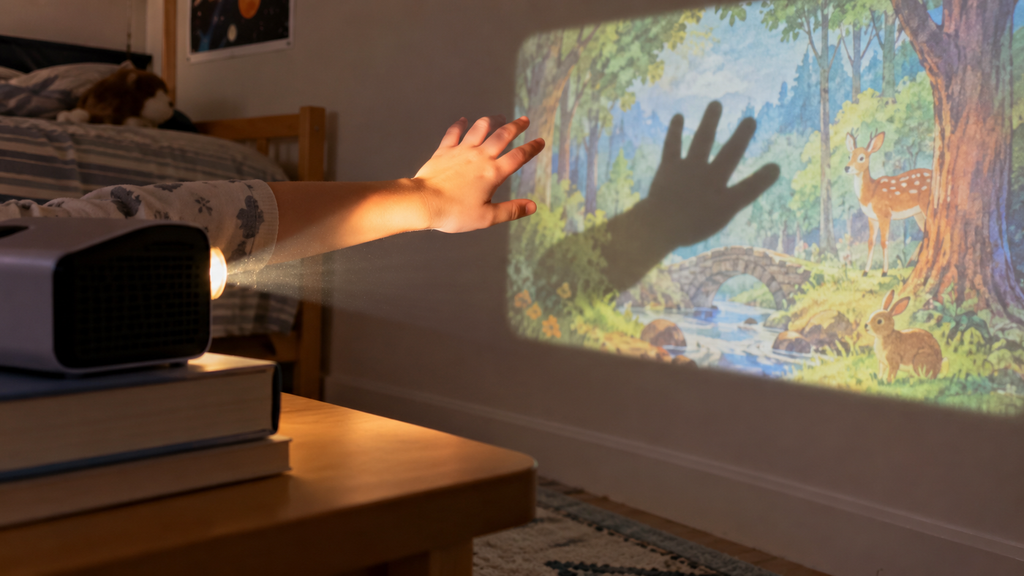
If you had slide projectors in your childhood, this evening might seem familiar. A sheet on the wall or light wallpaper, a projector on a shelf of books, a click when the frame is moved, and someone reading the subtitles out loud, trying to speak in different voices. And almost always there was someone who stuck their hand into the beam. The image showed a dark hand, sometimes a dog paw, the story stopped, and the room screamed «Take your hand off!».
When someone blocked the beam with their hand, part of the picture darkened. No one explained why; they just knew, as they know that the battery is hot in winter. The child with the dinosaur now does the same thing in their room with their toy, and the adult who once stood in the beam of the projector won’t need a textbook for this experience.
Isn't this physics for school?
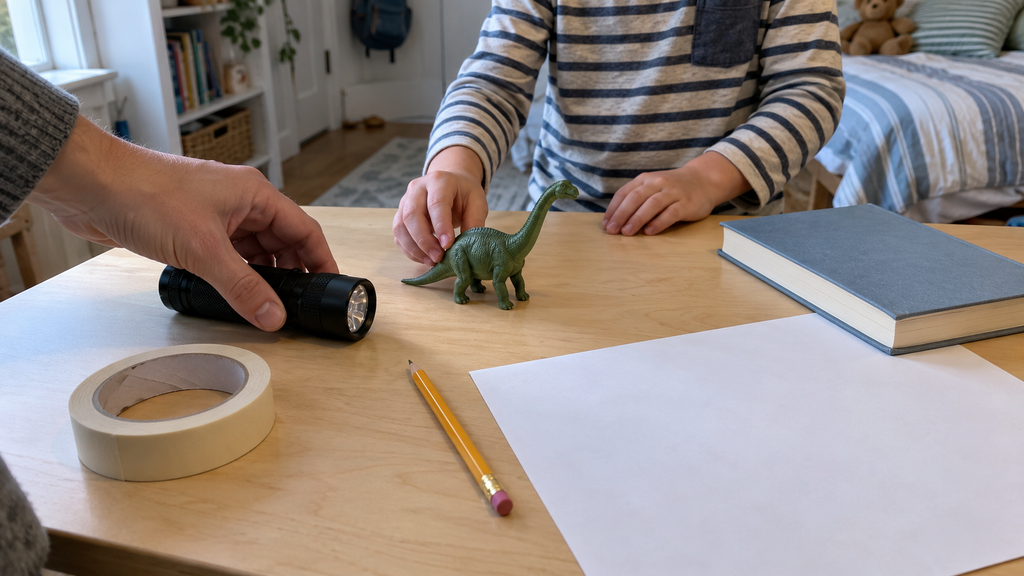
It looks like physics, and the thought «he’s still young, they’ll explain it in school» comes naturally. There are no formulas in this experiment; there’s no need to count anything. All you need is a lamp, a toy, a sheet of paper and a pencil, and the whole explanation fits on a single drawing with a kite. The point of the activity is that the child can see with their own eyes two different shadows of the same object and can say in Russian where that object stood.
A LED lamp would be suitable for the experiment, but it can also heat up. The toy and the paper are held at a distance from the lamp, and the experiment is carried out together with an adult. It is better to choose a lamp with a small light source or a LED flashlight and first test whether it is possible to create a sufficiently clear shadow on the paper to outline it. The detailed procedure and everything important about the lamp are gathered in a separate section below.
Two shadows on one sheet
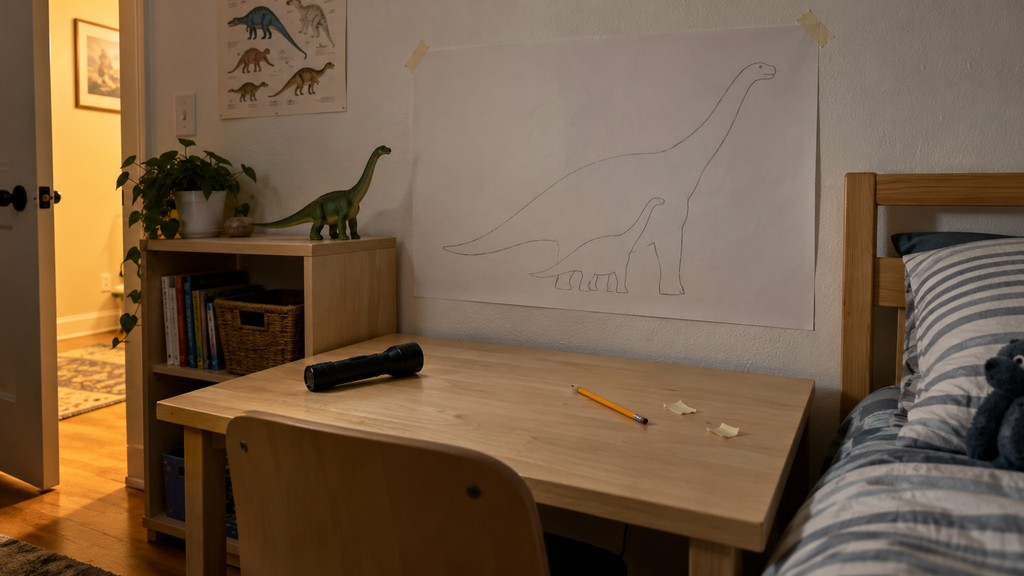
You will need a table lamp with a small light source or a LED flashlight, a small toy that can stand steady, a sheet of paper, tape, and a pencil. It would be good if you can dim the overhead light in the room.
Attach the sheet to the wall near the table. Turn on the lamp and check whether the shadow on the paper is clear enough to outline it. If the edges are very blurred, use a flashlight or a lamp with a smaller light source.
Place the toy on a book or box and mark two places on the table with masking tape; one at the edge of the page and the other closer to the lamp. Mark the lamp so that the large shadow covers the entire page.
Place the toy at the mark on the sheet and draw a shadow around it. While one person is drawing, the other doesn't touch the lamp or the table.
Move the toy to the mark near the lamp without turning it or changing the height. Draw a second shadow on the same sheet of paper.
Trace the contours under the child's dictation, where the toy was, «under the lamp» and «under the wall.» Then ask them to make the shadow large, small, and such that it falls between the two contours.
About the lamp and safety
A LED light bulb can also get hot. Keep the toy and paper at a distance from the light bulb and don't place them on the lamp shade.
Incandescent and halogen lamps heat up very much; for experiments they are not suitable. Do not use a candle or other open flame.
The lamp should be stable and the wire should not be placed where people walk. Experience is gained together with an adult.
A beam from a lamp
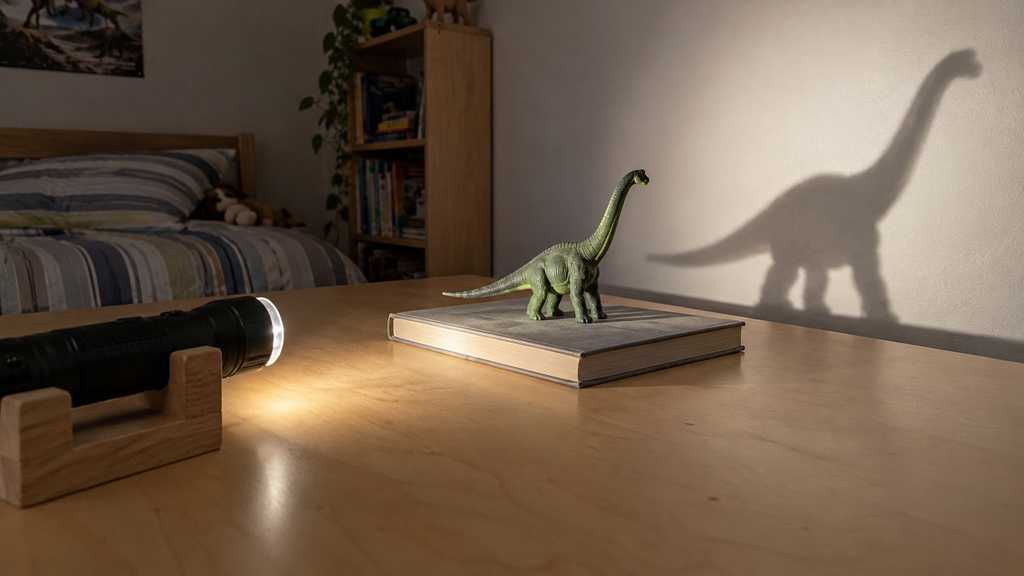
The light from the lamp comes in straight lines and spreads out in a fan-like pattern. The shadow lies where the light did not reach because a toy stood in the way.
If the toy is placed right next to the lamp, it blocks the beam where it is already narrow. The beam is far from the wall, so it can spread out wide; the dark spot on the wall appears larger. If the toy is placed against the wall, there is almost no way for the beam to spread out behind it, and the shadow is almost the same as the toy itself.
If the light source is small and the toy is about halfway between it and the wall, its shadow will be approximately twice as high as the toy itself. The distance is measured from the lamp itself, not from the edge of the shade. A child older than five can check this with a ruler; a five-year-old can do with just seeing the large outline at once.
Such a swirl can be easily drawn on the side of the same sheet. A circle instead of a lamp, a dash instead of a toy, a vertical line instead of a wall, and two straight lines from the circle through the top and bottom of the wall to the very wall itself. If you draw the swirl again, closer to the circle, the straight lines on the wall will spread wider, and the child will see it before you have a chance to say anything.
Two circuits on one sheet
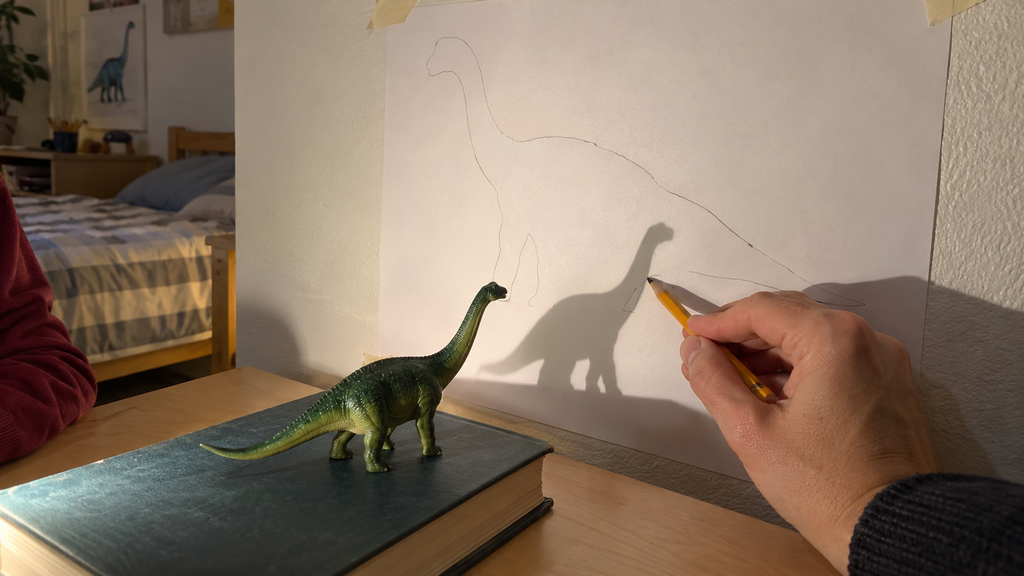
The sheet of paper is attached to the wall near the table. From this moment on, the lamp and the sheet remain in their places until the very end, and only the toy moves. It is better to place it on something stable, on a book or a box, and mark two places in advance on the table with masking tape, one at the lamp and the other at the sheet itself.
While one circles the shadow, the other doesn’t touch the lamp or the table. If you touch the shade, the contour will move to the side; it’s pointless to compare two contours drawn under different lighting conditions.
First, it is convenient to draw a small shadow when the toy is placed on the leaf. Then it is moved to the mark near the lamp without turning or changing the height; otherwise, the shape of the shadow will change along with the size. A second, larger contour appears on the paper. The mark near the lamp should be chosen with a margin so that the large shadow fits the entire sheet of paper. The tail on the ceiling is good for playing in the evening, but for comparison, you need the entire figure, from the head to the tip of the tail. Now there are two shadows of the same dinosaur on one sheet, and the dinosaur itself stands on the table exactly as it was.
The big one, the small one, and the one they asked for
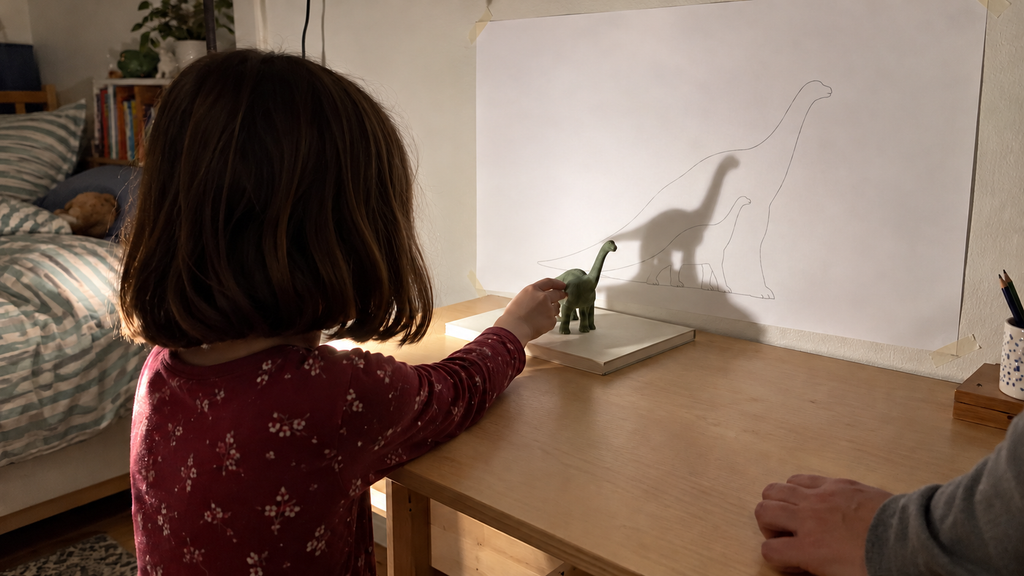
You can leave the sheet alone for now. Ask the child to make a large shadow. Most likely, he will immediately bring the toy to the lamp; he saw the movement a minute ago.
Then ask for a small one.
Then set a more difficult task and don't give any directions. «Make such a shadow that it is smaller than the large outline but larger than the small one.» Finding the middle point is more difficult than the edge, and here the toy starts moving back and forth until the shadow falls between the two lines on the wall.
The child is not required to explain with words. He can point with his hand, move the dinosaur, and say one word: «bigger.» This is the real answer. If he keeps choosing the right direction time and again, he has noticed the connection between the toy's location and the size of the shadow, and he is left with the task of giving it a name.
The phrase at the beginning of the evening sounded different by this time. «Look at how big he is!» might have seemed like excitement over a toy, but the dinosaur didn’t change a millimeter throughout the entire evening. What made it huge was the space on the table, and the child chose that space every time.
Signature on the sheet
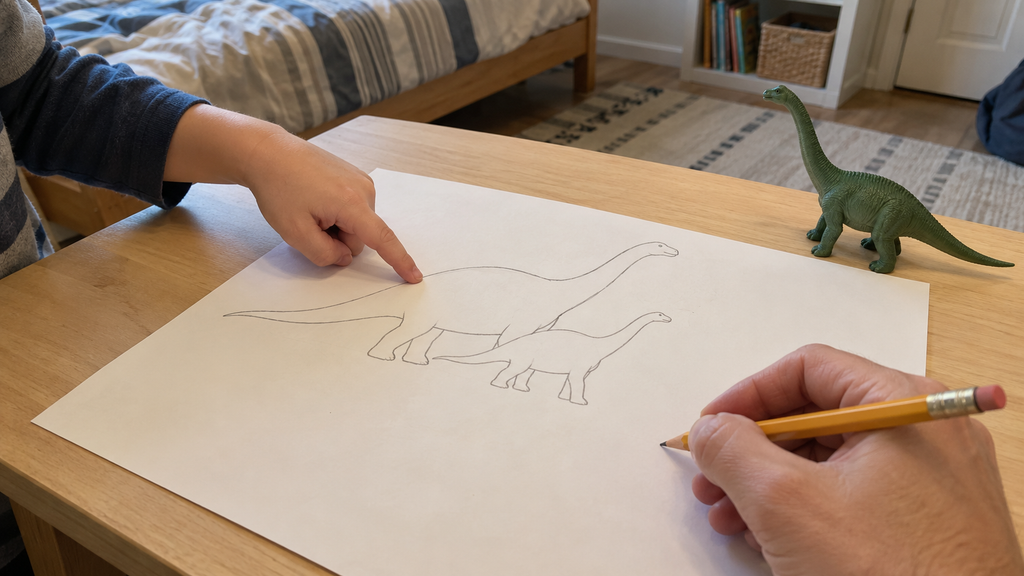
There is still room for a signature under the two circles. The adult writes, while the child comes up with the answer to one question about where the toy was.
«At the lamp.» «At the wall.» Two words next to each contour; a week later, this sheet will be as understandable as it is today.
If you want to say more, it’s better to offer the full sentence to an adult, after everyone has seen it with their own eyes. «The closer the toy is to the lamp, the more its shadow appears on the wall.» There’s no need to repeat it in a choir or to memorize it. It’s enough for it to be heard next to the sheet on which everything is already visible, and then the next time the child moves the toy closer to the light, they might say the beginning themselves.
To whom to show the sheet
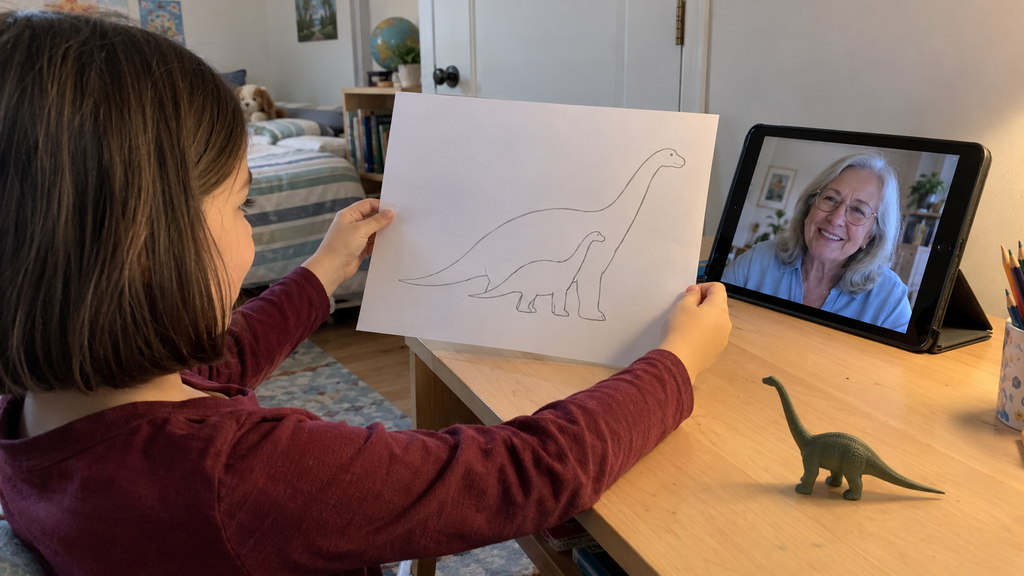
The grandfather can show the sheet to the grandmother next time she calls. If she had ever had slide projectors in her house, she might remember the bed sheet on the wall and the hand in the beam, and the grandson will hear that this game is older than he is himself.
A parent who does not speak Russian can participate in the experience without a single word. He or she holds a sheet while the child circles the outline, or draws a shadow while the child holds the toy at the mark. The Russian captions for the outlines remain Russian. The older brother or sister can help conduct the experience together with an adult.
The closer, the more
In English, the phrase has a counterpart: the closer, the bigger. Both constructions are built in the same way; the comparison at the beginning leads to a comparison at the end, and one without the other does not make sense. For a child who has heard the English construction in school, the Russian may seem familiar, even though not a single word in it resembles the English one. In both languages, this construction links two changes: the toy approaches the light, and the shadow becomes larger.
The lamp will still be turned off this evening. The dinosaur will return to its same-sized shelf as it was in the morning, and there will be two shadows of it left on the wall until tomorrow; and every child knows where it stood.
A child who grows up with two languages can first notice and then choose the words. «Closer,» «further,» «more,» «by the lamp» are supported when they are accompanied by what they have made with their own hands. In the «Russian for Bilinguals» course at Palme School, children aged four to seventeen are engaged online in small groups.
You can get acquainted with the school at two free lessons. First, the methodologist determines the child’s level and helps choose a program; then the family meets the teacher.
Sign up for free lessonsFrequently asked questions about the shadow from a toy
Is it possible to do shadow work if the child is still young?
Start with moving the toy and observing the shadow. The adult or a child can use it to draw a contour. A child who already knows how to use a ruler can be asked to compare the heights of the two contours. The experiment is conducted together with an adult.
Why are the edges of the shadow blurred?
If the light comes from a large luminous surface, such as from a light bulb diffuser, a semi-shadow appears along the edge of the shadow. With the toy and the wall positioned the same distance apart, the smaller light source produces a sharper edge. For contouring, a flashlight or a lamp with a small bright bulb is most convenient.
Is it possible to replicate this experience with a candle?
It’s better not to. The flame trembles, and the shadow trembles with it, so it’s difficult to outline it. Open flame near paper and a toy is dangerous. A flashlight or LED lamp will give a smooth shadow.
What do they call the shadows on the wall made by hands?
Shadow puppets or hand shadows. The shadow cast by an object, in English shadow, and the shadow under the tree in which they sit is called shade. In Russian, both are called with one word «shadow».
Another home experience, after which there is something to talk about in Russian, is described in the article about globus. There we offer Try to arrange the orange peel like a map.