


A little more than a hundred years ago, the word «tooth» was written with a solid sign at the end, «zub».
The reader of that time did not pronounce this sign. It was written after the final consonant letter, except for the y, unless the word ended in a soft sign: zub' (tooth), dom' (house), stol' (table), but the ending, ol' (deer), mys' (mouse). He did not change the sounds. The reforms of 1917–1918 removed it from such words.
This sign has its own history, and it explains what a child today faces when they write «zup» to their grandmother. If you go through it from beginning to end, checking the voiced and voiceless consonants at the end of the word stops looking like a rule from a textbook. The check turns out to be a way to find a form in which a vowel follows the consonant and the voiceness is clearly audible.
This will be useful for the parents of a child who is already learning familiar words and understands when an adult asks them to say a word in a different way.
When after B the vowel still sounded

The solid sign in old writing was called erom. How it evolved from a sounding letter into a silent one we discussed in the article about soft and hard sign. For the voiced and voiceless consonants in this story, one detail is important.
In the past, er denoted the real, albeit very short, vowel. The Old Russian word «zub» ended not with the letter B, but with this short sound after it.
It turns out that B stood before the vowel. The voiced consonant still sounds loud today, so in the word «zuby» we clearly hear [b]. Then it was also clearly heard in the word where there was only one tooth.
The sound and recording were at the same time, and there was nothing to check.
The vowel disappeared, but the letter remained

Then the short vowels at the end of words stopped being pronounced. In the history of the language, this is called the decline of reduced vowels, and it is usually attributed to the 12th century.
The word became shorter by one sound, and B ended up at the very end, before the pause. In this position, the Russian pairs of sonorous consonants began to sound dull over time, [b] like [p], [d] like [t], [g] like [k]. Today, this phenomenon is called deafness.
The letter remained the same for a long time. Both B and er followed it. Er became a silent sign, and B became a letter that sounds like P at the end of a word.
Thus, in the short word «zub», two letters were combined, which differed in their sound. The reform eliminated one of them. The other remained, and there was a reason for it.
Why B was not replaced by P
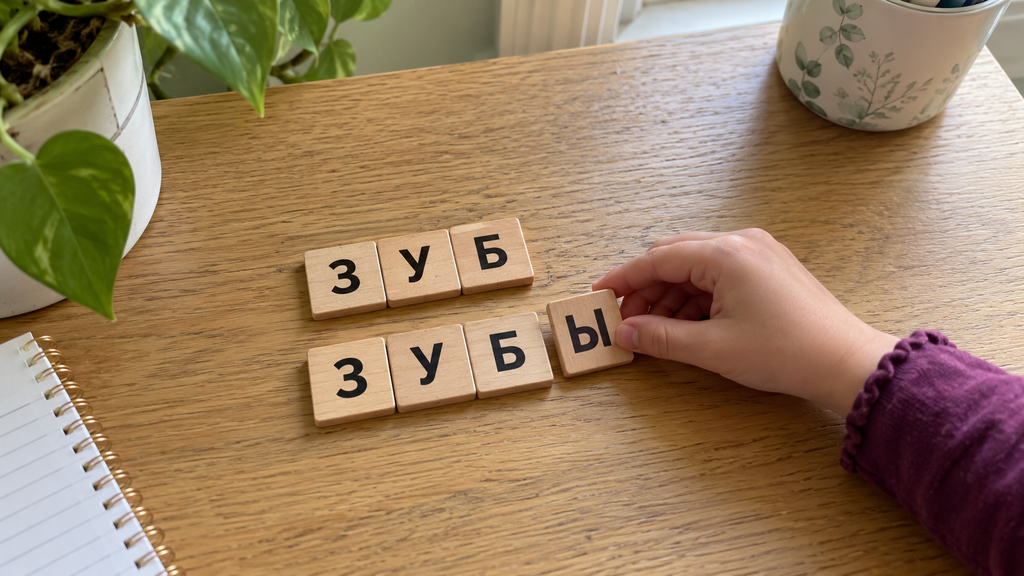
Imagine that the letters at the end are written only by ear. Then one word would have different spellings in different forms. One is «zup», but there are two teeth; there are no teeth, and the teeth hurt.
Russian writing tries to write the same part of a word the same way in all forms. To choose a letter, it relies on the form in which the sound is heard clearly. When a vowel follows a B, it sounds like [b], so the letter B is written at the end as well.
The final ъ no longer denoted a separate sound, and the reform abolished its writing in such words. The letter that connects the «tooth» with the «teeth» remained in place.
What a child who writes «zup» does»

Now let's look at the note to Grandma through the eyes of a child.
He says «zub», hears the [p] at the end, and writes P. By hearsay, he is correct. He is unaware of nine hundred years of language history, and knowing it is not necessary for writing.
We need something different. Find a word form in which the vowel is again after the consonant, as it once was at the end.
How to say if there are many teeth?
Teeth.
What is heard before the Ы?
[b].
The child chooses a different form of the word. After the consonant, a vowel is placed; therefore, instead of the final [p], [b] is clearly heard. It is as if the word returns to what it was in ancient times; after the consonant, a vowel is placed and the child listens to what it becomes.
Bread, snow, knife

This is how consonants behave; those that have a voiceless pair are B and P, V and F, G and K, D and T, J and S, and Z and C.
Old words with a 'r' at the end give a whole collection of such cases. Hleb', snye', dub', glaz', noz'. If we remove the old letters from them and say them out loud, a silent consonant is always heard at the end, even though it is written with a vowel. You can put a consonant before a vowel in each of them: hleb', snega', dub', glaza', noz'.
There are no consonant pairs L, M, N, R in the old «dom» or «miří». The «er» also stopped in the old «dom» or "miří", but the pronunciation of M and R did not change, and today "dom" and "miří" at the end sound exactly as they are written.
Due to the paralysis, some words are completely unrecognizable in the ear, like «field» and «leek.» Our article is dedicated to such couples. homonyms and homophones.
There is also the reverse case. In the word «soup,» the [p] sound is also heard at the end, and the form «soup» confirms exactly the P sound. It is useful for a child to see both outcomes; otherwise, they may conclude that the final letter is always written with a glottal stop.
When another form is not helpful

The consonant should be used immediately after the checked consonant. The word «fungi» is related and familiar, but after the B it should be pronounced with the K sound, and [p] is heard again. «Fungi» is suitable for verification.
The consonant itself should remain the same. In the word «friends,» the Z stands in place of the G, and for the verification of the word «friend,» it is not suitable. «At a friend's» is acceptable; after the G, the vowel is audible [g].
Similar procedures are being used to check for silent vowels; only there they are looking for a form where the stress falls on the vowel., How vowels are checked, We have a separate article about that.
The last letter
There is one letter missing in each word. Say the word together with the child, then change it so that a vowel appears after that letter, and choose one of the two.
du_
water_
snow_
cow_
head_
but_
friend_
shka_
An extra letter on an old page

If there is a book published before 1918 in your home, or a reprint with the old spelling, you can immediately see the eer at the end of the words.
You can show the child the «z» and ask why there is an extra letter here, in his opinion. Explaining that the sound used to be a vowel in this place can help the child understand the test. When the child checks the last letter, he/she also places a vowel after it.
And the next time he comes across the word «eye» or «knife,» the question can be asked quite briefly.
How to change a word so that a vowel appears immediately after the checked consonant?
When a child understands where a letter comes from, they can check it for themselves rather than having to guess. At the «Russian for Bilinguals» course at Palme School, children aged four to seventeen are learning online in small groups.
You can start with two free lessons. First, the methodologist determines the child's level and helps choose a program; then the family meets the teacher at a free lesson.
Sign up for free lessonsFrequently asked questions about voiced and voiceless consonants
Which consonants are muffled at the end of a word?
The pairs of sonorous consonants B, V, G, D, J, Z are muffled. At the end of a word before a pause they sound like the paired silent consonants P, F, K, T, S. In the consonants L, M, N, R there is no silent pair, and at the end they sound as they are written.
How to check the consonant at the end of a word?
Change the word so that the consonant immediately after the checked consonant appears. Tooth and teeth, snow and snow, soup and soups. The consonant itself must remain the same, so the word «friend» is checked by the form «at a friend's», and the word «friends» is not suitable for verification.
Why does a child write «zup» instead of «zub»?
Most likely, he is recording what he hears. In the word «zub» at the end, the [p] sound is indeed heard. A question that leads to another form of the word helps: «How do you say if you have a lot of teeth?» In the word «zuby,» the [b] sound is heard before the vowel.
Why did they previously write a hard sign at the end of words?
Once a solid sign, er, denoted a very short vowel. Then this vowel in the end of a word stopped being pronounced, and the sign became silent. It was written after the final consonant letter, except for y, if the word did not end with a soft sign. The 1917–1918 reform abolished this writing.
Why is Stroganoff called Stroganoff in English?
The ending -off is associated with the French tradition of passing on Russian surnames. According to the Etymonline dictionary, boeuf stroganoff has been appearing in English texts since 1907 and comes from French. The ending -off conveys what is heard at the end of a surname, the sound [f]. In Russian, it is written V, because in the forms «Stroganov» and «at Stroganov», the [v] sound is heard before the vowel.