Open a Russian newspaper from 1916. The first thing that will catch your eye is not the yat.
The hard sign will be thrown out. It sticks out almost everywhere: годъ, былъ, министръ, Петербургъ. It pronounces nothing, changes nothing, just takes up space.
Lev Uspensky dedicated a chapter to it titled «The Most Expensive Letter in the World» and once counted it. He took the 1897 four-volume edition of «War and Peace,» over two thousand pages, and it came out to about fifty-five hard signs per page, roughly three and a half percent of all letters. If one were to collect them in a row, it would make more than seventy pages of hard signs alone.
The strangest thing is that the reader didn't pronounce them. Once upon a time, the yer was a real letter with its own short vowel sound, and in writing it also helped show where a word ended, back before spaces had become a habit. The sound died centuries before the letter itself, spaces appeared, but people kept writing the yer.
A few years after that newspaper, almost all of those signs disappeared. But one remained and still lives to this day in the doorway, the off-ramp, and the advertisement.
A more interesting question than the school one about «when the hard sign is written.» Why wasn't it removed along with all the others?
What exactly did the reform abolish
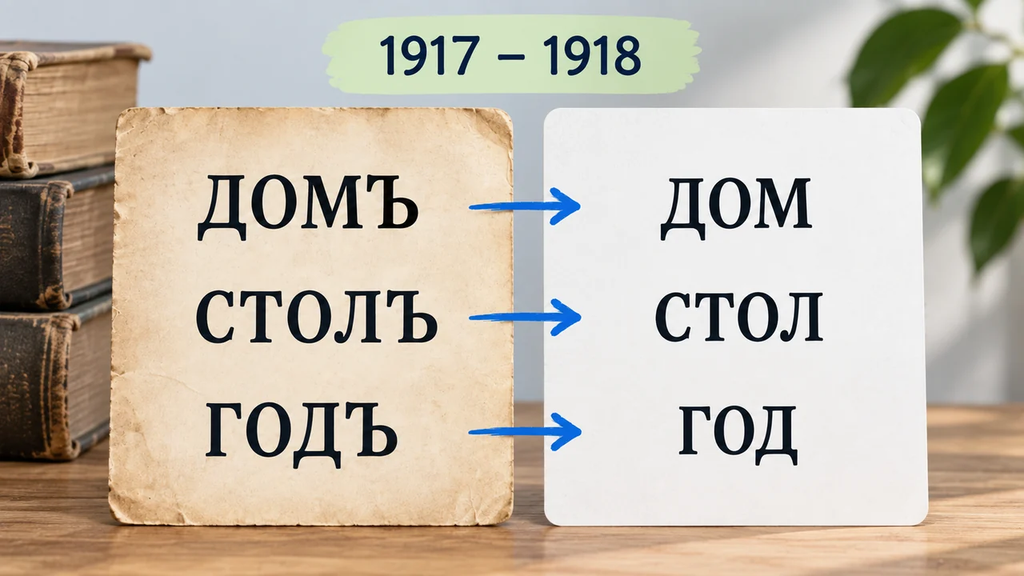
The reform of 1917 and 1918 deleted the hard sign at the end of words. Dom became dom, stol stol.
And they left the letter inside the word, and this is where it gets interesting.
Because it works inside the word
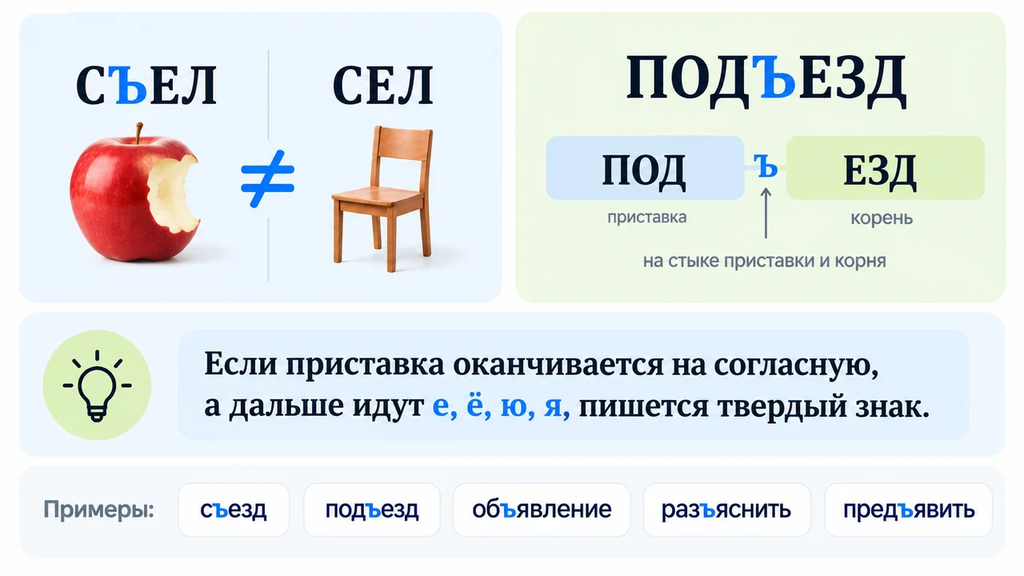
Take it away from ate. You get sat, and that's a different action.
Take it out of the entrance hall. It will become an entrance hal, and the word will fall apart when read.
The sign stands between the prefix and the root and indicates that the following sound is read as 'y'. The work is small, but it is still needed, which is why the modern ъ (hard sign) has remained a separating sign.
By the way, it used to be used more broadly. People used to write съэкономить (to save), разъикаться (to start hiccuping), двухъаршинный (two-arshyn long). Some of these spellings persisted into the Soviet era, and the 1956 rulebook solidified the use of ъ roughly within the boundaries we have today. It also used to distinguish between words that now look identical, like подарочного (gift, adj.) and подъарочного (under-arch, adj.).
Couldn't all the work have been given to the soft sign

It would seem, why keep two silent letters.
The work could theoretically have been given to another character, and in practice such a replacement even came about. In November 1918, printing houses began removing the type for abolished letters, along with the ъ. There was nothing left to print the separating sign with, and forms like под’езд (entrance) and об’явление (announcement) appeared in typesetting. The reform itself did not provide for anything of the kind; it removed the final ъ, but kept it inside words.
Besides, family and stairway are structured differently. In stairway, the prefix at the beginning ends with a consonant. In family, there is no prefix, the sign sits inside the word.
This leads to the most common mistake made by those learning Russian: "pod'ezd.".
The person already knows that a separator is needed before the "e"; they're more familiar with the soft sign, so they write the letter they recognize. It's a reasonable approach, but the result is incorrect. Break the word down into parts—"plus" and "ezd"—and the problem will solve itself.
And yes, the aide ruins everything
There is no Russian prefix there. Just like in the subject with injection.
These words came from other languages along with their prefixes, and the sign in them is simply memorized.
Horse, family, mouse
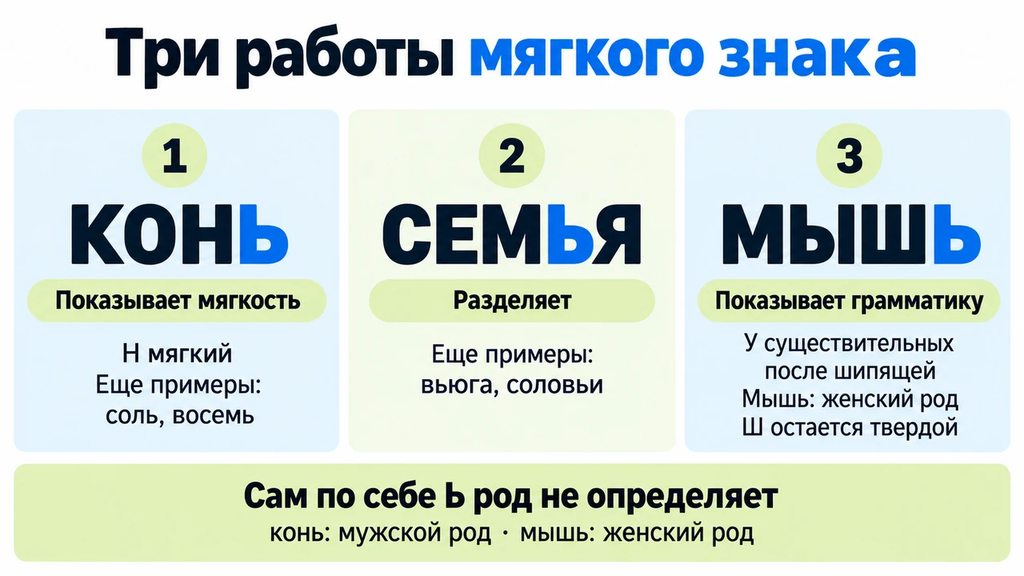
With the soft sign, it's even more confusing. It holds three jobs at once, and three words show this better than any explanation.
In the word "конь" (kon'), it indicates the sound. The soft sign shows the softness of "н" (n), and without it, you get "кон" (kon), a different word.
In the word “family,” its main function is to distinguish. It shows that the “ya” is pronounced with a yot, which is why “family” differs from “seed.” The same applies to “blizzard,” “dress,” and “friends.” And “nightingales” and “streams” are separate cases, because this symbol can also appear before the letter “i,” and this particular rule is the one most often forgotten.
In the word “mouse,” it has nothing to do with either of those things. The “sh” in Russian is always hard, and the soft sign does not soften it. Here, it serves a grammatical function. In nouns following a sibilant, its spelling depends on gender: “mouse” and “rye” versus “knife” and “walrus.” With verbs, it serves the same purpose; hence, you write “pish’,” “berech’,” and “rezh’.”.
And is a cocktail feminine then?
Here, the rule is chasing its own tail.
If, after “mouse” and “rye,” you try to remember that the word with the soft sign is feminine, that whole theory will fall apart at the very first cocktail. The cocktail is masculine. So is “horse.” And so is the dictionary.
In the story about the mouse, it wasn't the sign itself that was important, but the hissing sound that came before it. As for the other words, genus You have to know it separately.
Why is there no soft sign in the word dochka
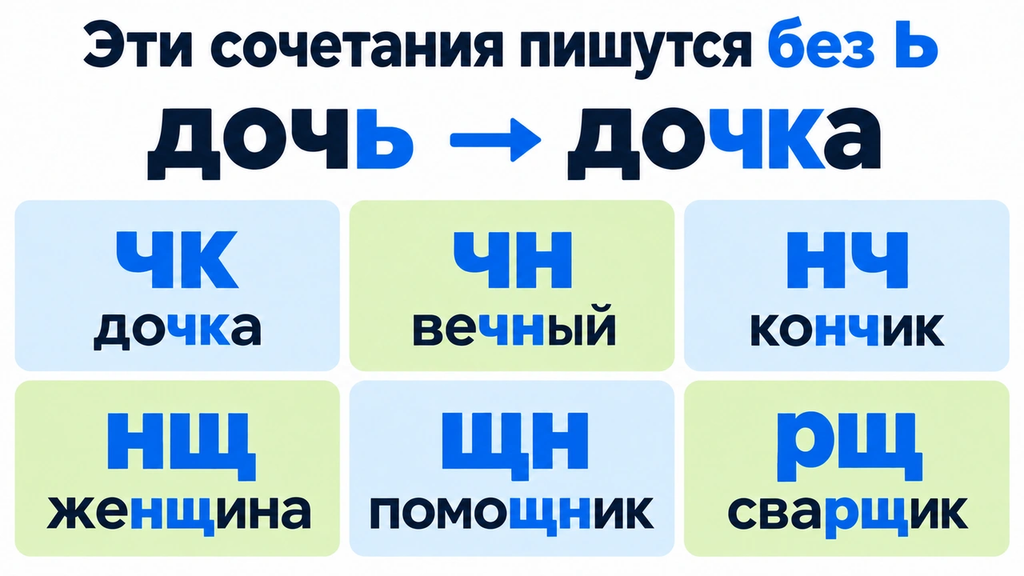
There is a daughter (дочь), but there is no little daughter (дочка).
There is a short list of combinations where the sign is not written, even though your hand reaches for it. Most often mentioned are chk, chn, nch, nshch, shchn, and rshch. Tochka, vechny, konchik, svarshchik.
Cheat sheet
Before and
The dividing sign in ordinary Russian words is soft. Nightingales, brooks, articles.
Before e, ё, ю, я
Usually, the prefix decides. With a consonant prefix, it is hard: съезд and объявление. Without a prefix, it is soft: семья and вьюга.
Before a consonant and at the end of a word
The soft sign most often indicates softness. Horse, letter, eight.
After a sibilant
This is already a question about grammar. For a noun in its base form, you look at its gender: "мышь" (mouse) and "рожь" (rye) versus "нож" (knife) and "моржа" (walrus). For a verb, the sign appears in the second-person form ending in "-чь" and in the imperative mood.
Combinations «ch-k», «ch-n», «n-ch», «n-shch», «shch-n», «r-shch»
The soft sign indicating palatalization is not written. Dot, eternal, tip, welder.
Remember separately
Bilingual and trilingual, as well as adjutant, injection, subject, and conjuncture.
Practice right here
Below is a training tool for three types of tasks. First, we remove the sign from the word and see what breaks, then we decide if it is needed at all, and then we choose between the soft and hard sign.
Three blocks of tasks. First, we remove the sign from the word and see what breaks, then we decide if it is needed at all, then we choose between soft and hard. After the choice, an explanation will appear.
A sign was removed from the word. Decide what has changed: only the spelling, only the pronunciation, or the meaning as well.
The family turns into a seed. What has changed?
Night turns into night. What has changed?
Eight turns into vosem. What changed?
Coal turns into an angle. What changed?
The mouse turns into a mouse. What changed?
Ate turns into sat. What has changed?
Determine whether a sign is needed in the blank space. Ear does not always help here; sometimes you will have to think about gender and part of speech.
Is a soft sign needed in the word mysh?
Is a sign needed in the word nozh_?
Is a soft sign needed in the word pishesh_?
Is a soft sign needed in the word точкка?
Is a punctuation mark needed in the sentence «На лугу пасется кон_»?
A punctuation mark is needed, it remains to choose which one. The main clue here is the consonant prefix ahead.
What is the letter/sign in the word под_езд?
What is the missing letter in the word сем_я?
Which letter/sign is in the word objavlenije?
What spelling mark is in the word vorob_i?
What punctuation mark is in the sentence «Он с_ел яблоко»?
How to practice this
Come up with pairs of words that differ by one character. Kon and kon (horse) come to mind immediately, and after that you have to search. Mel and mel (shoal), polka and polka (Polka dance), bank and banka (little bank), el (ate) and el (spruce). Such pairs are hard to find, but what is found is remembered forever. With a child, the same thing goes like a timed game.
The second task is harder. Take a paragraph where the punctuation marks are placed incorrectly, and instead of just correcting it, explain for each spot which rule a person applied and where it stopped working.
At Palme School, we conduct online classes with children from four to seventeen years old, in small groups. You can start on two free lessons. First, the methodologist will determine the level and select a group, and then a regular lesson with the teacher will take place.
Frequently Asked Questions
Do the soft sign and hard sign have a sound?
They have no sound of their own; both letters act as instructions for neighboring letters. The soft sign has three main jobs. It indicates the softness of a consonant, serves as a separating sign, or acts as a grammatical marker, as in the words мышь and пишешь. In modern writing, the hard sign has only a separating function.
What is the difference between the soft sign (ь) and the hard sign (ъ)?
They do the same job: they show that the letter й appears in the following vowel. The hard sign stands before е, ё, ю, я, and the soft sign also before и. The difference is in the location. The hard sign is placed after a prefix that ends in a consonant, as in подъезд and объявление. The soft sign stands inside a word where there is no prefix, as in семья and вьюге. Two-tier, injection, and adjutant are remembered separately, the rule with the prefix doesn't reach those.
Why is there a soft sign in the word "семья"?
Because there is no prefix in this word, the sign is placed inside the word before "я". It indicates that what follows is read as "y", and a palatalized sound appears between "м" and the vowel. Without the sign, a different word would result: семя.
Why is "подъезд" spelled with a hard sign?
Ahead is the prefix pod-, which ends with a consonant, followed by e. In this position, a hard sign is placed. Without it, the word would be read as podezd.
When is the hard sign used after a prefix?
Before the letters e, ё, ю and я, if the prefix ends in a consonant. Съел, съезд, объявление, разъяснить, предъявить. The same sign is written after the parts two, three and four, as in двухъярусный, and in borrowed words like субъект and конъюнктура.
Why is there a soft sign in the word "мышь" (mouse), but not in the word "нож" (knife)?
The soft sign in the word "мышь" (mouse) does not make the "ш" soft, because "ш" in Russian is always hard. In the word "нож" (knife), a hard consonant also sounds at the end. It is a matter of grammar. We are talking about nouns ending in a sibilant in the nominative case singular, and gender is considered in this form. In the feminine gender, the sign is needed: мышь, дочь, ночь, рожь. In the masculine, it is not needed: нож, ключ, врач, плащ.
Why is there no soft sign in the words точка and ночка?
In the combinations «чк», «чн», «нч», «нщ», «щн», and «рщ», the soft sign is not written to indicate softness, no matter how soft the word may sound. It is easiest to remember these combinations as a list.
Why did they used to write the hard sign at the end of words?
Before the spelling reform, it stood after hard consonants at the end of a huge number of words: домъ, столъ, годъ. The reforms of 1917 and 1918 abolished precisely this final spelling, while preserving the letter in its separating role. From being very frequent, it became rare.