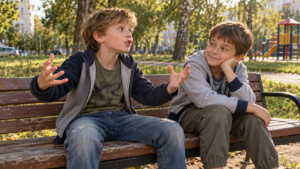
The caption under the photograph from Poltava consists of four words: «У неділю приїде Микола.» The letters are all familiar, and the translation practically suggests itself: "Next Sunday, Mykola will arrive.".
The translation is incorrect. "Неділя" in Ukrainian means Sunday, one day, and Mykola arrives on a specific morning. The word itself is general and has the same internal logic in both languages. The day when one does not do, meaning does not work. Only in Russian has the meaning spread to all seven days, while in Ukrainian it has remained for just one.
Further on, there will be an explanation of where such discrepancies come from. In English-language searches, the topic narrows down to a short "language Ukrainian vs Russian" and a list of differences, but what's truly interesting is: at what point and for what reason did the languages diverge. There are four such reasons, and it's more convenient to analyze them in order, from neighbors drifting apart to decisions made by decree.
Three hundred years with various neighbors

Until the thirteenth century, the language of Kyivan Rus' was more or less unified, and this language is commonly called Old East Slavic. Then the unity ended, and the pieces of the former whole ended up in different neighboring areas.
The lands of future Ukraine and future Belarus became part of the Grand Duchy of Lithuania, then the Polish-Lithuanian Commonwealth, and Polish settled nearby for centuries. The northeastern principalities grew separately, and the main influence there became Church Slavonic, the Literary language of worship that came from the Balkans.
Then a simple mechanism kicked in. Language absorbs what's nearby. After three centuries, neighbors already understood each other with effort, and different sets of borrowings interfered with this.
From Polish neighboring Ukrainian also received polite forms of address. «Pan» and «pani» function as ordinary words in it, whereas in Russian, after the disappearance of «gospodin» from everyday use, a void formed in its place, which is still plugged by awkward «muzhchina» (man) and «zhenshchina» (woman).
At the same time, the genealogy is explained. The closest relative of Ukrainian turns out to be Belarusian, because they traveled this stretch of road together. According to calculations of lexical coincidences in the common vocabulary, Ukrainian has about eighty-four percent with Belarusian, seventy percent with Polish, and sixty-two percent with Russian. The methodologies for such calculations are debatable, and the numbers should be taken as a rough guide, but the ranking is stable.
Second floor of the Russian dictionary

Russian took the most from bookish language, and the consequences of this can still be heard today.
Take pairs. City and grad, gold and zlato, shore and breg, milk and mleko, head and glava, gate and vrata. The first word in each pair is its own, East Slavic, with full vocalization, meaning with two vowels around consonants. The second came from Church Slavonic and sounds higher, more solemn, suitable for poems and sermons.
Hundreds of such pairs have accumulated in Russian, and it is precisely they that give it a second, elevated register. Without them, there would be neither the high poetry of the nineteenth century nor the «head of state» in the usual sense of the word. Ukrainian took noticeably less from the same source; its bookish layer is thinner, and its speech sounds smoother and closer to colloquial. It does not become poorer because of this; solemnity is simply achieved by other means.
Ukrainian also developed its own layer of books, but from a different source. Polish and Latin came through the Sejm, courts, and chancellery of the Polish-Lithuanian Commonwealth, and words settled from there are noticeable in the vocabulary of law, education, and urban life. Both languages gained a second floor, built from different materials.
How I Made "Khleb" and "Khlib"
There used to be a letter called «yat» in the Cyrillic alphabet, and it represented a special sound—somewhere between «e» and “i.” Over time, this sound disappeared from everyday speech, and its legacy had to be divided.
Russian unified «yat» to «e», resulting in the words «khleb,» «ded,» «les,» «sneg,» and «vera.» Ukrainian unified it to "i," resulting in "khlib," "did," "lis," "snih," and "vira." One decision, made spontaneously and at different times, diverged hundreds of words at once.
This is also the origin of «місто,» because the ancient word was spelled with a «yat,» and the Russian «место» and the Ukrainian “містом” diverged precisely on this sound. Behind this pitfall—which trips up anyone reading a Ukrainian sign for the first time—lies a phonetic process dating back eight hundred years.
The Ukrainian «і» has a second source as well. It appears in a closed syllable where Russian uses «o» or «e,» which is why «дом» becomes «дім,» «соль» becomes «сіль,» «ночь» becomes «ніч,» and «печь» becomes «піч.» This is called ikavism, and it doesn’t always apply, because in an open syllable the vowel returns, so “дім” and “дому,” “ніч” and “ночі” coexist side by side.
Two more phonetic features have been added, both noticeable from the very first phrase. The Ukrainian «g» sounds guttural and aspirated, closer to a voiced English «h,» whereas the Russian «g» remains plosive. And unstressed vowels in Ukrainian are not reduced; each is pronounced distinctly, which is why “moloko” sounds exactly as it is written, whereas a Russian ear hears “malako” in the same word.
One preserved it, the other grew it back

Their grammars are similar, and it is all the more interesting at the points where one has retained what it inherited from its ancestor, while the other has not.
Ukrainian has seven cases, while Russian has six. The extra one is called the vocative case. Both languages used to have it, but Russian lost it, leaving behind fossilized forms like «Боже» (Bozhe) and «отче» (otche). Ukrainian uses it daily, with «Oksana» becoming «Oksano,» «brother» becoming «brate,» "friend" becoming "druzhe," and "mother" becoming "mamo.".
The most interesting thing is that Russian, having lost the vocative case, eventually began to grow a new one. «Mom, I'm home,» «Dad, wait,» «Sash, do you hear?» The form appears only in direct address, only in conversation, and only with the truncation of the ending, and linguists call it the neo-vocative. One language preserved what it inherited, the other grew a replacement from scratch over several centuries.
The future tense seems to have turned out similarly. Russian builds it in two ways, using «буду делать» (budu delat« - will do, imperfective) and »сделаю« (sdelayu - will do, perfective). Ukrainian added a third way, where the auxiliary verb grew onto the root from the end, resulting in »робитиму« (robytymu), »читатиму« (chytatymu), »писатиму« (pysatymu). This form is ancient, tracing back to the verb »иму« (imu), meaning »I will take," and nothing remains of it in Russian.
In the past tense, the difference is immediately noticeable. The Russian «ходил,» «читал,» and «знал» correspond to «ходив,» «читав,» and «знав,» where a short «v» is heard at the end instead of «l.» And where Russian uses «должен,» Ukrainian uses the verb «маю,» and the phrase «я маю це зробити» is structured more like the English “I have to.”.
Traps in the General Dictionary

Words that diverge independently cause the most offensive errors because the error is not heard.
A Russian-speaking customer hears «nemae chasu» in a Kyiv store and assumes that the salesperson doesn’t have an hour to spare. In fact, «chas» refers to time in general, while the unit of measurement is called «godinou.».
A similar situation arises with the phrase «my homeland is great.» To Russian ears, this sounds like a patriotic statement, but the speaker is simply saying that he has a large family, because «roдина» means «family» in Ukrainian, whereas the Ukrainian equivalent of the Russian “roдина” is “batkivshchyna.”.
Next on the list is «чоловік.» The word means «man» and «husband,» while a person is «людина.» Nearby are «луна,» which translates to echo, and "гарбуз," which turns out to be a pumpkin, whereas a watermelon in Ukrainian is "кавун.".
There is a single mechanism behind all of this. Both languages inherited the word from a common ancestor, and subsequently, the meaning in one of them narrowed, broadened, or shifted to a related concept—and this happened independently, without any regard for the other language. This is how Latin words diverged in Spanish and Italian.
It’s worth taking a look at the entire week, since that’s where it all began. «Monday,» «Tuesday,» «Wednesday,» «Thursday,» «Friday,» «Saturday,» and «Sunday» follow the same order as the Russian days of the week, and the logic behind the names is the same, since the count starts on Sunday. Almost everything matches, but the last day of the sequence has a completely different meaning.
The same phrases in two languages
Russian on the left, Ukrainian on the right. Stress marks are placed where they differ or could be confusing.
When reading aloud, pay attention to the stress. In Ukrainian, it often shifts to a different syllable: «dochká,» «nemáye,» «mené,» «dopomozhí.» Stress is mobile in itself, just like in Russian, but it doesn't always match, and a speaker is identified by incorrect stress much faster than by their words.
Both norms are younger than they seem

Spoken language diverged over centuries, while the written norm for both developed late and almost simultaneously.
The Ukrainian norm's count begins in 1798, when Ivan Kotlyarevsky's «Aeneid» was published, a poem for which the author used living vernacular speech instead of the cumbersome literary language. Over forty years later, Taras Shevchenko's «Kobzar» solidified this norm and made it national, and the work was completed by Borys Hrinchenko, who released a four-volume dictionary in the early twentieth century.
The Russian norm developed in the same decades and in the same way, through the rejection of the literary language in favor of living speech. Karamzin and Pushkin played the role here that Kotlyarevsky and Shevchenko played, and the chronology almost matches.
The conclusion from this is unexpected. Both modern literary languages are young, both are about two centuries old, and neither is older than the other. Their spoken ancestors, however, diverged long before that, so the dispute about who descended from whom collapses upon first glance at the dates.
When was language started to be mandated by decree

The first administrative decisions regarding language appeared as early as the nineteenth century. In 1863, the Valuev Circular restricted the printing of religious and educational literature in Ukrainian, and in 1876, the Ems Ukaz went further, prohibiting the import of books from abroad, the staging of plays, and the printing of sheet music texts.
The twentieth century was harsher with Ukraine than the previous one, and turns came in both directions.
In the 1920s, the Soviet government pursued Ukrainization. The language was introduced in schools, newspapers, and official business, and the number of Ukrainian-language publications increased many times over. In the 1930s, the course changed to the opposite, and at the same time, a story occurred that is almost never encountered in European alphabets. In 1933, the letter «ґ» was removed from Ukrainian spelling by a top-down decision, and for half a century, words like «ґанок» (porch) and «ґудзик» (button) were written with the regular «г.» It was only reinstated in 1990, and some older people still write without it out of habit.
In the second half of the century, Russian became established as the primary language of cities, science, and careers in most of the republic. After gaining independence in 1991, Ukrainian was granted the status of the sole state language, as stipulated in Article 10 of the constitution. A separate law in 2019 expanded the list of spheres where the state language is mandatory, including services, education, and media. Opinions on these decisions vary both within the country and internationally.
The scientific aspect of the issue exists separately from the administrative one. Ukrainian is recognized as an independent East Slavic language, and this position belongs to linguistics.
Four reasons why languages diverged
The differences in letters and grammar did not arise on their own. Behind each one is a moment when history drove the neighbors another step apart.
Various neighborhoods
The unified space of Kyivan Rus' disintegrated. For three centuries, the southern and western lands found themselves under Lithuania and the Polish-Lithuanian Commonwealth, alongside Polish culture. The northeastern lands developed separately.
Result: different sets of loanwords and various relatives. Belarusian, which followed the same path, turned out to be closest to Ukrainian.17th century
Different bookish languages layered over spoken language
Church Slavonic, the language of worship from the Balkans, was overlaid on Russian. Polish and Latin, which came through schools and chanceries, influenced Ukrainian.
Result: second, solemn register Russian has a more even, closer to conversational, speech than Ukrainian.Sound changes went in different directions.
The old sound that stood behind the letter "yat'" disappeared from living speech, and languages divided its legacy differently. At the same time, the fates of vowels in closed syllables and in unstressed positions diverged.
Result: hundreds of words scattered at once, and by ear the languages no longer matched even where they matched in writing.2019
A century and a half of administrative decisions
The Valuev Circular and the Ems Ukaz restricted the press; the 1920s brought Ukrainization, the 1930s a reversal, and since 1991 Ukrainian has been the sole state language.
Result: Changing status and changing practice, down to what language is spoken in the family today.Twins in writing and strangers by ear

Four reasons were given for two languages that seem identical on paper, but diverge at the very first spoken word.
In writing, the differences come down to the alphabet. Ukrainian does without «yo» and «hard sign,», «y» and «e,» but it has «i,» «yi,» «ye,» and «g.» The role of the hard sign is played by the apostrophe, which is why Russian «s»yezd« and »pod«yezd» look like «z»yzd« and »pid«yzd.» Ukrainian has retained the soft «ts» at the end of words, and they are written «khlopts,» "palets," "kinets," whereas Russian has long since hardened these endings.
And therein lies the main pitfall. The spellings match, but the pronunciation differs, so the text in a neighboring language looks understandable, the eye easily scans the line out of habit, but an outsider cannot pronounce what they've read correctly. For precisely this reason, the thought constantly arises in conversations that all the difference comes down to pronunciation.
Mutual understanding between native speakers is asymmetrical. A Ukrainian who grew up in Ukraine understands Russian almost completely because they've heard it their whole lives. A Russian without prior exposure understands Ukrainian about halfway, and written text a little better. This can be tested on any newspaper page where names, numbers, and international terms are read immediately, but verbs and function words make you pause every other line. The comparison with Spanish and Portuguese works best here. The kinship is obvious, written text is generally understandable, but spoken language without preparation is hard to decipher, and no one thinks of calling one of them a dialect of the other.
Surzhyk, a mixture in which both systems operate simultaneously, is worth noting separately. Most often, Ukrainian pronunciation carries Russian words with it, and the proportion varies from person to person and even from one interlocutor to another. This phenomenon is old and familiar in border regions.
Ukrainian and Russian in comparison
The structure of languages in four levels, from letters to vocabulary. Ukrainian words are given in the original spelling.
| What are we comparing | Russian | Ukrainian |
|---|---|---|
| Your letters | yo, hard sign, yery, ye | i, yi, ye, g |
| Separator | hard sign: congress, entrance | apostrophe: congress, entrance |
| The letter «i» | Sounds like «and» | sounds closer to a short «uh» |
| The inheritance of Yat | bread, grandfather, forest, faith | moved to «i»: bread, grandfather, forest, faith |
| Closed syllable | house, salt, night, oven | house, salt, night, stove |
| The «g» sound» | explosive | Guttural, aspirated |
| Unstressed vowels | reduced: «malako» | not reduced: «milk» |
| Soft «ts» | stiffened: lad, finger | preserved: lad, finger |
| Cases | six | seven |
| Vocative case | lost, only «God» and «father» remain» | In everyday use: Oxana, brother, friend |
| Future tense | I will do it | I will do, I will make, I will do |
| Past tense | walked, read, knew | walked, read, knew |
| Obligation | I have to do this | I have to do this |
| Polite address | there is no stable form | sir, madam |
| Book layer | city and hail, gold and gold, head and head | Such pairs are rare |
| General vocabulary | Russian and Ukrainian share about 62% words; Ukrainian and Belarusian share about 84%; and Ukrainian and Polish share about 70% | |
False friends
| Ukrainian word | What appears | What does it really mean |
|---|---|---|
| Sunday | week | Sunday |
| city | place | city |
| hour | hour | time (an "hour" is a "годи́на") |
| man | person | man, husband (a person is a «human being») |
| homeland | homeland | family (the homeland is «batkivshchyna») |
| moon | moon | echo |
| pumpkin | watermelon | pumpkin (watermelon is "kavun") |
| handsome | ugly | beautiful |
| thing | speech | thing (the word for this is «mova») |
| oil | linseed oil | vegetable oil |
| to feed | feed | to ask |
The figures for lexical matches are based on counting methods commonly used in linguistic literature and are intended as a guide rather than an exact measurement.
Bilingualism That's Changing Right Before Our Eyes

A very large portion of the population in Ukraine speaks Russian, and bilingualism remains common, especially in major cities and in the south and east. That is precisely why people so often search for “do Ukrainians speak Russian” in English-language search engines.
At the same time, the situation has been changing rapidly in recent years. Surveys show a steady increase in the proportion of people who consider Ukrainian their native language and are switching to it in everyday communication, and this shift has accelerated noticeably since 2022. Many families who had spoken Russian at home their entire lives have consciously switched to Ukrainian as their everyday language.
For an outsider, there’s a simple rule to follow. Knowledge of Russian is common in Ukraine, but the choice of language in conversation today isn’t determined solely by convenience; it’s more polite to ask your conversation partner which language they’re more comfortable speaking.
First names, last names, and the "Count" field in the passport
The same names sound different in the two languages, and there is a consistent phonetic correspondence behind this. Nikolai is recorded as «Mykola» in Ukrainian documents, Elena as «Olena,» Vladimir as «Volodymyr,» Ivan as «Ivan,» and Anna as «Hanna.» Patronymics exist there as well, but they have their own endings, as seen in the forms «Ivanovych» and «Ivanivna.».
Surnames are a separate story. The Ukrainian suffix «enko» once meant «son,» so Shevchenko indicates a descendant of a tailor, a shoemaker, and Petrenko indicates a descendant of Petro. This is the same in structure as the Russian «ov» and «in.» The difference is that surnames ending in "enko" do not change by gender, so Mykola Shevchenko and Olena Shevchenko are spelled the same, whereas in Russian, one would have Ivanov and Ivanova.
Cities behave the same way. In Russian tradition, Kyiv, Lviv, Kharkiv, and Odesa appear as Kiev, Lvov, Khar'kov, and Odessa. English transliteration has changed in recent years, and Kyiv instead of the former Kiev has become the official form for international organizations and most publications. The same happened with Odesa and Lviv, where the transliteration now follows the Ukrainian original.
For a family applying for documents abroad, this has direct consequences, because in a foreign passport, the name is transliterated from the form in Ukrainian documents, and appears as Mykola. In one family, this results in three different entries for one person at once. The grandmother's Soviet passport says Anna, her Ukrainian passport says Hanna, and the granddaughter is listed as Hanna at her Canadian school, and all three spellings are correct, each for its own document.
Child between three languages

In families who have left the former USSR, the linguistic landscape is rarely simple. Great-grandmother writes in Ukrainian, grandmother replies in Russian, English is spoken at school, and the child pieces together their own mosaic from this, usually confident that it's all one language with variations.
Talking about differences yields more than it seems. It shows that similar languages can be truly different, that relatedness and borrowing are not the same thing, and that a familiar word can be deceptive. Children who hear two Slavic languages at home grasp this quickly and, at the same time, stop being embarrassed by their confusion.
It's also useful to understand that Ukrainian is an independent language with its own history. This removes the basis for offensive conversations in children's environments, where language topics come up more often than adults think.
At Palme School, children aged four to seventeen study Russian online with teachers, and questions about related languages arise constantly during classes because students come from different countries. You can learn more about the school at two free lessons, an introductory meeting with a methodologist who will assess the child's level, and a trial lesson in a small group with a teacher.
Four steps in different directions
Let's return to the caption under the photograph. «У неділю приїде Микола» means that Mykola will arrive on Sunday, and the mistake in translation is quite understandable.
There are four reasons behind it, which have been discussed: different neighboring conditions after the collapse of a common space in the thirteenth century, different literary languages on top of spoken language, a divided inheritance of an old letter, and a century and a half of administrative decisions. Each step took the languages further apart, resulting in two languages where about two-thirds of the vocabulary is recognizable, and the rest has to be learned.
The similarity here is not a reason to consider one derived from the other, but merely evidence of kinship, just like between Spanish and Portuguese. And the conclusion a child growing up between several languages should draw is precisely this. Related languages can be truly different, and knowing one of them does not mean understanding another.
Is Ukrainian considered a dialect of Russian?
No. We are looking at an independent East Slavic language with its own writing tradition, its own grammar, and its own vocabulary, and linguistics views this unequivocally. The ancestor of the two languages is indeed common, Old Rus' from the time of Kyivan Rus', but their paths diverged about eight centuries ago, and after that, each developed within its own environment. Belarusian is closest to Ukrainian.
How similar are Ukrainian and Russian?
Approximately two-thirds of their vocabulary is similar, and by this measure, Ukrainian is closer to both Belarusian and Polish than to Russian. The grammar structure is similar, with recognizable cases and tenses, but the sound differs so much that they can be easily distinguished by ear.
Do Ukrainians and Russians understand each other without translation?
Understanding is asymmetrical. Ukrainians understand Russian almost completely, as they have encountered it constantly. Russians without experience interacting understand Ukrainian approximately halfway, with written text being easier than spoken language. Everyday vocabulary is recognized well, and then come words that cannot be guessed.
What are the main differences between Ukrainian and Russian?
Each has its own four letters. Ukrainian gets by without «ё,» «ъ,» «ы,» and «э,» and in return has «і,» «ї,» «є,» and «ґ.» It's identifiable by ear by three things. It's the «і» where Russian has an «o» in a closed syllable, a guttural, aspirated «г,» and vowels that aren't swallowed in unstressed positions. Grammar adds to this the vocative case, lost by Russian, and a future tense like «робитиму» [I will do], which doesn't exist in Russian at all.
Do they speak Russian in Ukraine?
Yes, a very large portion of the population speaks Russian, and bilingualism is common, especially in large cities, in the south, and in the east. At the same time, the share of those who call Ukrainian their native language and speak it in everyday life has been growing in recent years, and the shift has been most noticeable since 2022.
Surzhyk is a mixed Ukrainian-Russian language.
Surgik is the term for the colloquial mixing of Ukrainian and Russian within a single phrase. Attitudes towards it within the country range from condescending to irritated, and in school practice, it is considered something to be avoided. Science views it more calmly and sees it as a common consequence of the long coexistence of related languages, which also occurs at other language borders.