
In American English, babushka can mean a scarf tied under the chin. The word is taken from the Russian language, where grandma, of course, is a person, not a headwear. A real grandma can, however, call you on video from Samara or Novosibirsk, go to yoga, and send memes with cats, and the scarf has nothing to do with it at all.
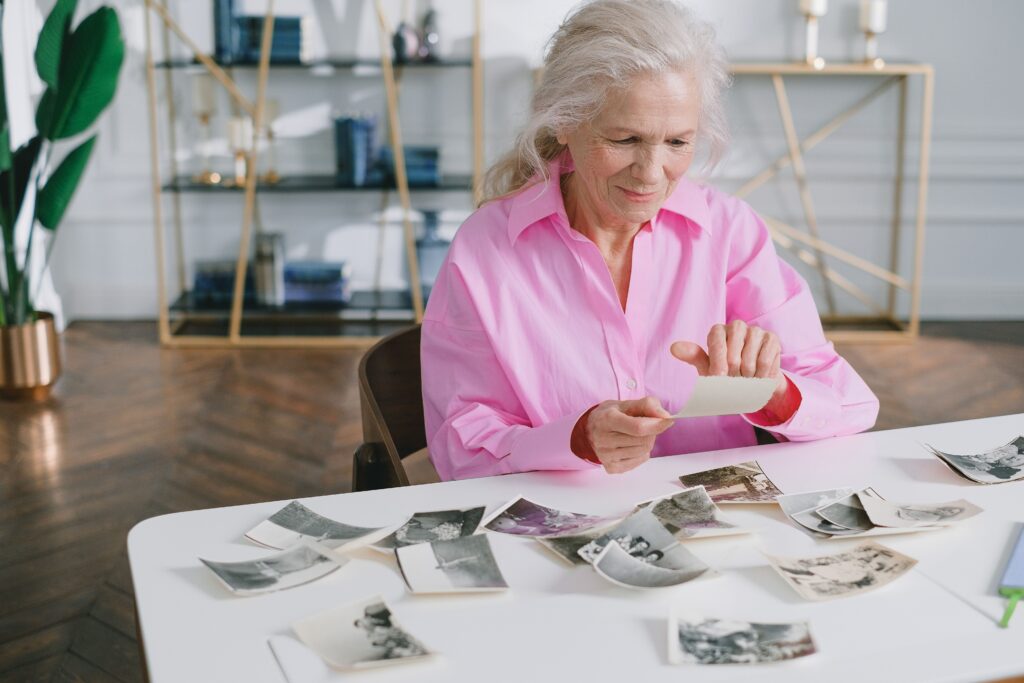
And then an old photograph comes into my hands, and the grandmother on it is completely unrecognizable.
Who is this girl?
The photo is small, black and white, with jagged edges, as if it were cut with a figure-cutting knife. The jagged edges are also worth looking at. The girl in the photo is about eight years old. A school uniform, a white apron, two huge belts, just a little bigger than her head. She stands in front of some kind of fence, squinting, holding the bicycle with one hand, which is clearly too big for her.
The child looks and doesn’t recognize it. That’s okay. It’s almost impossible to recognize a grandmother in an eight-year-old girl, because for her, grandma has always been grandma. She doesn’t have a limp, she doesn’t hold on to a bike that’s too big, she doesn’t squint in the sun.
And here comes the most valuable question of the day, for which it seems the whole celebration was worth it: «What were you like before you became my grandmother?»
Adults often respond to it with a single phrase like «well, the usual.» That’s a shame. Because Grandma in the photo had everything that a child has now. The best friend she sat with in the classroom. The teacher she feared or loved. The favorite food that now makes her laugh. The yard where everyone knew each other. Someone who took this picture and might have long persuaded her not to turn around.
Conversation about one single photo
It’s usually not necessary to interview your grandmother with a list of questions. A photo alone works well; if you take it slowly and together, it’s better with a video using a good camera or when the grandmother comes to visit.
You can ask about the background: where it came from; about the fence, whose it is; about the bicycle, whose it is, and whether she eventually learned to ride it; about the dress, why it was like that and whether she had to wear it every day; about the tie; who tied it in the mornings. Every such question brings up a story, and often the grandmother herself doesn’t expect how much she will remember about one card the size of a hand.
In a bilingual family, there is another little task for the child. Many words from the grandmother’s story will be heard for the first time. The apron, the tie, the yard, the scout camp, the photo studio. It is not necessary to explain them in advance; it is better when the word appears along with the picture that you are just looking at.
And usually at some point the child starts asking questions that adults don’t even think of asking. How much did the ice cream cost? Did she have a phone as a child? Was she afraid of the dark? Did her own grandmother scold her? The last question, by the way, is often the most unexpected for both parties: her grandmother also had a grandmother.
Conversation about one single photo
For all three tasks, you need one old photo of your grandparents from their childhood. It’s best to talk with them together, via video or in person. One task is enough for one go.
What is in the photo
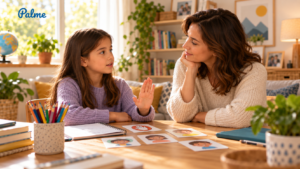
The child first describes the photo in Russian: who is in it, where it might be, what is around, what the person in the photo is wearing. Only then does he or she show the photo to their grandparents and compare their guess with the one they made.
Three questions about one detail
The child chooses one detail in the photo, such as a fence, a bicycle, a ribbon, or a house in the background, and asks three questions about it. For example, about the bicycle: whose was it? Where did you ride on it? Who taught you to ride?
New word with an image
The child extracts two or three Russian words from the conversation that he has heard for the first time. If the word’s meaning is visible in the photo, he points to it with his finger. Then he writes the word and draws a picture on a separate sheet of paper. On the old photo, we don’t mark anything. For example: a dressing gown, a yard, a photo studio.
Two holidays a year
In Russia, Grandparents' Day in 2026 falls on Wednesday, October 28. There is no day off on this day; it is a domestic holiday. In the United States and Canada, there is a separate Grandparents' Day, and in 2026 both fall on September 13. So, a family that lives in North America can celebrate it twice, in September and October, if they wish.
Any of these days is a good time to have a conversation. The photo does not depend on the date.
And if after such a conversation the child wants to write to his grandmother himself in Russian, we have a separate section on that., How to write a letter to your grandmother. Okay, if this letter contains a question about the girl with the ribbons, the answer will most likely be longer than the letter itself.
At the Russian for Bilinguals course at Palme School, children learn to have a lively conversation: asking questions, listening to answers, and speaking in Russian to their grandmother so that the conversation doesn’t end with «hello» and «I’m fine.».
You can start with two free sessions to get to know the teacher and see if the format is suitable for your child.
Try Russian for bilingualsFrequently asked questions about Grandparents' Day
When is Grandparents' Day in Russia in 2026?
In Russia, Grandparents' Day in 2026 falls on October 28, Wednesday. There is no separate day off on this day; the holiday is celebrated at home, in the family circle.
When is Grandparents Day in the USA and Canada?
In the United States, National Grandparents Day is celebrated on the first Sunday after Labor Day, in Canada on the second Sunday of September. In 2026, in both countries this will be September 13. The annual date in the United States was established by an 1979 law.
What does the word babushka mean in English?
The word came from Russian into English. Dictionaries list two meanings: grandmother and a scarf tied under the chin. In American English, babushka can also mean such a scarf.
How to talk to a child about his grandmother's childhood?
It’s best to start with an old photograph. Take a slow look at it and ask about the details: where it was taken, whose bike it was, who tied the tie. Every detail tells a story, and the conversation flows naturally.
From what age is a child interested in such conversations?
You can look at photos with your grandmother at almost any age. A little one can guess who is in the photo, and a child older than that can already ask questions about school, friends, and games on their own.
What to do if grandma lives in another country?
The conversation over photos goes well, as does the conversation over video. The grandmother shows the photo to the camera or sends it in advance, and the child asks questions. After the conversation, you can write a letter to the grandmother in Russian asking about anything that remains unclear.