

Say the word «onion» out loud.
Now say «hole».
The words are short, three letters each, and they end the same way. The difference is in the beginning. You hear it before you have time to think about the letters.
This is a good place to start a discussion about hard and soft consonants. Without a table or terminology, in two words that can be shown in an image.
The bulb and the lid on the road
First, it is important to make sure that the child knows both words.
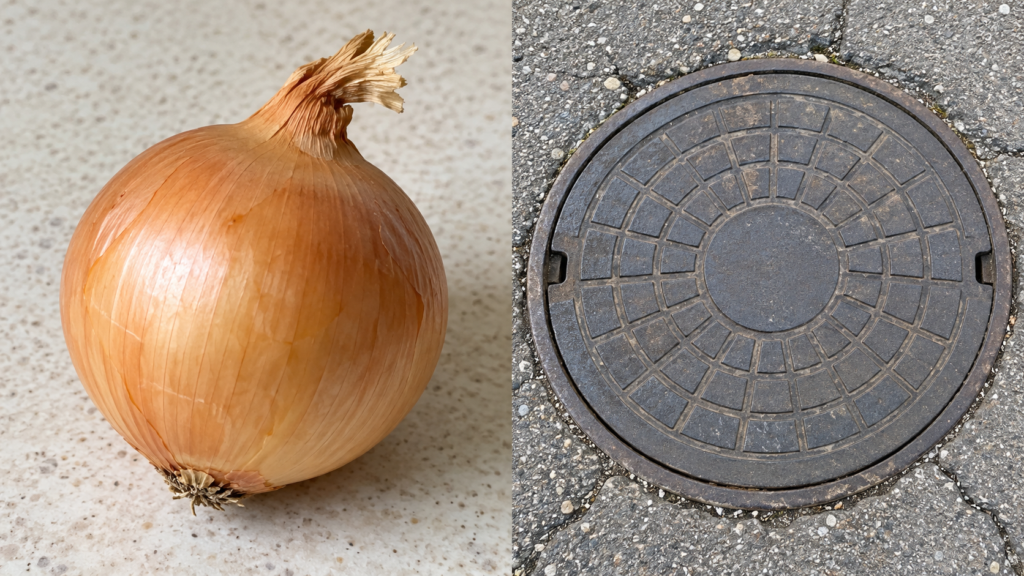
Onion is the bulb itself, the one that makes your eyes itch in the kitchen. In English, onion has a second meaning: a bulb with arrows on it, but for testing purposes, a single onion will suffice.
On our picture there is a closed road hatch, its round cover is visible. In English, it is called a manhole cover. The child could have seen it many times, but did not know the Russian word for it.
Show both pictures and name them. If one of the words is unfamiliar, the child may not be able to understand it by mistake, have difficulty distinguishing the sound, or may not have memorized the name of the object yet.
What changes at the beginning of a word
In the word «luk», the first sound is a hard one, [l]. In the word «luk», it is a soft one, [l’].
These are two different sounds. In Russian, the meaning depends on the difference. If you say it firmly, it will mean a vegetable; if you say it softly, it will mean the word «luk».
It is not necessary to explain the words «hard» and «soft» to the child in advance. For the experiment, it is enough for him to understand the word and show the appropriate picture.
Test with two pictures
You have two pictures in front of you. There are no captions yet. For the trial period, open the pictures in full screen mode so that the child only sees them.
Name both objects and make sure the child recognizes them.
Say a single word in a normal voice, without using an index finger gesture, and ask them to show you the picture.
Repeat several times. Change the order of the words; do not mix them in a predictable way.
Open images in full screenClose
Show the spelling
If the child already knows L, U and Y and wants to look at the words, open the spelling. For the auditory part, this is not necessary. Pay attention to the identical L and the different letters after it.
The block does not check the answer: the adult chooses the word and says it.
If the child has difficulty, name the pictures again together.
One letter L in two sounds

When the child has listened and shown that they can do it several times, you can start writing.
LUK.
Luke.
The first letter in both words is the same. The letter L indicates different sounds here; in one word it is a hard [l], in the other it is a soft [l’].
As a reader learns which of the two is needed, he looks at the next letter. After L comes U, we read «leek»; after L comes Y, we read «leek»; after L comes Y, we read ’leek”; after L comes Y, we read “leek”.
This observation applies to the three letters L, U and Y. There is no general rule for all the letters of the Russian alphabet; you shouldn’t make any assumptions based on that. Other letters have their own specific cases, and we’ll discuss those separately.
This part is suitable for children who already know the letters and are ready to look at a short word together with an adult. For those who haven't yet read yet, the first part, the auditory one, is enough.
I love people, the key

The same pair of letters is easily found in words that the child hears constantly.
People. Chandelier. Key. Plus. In every one after L there is a Y, and the sound is soft.
Moon. Pond. Magnifying glass. Club. Here, after L, there is a U, and the sound is loud.
A child most likely hears this word from the very first years of life. Luv. In it, the letter L appears twice, both times before the letter Y, and both times with a soft sound.
You can look for such words together, on a sign, in a book, or in a note on the refrigerator. It’s worth looking with both eyes and ears at once. Once you find L, look at what it stands for and say the word out loud. One familiar word is enough to continue.
I heard it, and I said the same thing
Sometimes the child confidently shows the correct picture, and he/she says both words almost identically.
These are two different skills. A child can distinguish words by hearing them, even if they sound the same at the moment.
You can offer to repeat «luk» and «luk» to an adult, but this does not make the trial condition any less strict. Hints like «say it more tenderly» or «smile» do not explain softness, and they should not be used.
It is impossible to draw conclusions about accentuation or speech in such a situation. In this situation, we observe how the child chooses the picture based on the word they hear. Errors in themselves do not explain the reason for the difficulty.
If choosing is difficult, name the pictures again together and return to them on another day. The words «does not hear softness» are unnecessary here.
How is this softness different from the soft sign?
Soft consonants in writing are shown in different ways. In the word «luk», this is done with the letter Y. In the word «mel», this is done with a soft sign.
We have a soft sign separate article, In this case, we are only talking about the case where there is no special sign at all and everything is decided by the neighboring letter.
And those who are just beginning to introduce the child to sounds will find it useful first. article about vowels and consonants. There is advice not to rush with explanations, and it remains valid. Listening to two familiar words does not contradict it.
What happened after one try
If the child selects the correct picture several times without prompts, this shows that in these attempts he distinguished the words «leek» and «leaky». If he then noticed the same L and different letters after it, it was possible to link what he heard to the writing.
This is by no means all the hard and soft consonants of the Russian language. But the child now has a pair to return to when the next one appears.
Frequently asked questions about hard and soft consonants
Does every consonant have a hard and soft pair?
No. For example, the [ж] sound in the word «giraffe» is a hard sound, while the [ч’] sound in the word «tea» is a soft sound, and they have no pairs with either hardness or softness.
Does the letter Y always indicate the softness of the consonant before it?
No. Here we are considering Y after L: in the word «l'uk», it indicates softness [l’]. This observation does not need to be applied to any combinations of letters.
What to do if a child can distinguish words but says them the same way?
It is precisely this that should be noted. The child can distinguish words by hearing them, even if he/she does not yet pronounce them the same way; one sound cannot be used to judge accent or speech.
How is softness in the word «luk» different from the soft sign?
In the word «hole», the softness of the consonant indicates the next letter Y, in the word «miel» the soft sign.