

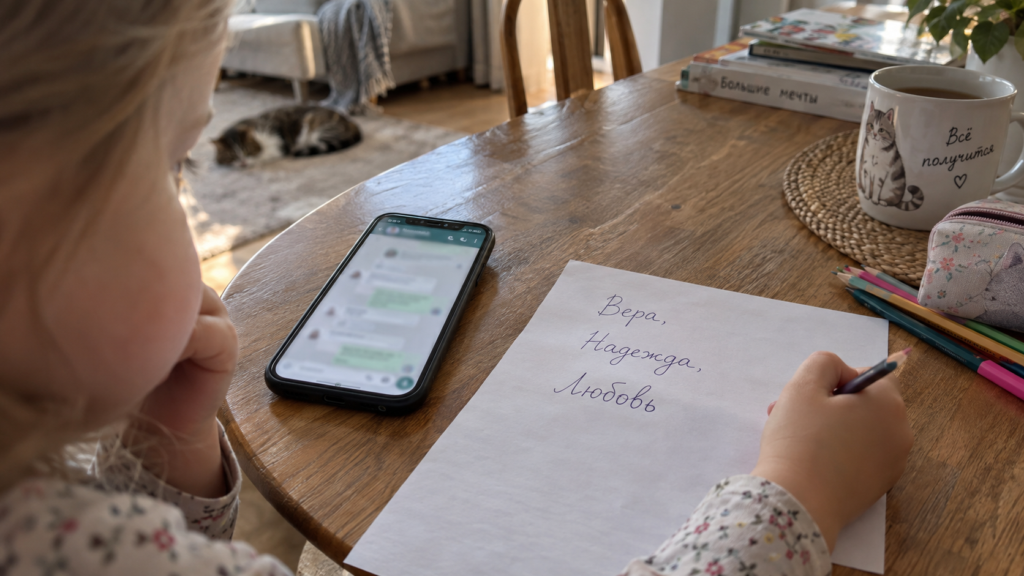

«Love arrives on Saturday.».
There is nothing unusual in this phrase for an adult. If there is an Aunt Lyuba in the family, it is clear who is coming and why the word is written in capital letters. A child who does not read in Russian every day may see something completely different: what love is coming, from where and why exactly on Saturday?
September 30 marks the anniversary of Vera, Nadezhda, Lyubov, and their mother Sofia. The three names out of the four sound as if they were taken directly from ordinary Russian speech.
And that’s almost exactly what happened.
Why Love became Love
In the Greek life of the sisters, their names were Pistis, Eplis and Agape. Their mother was called Sophieia.
Names usually change from one language to another based on their sound. Therefore, the Greek Petros became Peter, and Maria became Mary. But with three sisters, something different happened. Their names were changed.
Pistis meant faith, Elpis hope, Agape love. Thus in Slavic texts came to be Faith, Hope and Love.
With Sofia, the translation did not stick. In older texts, we can find the word “prudence,” because that is exactly what the Greek word sophia means; but in the Russian language, the name remained Sofia.
Therefore, today in one family Grandma Nadezhda, Aunt Vera and neighbor Lyubov can all live together; alongside them, in those very same circumstances, there exists hope, faith, and love.
The strangest thing happens with Love
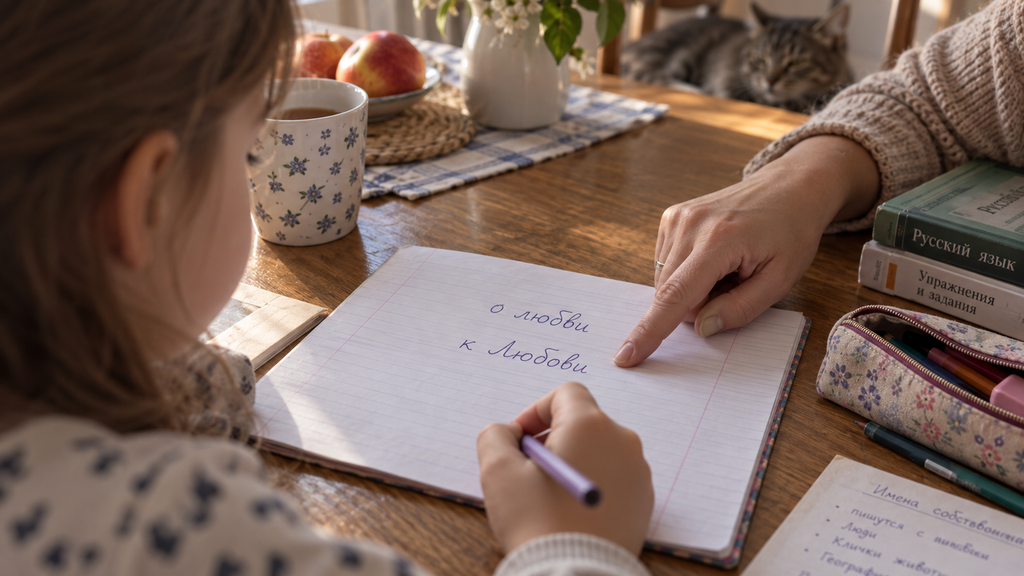
As long as the word is in the nominative case, the difference is almost not noticeable.
Love came home.
Love helps people.
It is only through conversation that it becomes clear who exactly came home.
But if you change the verb tense, the name starts to behave in its own way.
One could say:
«without love»,
But:
«No Love Petrovna.».
It is possible:
«to talk about love,
But:
«Call Love.».
Many children at first consider this difference a mistake. They think that they should say «call Love», because they already know the usual word.
With Vera and Nadya, there is no such hint. «I believe in Vera» sounds funny, but grammatically both Veras are constructed the same way. There remains only to understand what they are talking about.
You could even arrange a small family quiz.
«Vera has guests today.» Who is Vera?
«He didn't lose faith.» But here?
«We are waiting for Nadezhda.».
«We don't want to lose hope.».
In the letter, a capital letter solves part of the task. In a conversation, you have to listen to the entire sentence.
Why Vera doesn't become Faith in English
There may be another trap waiting for the child here.
If the Russian word «vera» is translated as faith, and «nadya» as hope, why can't Grandma Vera be represented as Faith?
Because they translate the meaning of the word, not the name of the person.
In English, there are indeed the names Faith and Hope. But Russian Vera does not become Faith, and Nadezhda does not turn into Hope.
With Love, this is especially noticeable. The English word «love» translates perfectly into Russian, but nobody calls Grandma Love "Love." In Latin, her name is written as it appears in her documents.
It turns out to be a good linguistic puzzle: the word can be translated, but the person cannot be translated with the word.
Luba, Lubochka and Lyubov Petrovna
Within a family, one name may have several other names attached to it.
The passport says «Love.» Her sister calls her "Luba." Her grandmother might have called her "Lubochka" in the past, her husband "Lubashay", and the doctor at the polyclinic calls her "Lyubov Petrovna".
For a child who grows up between two languages, these forms are not always obvious. He may not understand for a long time why Luba and Love are suddenly the same person.
Therefore, on September 30, you can completely skip the story about the martyrs or the rules of declension.
It is enough to ask Grandma:
«And what did they call you when you were little?»
Sometimes one such question yields more Russian language than an exercise on a whole page.
What people congratulate on September 30
Anniversaries are not the same thing as birthdays. It is the day of remembrance of a saint whose name a person bears.
In a family where there are no religious traditions, it is not necessary to make September 30 a separate ritual. You can simply write a few warm words of faith, hope, love, or Sophia.
And if there is a child nearby, ask him last:
«How do you think, if Love comes again tomorrow, we'll understand that it's about Auntie Love?»
Most likely, we will understand now.
Frequently Asked Questions about the Day of Faith, Hope and Love
When is Faith, Hope, Love and Sophia Day celebrated?
On September 30, according to the new style, in the church calendar it is September 17 according to the old style. The date is constant and does not depend on the day of the week.
Are there any other Russian names that match common words?
There are some, although such coincidences are rare. The name Roman sounds like the name of a book genre, the name Lev like the name of an animal. The difference between them is the capital letter in the letter and the meaning of the phrase in conversation.
Sofia and Sofya are the same name?
Sofia is a church form; Sofya is its Russian colloquial variant. In documents, only one of these forms is recorded for a particular person, and it is worth relying on that one.
Can the names not be on September 30?
Yes. There are several Saints with the same name in the calendar, and anniversaries are associated with the celestial patron of a particular person, so the date is determined according to the saints or by the priest.
Why is this day called the Day of the Babes?
«Babye Imenny» and «All-Russian Babye Imenny» are the folk names for this day, not the church name of the holiday. They have been established in the folk calendar as the day of remembrance of Vera, Nadezhda, Lyubov and Sofiya.
Russian for family conversations and calls
At Palme School, children aged four to seventeen learn Russian online in small groups. The program is tailored to the child's age and level of proficiency.
You can get acquainted at two free lessons. The first one is led by a methodologist; he determines the level and selects the group. In the second, the child works in a group with a teacher and gets acquainted with other students.