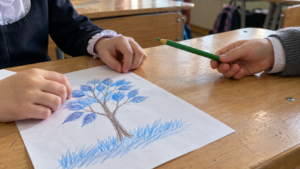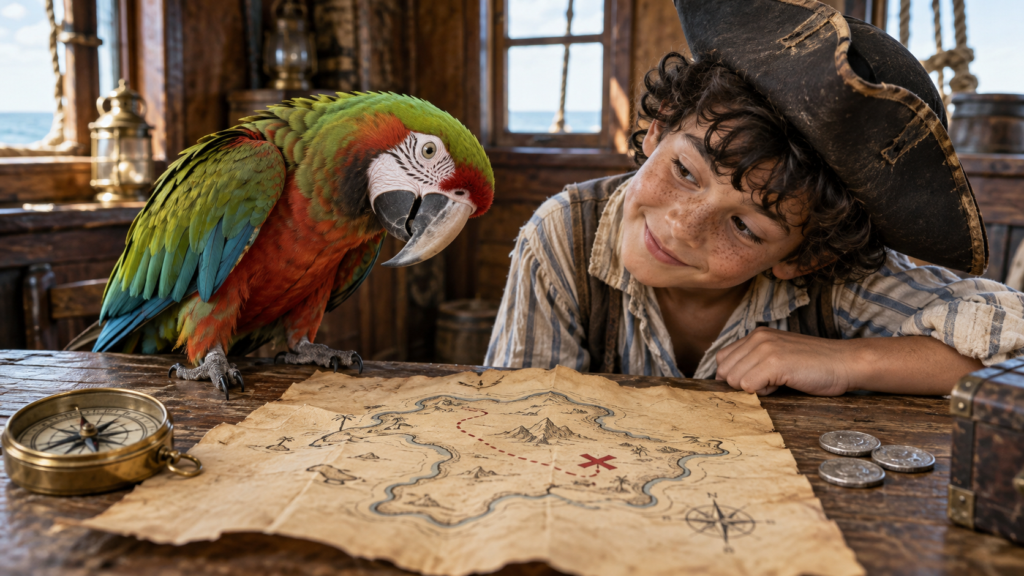

In the summer of 1881, there were rains in Braemar, Scotland, and the Stevenson family was at home. The writer’s son, schoolboy Lloyd, was drawing with watercolors. Stevenson sat down next to him and, out of boredom, drew an island. It turned out to be something like a thick dragon that stood on its hooves, with bays, hills, and coves. He painted the map, signed the places, and marked the treasure with a cross. As he looked at the map, he began to imagine the future heroes and their adventures.
The chapters he wrote in the morning he read to his children after dinner. The teen magazine would take them with the continuation from issue to issue, but the novel with the cover only came out in 1883. With the map, however, there was a problem that Stevenson would not speak of until many years later. Sent to the publisher, it never made it there, and the author had to draw his own island a second time, now with his own heads to reference. He found this almost insulting; to invent from the book what the book had once grown from.
Since then, Treasure Island has been adapted many times into films and cartoons. Each time, the pirates were dressed in a new way, the ship was changed, and sometimes even the sea itself. In both versions that we will discuss, the map remained the main guide for the heroes.
It’s handy to remember this when you’re watching two very different versions of the same book with a child.
Two versions that don't know about each other
The first one was filmed in Kyiv, at the «Kieivianuchfilm» studio, by director David Cherkasovsky. It was released in parts. «Captain Flint's Map» was shown in 1986, «Captain Flint's Treasures» in 1988. Many parents have known it since childhood, while some have never seen it.
The second one was made in America and is called «Planet of Treasures». It was 2002, the Disney studio, a ship with sails in outer space.
Disney Studios is celebrating its birthday this week. The company dates its history from October 16, 1923, when the first contract was signed. It has also been coming to Disney with Stevenson before, in 1950, with a game film about the same Jim. A half-century later, the studio returned to the book once again, now in animation and with stars.
One important clarification for adults: Americans did not translate the Soviet cartoon. Both studios read the same book, and all the similarities between the versions came from Stevenson.
Piastras and pieces of eight
John Silver has a parrot named Captain Flint on his shoulder. In Nikolai Chukovsky’s Russian translation, it screams «Piastry! Piastry!» over and over again. Many remember this scream longer than the plot itself.
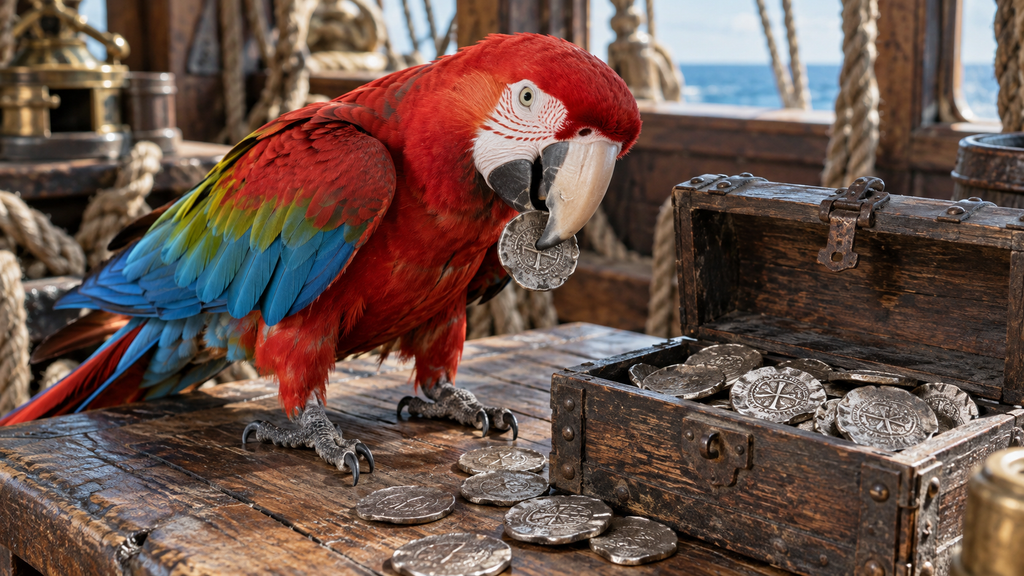
In Stevenson's book, the parrot screams "pieces of eight" in English. This was the name given to the Spanish silver coin worth eight reales. In the Russian translation, this is "piastres," another name for the same coin.
A child who attends an American school might know the words "pieces of eight". Then one parrot has two voices, and that in itself is a reason to talk.
In «Planet of Treasures,» the parrot is completely absent. His place on Silver's shoulder is taken by Morf, a pink lump that transforms into various objects and disrupts the voices of others. There are no feathers, no beak. The habit of repeating what people say has remained.
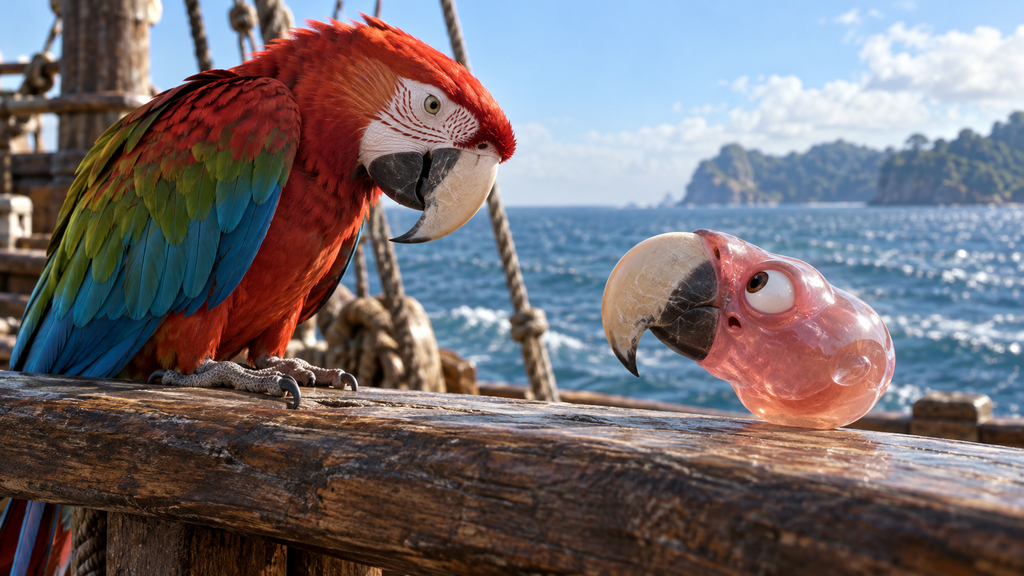
Show Morpheus and ask him who he looks like. Only point out if the child has no idea at all.
The map that became a ball
The map can be searched in both versions, just as one would look for treasure in a book.
In the Soviet cartoon, it's a sheet of paper. They find it in the chest of an old pirate; they open it and look at it.
In Planet of Treasures, the map looks like a small gold ball, similar to an old toy. Jim doesn't immediately understand how to open it. But when he does, a whole map of the starry sky lights up above the ball.
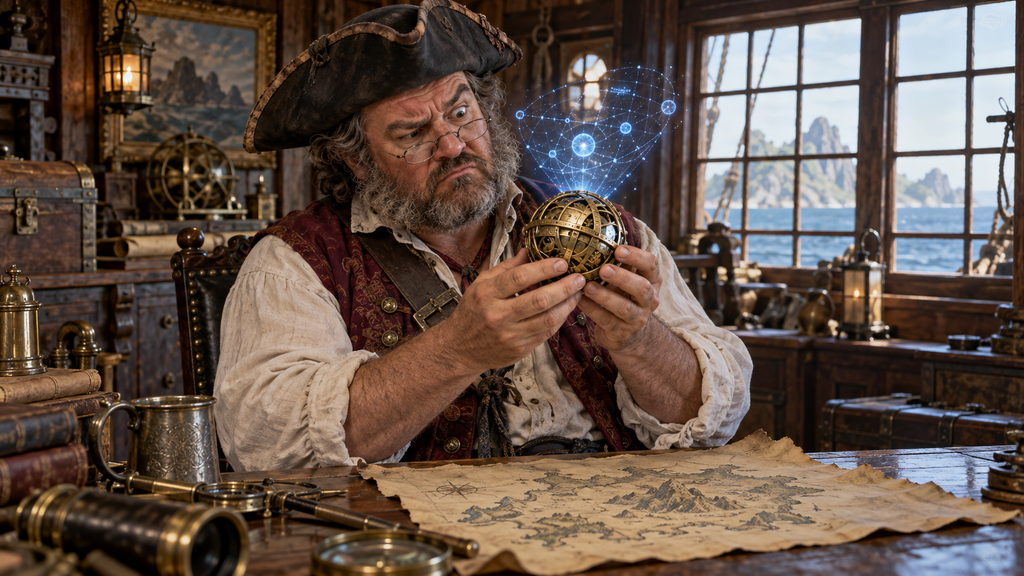
Place two frames next to each other and ask.
«Is that a map too?»
The child may respond in different ways. By the fact that everyone is looking for her. By the fact that she is being chased or flown away. By the fact that trouble starts because of her. Any of these answers is correct, because the card in this story is recognizable by its role; there are no two identical cards here.
Silver without a leg
The same thing applies to Sylvester, only more clearly.
In the Soviet version, he is fat, noisy, cheerful, and walks with a cane. He is easy to recognize; the artists have left out the most important details: one leg, a cane, and a parrot on his shoulder.
In «Planet of Treasures», Silver is huge. Instead of a hand, he has a mechanism from which a knife, fork, and a dozen other tools are pulled out. One of his legs is also mechanical; its eye glows.
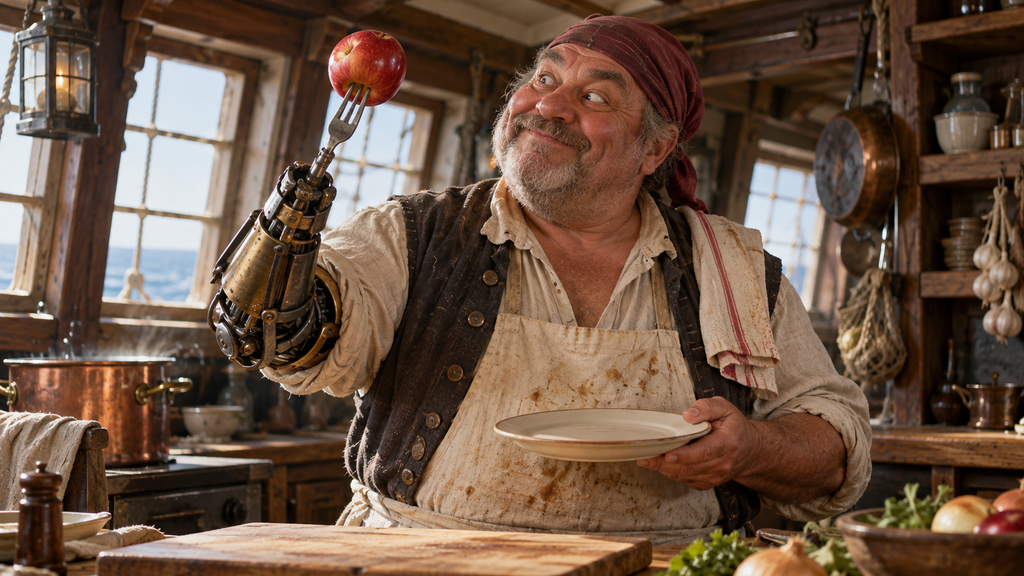
The loss of his leg remained in all three versions. In the book and among Soviet artists, it is replaced by a crutch; in space, it is a machine. It seems to be the main omen without which no one would recognize Silvera.
He is a ship's cook everywhere. He is kind to Jim every where, teaches him, praises him, and invites him along. And everywhere he also orchestrates a rebellion.
«Is that also Silver?»
If the child answers, «He also cooks here, but with the other hand,» he has already compared the two versions himself.
A barrel in which everything changes
There is a scene in the book where the story takes a different turn. Jim goes into the barrel to get an apple, falls asleep, or just sits there quietly; suddenly he hears Silver negotiating with the sailors about a mutiny. The good captain turns out to be the leader of the pirates.
In Planet of the Treasures, there is also a barrel. Jim gets into it after Morph and hears the same thing.
It is worth stopping at this scene.
«What is Jim feeling right now?»
The answer is quite short.
«He loved him, and he was a pirate.».
There's no need for more. This is already a discussion about the relationships between the characters, about trust, and about how it feels to learn about someone when you used to like them.
At the same time, it is noticeable that Jim is of different ages. In the book and in the Soviet animated film, he is a boy. In Planet of the Amulets, he is fifteen years old, and he is already on a flying board through the deserts, and he has already been caught by the police. In the book, Jim’s family runs the Admiral Benbow tavern. In Planet of the Amulets, his mother runs the Benbow tavern.
A ship with masts among the stars
The Soviet ship has the name «Ispanola,» as in the book, and it sails on the usual sea.
The Disney ship is flying in open space, and its sails catch the light. The masts are still in place. The ropes, the steering wheel, the deck, the hull, the barrels, the ship's kitchen are also there.
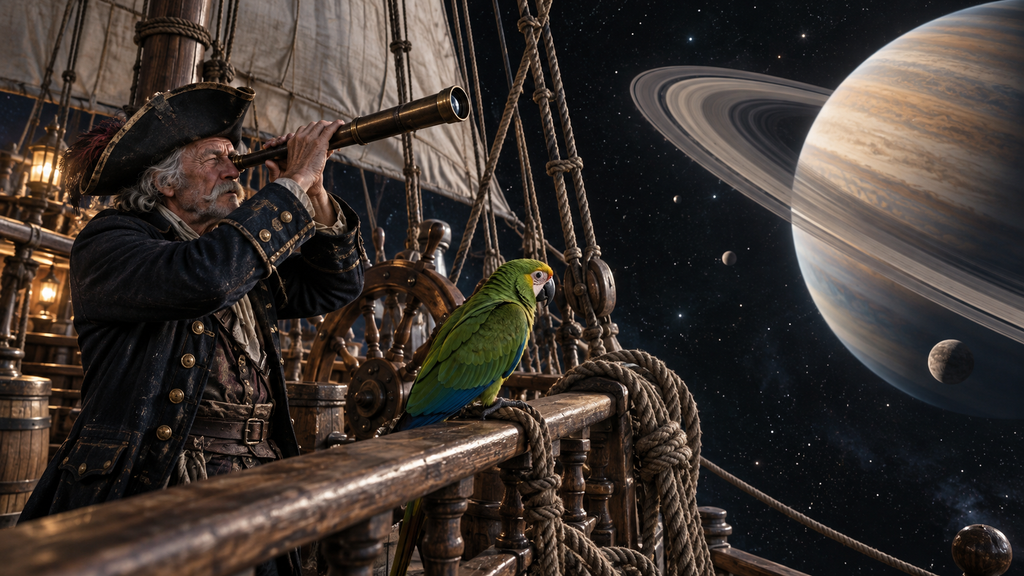
The child will surely ask why the ship is flying. The answer is only found within the imaginary world, and the conversation will take a long time to get there. It is better to ask in a different way.
«What shows that this is still a pirate ship?»
The crew. A team suspiciously like a gang. A captain who doesn't trust this crew. A map in the cabin. A mutiny in the middle of the journey.
Each action can be found on the screen and shown with a finger.
If the child has already seen a doctor
In the Soviet cartoon, Dr. Livsey walks with a special springy gait and laughs loudly. A few years ago, this gait went viral on the internet in short videos to music.
Perhaps the child has seen such a video and doesn’t even know who this doctor is. Then the recognition will go in the opposite direction. The child will recognize the character, and you will show them where this doctor actually lives and what he does when he’s not dancing to music.
How to watch
It’s not necessary to watch both versions in one night. You can split them up over different days or take a few scenes from each one.
For comparison, you only need to pause the video. Find the same place in both cartoons: the first encounter with Sylvester, the map, the barrel, or the departure of the ship; stop the video and watch it together.
There is no need to ask all the questions from this article. Just one is enough; on the stage that the child liked. Let the others wait for another time.
A successful conversation can be considered successful if the child has noticed one common trait or difference and has been able to point it out or explain it. You can suggest the missing word yourself.
Which one did you like better?
This question is asked almost always.
«Which one did you like better?»
The answer may not match yours. A child does not have to like the cartoon that an adult grew up on, nor have to agree that one version is better than another. He or she may like the iron hand of Silver, but may not like the songs of the Soviet pirates. It can also be the opposite.
One such conversation proves nothing about the vocabulary or the understanding of the book. It simply connects two stories that don't know each other on their own.
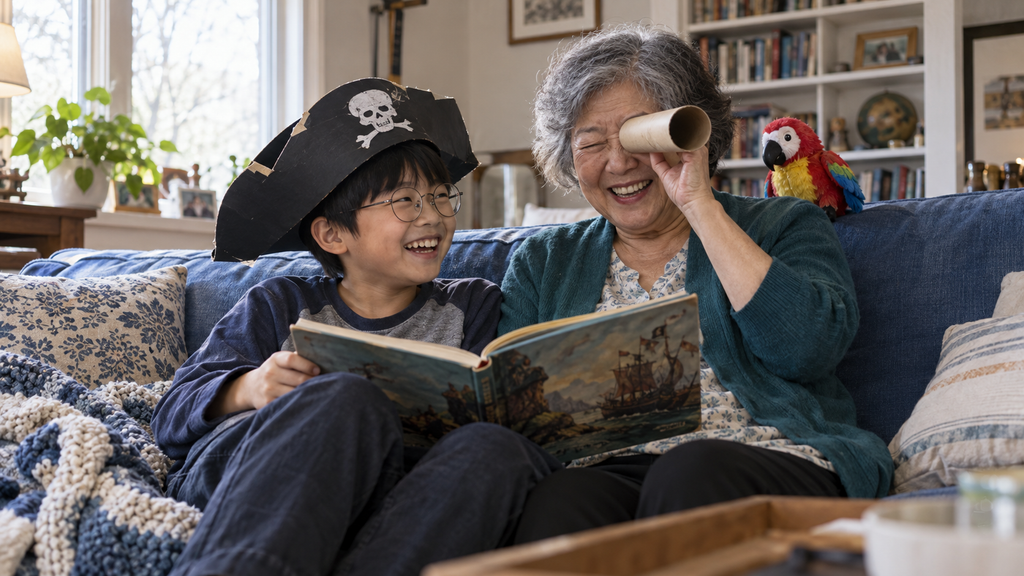
But the book will remain. One day the child will open it on the first page and see a map of an island that looks like a dragon, and maybe they will remember the golden ball.
Discover the hero in another version
On the left is a Soviet cartoon, on the right is «Planet of the Gems». Click on the card on the left, then find the one on the right that tells about the same hero or the same ship.
«The Island of Treasures»Kievenauchfilm, 1986 and 1988
«The Planet of Treasures»Disney, 2002
All three pairs have been found. The treasure map is yours.
How did the two animated films have common characters?
Both studios drew from one book, Robert Louis Stevenson's novel «Treasure Island» (1883). The Soviet version was not a model for Disney; the similarities came from the book. In the book, Silver walks with a cane and keeps a parrot named Captain Flint, and the ship is called «Ispanhola».
To discuss characters and compare stories, children need words, and it’s easier to learn them in a live conversation. At the «Russian for Bilinguals» course at Palme School, children aged four to seventeen engage online in groups of up to eight people.
You can start with two free lessons. First, the methodologist determines the child's level and helps choose a program. Then you can meet the teacher during a free lesson.
Sign up for free lessonsFrequently asked questions about «Treasure Island» and «Treasure Planet»
How is «Planet of Treasures» different from «Island of Treasures»?
The plot is similar to that of Stevenson's novel. In «Planet of the Treasures», the action is set in space; Jim is fifteen years old, Silver is a cyborg with a mechanical hand and foot, and instead of a parrot, he has a pink creature named Morph.
Disney remade the Soviet animated film «The Island of Treasure»?
No. The Soviet animated film, «Kivianauchfilm» and «Planet of Treasures,» were based on one book, each in its own way. The similarities between them came from Stevenson. Disney had previously approached this book; a feature film was made in 1950.
At what age is it appropriate to discuss two animated films?
The age range for a conversation is approximately eight to twelve years old, provided the child understands a short story about events in Russian. Knowing the book beforehand is not necessary. This is not a recommendation based on the age rating of the films themselves; you should check the age rating separately.
Why does the Silver Parakeet scream «Piastry»?
In Stevenson's novel, the parrot cries "pieces of eight," which was the name given to the Spanish silver coin worth eight reales. In Nikolai Chukovsky's Russian translation, this is piastres, another name for the same coin.
What else to see after «The Island of the Treasures,» suggests our guide a collection of Soviet animated films.