

The finger points to the line. «The red cat sleeps on the window.» The seven syllables are read out aloud, none of them are confused, and the adult asks who is sleeping on the window. In response, there is a pause, then the gaze moves back to the beginning of the line, then another attempt with the first syllable. The sentence is short, the words are familiar, and the question remains unanswered.
What happened between the first syllable and the last is not clear from the text. Perhaps at the end of the line the beginning of the word was actually erased. Or perhaps the syllables formed a word, but for the child «red» is still just a set of sounds; he is used to calling colors in English. Therefore, it is first necessary to check the words individually, without reading them; for example, you could ask the child to point out any red objects. You could also say the whole sentence yourself and ask the same question. If the child understands the sentence by hearing it, but has difficulty answering after reading it on their own, you could try breaking the sentence into parts. Next, we will discuss this case specifically.
Two bars instead of one line
The same phrase, but written by hand on two pieces of paper. On the first one is «The Red Cat,» and on the second one is «Sleeping at the Window.» The pieces of paper are placed on the table one under the other while closed.
The first one opens. The child reads the words, as he/she can, in syllables, with a finger, out loud or to himself/herself. The strip does not disappear anywhere and remains lying in front of him/her. The second one opens as well. The same thing is read. Now the whole phrase is visible on the table, and it can be read as many times as you want.
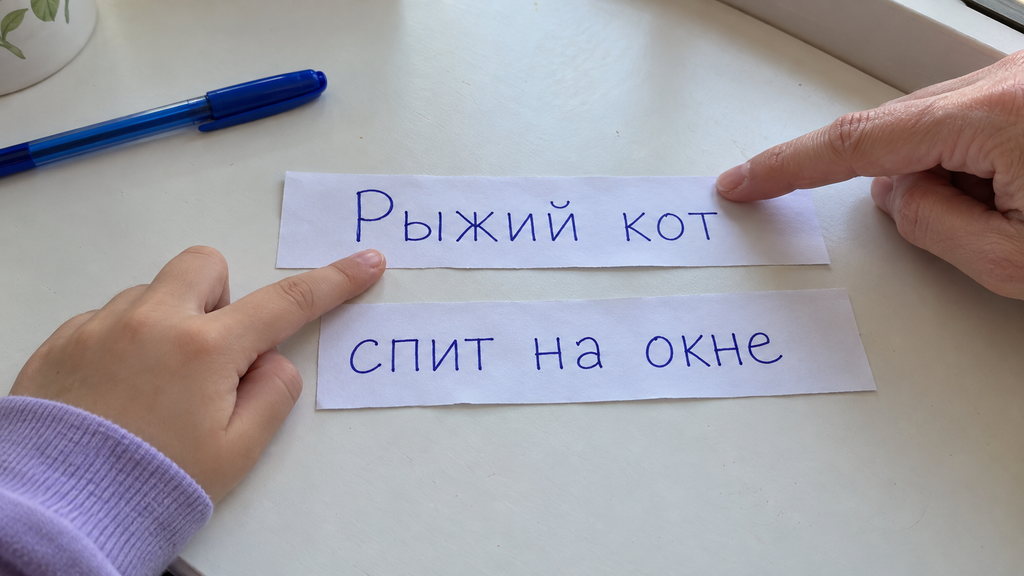
Only after that does the question arise. Who is sleeping on the window? If the answer is not found, the adult does not repeat the question louder and does not ask to read it all over again. He points to the first page. There are two words there, and they have already been read. If it is difficult, the adult reads the page together with the child and discusses the meaning.
The difference from a regular line in a book is slight. The sentence is divided into parts in advance; the line is drawn by an adult, not by the child's eyes, which are still only able to process a few syllables at a time. And no part of the text is left out of sight, so the answer to the question can be given by looking at the text.
Where to cut
«The »ginger cat« refers to the one who is said to be »sleeping on the windowsill," reports what he is doing and where. There are other possible divisions. We will leave the definition next to the noun here, and the preposition next to the word to which it refers.
For the first few sentences, it is easiest to draw a line between who is acting and what is happening. In a longer sentence, a third part will appear, for example «after the rain».
The phrase should be taken from familiar words and the usual order of words, so that the child can read it themselves. If the child finds the answer on their own using the two lines, you can offer a similar phrase without the division, in one line. Phrases with three parts and with a subject at the end, for example «Grandma's cup is on the top shelf,» will wait.
One question
To begin, ask one question about the phrase: Who is sleeping? Or where is he sleeping? A full breakdown of «who, what, where» is not necessary every time; otherwise, reading becomes an interrogation. If the first question has received an answer, you can ask a second question, or you can take the next phrase.

After an error, you can suggest going back to the proposal and finding where it says this. In this case, rereading serves a clear purpose: the child is looking for a specific part instead of reading the line from the beginning at the command. There is no limit to how many times to reread.
The ability to understand what is read in an American school is called reading comprehension, and finding the answer to a question in a sentence is only one of the tasks for understanding.
The trainer below contains 24 sentences, divided into meaningful parts. In one mode, the parts appear one by one and remain on the screen; the question comes last, and after an error, the correct part is highlighted. The adult can read the answer options in the trainer aloud themselves. In another mode, the sentence is given in its entirety. It is possible to draw lines between the parts and compare your division with the proposed option. There can be several semantic divisions; the proposed option is not the only possible one.
Russian cognitive reading exercise for children
Two modes. In the first mode, sentences are opened with meaningful parts, like strips on a table: the child reads each one as he/she can; the parts remain on the screen, and only then does one question come up. In the second mode, the sentence is given in its entirety; the boundaries between the parts are set independently, and then compared with our version. There is no single correct division option; there is a comparison of which words remain together. This mode is for parents and older children. Before starting, it is important to make sure that the words in the sentences are familiar and that the sentence is understood by hearing it spoken by an adult.
Levels vary in length of phrases and word order, not age. Reading out loud is not required; speed is not taken into account anywhere. If the child answers confidently at the first level, you can move on, or you can simply read the following sentences.
At the Palme School, children aged four to fourteen learn to read and understand what they read in Russian in mini-groups of up to eight people or individually, twice a week for forty minutes. The program follows a cycle, from the first letters to working with the meaning of the text.
It all starts with two free lessons, where they watch how the child is reading now and determine the starting level.
Register for the Reading SchoolFrequently asked questions about reading by syllables and the meaning of the phrase
Why does a child read the words correctly, but cannot answer the question about the phrase?
The reason for one scene cannot be determined. Sometimes the beginning of a line is lost while the child is putting together the last syllables; sometimes the word they read is simply unfamiliar to them. Therefore, they first check the words individually and understand the sentence orally, and only then try the strips. Why is it so difficult for bilinguals to read in Russian, explained in a separate article.
How to divide a sentence into meaningful parts?
For the first exercises, the boundary is drawn between who is acting and what is happening: «The red cat» and «sleeping on the window». The definition remains next to the noun, the preposition next to the word to which it refers. There is no correct division at all. In a longer phrase, a third part appears, for example «after the rain».
Is it necessary to remove the read-through strip to check if the child remembers the beginning?
No. All the parts remain in front of your eyes, and you can answer the question by looking at the text. The exercise tests your understanding of the sentence, not your memory, which is why the text is not hidden.
How many questions should I ask after one sentence?
To start with, one question, for example, «Who is sleeping?» or «Where is he sleeping?» If the answer is found, you can ask a second question or take the next phrase. A full explanation of «who, what, where» after each sentence is not necessary.
What to do if the child still doesn’t find an answer even after asking several times?
The adult points to the correct strip, reads it with the child, and discusses the meaning. The answer after such prompting is considered a prompt answer, and this is a normal part of the exercise, not an error.
When to switch from the bars to the regular line?
If the child finds the answer on their own using two lines, you can suggest a similar sentence without punctuation, one line at a time. Sentences with three parts and a subject at the end are introduced later, when a whole line of familiar words no longer causes any difficulties.