


Names and identifying details of every student here are changed, as they are everywhere on the blog.
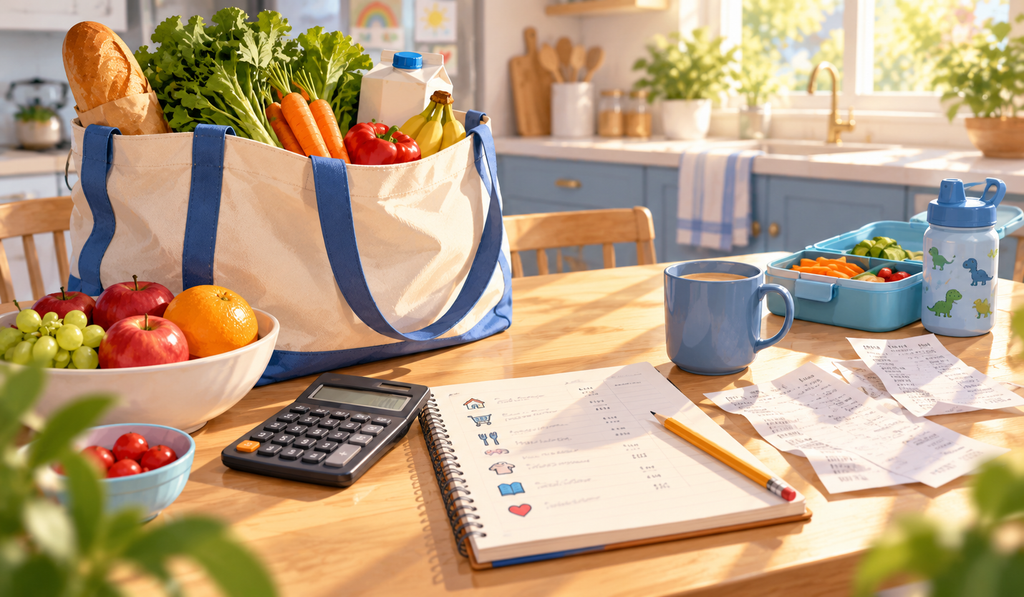
Dina has two kids, 4 and 9, and a question she has been carrying since spring: Where does it all go? Two salaries, no vacations, no restaurants worth mentioning, and the account is flat at the end of every month.
So we built the month on paper, line by line, her numbers and the national numbers side by side. It took most of an appointment and it was the most useful hour either of us had that week.
Two lines that dwarf everything else
Start with child care. For the 4-year-old it is the second largest payment in this family after rent, and in California that is the normal shape of a budget, not a sign of bad planning. There is a state survey on exactly this, and for an infant in a licensed center, full time, the median landed near $20,000 a year. The catch is the date. That was 2023, so treat the number as a floor.
Then food. Here there is an official benchmark, and almost nobody knows it exists. It works like this. Every month the department prices a nutritious diet at several levels for a reference household, two adults plus two children aged 6 to 11. August 2026 came out at roughly $1,024 a month on the thrifty level, $1,126 on the low-cost, and $1,388 on the moderate. Next month they shift again.
Family numbers, those, not per-child numbers. Everybody misreads that line, and then feels like a failure at the grocery store.
The month, side by side
| Line | What the benchmark says | Dina's month |
|---|---|---|
| Childcare, one preschooler | The California median for center care was near 20,000 per year in 2023 | |
| Groceries, a family of four | USDA, August 2026: $1,024 frugal, $1,126 low-cost, 1,388 moderate | |
| School meals | Free for every public school student in California | $0 |
| After school | Free programs at more than 700 LAUSD schools | $0 |
| Sports and activities | About 1,016 children per year in primary sports | |
| Doctor | Preventive visits without cost sharing on ACA plans | $40 |
| Clothes and shoes | No official benchmark | $120 |
| Phones, transportation, everything else | No official benchmark | $180 |
Her total for the children, without rent and without the adults’ own expenses, came to $3,435 a month. She looked at it for a while and said the number was both worse and better than she expected, which is the most honest reaction to a budget I have ever heard.
A line I cannot put a number on
Health coverage. A family pays a premium through work, or buys a plan, or qualifies for Medi-Cal, and those three paths produce numbers so different that any average is useless. What I can tell you is the shape of it. The preventive visits are covered without a copay on a plan that follows the ACA, and the bills that surprise people come from the things around those visits, which is its own subject.
Part of the premium comes out of a paycheck she never sees whole, which is why it did not appear in our arithmetic at all, and why her real number is higher than $3,435.
Zero lines, no one claims
Both of those zero lines deserve a paragraph, because they are the ones new families pay for without needing to.
Every public school student in California who asks for a meal eats for free, period, regardless of income. And the after-school program at her older child’s school costs nothing, runs until evening in elementary schools, and includes homework help. Dina had been paying a neighbor to watch the 9-year-old for two hours a day since September.
That stopped in October. That single line was $260 a month.
Money that comes back in April
There are two tax credits for families with children, one for having a child and one for paying somebody to look after a child while the parents work. The second one covers a percentage of qualifying care costs, with a higher limit for two children than for one, and the families who actually get it are the ones who have the provider’s tax number and keep the receipts.
It had never been claimed in this family. The preschool gives a statement every January with their tax number on it, and she had been filing it in the drawer with the school papers, because nobody had told her what it was for.
Where the money actually leaks
Not on the big lines. The big lines are visible, painful and planned for. The leaks are elsewhere.
Birthday parties, a handful a year per child, with a gift each time. Field trips and classroom funds. The class T-shirt everyone else already has. Shoes that stop fitting between seasons. School pictures. The Friday pizza that costs nothing and costs $40 a month. None of these belong in a budget line, and together they are one.
We gave them a name and a number, $150 a month in a separate envelope, and that is the only trick in any of this.
How my mother did it
In Rosario my mother kept cash in envelopes in the cupboard behind the cups, one for the electricity, one for school, one for meat. When an envelope was empty the month was over for that thing, and there was no conversation about it.
My first American paycheck, I did the same thing with envelopes from the bank, and my coworkers thought I was a lunatic. Then the salon owner asked me to show her how it worked, because she had been trying to save for two years.
Changes, three of them
Three things, and only three, because a plan with ten changes is a plan that dies in a week. The after school program instead of the neighbor. Groceries planned around the USDA level she chose rather than around the store. Plus the envelope for all the small things that used to arrive as surprises.
She has not become rich. In December she told me the account was no longer flat at the end of the month, and it was the first time in two years, and she said it quietly, the way you say something you are afraid to jinx.
Courses at Palme School
Russian for bilingual children
When a kid understands Russian and answers in English
School of reading
Reading and writing for kids who already speak Russian
Free materials
Things to print and do at the kitchen table
Frequently asked questions
There is no single official number. The closest benchmarks are the USDA food plans, published monthly for a reference family of four, and state child care surveys. In the August 2026 report, the USDA levels for a family of four run about $1,024 frugal, $1,126 low-cost, and $1,388 moderate, and those totals cover the whole household rather than one child.
The state's own child care survey put the median annual cost of full-time licensed center care for an infant near $20,000 in 2023. Costs fall as a child moves from infant to toddler to preschool, and family child care homes generally cost less than centers.
In California every public school student from TK through twelfth grade who asks for a meal receives a free breakfast and a free lunch each school day, regardless of family income.
In Los Angeles Unified, free after school programs run at more than 700 schools, until evening in elementary schools, with homework help. Applications go through the site coordinator at the school.
Not on the large planned lines but on the small unplanned ones, such as birthday gifts, field trips, class clothing, shoes outgrown mid-season and occasional takeout. Grouping them into one named monthly amount makes them visible.
Palme School: Russian for bilingual children · School of reading · Free materials for families
Monica Perez is from Rosario, Argentina. These days she does nails in Los Angeles, and her regulars are mostly Russian-speaking, which is how these stories reach her before they reach anyone else.