

In families where the mother is the only one who speaks Russian, Russian classes often take place without the father present.
Not because he doesn’t want to. He doesn’t always know how to get involved. He won’t read the book in Russian, won’t sing the song, won’t enter into conversation. He either sits next to you or goes into another room, and often he leaves.
At the same time, the game includes a role for which Russian is not required.
The host.
What Dad does and what he doesn't do
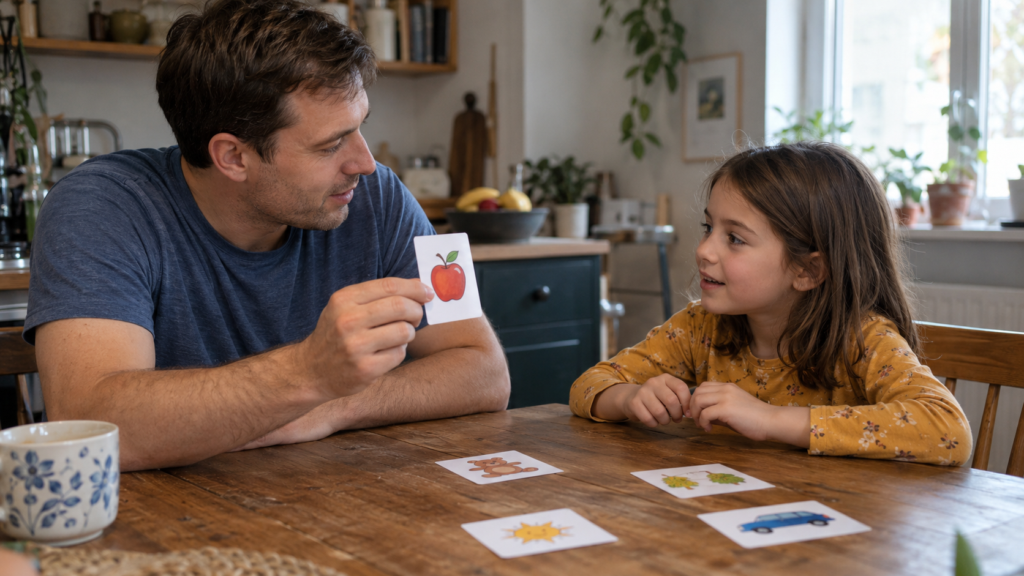
The host chooses a card, shows the picture and asks a question. In English, in their own language.
What is this?
The child answers in Russian. The father turns over the card, looks at the hint and suggests the next move.
That's the whole role. Show, ask a question, turn around, and none of these actions require Russian.
What dad doesn't do should also be mentioned in advance. He doesn't evaluate pronunciation. He doesn't check for endings. He doesn't pretend to understand if he doesn't. And he doesn't ask to have every sentence translated.
Dad is in charge of the game. The child calls out in Russian what Dad doesn't know yet.
Card with two sides
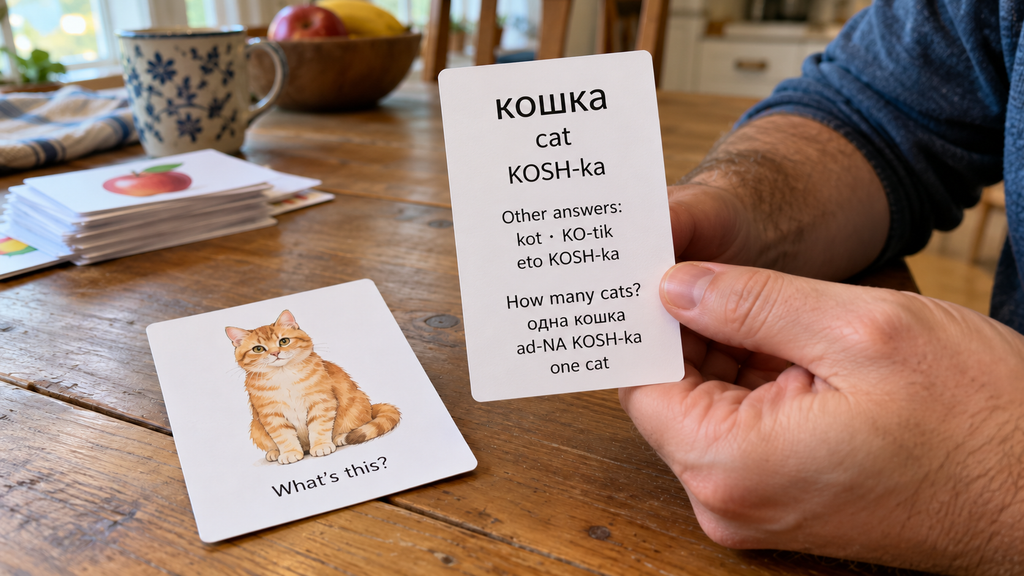
The whole game is based on cards, so it’s not like a regular card for memorizing words.
On the front side of the picture there is a picture and a question in English. There is no Russian word there. If you write it under the picture, the child will read the caption and not remember the word.
On the back, everything you need for an adult without Russian is included.
Just the word "kirilliches", "cat".
Translation, cat.
The word sounds roughly like this in Latin, with a stressed syllable in the capital letter, KOSH-ka. This is a hint for a parent’s ear; it is not considered an exact transcription of the pronunciation, and the child is not offered instruction on how to read it.
Several answers that would also be suitable. Cat. Kitten. This is a cat.
And one more question to continue with example answers.
Dad can turn the card over at any time. There is no «answer first, then hint» rule here.
Where to start
Before the first card, one phrase is needed. It sounds like an invitation.
Want to play a Russian word game? I’ll ask in English, you answer in Russian.
Want to play Russian words? I ask in English, you answer in Russian.
The child understands that a Russian answer is expected from him, and understands why his father asks in another language. Without this phrase, the Russian answer in the game appears as if by itself, and the child can quite well answer in English because the question was in English.
For the first cards, choose items that the child already knows by name in Russian without prompting. A cat, an apple, a table.
Otherwise, the game will have two tasks at the same time. Papa needs to take on the role, while the child needs to remember unfamiliar Russian words. One of them will be enough for the first time.
Cat, cat or kitten
The card says «cat.» The child says «cat.» Or «kitten.» Or "that's a cat.".
Dad looks at the flip side and sees kot and KO-tik among the possible answers. Okay. But what if the child said something that’s not on the flip side?
Rejecting an answer just because it doesn’t match the card is not acceptable. A Russian father doesn’t know, and a card doesn’t make him the kind of person who knows.
He has another response.
Can you show me?
Show me.
The child points to the picture, or explains with a gesture, or speaks in English what he meant. Dad understood. The game continues.
You need a hint on the page to know the familiar word when it is heard. Judging what is not there on it does not help and should not be done.
If the answer was given in English
Dad asked in English, the child answered in English. Cat.
This is not a violation. Dad takes the answer and continues. I could ask you one more time, just as a matter of course.
And in Russian?
If the Russian word is not available, the card is put aside, and the child can listen to the word later together with his mother. There is no need to repeat the Russian word in Papa's Latin alphabet; it is meant for Papa's ears. The Russian response in this game is not required. A child who is forced to repeat may not want to play anymore.
The second question
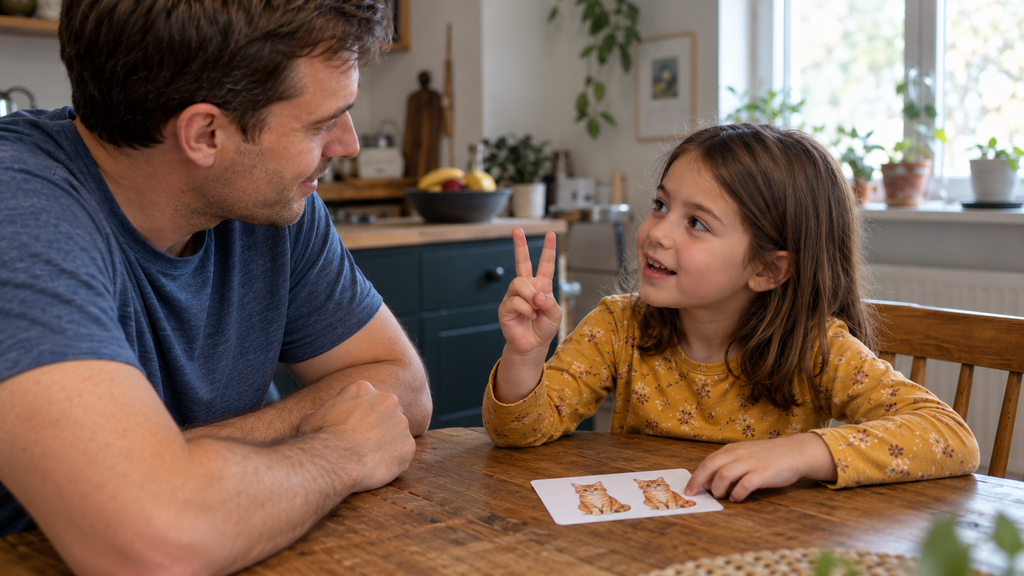
Naming the object is the simplest task. When it comes up, there is a second question on the same card. It is not mandatory.
What color is it?
How many?
Is it hot or cold?
To begin with, it’s easier to ask about what is visible in the picture: that way, dad will understand the answer better.
Here, the word KOSH-ka won’t help my dad anymore, so next to the second question on the page are examples of answers with translations and pronunciations. And in appropriate forms. If there are two cats in the picture, it would be «two cats,» dvye KOSH-ki. If the child called them cats, it would be «two cats,» dva ka-TA.
These are just examples. The child can answer differently. If there is no answer on the page, it doesn’t mean that it’s incorrect. If the dad didn’t understand, he has a second response. Can you help me understand? The child will show it to me, explain in English, or point to the picture. The Russian answer has already been given; an explanation in English does not invalidate it. No one is asking anyone to translate every answer.
What this game doesn't do
She doesn't teach her dad Russian. She will most likely remember the words from the conversation, but that's not the goal.
It does not replace the Russian conversation with mom or grandma.
And she doesn't check anything. Not the pronunciation, not the grammar, not even how many words the child knows.
But in this game you can answer in Russian, even when Dad asks questions in English. The picture and the prompts help him keep track of what's happening and not get lost in what was going on without him.
Cards below
Three sets, animals, food and a house, eight cards each. On the screen, the card is flipped by pressing a button. The print button folds the cards into A4 sheets. The memo on the first page is printed separately; the remaining pages are double-sided, with the long edge flipped over.
An interface for parents in English. Russian words for children.
The guide for the host in the block is also in English; it should be shown to Dad before the first game.
Three sets of eight cards, all the instructions for the dad are in English. On the front side there is a picture and a question; the Russian word is not there intentionally so that the child can say it instead of reading it. Clicking on the card or the Show hints button opens a page with hints for the dad. There is a Russian word, a translation, an approximate pronunciation in Latin with accent marks for the vowels, other answers that are acceptable, and an optional second question about what is shown in the picture, with examples of answers in the appropriate formats. The hints help the dad to recognize a familiar word rather than checking the Russian child's understanding. If the answer is unclear, the dad has the Can you show me? and Can you help me understand? buttons. If the child answered in English, the dad accepts the answer and moves on. If the word is forgotten, the card is set aside and listened to later with the mom. Below is a guide in English for the presenter; it should be shown to the dad before the first game. The Print cards button folds the guide and the set into A4 sheets, six cards per sheet. The first page of the instruction manual is printed separately; the pages from the 2nd to the 13th are double-sided with a fold at the long edge; the instructions are on the first page.
For the game leader
- Start with: Want to play a Russian word game? I'll ask in English, you answer in Russian.
- You lead the game: pick a card, ask the question, flip for hints, ask the optional next question.
- You do not grade the answer. Pronunciation and grammar are not your job here.
- The back shows the expected word and other answers that are also fine. A different answer is not necessarily wrong.
- If you do not understand the answer, say: Can you show me? or Can you help me understand? The child may point, show, or explain in English. The Russian answer still counts.
- If the child answers in English, accept it. You may ask once: And in Russian? Do not insist.
- If the child forgets the word, set the card aside. Do not teach the word from the Latin line. Listen to it later with a Russian-speaking adult.
- Capital letters in the Latin line mark the stressed syllable: KOSH-ka. It is a rough guide for your ear, not a reading exercise for the child.
- The answers to the next question come in the forms that fit the card, for example две кошки or два кота, because the child may have said кошка or кот. Both are fine.
The Latin line on the back conveys the sound approximately; the stressed syllable is highlighted in capital letters. The child does not need to read it.
Russian word cards. Notes for Dad
- Start with: Want to play a Russian word game? I'll ask in English, you answer in Russian.
- You lead the game: pick a card, ask the question, flip for hints, ask the optional next question.
- You do not grade the answer. Pronunciation and grammar are not your job here.
- The back shows the expected word and other answers that are also fine. A different answer is not necessarily wrong.
- If you do not understand the answer, say: Can you show me? or Can you help me understand? The child may point, show, or explain in English. The Russian answer still counts.
- If the child answers in English, accept it. You may ask once: And in Russian? Do not insist.
- If the child forgets the word, set the card aside. Do not teach the word from the Latin line. Listen to it later with a Russian-speaking adult.
- Capital letters in the Latin line mark the stressed syllable: KOSH-ka. It is a rough guide for your ear, not a reading exercise for the child.
- The answers to the next question come in the forms that fit the card, for example две кошки or два кота, because the child may have said кошка or кот. Both are fine.
Printing: A4, scale 100%. Print page 1 (this page) on its own. Then print pages 2 to 13 double-sided, flip on long edge. Page 2 is the front, page 3 the back of the same six cards, and so on. Print pages 2 and 3 first as a test and check that the cats’ front has the cats’ back.
Игра с папой дает ребенку повод назвать слово. На занятиях с преподавателем ребенок может расширять словарный запас и учиться использовать знакомые слова в разговоре. На курсе «Русский для билингвов» в Palme School с детьми от четырех лет занимаются сертифицированные учителя, а на уроках ребенок говорит сам, в играх и обсуждениях.
You can start with two free lessons. На них определят уровень русского у ребенка и подберут программу.
Записаться на бесплатные урокиЧастые вопросы про игру с папой без русского
Does Dad need to know Russian to play cards?
No. Dad is in charge of the game: he chooses a card, asks a question in English, if necessary opens up the prompts and suggests the next move. The child calls out the Russian words in the game. Dad does not evaluate the correctness of pronunciation or grammar; for this game such verification is not required.
What to do if the child answered in English?
Answer and continue. You can ask the question again if necessary. If the Russian word does not come up, the card is put aside; the child can listen to the word later with a Russian-speaking adult. It is not necessary to demand a Russian answer or not to give the next card until it is pronounced.
What to do if a child says a word that is not on the page?
The absence of a word on the answer sheet itself does not mean a mistake. The expected word and several other appropriate answers are written on the answer sheet, but the list is not complete. The child may say «cat» instead of «cat» or answer with a whole sentence. If the parent doesn't understand, he has two options: Can you show me? and Can you help me understand? The child will show it, explain in English, or point to the picture, and the Russian answer has already been spoken.
How do I read the Latin line on the back of a book to my dad?
Absolutely not; you don't need to read it out loud. Latin with a stressed syllable in the capital letters, for example KOSH-ka, conveys the sound roughly and helps the parent to recognize the word by hearing it when the child says it. It is not a model for pronunciation, and the child is not offered to learn to read by it.
If mom speaks to the child in Russian and dad in English, does the game interfere with that order?
No. The choice of a language of communication and the role in the family game are different issues. The principle of «one person, one language» was described by Jules Ronja in a 1913 book on the advice of Maurice Grammone, and it concerns the language each adult speaks to the child. In the game, the father still speaks in English, and the child answers in Russian. We wrote about how this principle works in families where one parent speaks Russian, in a separate article.
At what age is this game suitable?
Age is not a factor here. The game is suitable for a child who already knows at least a few names of objects in Russian, because on the cards he remembers familiar words, not learning new ones. For a child without such a foundation, first he needs to become familiar with the words together with an adult who speaks Russian. Picture cards are usually given to preschoolers and younger schoolchildren, but for a teenager the same approach should be adapted to other topics.
О том, работает ли принцип «один человек, один язык» и что делать, когда один из родителей выпадает из разговора, мы писали в статье про OPOL в семье.