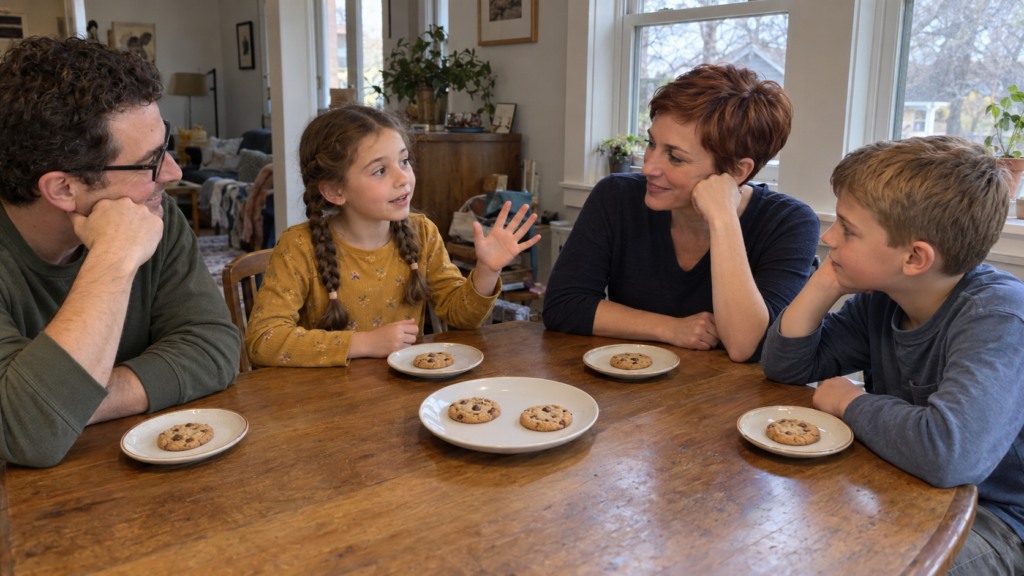

At the table, where there are six cookies for four people, the decision is usually made by the one who shouts «Chur!» first.
«Shit, it’s mine!»
Or in English, if the child grew up in an American school. Dibs!
The words are different, but the results are the same. Those who managed to get in got in. It's hard to argue with that because it's too late to argue; the cookies are in your hand.
There's no honesty in that kind of relationship. It's just speed.
First one at a time
Six buns, four people. One for each, no one is shouting «chur» here. Everyone sees that everyone got the same amount.
They scream when there are two left on the plate.
That's where we should stop the game and speed it up. Put two cookies in the middle of the table and ask the child to guess which one it is.
How will we divide it up?
Let him/her come up with the rule first, and then someone else will get the cookies.
The rule begins with the word «let's»
In Russian, you can offer everyone at once with just one word. Let's do it.
Let's break it down. Let's put it on hold. Let's give it to the person who helped.
The child who is used to shouting «chur» or "dibs" may not even know the phrase. He/she can speak it. It just wasn't necessary before; the cookies came faster.
Tell him the beginning, then he will figure it out on his own.
Let's break it down
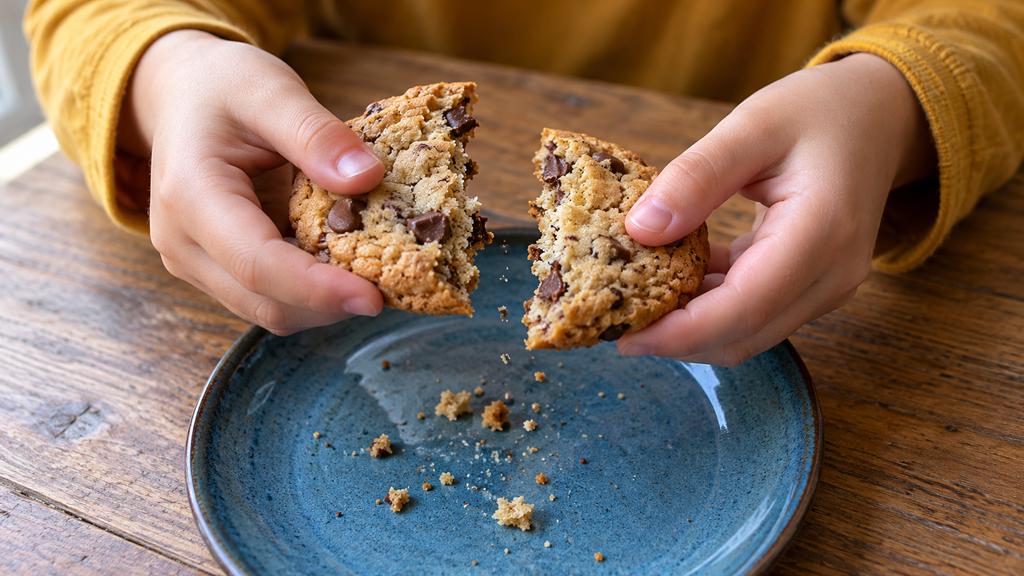
Two biscuits are cut in half to give four halves. That's one for each person.
Each one is a whole and a half. You could say it's a little more like a half-and-half.
If the cookies are the same and they have crumbled evenly, everyone gets the same amount. But they don’t always crumble evenly. One half comes out bigger, and then someone again shouts «too much, my big one.».
There is an old rule for this situation. One breaks it, the other chooses to ignore it. For the one who breaks it, it is advantageous to break it as smoothly as possible; otherwise, the smaller piece will go to them themselves.
It's also possible to do it another way. One turns away, the other points to a half and asks, «To whom?» The one who turned away calls out the name, not seeing which piece. Mom, Dad, me. Then we switch places.
Let's put it off
Sometimes it's a shame to break things. The cookies will crumble, and there won't be anything left to share.
The two remaining ones can be removed. For those who arrive later. Or tomorrow.
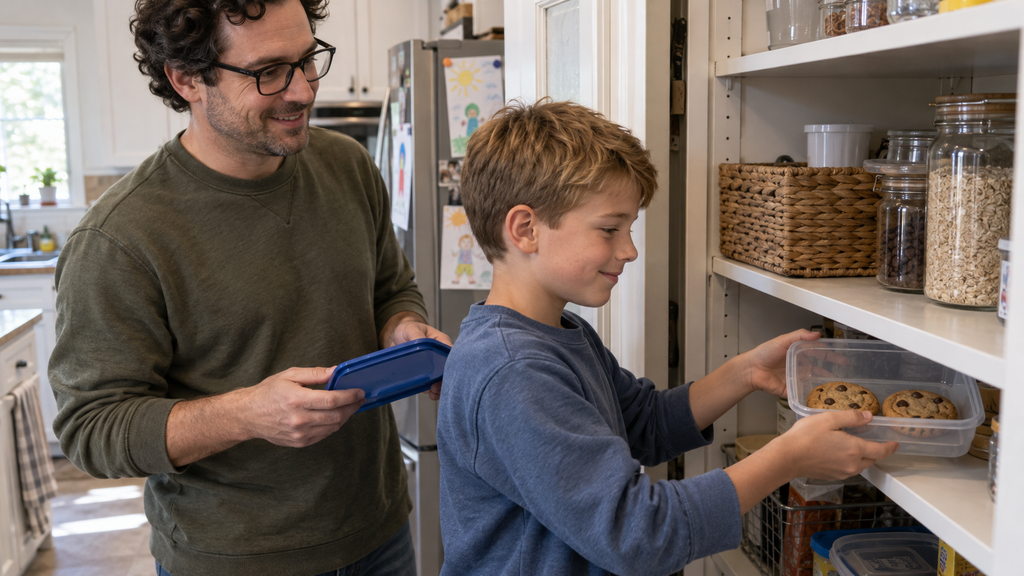
If that's how everyone decided, that's also an honest rule. Today, everyone has one.
Let's give it away
Or we could decide that someone will get the rest. The one who set the table. The one who has a holiday today.
Here the child will have to explain why that is the case. People have been arguing about what «fairly» means for a long time, and so do they at the kitchen table. Some will say that help is more important. Others will say that the queue is longer. Still others will say that they got less yesterday.
Let them argue in Russian. If they don’t have enough words, help them find them. This kind of discussion at the table is more useful than any exercise.
The task is for six pieces
Six pies, four people. One for each. What should we do with the two remaining ones?
Let's break it down
Two biscuits are cut in half to give four halves, one for each person.
One whole and one half each, about a half a biscuit each. So that no one would argue over the larger half; one breaks it, the other chooses it.
Let's split it in half.
Let's put it off
Today everyone has one liver. The two remaining ones are waiting for someone to come later, or for tomorrow.
Let's postpone it for tomorrow.
Let's give it away
The rest gets someone alone. Here you need to explain why it’s him, and agree on it with everyone.
Let's give to the one who set the table.
There are several honest rules here. If the condition is «distribute everything equally,» the answer is one: one cookie for each person.
If there are seven loaves
Tomorrow you can take seven.
One for each; there are still three left. If we divide each one in half, we get six halves, but on four we can't divide the halves equally.
The child can suggest breaking the cookie again. Then everyone will get half and a quarter, that is, three-quarters of the cookie. They can suggest putting one cookie aside and breaking the other two. They can come up with their own idea.
The main thing is that he starts with the word «let’s», not with the word «stupid».
We have other meanings of «let's do it,» from «let's do it here» to «that's enough, let's do it.» separate article. And the games with the score are collected in a collection of mathematical games for children.
Frequently asked questions about cookie slicing
How can six cookies be divided among four people?
First, one for each person; there are two left. If you split them in half, you get four halves, and each person gets one more. That makes a total of one and a half cookies.
How to record division with a remainder?
In the Russian textbook, it says 6 ÷ 4 = 1 (page 2). In the American textbook, it says 6 ÷ 4 = 1 R2, where R is the word remainder.
What does «chur» mean and how do you say it in English?
«Chur, mine!» they say to claim the right to something first. In an American school, children in this case shout dibs. This has nothing to do with fair sharing; the one who is the first to succeed wins.
How to divide the halves if they are uneven?
We can agree that one breaks things, and the other chooses to pick up the pieces. For the one who breaks things, it’s advantageous to break them as evenly as possible. Another way is the «Who?» game, where the person who has turned away calls out the name without seeing the piece.
How to divide seven pies among four people?
One for each, there are still three left. Six halves cannot be divided equally among four people; therefore, the halves can be divided again. Then everyone will get half and a quarter, for a total of one cookie and three quarters.
Does the child need to know fractions for this task?
No. It’s enough to be able to divide the rest between the children. You can show the halves and quarters on the actual cookie or in a drawing.
More games with a score in a collection of mathematical games for children, And read about the word «let's» in the article about five meanings of «let's do it».