


In the morning Aunt Olya sent a photo of a garden from the family chat, showing a bucket of apples on the porch. In an hour, nine responses had been received under the photo. «Beautiful!» «This is a good harvest!» «Olya, well done!» «How many apples!» «A sight to behold!» Three hearts and one apple emoji. The grandson is also a member of this chat; he read everything and didn’t write anything. He can write in Russian, and he sends short messages to his grandmother himself. This is what we will discuss when the child is in the general chat, but he has no responses.
Nine adult responses are worth rereading in succession. They all talk about the same thing—what is visible in the photo. There are many apples, beautiful apples; Olya is good. The tenth «beauty» from a child will add nothing to them, and he feels it no worse than an adult. He has no place to put his news under other people’s apples. He has enough Russian words. He lacks the words to say.
What remains behind the camera
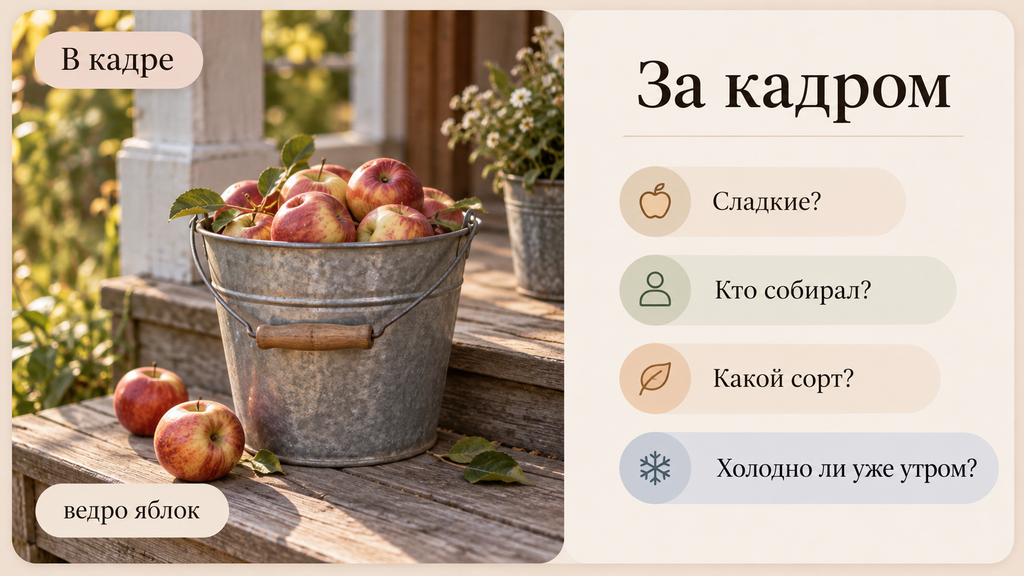
Photographers and filmmakers have a term for it: «off-camera.» That's what they say about everything that doesn't make it into the photo. There's a bucket on the porch; that's in the photo. And those sweet apples—who climbed up the tree to get them? How many buckets were there before that, and is it still cold there in the mornings? The photo doesn't tell you that.
About what remains behind the scenes, Auntie Olya might tell more. And none of the nine adults have asked her about it yet.
This is no longer the tenth assessment of a photo; it is the first question about what is not visible in the photo. Auntie Olya has an opportunity to answer and continue the conversation. The child does not need their own news or an adult topic for this question. They just need to look at the photo and find what is missing. Adults may not have this question; some of the stories from their childhood are already familiar to them. The child who is there may have never been there before and is asking seriously.
«Auntie Olya, are the apples sweet?»
Another question is also relevant: what is not visible in the photo. «And who was climbing the tree?» «And what kind of tree is that?» «And were there worms?» The short «a» at the beginning connects the question to what we have already discussed; without it the question is also correct.
To whom and what
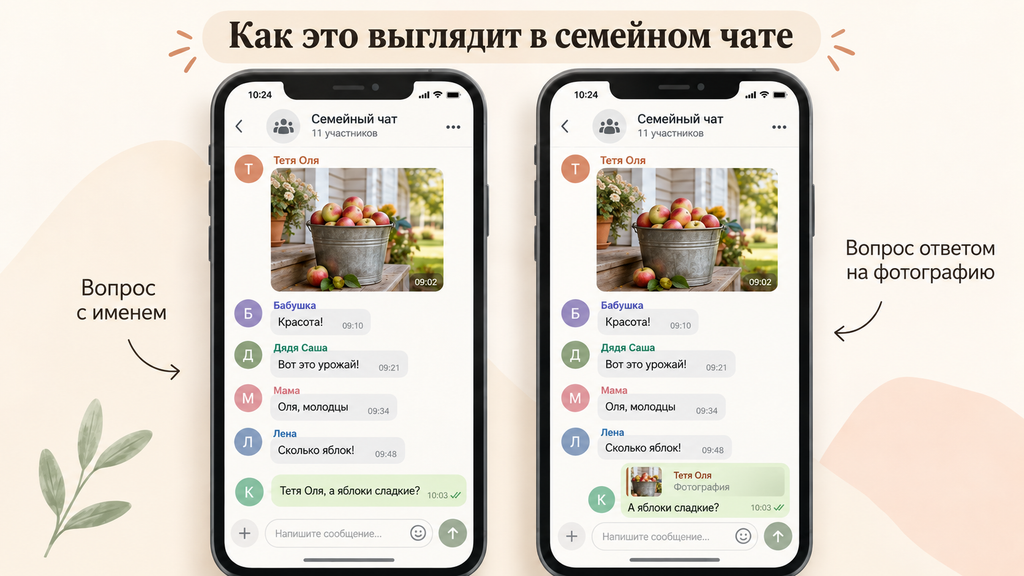
In a chat with eleven people, it’s easy to lose track of the question without an address. The address can be given by name, as in the question about sweet apples. You can reply directly to a message with a photo, then it will be clear which message the question refers to, and the name is not necessarily required. A child can call Aunt Olga the same way they call her out loud, and they can also call her «you» or «you guys» out loud.
Next up is Aunt Oleya. You don't have to answer for her; you have to correct the missing letter no matter what. If the question gets lost in the new messages and the child gets upset, you can tell him directly that Aunt Oleya apparently didn't notice it.

The child has the right to reply, but no obligations. There will be many more photos in the family chat, and everyone will have something left behind behind the scenes. How this question looks on the screen is shown below.
The child's question on the chat screen
This is what the chat looks like on the child’s phone. Above is a photo of Aunt Ole and nine adult responses; below is the child’s question, answered with a message containing the photo. Under the screen are four questions from the article; click on any of them to see how the child will start the conversation.
What is not visible in the photo
The mockup is fictional; the names and messages are just examples. In your messenger, the response to the message may look different.
Frequently asked questions about the child in the family chat
What should a child write in the family chat in Russian?
You can ask about what is not visible in the photo you sent. For example, «Auntie Olya, are the apples sweet?» This question gives the author of the message a reason to answer and continue the conversation.
What does «off-camera» mean?
That's what they say about everything that didn't make it into the photo or film. There's a bucket of apples on the porch in the shot, but who was sneaking them up the tree remains out of focus.
How to ensure that the child's question is not lost in a large chat?
A question without an address is easy to lose. You can give the address by name or reply directly to the message with a photo, then it will be clear to which message the question refers.
Is it necessary to start the question with «a»?
Not necessarily. The short «a» at the beginning connects the question to what has already been discussed. Without it, the question is also correct.
Is it possible to write «teet Olya» instead of «teet Olya»?
It is acceptable if the child calls her out loud. Some household names have a short form: mom, dad, Aunt Ol, Uncle Sasha. «Auntie Ol» sounds more neutral, «Auntie Ol» more conversational.
Is it mandatory for a child to write in the family chat?
No. The child has the right to reply, but there are no obligations. There will be many more photos in the chat, and the question can be asked another time.
There is an article about how the cuts in Russian correspondence are arranged on the blog. PS instead of P.S.