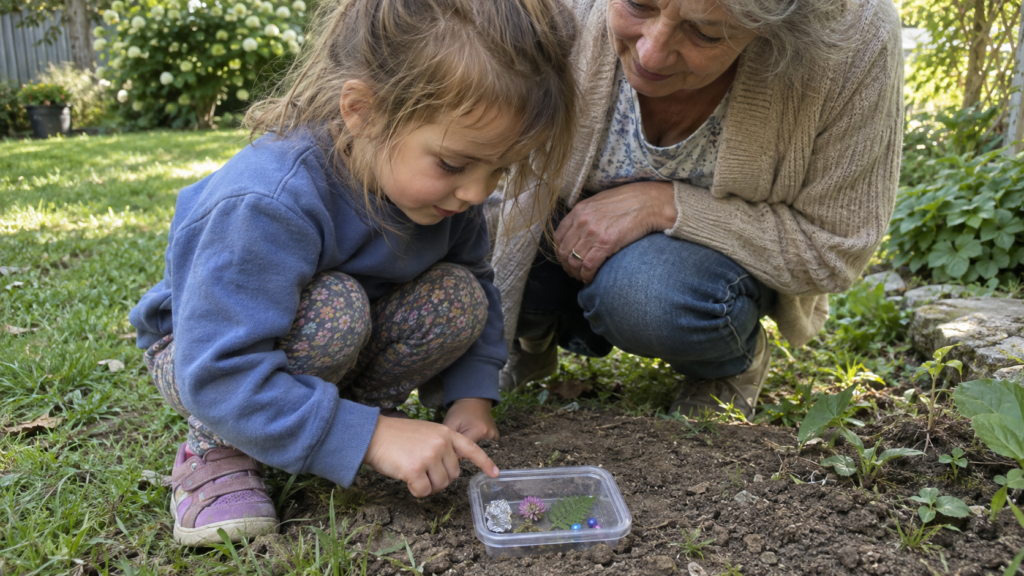

Cardboard from a chocolate bar, a napkin, a clover flower, three beads and a glass bead without scratches.
If you grew up in an English garden, you don't need to explain further. A hole in soft soil in a secluded corner, foil at the bottom, treasure on top, everything covered with glass and sprinkled so that no one else can find it. Then you rub your finger across the window in the ground and look. It's a secret.
If the child doesn’t know about this game, you can tell them how they did things in their childhood. And hardly anyone thought that it was geography back then.
Where is it buried
The secret could have been shown to a close friend. So, it was necessary to take her to that very place or explain where to look.
And that’s where the main thing began. «Behind the garage.» What a garage it is—there are five of them. «Behind the green one, by the pipe.» Which side of the pipe? «Between the pipe and the bush, where the ground is soft.» To explain more precisely, there are two landmarks to keep in mind. Otherwise, the secret will remain a secret until the autumn, when someone’s grandfather digs it up with a shovel.
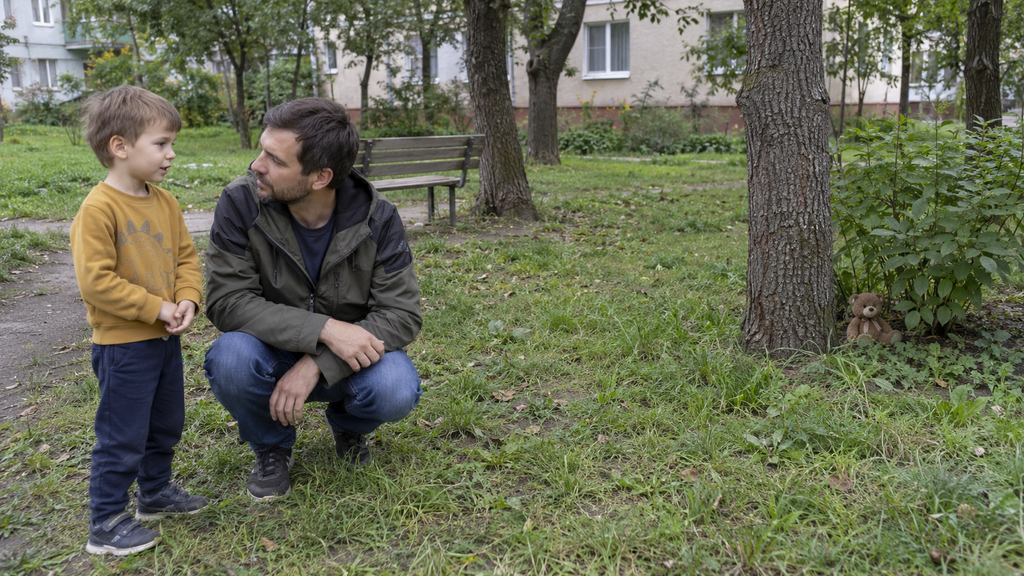
We won't need any glass for our game. We'll hide a teddy bear in the yard, and the task will remain the same: explain where it is without showing a hand.
«Behind the tree.».
What kind? There are four trees in the yard.
Behind the tree, if you look from here
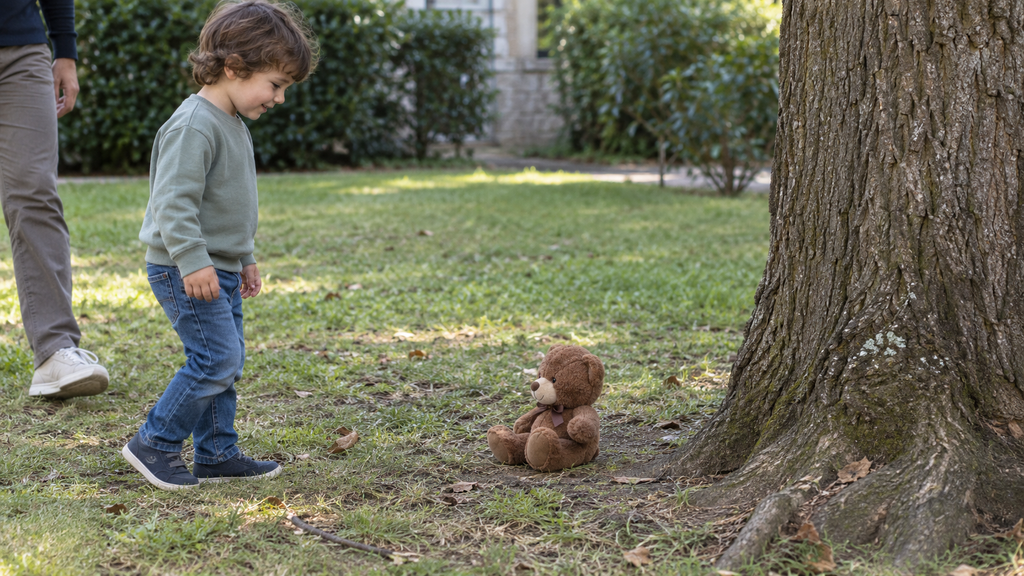
Take a tree or a pole. They don’t have a front and a back side. Agree that you will now determine the «front» and «back» from the place where you are standing. Place a teddy bear under the tree so that its trunk covers it.
«Where is the mouse?»
«Behind the tree.».
Now walk around the tree together so that the mouse is between you and the trunk.
«And now where?»
«Before the tree.».
«Did he move?»
A pause. And then a sincere «no.».
If the child simply smiles and rejoices at the found teddy bear instead of answering, don’t bring up the subject again. Next time it will work out. But if he says «we were there» and points to the previous location, that is the answer.
The location is the same, but it can be described from different angles. The person who kept the secret knew it without saying a word. That’s why he said «behind the garage, if you go from the entrance.».
Four words that were enough
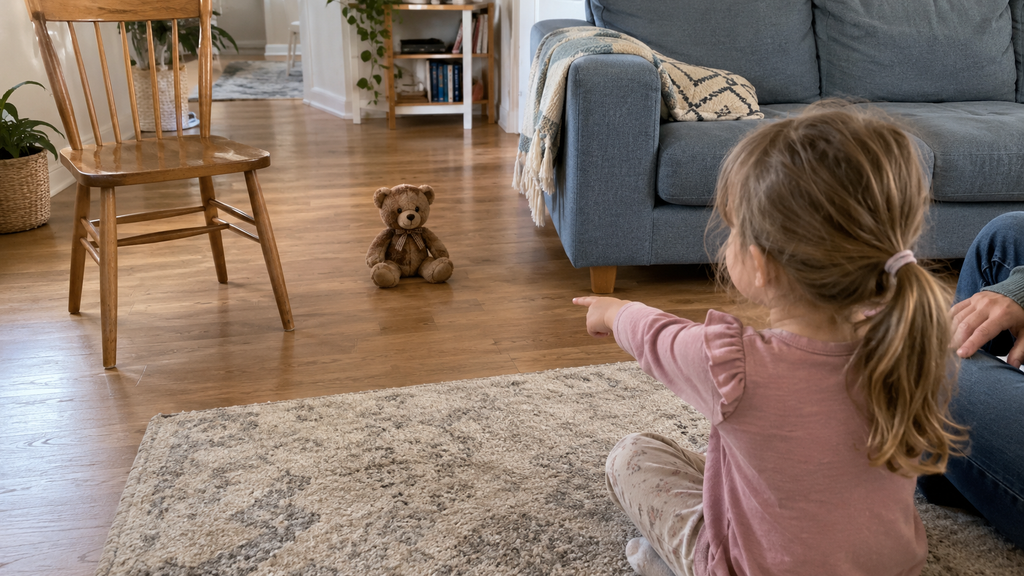
The secretarial vocabulary was short. «Behind,» «in front of,» «between,» «nearby.» They described any courtyard, and in an apartment they work the same way.
«The »between« requires taking into account two immediate guidelines. The »between« is the space between the chair and the sofa. The sofa was removed, and the »between« has become empty; only »next to the chair” remains. If the child points with their finger instead of using words, accept the answer and name the position yourself. “Yes, between the chair and the sofa.” A finger is a complete answer at this age; words will follow later.
There is no need to rush to the «right» and «left.» A child can perfectly understand where things are and confuse the words themselves, or confuse the directions themselves. By making one mistake, you won’t be able to tell the difference. If in the kindergarten he hears left and right, at home you can associate them with Russian words in a specific situation, for example, «We turn right, to the swings.» We don’t count mistakes here. Our five games can do without the “right” and “left.”.
The road to the secret
The second step after «where» is «how to get there.» The person who led his friend to the secret passage spoke the route out loud. Past the sandpit. Around the flowerbed. Under the rope with the underwear.
At home, they do this with a toy; a drawing is not needed for this. The plan of the room with the rectangular bed was disassembled in the usual way at home. Geography classes. The adult says the path from the window to the door; the child leads the teddy bear. Then, in the opposite direction, the child describes the path; the adult guides them. If it is possible to walk in different ways, the adult clarifies. «Between the table and the window or between the table and the sofa?» The answer can be given in words or shown.
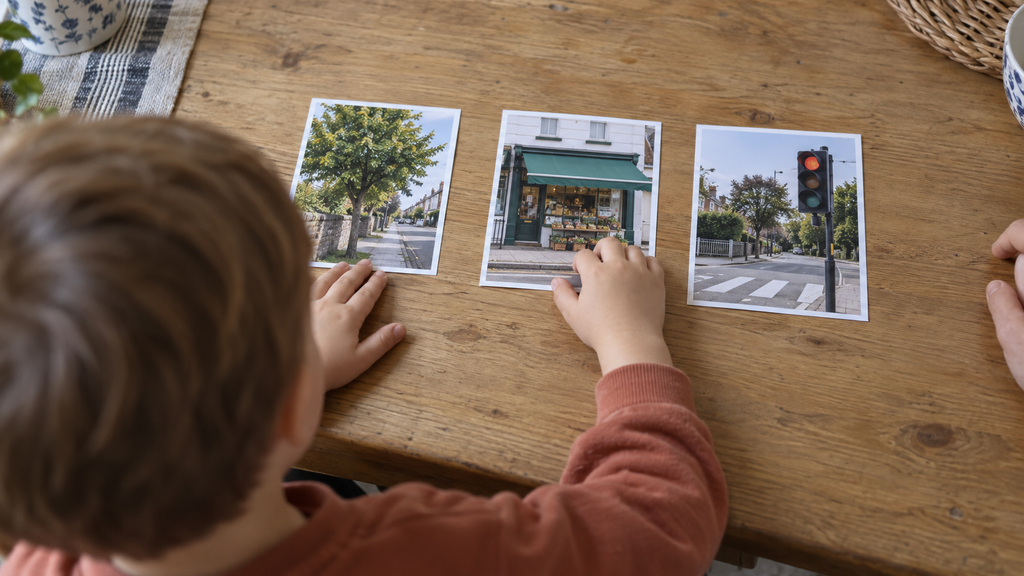
The way to the kindergarten is assembled from photos. Three familiar places along the way: a tree, a shop, a traffic light; and three photos that need to be arranged in the correct order. It’s convenient to start with order; the distances and directions of the light will wait. Then ask what was between the store and the traffic light. If the child remembers a fence or a car that’s not in the photos, the road in their head is longer than the three photos combined.
The same courtyard on the other side
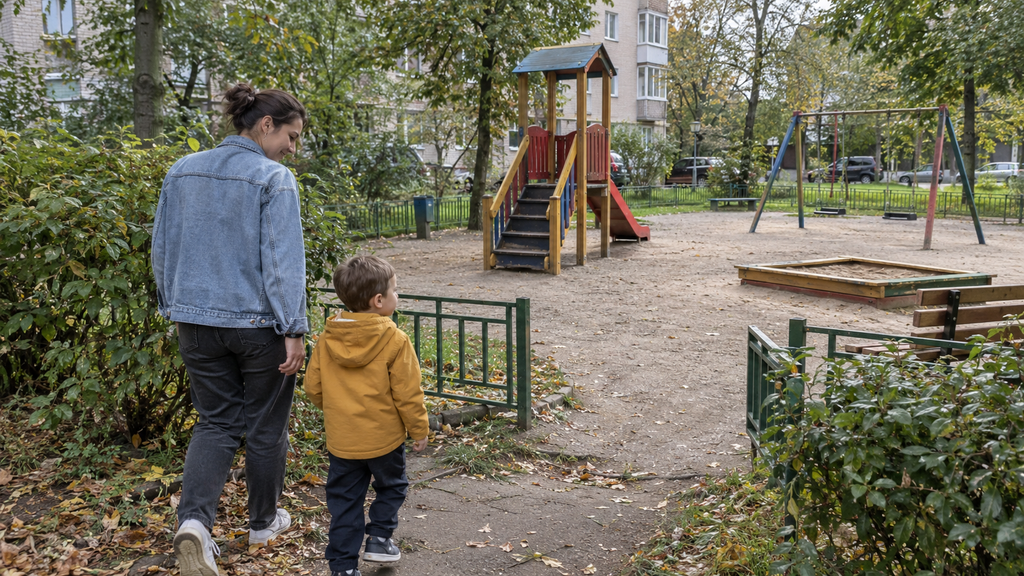
If you approach the secret passage from the other side, finding it may prove more difficult. The familiar corner of the courtyard suddenly looks foreign.
Test it out on your own property. Approach it or the entrance to the yard not from the side you usually go from, and ask if the child recognizes the place. Often they won't recognize it right away. A familiar place on an unfamiliar side looks new.
And when he finds out, the same thing will happen as with the little mouse behind the tree. The place is the same. We watched from the other side.
Five sessions with a room and a yard
Each activity takes a few minutes. «Show me,» «Name it,» and «Explain it» are different ways to participate, not steps that need to be completed in one go. An answer with an action or a single word is considered complete.
A mouse between two chairs
Place two chairs at a distance from each other. Say, «Put the teddy bear between the chairs.» Then ask who the teddy bear's neighbors are.
Show me. The child places the teddy bear between the chairs and points to both chairs.
Name it. «Between the chairs.» «Chair and chair.».
Explain. «On the one hand, a chair; on the other, a chair too. No need for a short »gap« between the chairs.
If it's difficult. If the child puts the teddy bear on a chair, point to the space with your hand: «Here, between these two chairs.» Remove one chair and ask where the teddy bear is now. The word «between» disappeared along with the chair.
One tree from different sides
In the yard there is a tree or a pole, behind it is a toy. A large box in the middle of the room would be suitable. Agree on where to start and end—where you stand. «Where is the mouse?» Go around the tree so that the toy is between you and the trunk. «Now where?» The mouse passed by.«
Show me. The child walks around the tree and shows a toy.
Name it. «Behind the tree.» After passing by: «In front of the tree.».
Explain. «The mouse didn't move; we got around it.» One «we» is enough.
If it's difficult. If the child says that the mouse has moved, put the mouse itself in its place and walk around it. «Did you move?» The chair for this game is not suitable; it has its own backrest, and «behind the chair» the faithful can stay after the walk.
The road to the door
The child holds the toy by the window. Say the words: «Past the table. Around the chair. To the door.» There is no need to draw anything.
Show me. The child moves the toy along the described path.
Name it. The child himself is playing with the toy and calling it «next to the table,» «around the chair.».
Explain. The child describes the path, the adult leads the toy. If it is possible to go in different directions, the adult asks: «Between the table and the window or between the table and the sofa?» The answer can be given in words or shown.
If it's difficult. If the child gets lost, reduce the distance to one step: «Just past the table.» Add the second step another time.
The road to the kindergarten in three photos
Take photos of three landmarks along the way to the kindergarten, for example a tree, a shop, a traffic light. The child sorts the photos in order and shows on the phone which was the first and which was the next one. «What do we see first when we leave the house?»
Show me. The child arranges the photos or shows them in order of the walk.
Name it. «First the tree, then the store, then the traffic light.
Explain. «The tree is the first because it is at our house. Enough of the wrong order without explanation.
If it's difficult. If the order gets confused, arrange the photos during the walk; have one guide for each.
The other side of the square
Approach an unfamiliar place or entrance to the yard in an unusual way. Ask, «Where are we?»
Show me. The child looks around and points to a familiar object, swing, or door.
Name it. «This is our venue.».
Explain. «We came from the other side.» It's enough to say «we came from the other side.».
If it's difficult. If the child doesn’t recognize the place, approach it closer until a familiar object appears. Learning from an unfamiliar side doesn’t happen immediately, and that’s normal.
Next time you go for a walk, you can switch roles. Now the child chooses what to show you in the yard and explains the way. If they say «over there,» ask them to name something nearby—a bench, a tree, a patio. This way, familiar places become landmarks that you can share with another person.
It's all geography, although there isn't a single map on it yet. These games teach you to notice where you're looking from, and they'll come in handy when you're learning to use maps. And you can make your own version of the secret here, in your own backyard, in a box with a transparent plastic lid, without a glass cover. After the game, take the box home. You'll have to explain the way to it in Russian.
When the child turns four, Palme School offers a separate geography course, online and in Russian, with maps, projects, and discussions. You can start with free trial lesson.
Frequently Asked Questions about Geography for Toddlers
From what age can geography be taught to a child?
You can start with everyday conversations about where the toy is and where you are going. These five games are designed for children aged 3–5 years; the adult chooses the appropriate option and helps if necessary.
Is it necessary to teach right and left from the age of three?
It is possible to use «right» and «left» in the game to indicate the direction, but it is not necessary to require infallible answers. For these exercises, the words «behind», «in front of», «between» and «nearby» are sufficient.
What should I do if my child answers in English?
To accept the answer and repeat it in Russian: «Yes, behind, at the table.» The child may know the spatial word in one language and not know it in another yet, and that's okay.
How long does such an activity take?
Five minutes is enough. It’s better to do one exercise on the way to the kindergarten every day than a long session at the table once a week.
Is it possible to play this game outdoors?
Yes, the yard is even more comfortable than the room for this purpose. The wood, the bench, and the porch provide the same «in front of,» «behind,» and «between» dimensions, only on a larger scale.
When to switch to the first card?
A simple scheme of a familiar place can be presented along with a walk or a game. Show which object represents the drawing and ask them to find another one. It is not necessary to explain the entire route in detail for this purpose.