

Names and identifying details of every student here are changed, as they are everywhere on the blog.
Klim is nine years old, lives outside Hartford, and can spend forty minutes not doing twelve minutes of homework. His parents have tried timers, charts, rewards, and one memorable week of removing everything from his room that wasn’t a desk, and none of it changed the forty minutes into anything shorter.
The task is not heavy, it is hot
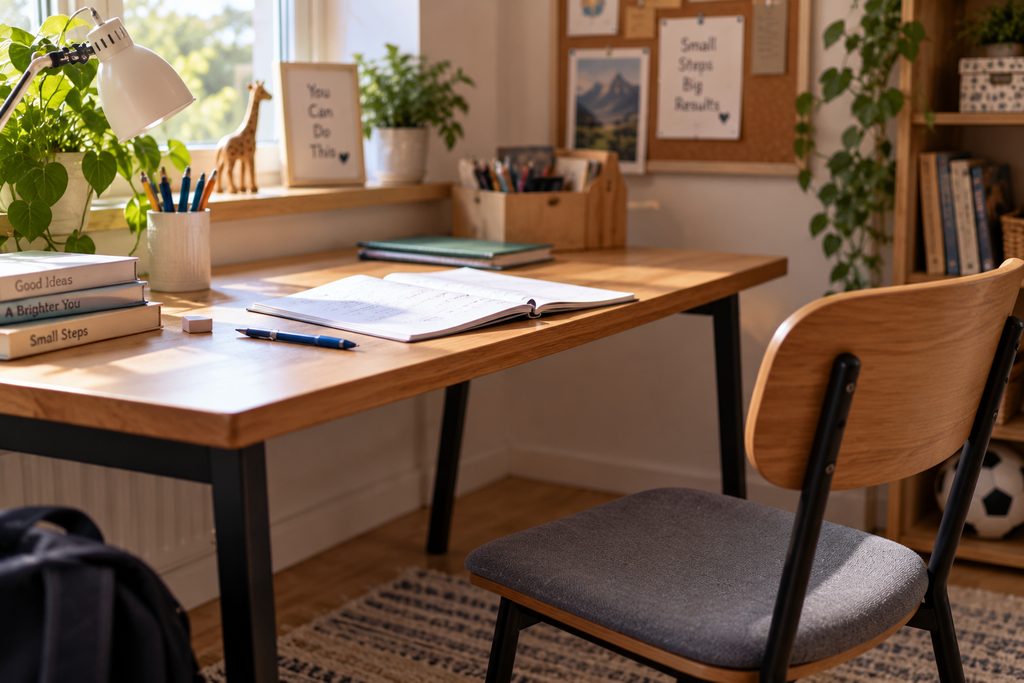
Watch what he actually does in those forty minutes and the picture stops being mysterious at all, because he is not sitting at the desk struggling to begin, and in fact he is not at the desk. He gets water, finds the cat, reorganizes a shelf that has never once needed reorganizing in its life, and every one of those small useful-looking errands has precisely the same shape as the others, which is that it takes him one step further from the page than he was before he started it.
He is not avoiding the work. He is avoiding a feeling, and he is doing it rather well.
Procrastination is emotional, not managerial
Here is the finding that reframes the whole subject, and it comes from researchers who spent years watching people fail to start things.
Procrastination is not a time-management problem. It is a self-regulation failure driven by short-term mood repair, which is the same system that fails when a child comes apart over a blue cup, differently configured, and it appears most reliably when a task is seen as aversive: boring, frustrating, lacking meaning, or lacking structure. Faced with that, a person delays, and the delay works. It genuinely does relieve the unpleasant feeling, immediately, which is exactly why it repeats.The delay works. That is the problem with it.
Its cost lands on a version of the child who does not yet exist. Tonight’s Klim feels better. Tomorrow’s Klim inherits the bill, and tomorrow’s Klim is a stranger to him in a way that adults sometimes forget, because we are only slightly better at this ourselves.No one delays because a task is difficult. People delay because a task burns.
I spent a year calling a boy lazy in my own head
He was thirteen, he never did the written work, and I had a private explanation for it that I would have been embarrassed to say out loud but held anyway, which was that he didn’t care very much and that his parents cared for him instead.
Then his mother mentioned, in passing, at the end of a call about something else entirely, that he had been assessed for a writing difficulty two years earlier and that the school had never told anybody because the paperwork had gone to an address the family had moved out of.
Every child who looks lazy is doing something that makes sense from inside.
A year of watched avoidance rearranged itself in about four seconds. The boy had not been indifferent to the written work. He had been declining to spend forty minutes producing something he already knew would come back covered in red, which is not laziness by any definition I would want to defend, and I had spent a year quietly not asking why.
Which means the usual tools are aimed at the wrong problem
Timers, charts, and reward stickers all assume that the child cannot organize themselves. Some children cannot, and executive function It is a real constraint that a nine-year-old is still building. But a chart does nothing about heat. Ask what the task feels like before you ask when it will be done. A page of long division that a child expects to get wrong is not boring; it is threatening, and no schedule addresses that. A reading assignment about a book they find pointless is not hard; it is meaningless, and meaninglessness is one of the four things the research names.What to do about the heat
Make the first move absurdly small, and mean it. Not do your math, which asks a child to touch the hot thing, but open the book to the right page and put the pen next to it, which only asks them to stand near it. Starting is where the heat is concentrated, and once a child is three minutes in, the temperature usually drops on its own.
The part where I recognize myself
I have a folder of administrative work that I’ve moved between three computers without opening. Invoices, mostly, and a form about qualifications that has been outstanding for so long that opening it now involves a second unpleasant feeling on top of the first one. Every time I sit down to do it I find that the kitchen needs something. Not consciously, not as a decision I could catch myself making, but as an entirely reasonable-seeming sequence of small useful acts that end with the folder still closed and me feeling briefly fine about it.A child putting off homework is doing what I do, with fewer years of practice at hiding it.
That is worth saying to them out loud, and it is the only part of this that reliably changes the temperature in the room.Klim now does the first line before dinner, which was his mother’s idea and better than any of mine. The forty minutes have become about fifteen.
At Palme School we teach online, in groups of up to eight, two forty-minute classes a week, and the first two lessons are free. You can book those here, and there are printable materials for parents in our resource library.Frequently asked questions
Usually because the task produces an unpleasant feeling and delaying it removes the feeling immediately. That relief is real, which is why the behavior repeats, and it has very little to do with laziness or with not knowing how to plan.
Shrink the first step until it barely counts as starting, decide the time in advance rather than in the moment, and sit nearby with your own work.
Ask what the task feels like before asking when it will be done.
Occasionally. Persistent avoidance across all subjects, distress that lasts months, or a child who wants to start and cannot are worth raising with the school or a pediatrician.
Most procrastination is ordinary and responds to changing the temperature of the task rather than the child.
Sources
- Sirois, F., & Pychyl, T. (2013). Procrastination and the priority of short-term mood regulation: Consequences for future self. Social and Personality Psychology Compass, 7(2), 115–127. doi.org
Palme School: Russian for bilingual children · Conversation school · Free materials for parents
Lily Rozberg has been teaching for sixteen years, first English in Russia and now Russian to bilingual children across the US and Canada. She writes for Palme School about heritage language, reading, and the things report cards do not measure.