Everyone who grew up speaking Russian played in «Goryata,» and no one read the rules; they were passed on in the car, on the train, in line at the dentist. One calls a city, the next has to remember the city by the last letter. If the word ends with a soft sign or an Ы, they take the letter before it, because there are no cities with those letters; with Y they usually do the same, although that is already a convention, and they agree on it in the first five minutes, usually after Tyumen or Perm. Then the game continues until they run into the same wall. The wall is called the letter A.
The city names on the Russian map often end with A. Moscow, Samara, Tula, Penza, Riga, Odessa, Ufa. Every such move again sends the opponent on a quest to find a city with A, and the child’s stock of A strangles quickly, and the adult a little later, but it also runs out. It is at this point that «Cities» from the memory check turn into a geography game, because there is nothing left to remember, you have to look for it, and the map opens up. This is where the conversation we would like to offer parents begins. About where new cities and countries come from in ordinary life, if they are not specifically taught.
Where do new cities come from

The first source is the most prosaic. It lies in the refrigerator. On the banana is an oval sticker with the inscription Ecuador, on the box of the raspberry there are small letters Product of Mexico, and this line has to be found between the barcode and the weight. On the tea it says Sri Lanka, on the package there is a stamp with the city that no one in the family had heard of until now, and on the T-shirt label it says Made in Bangladesh, and this label, by the way, is sewn on from the inside, so it takes the longest to find it. None of these labels was intended to be a teaching material, but each one names a real place, and if the card is displayed where purchases are sorted, the place can be found right now, before the banana is eaten.
What to do with the found item depends on the object. With Ecuador, it’s interesting to see which ocean it comes out of and what water the banana traveled through. With Sri Lanka, the task is different; the island on the world map is tiny and hidden under the Great Indian Ocean, and a child could quite easily find it before an adult does if the adult doesn’t point at it. With Mexico, it’s a third option; it has a common land border with the USA, and you can point to it from your city without ever going into the ocean; with Ecuador, that’s not possible. One action is enough for one sticker. All three don’t need to be done at once.
It’s worth mentioning something that specifically concerns children from Russian-speaking families in the USA and Canada. The labels on the packaging are in English, and the map on the wall may be in Russian. With Ecuador and Mexico, it doesn’t matter; the names are similar. With Hungary and Hungary, with Germany and Germany, with Georgia and Georgia (which is also confused with a state), a child may know where the country is, but not know that it’s the same country. Then you should look for the place, not the name, and that’s a separate skill that we’ve written about in detail in the article about home geography. It is worth noting here that the English name on the packaging and the Russian name on the map are the same reason to open the map.
A bottle opener that was returned after 132 years
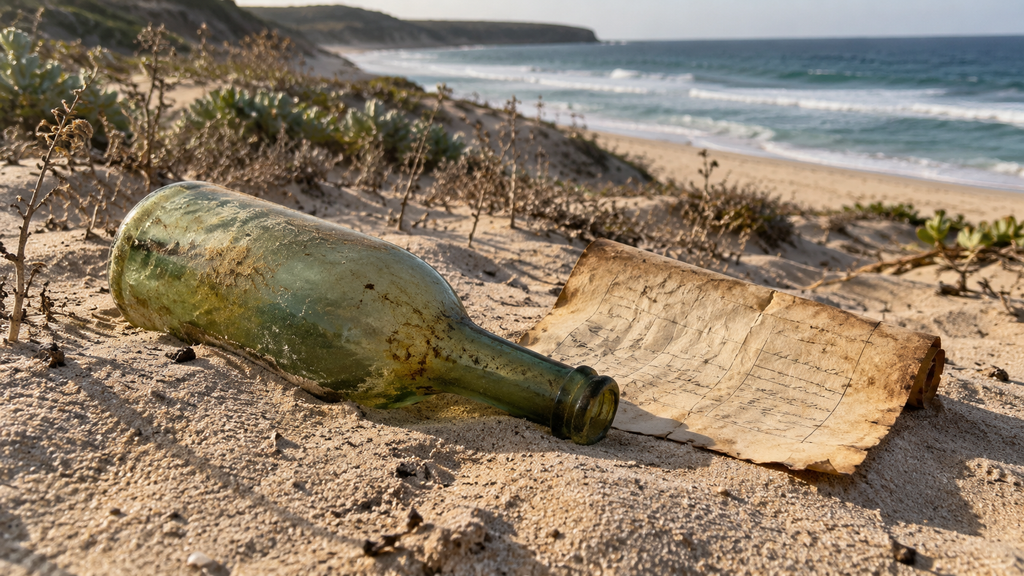
New places on the map also come from stories, if the places are named correctly. One such story happened recently, and all the names in it are real, so it’s easy to lay out the map with the child.
On January 21, 2018, on a beach north of Wedge Island, in Western Australia, about 180 kilometers north of Perth, a family found a car stuck in soft sand. While they were pulling it out, Tonya Illman and her friend Grace Richchardo went for a walk along the dunes. Tonya noticed an old bottle sticking out of the sand and took it because it looked beautiful and would make a good book shelf. The note inside was found at home by the daughter of her son when they were shaking the sand out of the bottle. The wet, tightly rolled, tied with rope paper was dried and unfolded. It was a printed form in German, dated June 12, 1886, and the name of the ship, the bark Paula.
The Western Australian Museum approached the find cautiously. Ross Anderson identified the bottle as a Dutch gin bottle from the second half of the 19th century; the paper also matched the age, but the museum had little to go on, so it asked colleagues in Germany and the Netherlands for help. In the German archive, a meteorological journal of the very same barque was found, and in the entry for June 12, 1886, the captain noted that a drifting bottle had been thrown into the sea. The date, coordinates, the ship's name, and the handwriting matched. Paula was sailing from Cardiff to Macquarie Bay, and the bottle was thrown into the Indian Ocean about 950 kilometers from the west coast of Australia.
It’s worth saying honestly about the thirty-three years because the child would immediately ask how she could have been swimming for so long. Most likely, almost not at all. The museum believes it’s likely that the bottle reached the Australian coast within a year, and then it lay in the sand; the location of the find was five-hundred meters from the current high tide line. It didn’t travel, it waited.
And the note was not a personal letter from anyone. The German scientist Georg von Neumann had been throwing out such bottles since 1864 to study currents; then the Hamburg-based Deutsche Seewarte took over the work. The captains filled out identical forms, including the date, coordinates, the ship, the port, the route, and asked the finder to add where and when the bottle was found and to send the form to Hamburg or to the German consulate. The program continued until 1933, and during that time 662 forms were returned to Hamburg; no one had kept the bottles themselves. The Australian became the 663rd, the previous one having come from Denmark on January 7, 1934.
Three words are important for the game of this story: Cardiff, Makassar, Perth. Cardiff, a port in Wales, Makassar, a port on the island of Sulawesi in Indonesia, and Sulawesi is still to be seen among the Indonesian islands; Perth is on the western edge of Australia, where on the map, apart from it, there is nothing for a long time. Three cities that were almost certainly absent in the family «Cities»; and all three have convenient last letters. After Cardiff, a city on the F is needed, and here the supply of adult characters is also quickly running out.
Four other games in which «Cities» hit the wall
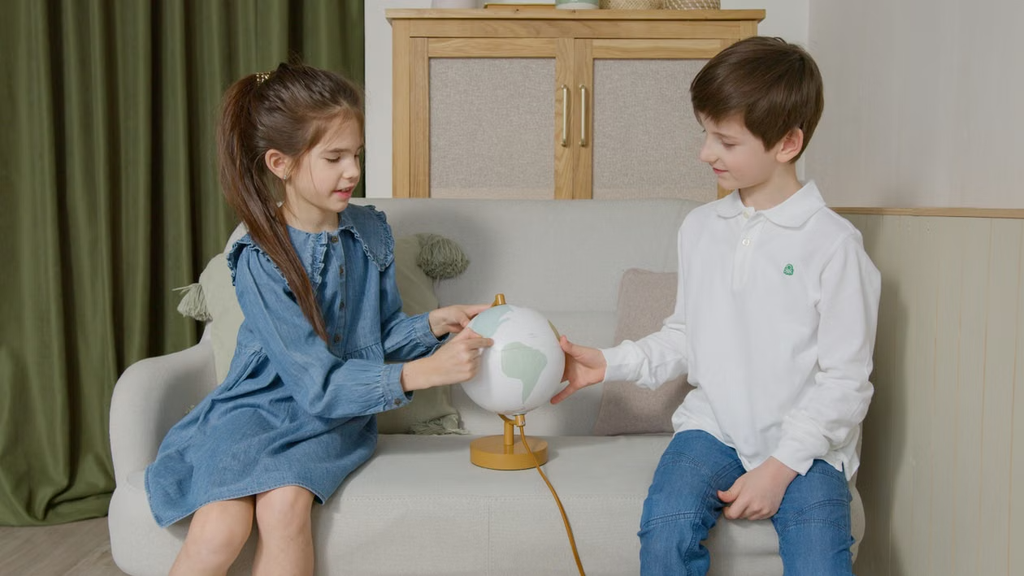
«Cities» is the only one of the five games that requires a card. The other four do not, and the rules for checking the answers are included in a separate section after the article; here we are just talking about the fact that in each of them the child gets a card.
In «Where Am I,» he gets the role of the one who knows. The child chooses a point on the map, holds it in his head, and answers only yes or no; the adult has to ask about the hemisphere, the nearest ocean, the neighbors, and the usual order: the adult knows, and the child searches, and the arrangement turns upside down. In «Three Hints,» he is allowed to come up with the hints himself, from the broadest to the narrowest, and from these hints it is clear that he has actually remembered the country, sometimes the ocean and the neighbors, sometimes only that bananas grow there. In «The Route Blindly,» one leads the finger from point to point and calls out everything that one goes through: countries, seas, straits, and the other follows the map and catches mistakes; the adult child wins the most, especially since even adults get confused about the countries between Europe and Asia. And in «Two Facts and a Invention,» it is the one who lied the best who wins, and in order for the country invention to be plausible, one has to first find out what actually happens in that country. This is a rare case where the child opens the atlas himself because he needs to trick his mother.
There is another thing about «Cities» that is worth mentioning in advance, before the first game. A child from an American school may know Florence, Vienna, Munich, and not know that in Russian these are Florence, Vienna, and Munich. It's not a gap in geography; the child knows the city. It makes sense to allow them to name it in English, find the Russian name together, and then play with the Russian letter. At the same time, it will be discovered that Rome and Rím sound almost identical, and Vienna and Rím don't exist at all, and that discovery alone is worth a move.
Where to keep the card
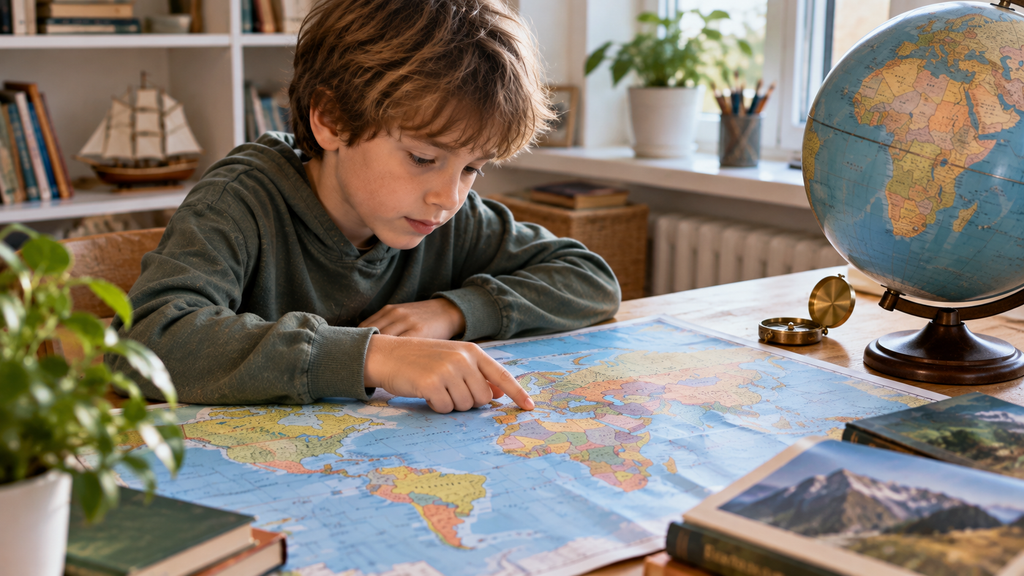
The last point is more of a practical matter. Everything we talked about works if the card is in the same place where the packages are received and where the games are played in «Cities,» which is the kitchen and the car, but not the shelf in the children's room. The wall map over the table, where purchases are sorted out, opens up ten times more often than the beautiful map in the child's room, which you have to go to specifically to get to. And the small atlas in the glove compartment solves the issue of the city on the F at the first traffic light. Which map to choose depends on the age. In our in the geography course For children aged four and up, we start with the simplest ones, where countries are read by color, but any map that includes Sri Lanka and Sulawesi would be a good starting point. We have a separate article about the Earth's oceans for how to navigate on such a map and why they are considered four or five oceans.
Five games without a screen and how to check the answer
The rules are short because in every game the main thing is not the rules but the verification. A map is needed for four of the five games; any map that shows the countries and major cities is suitable. It is better to check the answer together with the child using the map rather than by rote memory from an adult.
Cities
The first one names any city. The next one names the city with the letter at the end of the previous word. If the word ends in Ь or Ы, they take the letter before it (Perm gives M, Almaty gives T). With the letter Y it is a promise, not a law: there are few cities with Y, so it is usually also skipped (Shanghai gives A), but if the child remembers Yoshkar-Ola or York, the round is counted. Repeating the named cities is not allowed. If someone cannot remember the city, they skip the round or are eliminated as agreed beforehand.
For bilinguals, one additional element. If the child knows the city by its English name (Florence, Vienna, Munich), they call it in English; together, find the Russian name, and then the game continues with the last letter of the Russian word. Florence gives I, Vienna gives A, Munich gives N.
Where am I
The child chooses a country (for a start, a country and a city will be more difficult) and says only «I’m here». The adult asks questions that can be answered with a yes or no. In the Northern Hemisphere? Is there access to the ocean? Does it border Russia? More France? The child answers, looking at the map, the adult guesses. Then we switch roles.
Three tips
The guesser chooses a country and prepares three clues, from the broadest to the narrowest. The first clue is about a part of the world or a hemisphere; the second about neighbors or the sea; the third about something noticeable on the map, a shape, a river, the capital. The guesser can name the answer after any clue. If they guess after the first one, they get three points; after the second one, two; after the third one, one.
Route blindly
The first player names two points, for example Lisbon and Istanbul. The second closes their eyes or turns away and leads the way out loud, naming all the countries and seas in order of their passage. The first follows the map with his finger. As soon as something is named that is not on the route, or a country that cannot be bypassed is missed, the route is interrupted and the points change.
Two facts and a fiction
The player names a country and makes three statements about it. Two are true, one is made up. The rest have to find the made-up part. The statements must be such that they can be verified on a map or atlas: access to the sea, neighbors, capital city, longest river, whether there are mountains. The statements about food and weather on the map cannot be verified, so they are not counted.
Playing games in the car and stickers with bananas give a reason to open the map, and then the child needs someone to show them that there is more to it. At the geography course at Palme School, children from the age of four are learning online in Russian, in groups with children who are also growing up between the two languages.
You can learn more about the course on free trial lesson, In this case, the teacher will look at what the child already knows and will choose a group based on age.
Frequently asked questions about geographic games
From what age can children play geographic games?
The «Cities» game is played when the child is confident enough in letters and remembers at least a dozen cities; usually this is between the ages of six and seven. Games with a map («Where am I?», «Three clues», «Route by guesswork», «Two facts and a guess») are designed for children aged six to nine who can already find the country by name on a map. Tasks from the article on home geography.
What card is needed for these games?
Any political map of the world that shows the countries and major cities, or a children's atlas. For «Blind Route,» a map with seas and signed straits is more convenient. A map on a screen is also suitable for checking the answer, but playing with it is inconvenient because you have to move and scale it, and the paper version is completely visible.
What to do if a child calls cities in English?
Keep track. A child who knows Florence or Vienna knows the city, not just the word. Together, find the Russian name, pronounce it, and continue the game with the last letter of the Russian word. Over time, the Russian names themselves become fixed, because they are needed for the next move.
Why aren’t the soft signs Ы and Й counted in «Goras»?
There are no cities with Ь and Ы, so they take the previous letter: Perm gives M, Almaty gives T. With the letter Y, it’s a different arrangement. There are few cities with Y, and it’s usually skipped too (Shanghai gives A), but Yoshkar-Ola, York, and Johannesburg do exist, and if the child remembers one of them, the score is counted. It’s better to agree on this before the game starts so that you don’t argue over the very first Kazan.
What to do if a child doesn’t know the cities at all?
Start with an open map. Allow yourself to search for cities on the map while you're still in the game; that way the game becomes a search on the map, and that's also geography. After a few games, some of the cities will stick out, and you can remove them from the map for individual moves.
How long should one game take?
As much as a child is interested in. One game in «Gorky» in a car can last five minutes, while «Two Facts and a Fiction» with an atlas can last an hour and a half. It's better to stop the game before it gets boring, then they'll want to come back to it.
How to check the answer if an adult is not sure himself?
On a map or by following a guide in an atlas, together with your child. An adult does not need to know all the countries by heart; he or she needs to be able to find the answer, and the child learns this skill faster than facts. If a city is not on your map, that does not mean it does not exist; not everyone signs overview maps.