
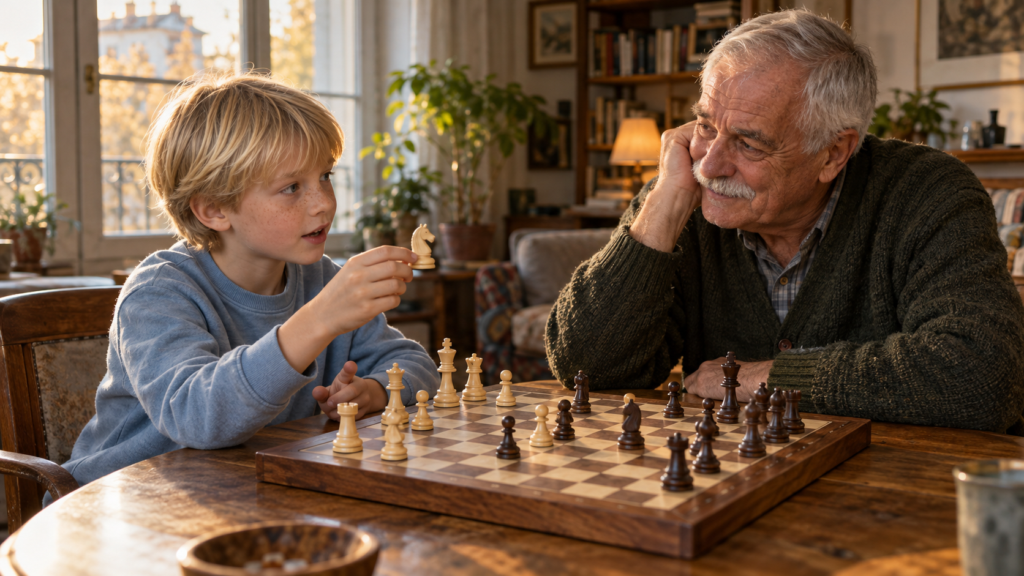

The child who learned chess in the school club sits down to play with his grandfather. He makes the first move and announces it in Russian, as he is able to.
«I walk like a knight.».
The grandfather raises his eyebrows. What a knight, where? On the board stands an ordinary horse with a mane, the same as the one he had when he was a child. And for a child, it's knight; he simply translated the word, honestly and according to the dictionary. Knight in English really means knight.
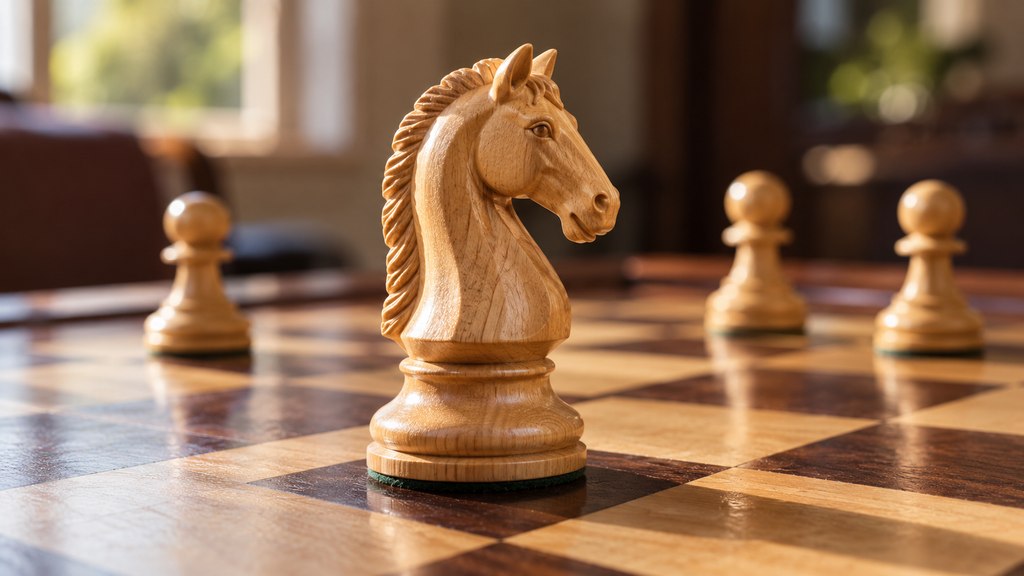
There’s no point arguing here; they’re both looking at the same figure. It’s carved in the shape of a horse’s head in both America and Russia. Only the English named it after the rider who’s not visible on the board, while the Russians named it after the horse that is visible. The grandfather calls what’s on the cage; the child calls the one who, by design, is sitting on it.
One line, different letters
The figure moves the same way, no matter what you call it. Two cells straight ahead and one to the side; and in doing so, it jumps over everything in its path. Only a horse can jump over figures in a normal manner.
The grandfather will explain the process in a typical way.
«The horse goes by the letter G.
At the school club, the child was told something different.
«The knight moves in an L.
If you write these two letters next to each other, you can see that it is the same figure, just reflected. G looks like an L, flipped upside down, like a reflection in water. It turns out that the two languages describe the same angle and each took its own letter for it. For a child who knows both alphabets, this may seem funny, but funny is easier to remember.
The party's first move
The easiest way to show all this is in the very first position. The pieces are standing in their places, the pawns are ahead, and only the pawns and horses can move at the moment. The elephant, the rook, the knight, and the king are prevented from moving by their own pawns, and the horse simply jumps over them.
Let the child make the most usual first move: a white knight with g1 on f3. Two cells up, one to the left. Through the pawn on g2 he jumps over and stands in front of the pawn f2.
And then you can ask him to tell about this move twice, first to his grandfather, then to a friend from the club.
«The knight went from g1 to f3, with the letter G, through the pawn.
«The knight went from g1 to f3, in an L, over the pawn.
The steps are the same, the cells are the same, the names of the cells do not change at all; f3 and, in Russian, f3. Only the word for the figure and the letter for its path change. If the child was able to describe the same steps in two ways, he saw for himself that only the words change.
The horse's first move in two languages
Starting position. Click on the white horse, then on the square where it will jump. The same move will appear on the board in Russian and English, with its recording.
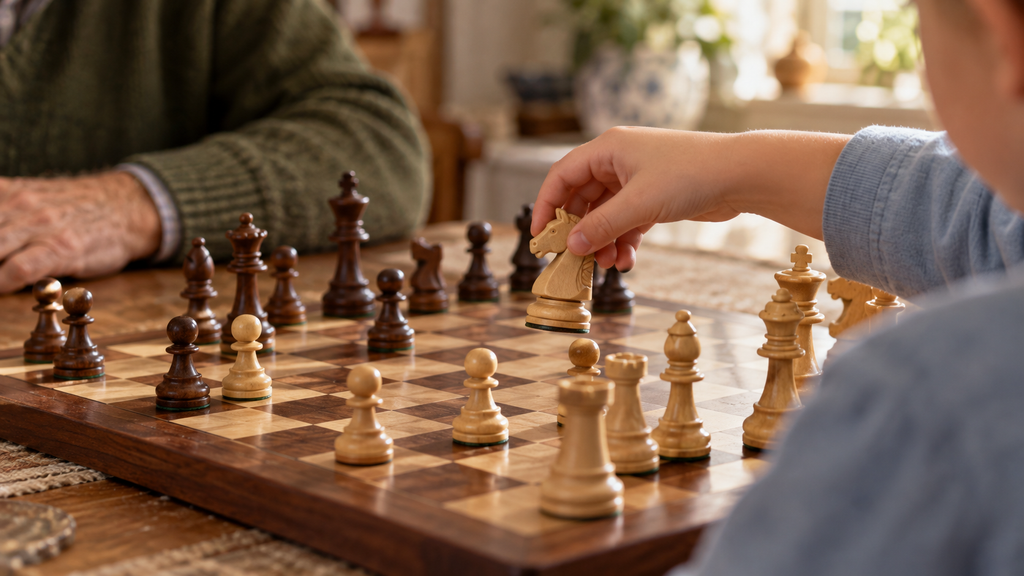
Another mirror in the party's records
Chess players write their moves in a short form, with one letter for the piece and the name of the cell. And here again, the two languages diverged, mirroring each other.
In the Russian notation, figures are denoted by the first letter. Ferz F, Ladle L, Elephant S. The horse and the king start with one letter. To distinguish them, the horse is denoted by K and the king by Kr. Our move in the Russian notation looks like this.
«Kf3».
The first letters are also used in the English version. K stands for king, king. To avoid confusion with the horse, knight is written with the letter N. The same move is written in English as follows.
«Nf3».
So, in one language the horse took the letter from the king, and in another the king took it from the horse. The child who keeps track of the game in two languages will come across this for himself, and it is better if an adult warns in advance that the K in the English notation is not at all a horse.
Who is right, the knight or the horse?
Both. It's one figure with two names, like many things in a bilingual household.
It’s easier to say «knight» with grandpa because that’s how everyone says it on any Russian board. With the trainer at the club, it’s easier to say knight. But you can leave «knight» as a joke. Maybe grandpa will smile if his grandson one day says that he became a knight using the letter G. A knight is of course nothing, but a knight is nothing either.
Frequently asked questions about the chess horse
Why is a chess piece called a knight in English?
Knight in English means «knight». The figure is carved in the shape of a horse's head in both America and Russia, but in English it is called after the rider, and in Russian after the horse.
How does a chess piece move?
Two cells are straight ahead and one is to the side. In Russian, they say «the knight moves in an L.» In English, «the knight moves in an L.» Only the knight can jump over the pieces in a normal way.
Why is the horse in the English recording denoted by the letter N?
The K in the English spelling stands for king, king. To avoid confusion with the horse, knight is denoted by the letter N.
How are figures denoted in the Russian chess notation?
Ferz F, Lada L, Slan C, Kon K, Kr King. The horse and the king start with the same letter, so the king is written with two letters. The pawn is not denoted with a separate letter.
Which characters can move in the beginning of the game?
Only pawns and horses. The elephant, the lance, the feruz and the king are prevented by their own pawns; the horse jumps over them. The usual first move of the horse, with g1 on f3, is written Kf3 in Russian and Nf3 in English.
Is it possible to call a horse a knight?
On the Russian board, the figure is called a horse. A «knight» is created when a child translates the English word "knight" into Russian, and it can be used as a joke.
We have a separate section on the history of gambling in Russia. A story from Alekhine to Kasparov.