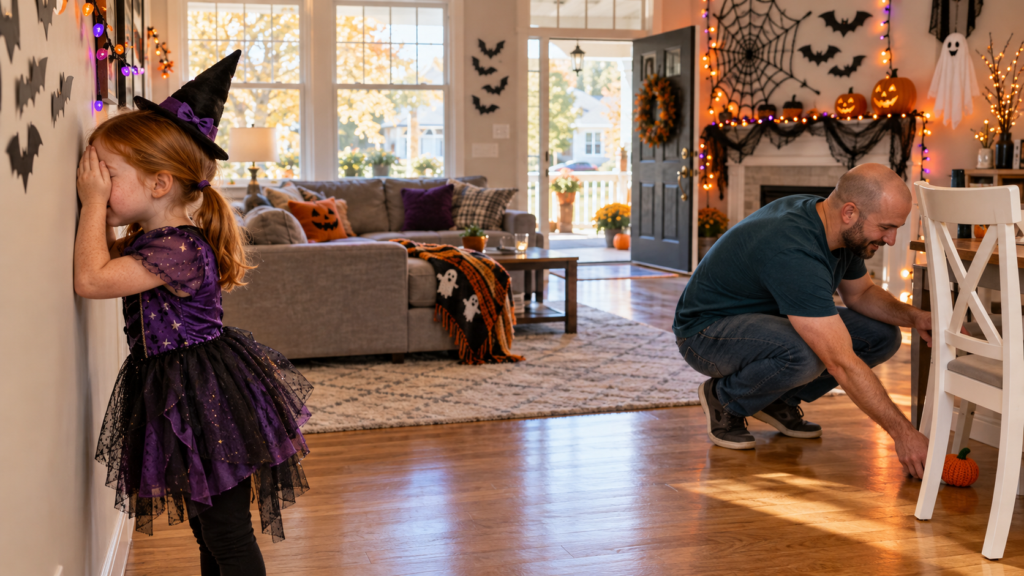

«One, two, three, four, five, I’m going to look for it.
Many parents decide on this themselves without thinking too much about it. «If someone didn’t hide, it’s not my fault.».
In an American schoolyard, at that very moment, a child shouts something else: ready or not, here I come. The meaning is almost the same. Those who haven’t managed to hide are to blame themselves.
This counting game is also suitable for a Halloween home scavenger hunt. A small pumpkin, toy or drawn on a sheet, the size of a hand, will be hidden in it. In an English-speaking family, this game would be called treasure hunt, although the treasure here is orange and quite small.
It's convenient to play with children from about five to eight years old. There's no need to read anything; everything is spoken aloud.
I'm going to look for it
In the hiding places, the calculator does an important job. While one counts with his eyes closed, the others hide. You can't peek, otherwise there won't be anything to look for.
In the pumpkin quest, the rule is the same. Whoever is looking turns around towards the wall or leaves the room and counts. Until five, and if they take a long time to find the treasure, they can count up to ten.
The child thinks first. That's how the first Russian phrase in the game sounds to him, and it sounds loud, as is appropriate in hide-and-seek games.
Who didn't hide
The second half of the quest is funny. The pumpkin itself can't hide; they hide it for her.
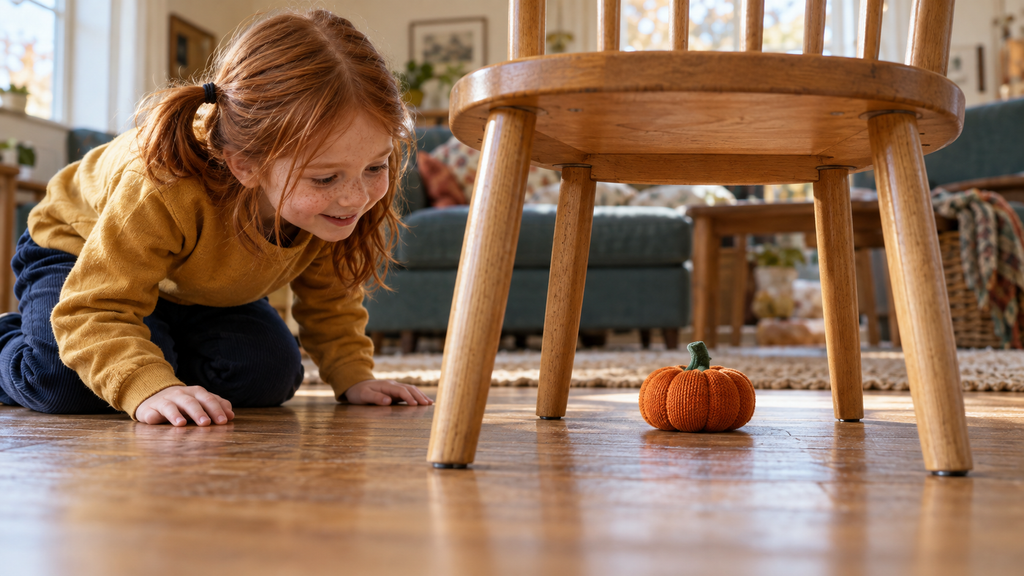
The child opens his eyes and declares that he is not at fault. And the pumpkin remains silent and lies somewhere under the chair.
The girl will say «I am not to blame.» If that is what it sounds like, that's fine. There's no need to dwell on it specifically; the quest has another purpose.
Under or behind the chair
Before the child starts counting, show them how the prompts sound.
For this, it is convenient to take one chair and stand side by side with the seat. An adult places the pumpkin under the seat.
«Under the chair.».
Then he moves it to the floor behind the backrest.
«Behind the chair.».
The word «stol» sounds the same both times; only the first word changes. When referring to places, «under» and «behind» require the accusative case, and for one object the form coincides. For other objects, the endings will be different; «behind the curtain,» «under the pillow,» «behind the books.» We suggest starting with one chair for convenience; we do not consider this to be the only correct order.
If the «behind the chair» hint is unclear, you can ask: «From the side of the backrest.».
Then the child turns away and the cube disappears. For the first time, two or three items in one room are enough. It is better to choose items that the child can name and that are easy to reach.
«Look under the chair.».
If the child gets lost, point to it with your hand. The pumpkin will still be there, and the word will still be heard.
Now he considers himself an adult
In the second round, the adult turns around.
«One, two, three, four, five, I’m going to look for it!»
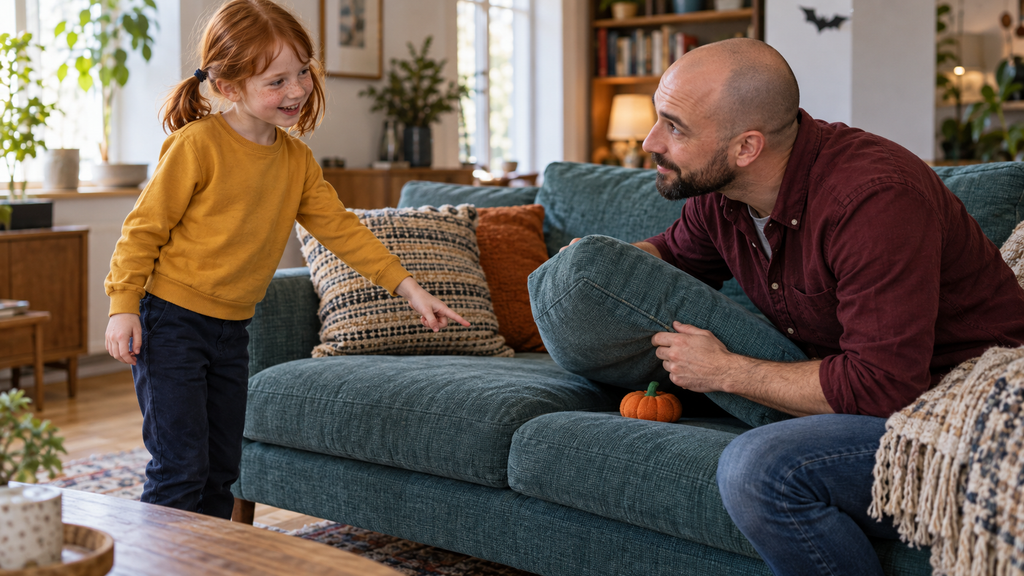
The child hides the pumpkin. Only he knows where it is now, and without his help an adult won't be able to get through it. That's why the quest round is initiated.
«Where is the pumpkin?»
We choose this question deliberately so that the answer will sound like «under the chair» or «behind the chair». If you ask «Where did you hide the pumpkin?», the correct answer would be «under the chair». «Where» asks about the location, «where did you hide it?» asks about the direction. In English, both questions start the same way: where is the pumpkin and where did you hide it? In Russian, these are two different words.
If the child still answers «under the chair» when asked «where is the pumpkin?», the game does not stop. The hint is clear.
«Oh, under the chair. I'll take a look now.».
It is not necessary to repeat what an adult says.
When a hint is without words
The child can simply point to a chair. Or say one word, «chair.» That is enough to find it. Now the adult can ask, «under the chair or behind the chair?» and the child will answer with a word or gesture.
It is only advisable to ask for a choice after the child has named or shown the object themselves. Otherwise, the adult will have to guess the object themselves and look for it on their own.
«Cold, warmer, hot» is something many parents also remember from their childhood. How to play it together with a peer was something we discussed in An article about a child who keeps quiet with his peers. You can keep this toy for a rainy day. Only with it you will find the pumpkin without saying a single word about the place.
If the hint is completely unclear, it’s easier to ask to be shown. «Show me what place you mean by that.» Then you can name the place.
Ready-made replicas for both rounds and caches of choice are included in the scenario.
The scenario of the quest with the pumpkin
You need one small pumpkin, a toy or one made from paper. Before each round, the seeker turns to the wall or leaves the room and counts out loud. Two or three seats in a single room are enough for the first game.
Display on a chair
Stand with the child on the side of the seat. Place the pumpkin under the seat, then on the floor behind the backrest.
Adult«Under the chair.».
Adult«Behind the chair.».
This is a support for the game, not a test. If the child nods and reaches for the pumpkin, you can start.
The child is searching
Child«One, two, three, four, five, I’m going to look for it!»
While the child is thinking about it, hide the pumpkin.
Adult«Look under the chair.».
Childfinds the pumpkin.
If the child gets lost, point with your hand. Play this two or three times, each time with the words «under» or «behind».
The adult is looking for
Adult«One, two, three, four, five, I’m going to look for it!»
While you're thinking about it, the child is hiding a pumpkin. Don't peek, otherwise you won't need the hint.
Adult«Where is the pumpkin?»
Child«Under the chair.».
Adult«Under the chair? I'll take a look now.».
If «under the chair» is heard, answer «Yes, under the chair. I'll look now» and go find it. You don't need to repeat what you just heard.
If the child points to or names only one object
Adult«Where is the pumpkin?»
Childpoints to a chair or says «chair».
Adult«Under the chair or behind the chair?»
Childresponds with a word or gesture.
Only ask the child to choose after they have identified the object. If the hint is completely unclear, ask them: «Show me what place you have in mind,» and then say it yourself.
Tainiki to choose from
Pick the places that the child knows how to name and that are easy to reach. You don't have to go through everything.
Where is the pumpkin?
Read-aloud hint
The picture repeats the game on the floor. The real pumpkin and the real chair work better than the screen, and you can even shout at the timer here.
When the pumpkin was found
For the game, the result is the same: the cube was found. How exactly the child helped can be seen separately: by gesture, the word «chair,» or by «under the chair.» One successful phrase does not mean that it will always work that way.
If the child himself hides the pumpkin on a shelf or in a box, the adult simply calls the place «on the shelf» or «in the box,» and the game continues.
After the holiday, the child will have something to talk about in Russian: who he was on Halloween. We have that here. separate article.
And the calculator can be left unused after October 31st. «I'm going to look for it» is suitable for any household item that might be lost, from a pumpkin to a second pair of socks.
The Russian for Bilinguals course at Palme School also includes games. Children aged four to seventeen participate online in groups of up to eight people.
You can learn more about the course on two free lessons. First, the methodologist determines the child's level and helps choose a program. Then you can meet the teacher during a free lesson.
Sign up for free lessonsFrequently asked questions about the pumpkin quest
How to organize a Halloween quest at home if the child doesn't yet read in Russian?
There is no need to read this quest. All the clues are spoken, and instead of notes, a counting system using the numbers 1, 2, 3 works. All you need is one small pumpkin, one chair, and two words: «under» and «over.».
Which is correct, «under the chair» or «under the chair»?
Both forms are correct, but they answer to different questions. «Where is the pumpkin?» «Under the chair.» «Where did you hide the pumpkin?» «Under the chair.» In the quiz, the adult asks «where?», so that the clue sounds «under the chair».
What should I do if the child speaks English or only points with their hand?
Take the hint and go look for it. If the child points to a chair or says «chair,» you can ask, «under the chair or behind the chair?» If they say under the chair, the adult repeats the location in Russian, «under the chair,» and looks for it. It’s not necessary to repeat after the adult.
Is it possible to play this quest with a child under the age of five?
It is possible if the child understands the request «look under the chair». The age in the article is given as a guide. It is more convenient to leave only the first round, where the child is looking for, and one or two hidden objects.