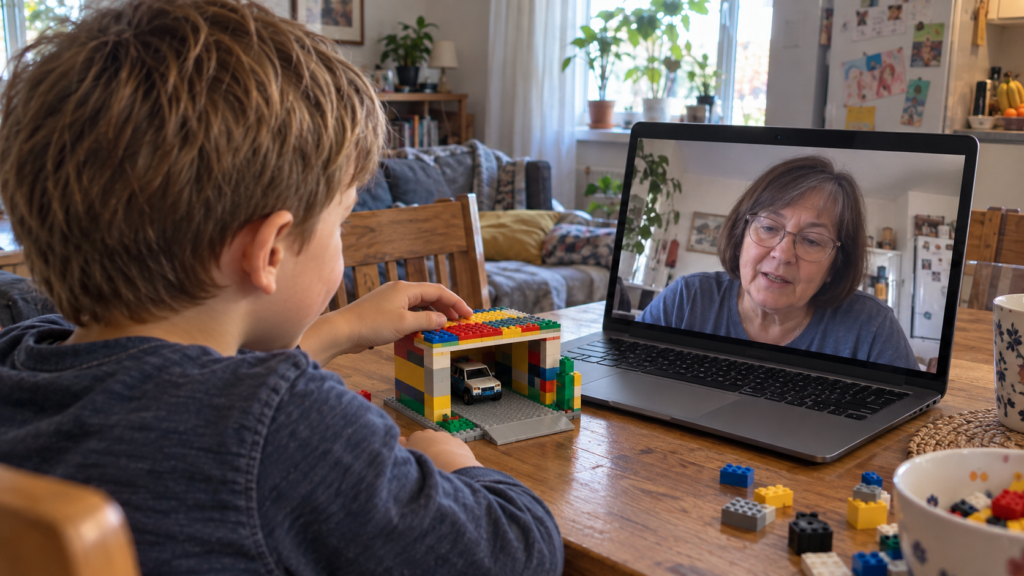

Grandmothers have a saying for grandchildren who haven’t visited or called in a long time: «You haven’t said a word in a while.» Video communication was supposed to cancel that out; now the grandchild sees the screen every night. In reality, the screen often shows only the top of the screen, the edge of the ceiling, and the door of a closet, because the phone was placed on the table, and the child is sitting lower than the one who placed it. From under the top of the screen, the grandmother hears «normal» when asked about work and another «normal» when asked about school; a few minutes later, the call ends on its own, even though no one interrupted it.
Why the conversation never really got started is beyond understanding, and we won’t speculate on it. Let’s focus on the actual phrase itself. The verb on which it is based has almost disappeared in ordinary speech and has survived mainly in these forms. «To say» means to show. In Shansky’s etymological dictionary, the word «to say» is explained as «to show.» The common Slavic root for both showing and speech is «kazati,» which meant «to speak, to show.» The common historical root of both showing and speech is still present in «to show,» «to say,» «to tell,» and «story.».
Let me show you
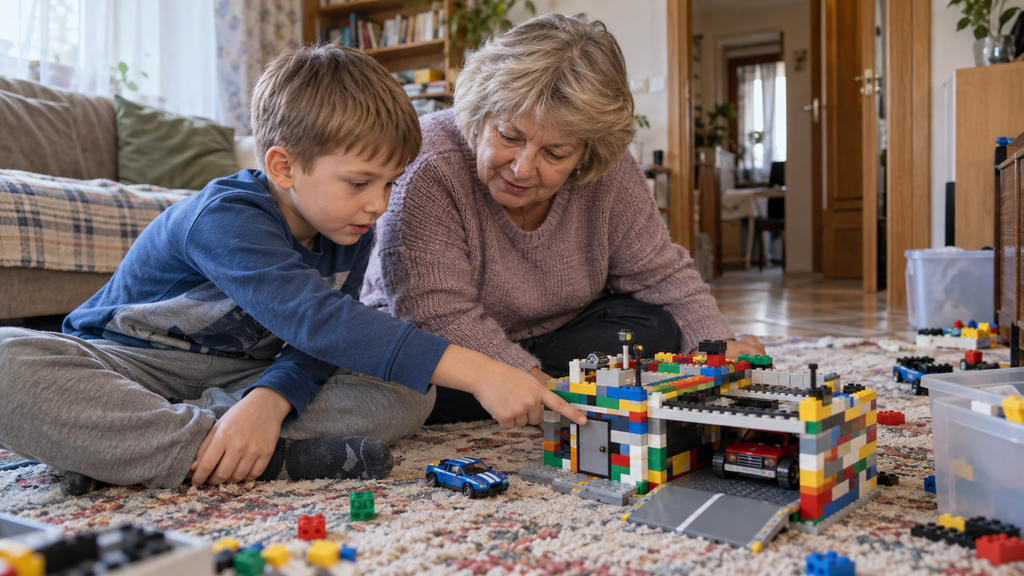
At Grandma’s house, the conversation can quite easily start without any questions being asked. The grandson drags her into the next room, where a garage built with a construction set has been standing since morning; on the doorstep he already announces that the garage has three doors, and one of them is secret. Grandma scoffs, asks who the secret door belongs to, the grandson explains, and in about ten minutes they are sitting on the floor together, and no one has even asked about school.
There are no hand gestures in video calls. You can’t drag grandma into the next room, and there’s nothing on the screen between the two of them that could spark conversation. Questions remain, most often about what’s missing in the footage, about school, about friends, about the weekend. The question «What did you do on the weekend?» leaves the child with a lot of choice about what to talk about and where to start. Some children can answer «Playing,» while others can’t even say their first word. If the child talks more in English on weekends, the English phrase may come before the Russian one.
Hence the answer to the question posed in the title. Before the camera, you should put something that the child would bring to grandma to watch, if she were there. He chooses for himself. If the object is chosen only for good grades and achievements, the call risks turning into a report, so a crooked garage that the owner boasts of is more appropriate here than the letter of reprimand that the adults have handed out.
Here's the garage
You can start with two words in your hand: «Here’s the garage.» This is a complete sentence without a verb. You don’t have to choose between «built» and «built by.» You don’t have to remember when the construction started. The word «here» draws the grandmother’s attention to what the child is showing, and she already understands what to ask about.
There’s no magic here. The object provides a theme; its linguistic difficulty doesn’t cancel out the fact that no one can promise that a child who has a garage will start talking or speak for longer. However, you don’t have to invent a theme on the fly; it’s already there on the table, and both of you can see it.
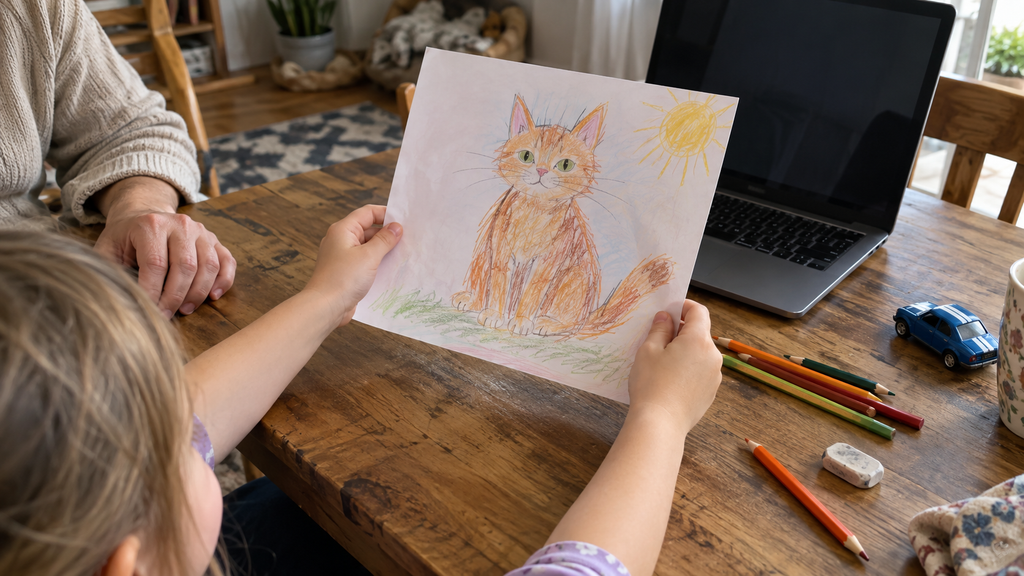
In a visit to a friend’s house, the grandchild not only asks questions, but also does so without any preparation. For a phone call, one can come up with such a question in advance, together with an adult if it is difficult for the child to answer on his own. For a question about a car, «Did you have a car when you were a child?» or a question about a cat drawn by the child, «Did you have a cat?» are good. This gives the child the opportunity to choose for themselves what to ask their grandmother about. In any case, no one rehearses the whole conversation; the grandmother will still answer something that is not according to the script.
How to prepare a call to grandma
This is not a mandatory program; it is just a few tips in case the conversation gets stuck. One step is enough. If grandma and her grandson are chatting away in their own way, there’s no need to add anything.
The object is chosen by the child
Things that can be opened or turned in your hands are convenient: a machine with opening doors, a box with marbles, a paper airplane. Too small on the screen turns into a spot; you can't show the entire huge structure; then they show the most interesting part.
A four-year-old will show a toy, a stone from a walk, or a doll in a new dress; a nine-year-old may show a craft project, a school project, or a collection of cards. Things with a grandmother’s story are especially good: a book sent by her, a sweater knitted by her, pancakes made to her recipe. The object doesn’t have to be new; the same fortress with a new addition is again a reason for conversation.
One question from a child
The question should be one that the child is genuinely interested in finding the answer to. You could ask the child about the tower, «Who do you think lives here?» about the toy car, «What kind of car did you have?» and about the cat that was drawn, «Did you have a cat when you were a child?» You could also ask about the grandmother's house, her childhood or what she thinks about the construction.
If it’s difficult to formulate a question, an adult can help. A five-year-old can be offered two options to choose from. If the child already reads in Russian, the question can be written down on a sticky note and stuck on the phone. One question is prepared, and the whole conversation is not rehearsed. It’s enough to say the question out loud once.
Phone, light and time
It is better to place the phone on a stand or rest it against a pile of books so that the child has free hands. Keep the light falling on the child's face: if the child sits with their back to the window, the grandmother will see a dark silhouette, and the object will be lost. It is better to place the object itself near, at arm's length. It is more convenient to make calls when no one is in a hurry.
What to tell Grandma
You can warn the grandmother that the grandson has prepared something and wants to ask a few questions, and ask him to be given time to ask them himself. If necessary, you can discuss the topic in advance.
A child may need time to find the right word. If the grandmother waits a little, the grandchild often says the word itself. Sound over the network comes with a delay, so a simple rule works for everyone: say the word and wait for an answer, even if it seems like the connection has dropped.
If the child says «my tower,» you can answer the question in a meaningful way and at the same time repeat the correct form in your phrase: «Your tower? How tall is your tower?» After showing the toy, the grandmother can ask about the details, for example, «What’s on the top of the tower?» or «Can you show me how to open the gate?» She can first answer the grandson’s question and then ask his opinion, the main thing is that the conversation does not turn into a test.
After the call
It is worth noting whether the child has said something on their own: a prepared question, «look,» a new word. It is worth noting silently, without asking «well, did you ask Grandma?» It is also useful to write down other things: what subject sparked interest and what question did the grandmother answer with a long story.
You can share the news with your grandmother in a different way as well, for example to write her a letter in Russian.
Sometimes a child gets excited and shouts «Look!» and then continues in English, so it’s faster that way. The doorbell doesn’t break because of that; the garage is still in the frame. How to react depends largely on whether the grandmother understands English, and that’s a whole separate big topic.
When the item is not helpful
There are evenings when the child doesn’t want to show or ask, and waving a hand to his grandmother is also a normal greeting. The child’s own phrase remains a possible result, not a mandatory one. If he only showed the garage and then listened to his grandmother talk about a car that he never had, but that his neighbor did have, the call still took place. The grandmother saw a part of her grandson’s life; the grandson listened to Russian speech addressed to him alone for a few minutes.
And the story about the nose can be put aside for now. When a garage appears in the frame instead of a top of the head, the grandmother sees more than just a nose.
At the «Russian for Bilinguals» course at Palme School, children from the age of four learn to communicate in Russian. The classes use games and discussions that give the child a chance to speak.
You can get acquainted with the school at two free lessons. The school will determine the child's level of Russian language and recommend a program of study.
Sign up for free lessonsFrequently asked questions about video calls to grandma
Why is the child silent during a video call with her grandmother?
With one short answer, you can’t understand the reason. Perhaps the child has difficulty immediately remembering the events of the week, choosing what to talk about, and finding the right Russian words while grandma is waiting for an answer. There are other reasons as well, and sometimes the child simply doesn’t have the mood to talk.
What to put in front of the camera during a call to grandma?
Something the child would like to show their grandmother: a construction from a building block, a drawing, a craft or a toy. The object provides the topic for the conversation, and you don't have to come up with it on the fly. The child chooses it themselves.
Will the child talk if they show an object to their grandmother?
You can't promise that. The object gives a theme; the linguistic difficulty doesn't cancel it out. If the child just showed their thing and listened to grandma, the call still happened.
Is it necessary to cook with a child a question for grandma?
You can prepare one question that the child is genuinely interested in answering, for example, «Did you have a cat when you were a child?». The adult can help formulate it. The whole conversation is not rehearsed in advance.
What to do if a child answers grandma in English?
The call will not be interrupted by this, the subject will remain in the frame, and the conversation about it can be continued. How to proceed depends largely on whether the grandmother understands English. If the grandmother does not understand, an adult can briefly translate what has been said and let them continue the conversation.
At what age is this method suitable?
The article is intended for children aged approximately four to ten years. The item is chosen based on the child's interests, and assistance with the question is offered if necessary. It is simply possible to show your item at any of these ages.