

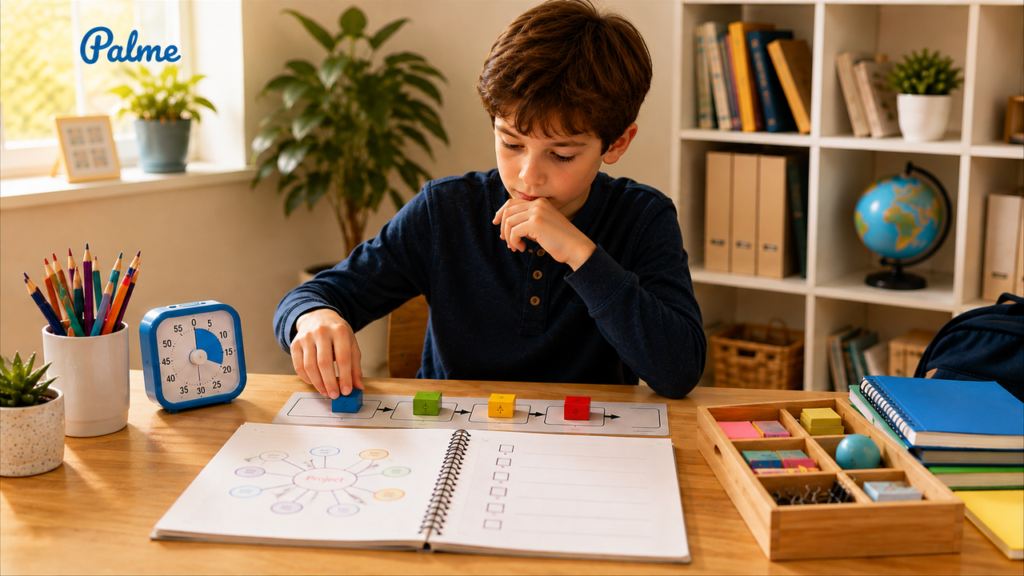

Notebook out, date at the top. Same words from me, every lesson, the whole of September. Timur took out the notebook and stopped. No date. I would say it again slower, he would write the date, and then sit with an open notebook and no idea why.
Eight years old, second year with me, Sacramento suburbs. By October I had a theory about his motivation. Then I split it. Notebook. Thirty seconds of nothing. Then the date. He did both halves twice running without a stumble, and I sat there feeling the floor tilt under a comfortable assumption.
His attitude had been fine all along.
The sentence was simply longer than his shelf. That shelf has a name. So do the two abilities working beside it, and the reason to learn all three is that they fail one at a time, which means they can be propped up one at a time. A label gives you nothing to hold on to.
I know the label from the inside. My mother kept a list on the back of the kitchen door of everything I lost that month, not as punishment, just bookkeeping, and I remember watching it get longer with nothing to say for myself. Gloves, keys, a library book that surfaced two years later behind a radiator. Nobody in that apartment had heard the words executive function. They had rasseyanny, and I wore it until thirty.
Which is why I catch this in children faster than I catch anything else. It is also why I distrust the word, since clouds arrive, clouds go, and the weather report changes nothing about your Tuesday.
It describes weather.
Three abilities, not one problem
Hold a goal in mind. Reach it while the room and your own impulses argue otherwise. That is executive function, and every complication in the research comes down to which half of that sentence gave way.
Adele Diamond wrote the review the field still runs on, published in the Annual Review of Psychology back in 2013, and a parent can map her three-part division onto a kitchen table in about five minutes.
Her one-line account of the purpose: «taking the time to think before acting.»
| The job | What its absence looks like at home | |
|---|---|---|
| Working memory | Holds material in mind and works on it | Back half of a two-part instruction evaporates |
| Inhibitory control | Blocks the automatic move so a better one gets a turn | Blurting, interrupting, dessert before dinner |
| Cognitive flexibility | Swaps rules, angles, methods | First approach fails and the child runs it again |
Planning is missing from that table on purpose. Diamond treats planning and reasoning as upper-storey abilities built from the three underneath, and missing the hierarchy will cost you. Take a boy who cannot outline a book report. Planning weakness, possibly. Or working memory running out of road before an outline gets built, and those two want opposite things from whoever is standing there. Akira Miyake and colleagues tested separability in adults in 2000 and came back with what the field calls unity and diversity: correlated, so something is shared, yet still separable. In young children the components sit closer together and pull apart with age.
A short shelf looks exactly like a bad attitude
Never once has it reached me as a complaint about executive function. Parents and teachers describe the child instead, and the description is usually accurate and entirely beside the point.
My first year teaching online I timed myself and found I was packing three separate demands into an average instruction, which works in a classroom, where a child watches your hands and the others starting. On a video call none of that exists. A mother in Vancouver put it plainly that winter: her daughter could not see what I meant.
Timur’s version was the compound instruction, issued constantly because most children manage it. Take out your reader, turn to page forty, underline the words you don’t know.
Three operations riding one sentence.
A child with a short shelf pulls out the reader and halts, the room reads a boy who wasn’t listening, and splitting the instruction is a thirty-second test that tells you which of the two you have.
Homework finished and never handed in runs on different hardware. Carrying an intention across a noisy day is working memory; acting on it at the one moment it counts, with nothing in the room nudging your elbow, is inhibition. Adults, who mostly cannot do this either, farm the job out to calendars. Flexibility fails quietly, which is why it goes unnoticed longest. Olya, eleven, out in the Houston suburbs, could not tell me at the start of a lesson what she meant to talk about, and treated every session as though nothing had preceded it. A child who cannot picture Thursday will not prepare for it in any language.
Wrong expectations do more damage here than anything else. What follows is my classroom shorthand. It is not a developmental norm, though it does sit beside the trajectories Best and Miller describe.
At six a child holds one rule and follows one instruction dependably, two-part instructions stay hit or miss, and waiting a turn works at visible cost. By nine a plan survives an afternoon. Not a week. An afternoon, and the gap between that and what a school calendar assumes accounts for a startling share of household shouting.
Thirteen is the strange one. Capacity has turned up and reliability has not, so a teenager plans a project properly and then fails to begin it, and that failure reads as defiance when it is initiation. Middle school picks that month to hand a child six teachers and a locker combination. Sitting one band behind peers is normal variation; support pulled away too early comes back in October of sixth grade, by telephone.
When to stop reading and call a doctor
Executive function difficulty sits close to ADHD. It is one important component of the picture, and calling it a side effect gets the relationship backwards. Erik Willcutt’s 2005 meta-analysis is the work to know: across eighty-three studies the deficits showed up reliably at moderate size, and weak executive function turned out to be neither necessary nor sufficient for a diagnosis. According to the CDC’s survey, roughly one in eight American children between three and seventeen currently holds an ADHD diagnosis.
Certain signals move a situation out of my territory. Difficulty that turns up everywhere and not in one subject, that has held six months or more instead of following a move or a divorce, that shows at home and at school and among friends at once, and that shrugs off every ordinary support.
When several of those line up, the next conversation belongs with a pediatrician or the school psychologist, and it goes better if you bring the assignment log for a month and a note of what changes when instructions get split.
The tower takes twenty years to build
Harvard’s Center on the Developing Child supplies the metaphor American schools use: a busy tower, planes circling, one runway, no pause button on the sky. Anyone who has watched a nine-year-old pack a bag, answer a question and hunt for a shoe at once has seen that tower go dark. Nobody passes the schedule along to parents. Raw capacity arrives at birth, wiring the rest takes roughly two decades, and the prefrontal regions carrying most of that load mature late. John Best and Patricia Miller traced those trajectories in a 2010 review, and the three do not develop in step.
Switching languages costs capacity
Each switch between languages draws on the same limited capacity the child needs for the work itself, because selecting one system, muzzling the other and keeping both retrievable all bill to the same account. So one child looks buttoned-up in English and scattered in Russian, same desk, same Tuesday, and her parents read that gap as a verdict on Russian when it is a reading on load.
Now the boundary, which matters more than the observation. Whether growing up bilingual strengthens executive function across the board has been argued for decades, and the evidence stays contested with any effects small. I keep out of that fight. What nobody disputes is the price of the switch itself, pinned down by Renata Meuter and Alan Allport in 1999 with adult bilinguals naming numbers. It runs asymmetric. Returning to the stronger language costs more, and a Russian lesson asks for exactly that in its final minute, when the child goes back to English for the rest of the evening.
Three studies everyone quotes wrongly
| The study | What it examined | What came out |
|---|---|---|
| Diamond, Annual Review of Psychology, 2013 | Review of definitions and development | Three core functions; planning built on top |
| Miyake et al., Cognitive Psychology, 2000 | Latent-variable analysis, adults | Correlated, still separable |
| Moffitt et al., PNAS, 2011 | About 1,000 New Zealanders, birth to 32 | Childhood self-control predicted adult health, finances, offending |
| Watts, Duncan and Quan, Psychological Science, 2018 | Marshmallow replication, 918 children | Association half the original size, cut by two thirds under controls |
| Kassai et al., Psychological Bulletin, 2019 | Meta-analysis, EF training | Trained skill improved, no convincing spread |
| CDC, National Survey of Children’s Health | Parent-reported ADHD, ages 3 to 17 | About 7 million children, 11.7%, current diagnosis |
Parents arrive frightened of the marshmallow. Wait for the second sweet at four, the story runs, and you grow into an adult who earns more and weighs less. That study was small, drawn from families near Stanford. Tyler Watts, Greg Duncan and Haonan Quan repeated it in 2018 on a messier sample, and the link held at about half the advertised size.
Once family background, early cognitive ability, and the home environment were controlled, the association was «reduced by two thirds,» the authors report.
Whatever survived came from the gap between children who could hang on briefly and those who could not hang on at all. Narrower than the finding parents arrive with.
Never a crystal ball. A thermometer.
Training apps are the second distortion. An industry sells working memory games on one promise, that a roomier memory produces a better student. Reka Kassai and colleagues pooled the evidence in 2019, confirming training lifts the trained task while finding no convincing evidence of the lift travelling next door, and a companion review across ninety studies found the gains not convincingly standing at follow-up. Timur’s mother ran a well-reviewed app for a season; his scores climbed beautifully; the notebook and the date carried on as before. Terrie Moffitt’s Dunedin cohort is the strongest evidence here and the most oversold. A thousand New Zealand children followed into their thirties, with childhood self-control predicting adult health, finances and offending even once IQ and social class were accounted for. Real result, and still a pattern across a thousand people, which tells you nothing about which four-year-old in your kitchen becomes which adult.
Sleep and routine beat any app

Whatever has the strongest evidence behind it looks like ordinary life, not treatment. Sleep. A routine the child can see coming. Activities demanding planning and self-control while she does something she cares about anyway. Diamond has been making this argument since at least 2013, without much commercial success.
Halve the instruction, because under about ten the ceiling is what binds. Move the plan out of the child’s head onto a note card or a whiteboard by the door. Hang routines on events, not clock times, since after dinner survives a chaotic week and six-fifteen does not. And name the function, not the child. «That was a lot to hold at once» lands differently from «you never listen.» Some things have fallen flat in my hands. Sticker charts curdle, past about eight, into a negotiation more interesting than the task, and the color-coded planner I once built with a Toronto family had turned into a second homework assignment inside three weeks. I have also given the responsibility lecture more times than I want to count, in two languages, to no effect I could measure.
Scaffolding, not a crutch
Drills do not build the tower.
It goes up through a child holding something in mind because the situation demanded it, dropping it, and noticing the drop before an adult swoops in. That happens on ordinary weekday afternoons, in no particular order, for about fifteen years.
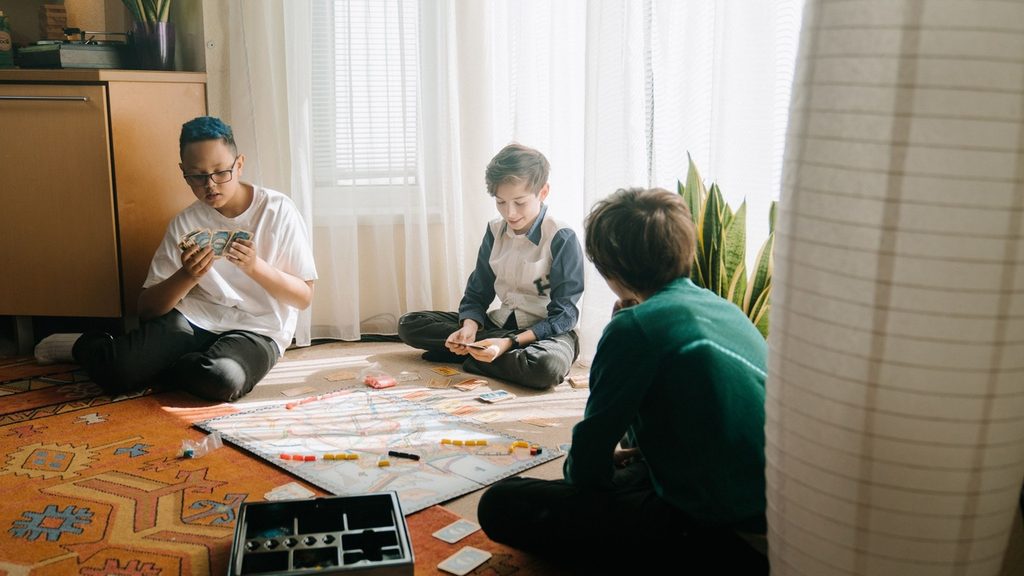
Part of that practice needs other children, and here a parent cannot stand in. At home the adult is the memory, since watching a child forget is unpleasant and most of us cave before the failure lands. In a small group nobody supplies the reminder. The rule has to be held, the turn waited out, the plan kept alive through ten minutes of somebody else talking. In our lessons for bilingual kids that means holding an instruction while four others hold theirs, and the conversation school loads it harder still.
Timur is twelve now and still writes the date last. He also carries a folded index card listing the two things he owes that day, an invention entirely his own, and he has not mislaid an assignment since spring. His working memory did not improve. He built a system around it, which is what adults with the same wiring end up doing anyway, quietly, for good.
At Palme School we teach online, in groups of up to eight, two forty-minute classes a week. The first two lessons are free and open with an assessment of where your child stands. You can book those here, and there are printable materials in our resource library. Start with one instruction at a time, tonight.
Frequently asked questions
The abilities that let a person hold a goal in mind and get to it while life keeps interrupting. Three count as core: working memory, inhibitory control, cognitive flexibility. Planning and organization are built on top of those three rather than sitting beside them.
Across roughly two decades, wrapping up somewhere in the twenties, which catches most parents off guard. Around six a child holds one instruction dependably; by nine, several; at thirteen the capacity has arrived while the reliability lags behind.
They improve the trained task and stop there. The meta-analytic evidence does not support the jump to untrained abilities, and a second review found the gains were not convincingly present at follow-up. Sleep, routine and demanding activities the child actually cares about have better evidence behind them.
No. It is one important component, neither necessary nor sufficient for a diagnosis, and plenty of children carry the difficulty without one. Consistency across settings, duration past several months and no response to ordinary support are the signals worth taking to a pediatrician.
No, and the opposite claim is not well supported either. What is clear is that switching languages costs capacity in the moment, which is why one child can look organized in one language and scattered in the other.
Sources
- Best, J. R., & Miller, P. H. (2010). A developmental perspective on executive function. Child Development, 81(6), 1641–1660. doi.org
- Center on the Developing Child, Harvard University. (2012, May 20). InBrief: Executive Function. developingchild.harvard.edu
- Centers for Disease Control and Prevention. (2026). Data on ADHD in Children. cdc.gov
- Diamond, A. (2013). Executive functions. Annual Review of Psychology, 64, 135–168. doi.org
- Kassai, R., Futo, J., Demetrovics, Z., & Takacs, Z. K. (2019). A meta-analysis of the experimental evidence on the near- and far-transfer effects among children’s executive function skills. Psychological Bulletin, 145(2), 165–188. doi.org
- Meuter, R. F. I., & Allport, A. (1999). Bilingual language switching in naming: Asymmetrical costs of language selection. Journal of Memory and Language, 40(1), 25–40. doi.org
- Miyake, A., Friedman, N. P., Emerson, M. J., Witzki, A. H., Howerter, A., & Wager, T. D. (2000). The unity and diversity of executive functions and their contributions to complex frontal lobe tasks. Cognitive Psychology, 41(1), 49–100. doi.org
- Moffitt, T. E., Arseneault, L., Belsky, D., Dickson, N., Hancox, R. J., Harrington, H., Houts, R., Poulton, R., Roberts, B. W., Ross, S., Sears, M. R., Thomson, W. M., & Caspi, A. (2011). A gradient of childhood self-control predicts health, wealth, and public safety. Proceedings of the National Academy of Sciences, 108(7), 2693–2698. pnas.org
- Takacs, Z. K., & Kassai, R. (2019). The efficacy of different interventions to foster children’s executive function skills: A series of meta-analyses. Psychological Bulletin, 145(7), 653–697. pubmed.ncbi.nlm.nih.gov
- Watts, T. W., Duncan, G. J., & Quan, H. (2018). Revisiting the marshmallow test: A conceptual replication investigating links between early delay of gratification and later outcomes. Psychological Science, 29(7), 1159–1177. journals.sagepub.com
- Willcutt, E. G., Doyle, A. E., Nigg, J. T., Faraone, S. V., & Pennington, B. F. (2005). Validity of the executive function theory of attention-deficit/hyperactivity disorder: A meta-analytic review. Biological Psychiatry, 57(11), 1336–1346. pubmed.ncbi.nlm.nih.gov
Palme School: Russian for bilingual children · Conversation school · Reading school · Free materials for parents