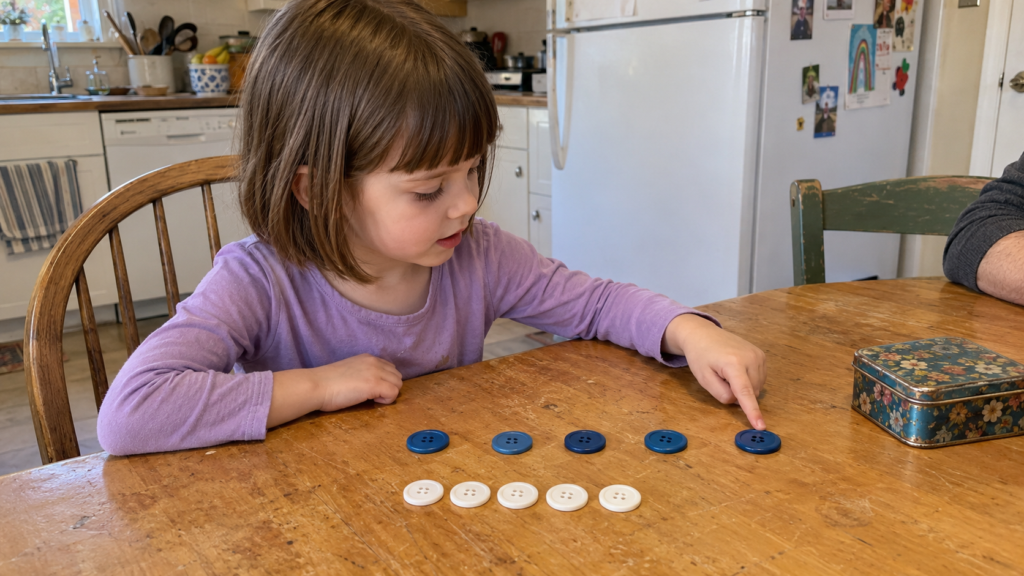

The five-year-old child himself placed two rows of Grandma’s buttons on the kitchen table: five blue and five white ones, each white under a blue one; he counted them and agreed that they were equal. Then he pushed the top row almost to the edge of the table, and pointed to it as if it were the one with more buttons. At the request of the child, he counted again, said «five» and pointed to the same place again, leading the finger to the very last button.
There is a boy in a 1941 Swiss book who did the same thing with coins, and we know a little more about him than we do about the typical participant in the experiment. His name is Don, he is four years and one month old, he has a sister named Miriam, and the author returns to him five times in five consecutive pages.
Page eighty-ninth
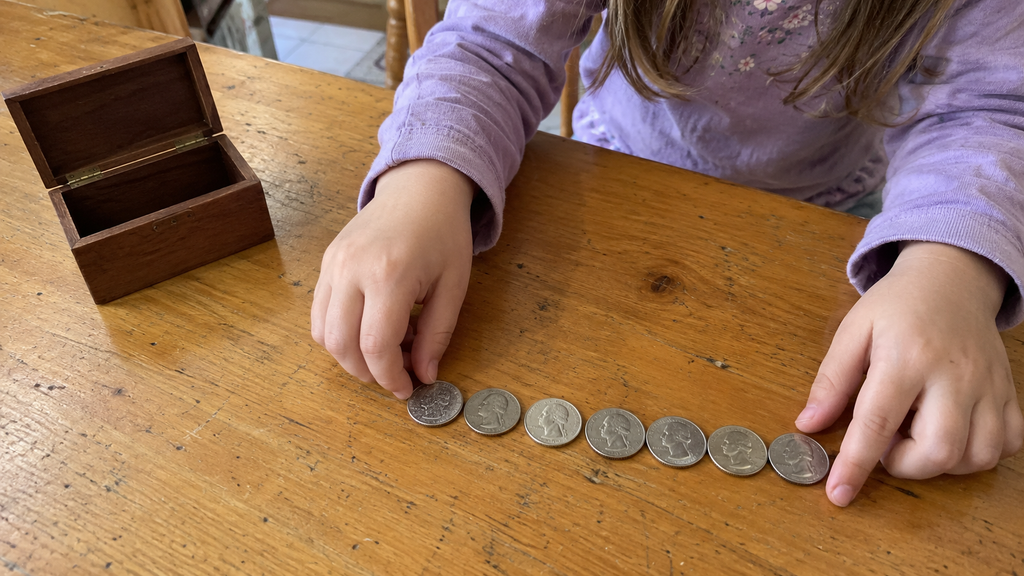
The book is called «La genèse du nombre chez l’enfant», «The genesis of number in children», it was written by Jean Piaget and Alina Sheminskaya, and Don appears for the first time in the fourth chapter. The experimenter tells him that his mother gives all the coins to Miriam so that she can go on the carousel, «pour aller au carrousel», and asks Don to take the same amount «la même chose de sous».
Don picks up a handful of money, accidentally finds five coins in it, and arranges them so that his row is longer than his sister’s. And immediately he gets upset. «Mais c’est plus grand, c’est pas juste!» But that’s more, it’s unfair!
They ask him if anyone of them has gotten richer or if they are even. «Oui, c’est moi qui suis plus riche», yeah, I am the richer. Then they tell him to do it honestly, «alors fais juste», and Don tries honestly. He puts the coins back in the box, takes four and one more, and puts them tightly together, one next to the other, and is upset that that will make it smaller «ce sera plus petit ça». «Il faut en remettre», they add. He puts one coin from each edge, and now his seven coins are lying next to the same length as Miriam’s. The experimenter asks if it is the same now or if one of them will get richer, and Don answers that it is exactly the same «c’est juste la même chose».
The page does not say how many coins Miriam had. According to Don, that didn't seem necessary; honestly, it meant the same thing to him.
Page ninety
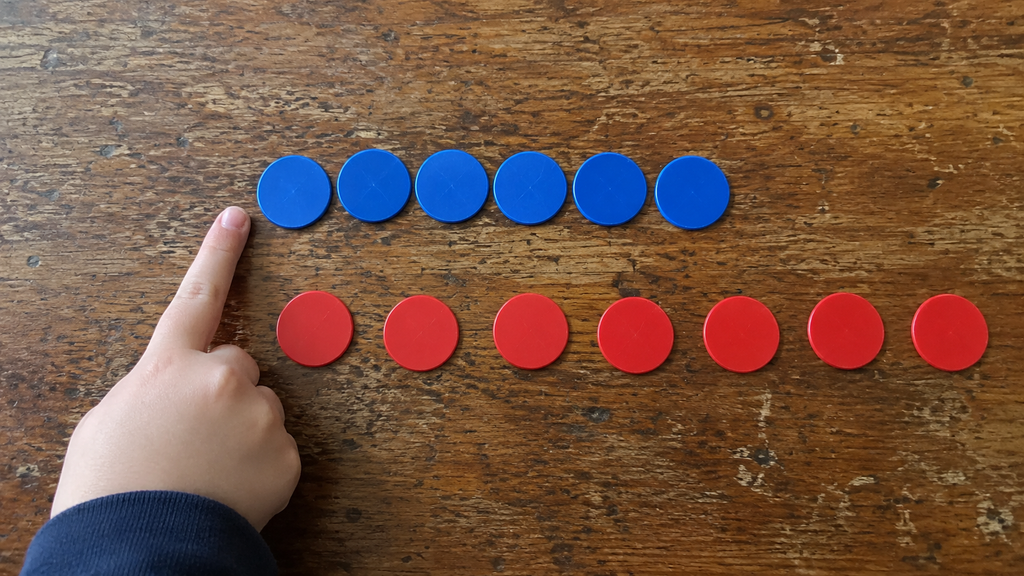
On the next page, Don is dealt seven red chips; his own. He places them tightly under the six blue ones, which are considered Miriam's chips, and agrees that they are equal. Then the experimenter pushes the blue row a little harder and the red a little more, and asks what to do now.
«C’est moi qui a plus, parce que c’est plus grand», I have more because my row is longer. And immediately, without any prompting, Don changes his mind. «Oh! non, c’est Myriam qui a plus.» Oh no, it’s Myriam who has more. They ask him why, and he explains it as if it were obvious. «Parce que c’est serré: il y a beaucoup.» Because it’s cramped, that means there’s a lot.
In a matter of seconds, Don changed his answer twice. First he looked at which row was longer, then at where the chips were stacked more tightly, and each time the answer seemed completely clear to him.
Pages ninety-first, second and third
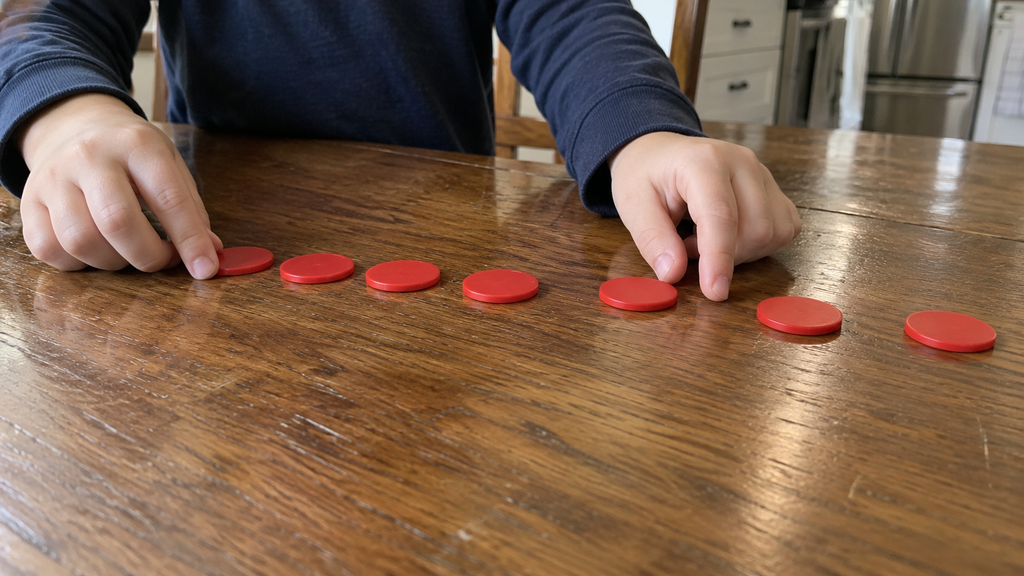
Piaget no longer mentions new conversations with Don, but he keeps returning to him. On the ninety-first page, he recalls how Don said that he had more because his row was longer: «c’est moi qui a plus parce que c’est plus long». On the ninety-second page, he again quotes him: «c’est serré : il y a beaucoup». On the ninety-third page, he again recounts the story with the six blue pieces and the seven red pieces that were pushed apart and notes that Don is holding on to one side of the matter in this reasoning and completely overlooks the length of the row.
For Piaget, the four-year-old Don was a convenient example of how a child compares quantities by eye, one at a time. For us, he is also interesting because he argued with himself. He didn’t care if he shared with his sister honestly; he kept checking, only checking in the way he had.
And what about the child at the kitchen table?
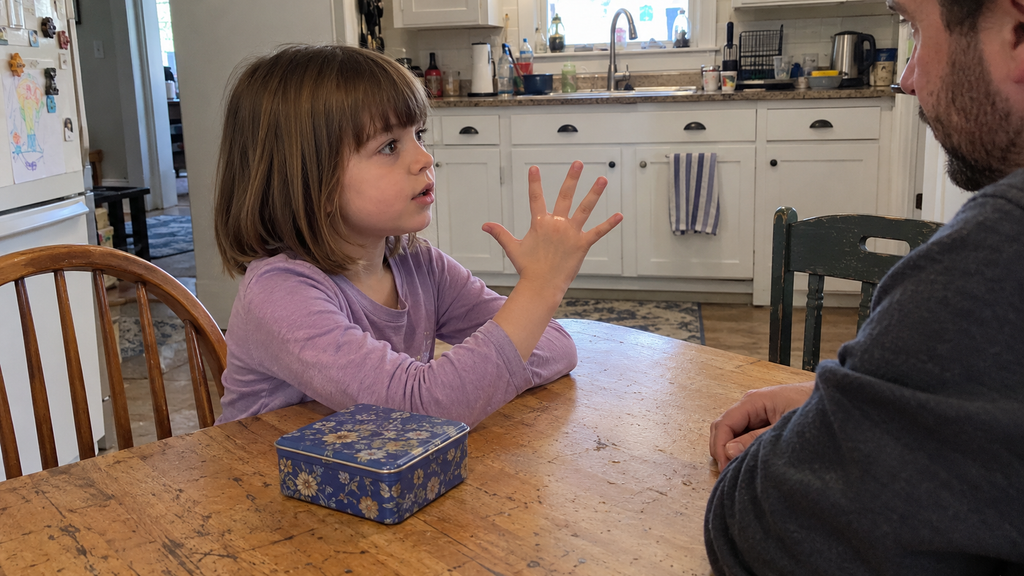
The first thing I want to say about the kid with the buttons is that he still doesn't know how to count. He counted the items correctly. Why he chose the long line after that is unknown.
Later, psychologists began to describe this as different skills. Being able to go through the items, naming the numbers, understanding that the last named number is the answer to the question «how many», and being able to keep that number when the items were rearranged can be learned not simultaneously. And sometimes it happens that the child simply understood the question differently than the adults asked it.
By the way, Don and I spoke to each other the same way all the time. Coins in the carousel, sister’s chips, richer or not richer, honest or not honest. The number problem in Geneva was told to four-year-old children as a story about the division of household chores.
Miska, who appeared later
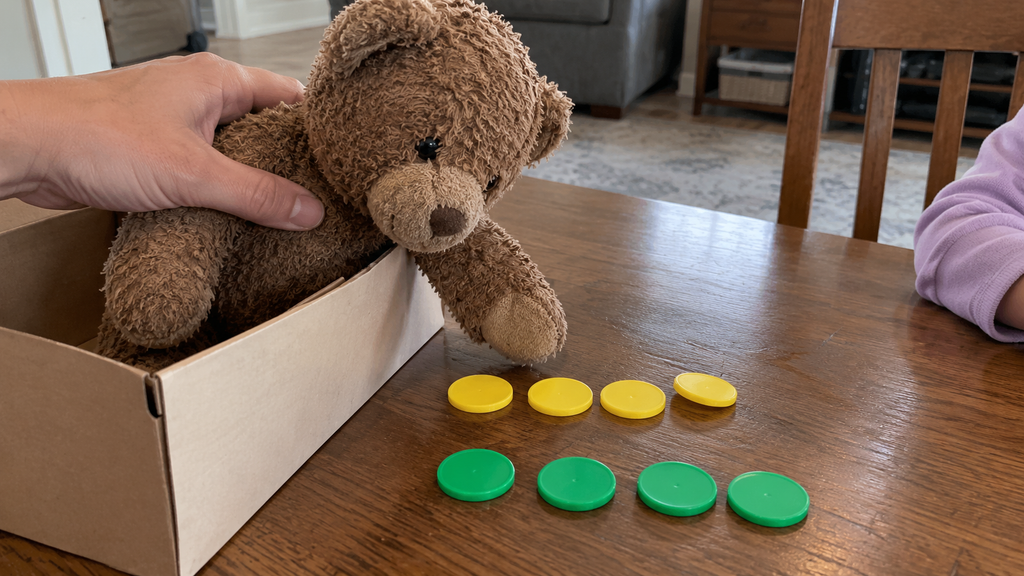
About a third of a century later, a dispute broke out in Edinburgh between James McGarrigle and Margaret Donaldson. They noticed that in such experiments, a series of factors change the adult themselves, often with the child’s eyes, as if deliberately, and then the adult asks a question to which the child has already answered. They took two rows of four pieces each, and in some trials the adult shortened the row, while in others a toy «naughty bear» appeared from the box and, as if by chance, disrupted the arrangement of the pieces. Eighty children aged four to six months and three months old went through both versions, and in the commentary to the article in the journal Cognition, the authors report that fifty children successfully managed the «random» change, while thirteen did so intentionally. Later, the experiment was repeated, and the dispute over why the bear works differently, for example whether it distracts the child, continued.
The conclusion from this is modest. The environment and actions of an adult can influence the child's response.
Buttons, a toy, and one question
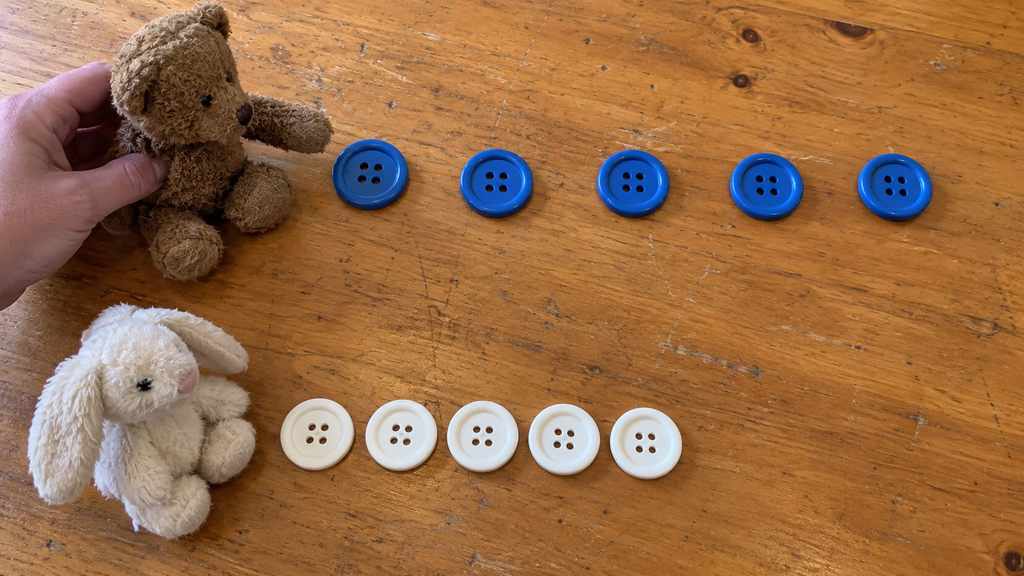
The pages about Don and the Edinburgh mouse form a home game for five minutes. It is not a repetition of the study; it is a game based on the original.
Together with the child, lay down two rows of five buttons each, each under their own, and do not ask beforehand whether they are equal. If you want, as in Geneva, give the rows to the owners; let the blue ones be for the bear, the white ones for the hare. Then the bear «accidentally» hits its row with its paw, and the buttons scatter. Be devastated together that he has rearranged everything again, and ask one question.
«In these ranks, should there be equal numbers of buttons or more in one group?»
Whatever the child answers, «Exactly?» don't add anything after that. Don changed his mind on the ninth page without asking again, and that happens too.
If the question can be understood in two ways, clarify what you are comparing—the length of the line or the number of buttons. In Ushakov’s dictionary, «more» is written as a comparative degree immediately after both words, namely «big» and «many.» How the words change the child’s response—as the conditional words change the answer of a child who is good at counting—we have discussed in detail in the article about why. The child knows how to count and does not understand the math task in Russian..
Pairs after the answer
Next comes the joint part, and the child doesn’t give up anything in it. Suggest that they find pairs of white buttons for each blue button. Have them place the white button next to the blue one, one after the other, and then you can together see if there are no pairs of either the blue or the white button left.
If after the couple’s dance he says that it’s even, that’s fine. That doesn’t mean that the next time he’ll answer the same way without the couple dance. Couples just show how to check without counting, and this method can be used further on, for example when you’re sharing candy tomorrow between two people.
A mischievous mouse
A game for adults and children in two steps. First, the mouse rolls the blue row, and the adult asks one question. Then the child finds the pair for each button by themselves. There are no right or wrong answers here, nor are there any points.
This is a home game based on the experience with the mischievous mouse, not a test. If the child says «evenly» after the pair, that doesn't mean that they will answer the same way next time. The pairs are just showing how to check without counting.
To whom to send
To the second parent and grandmother, if they also play with the child with buttons. They need two things: one question without the word «exactly?» and a follow-up question after the answer.
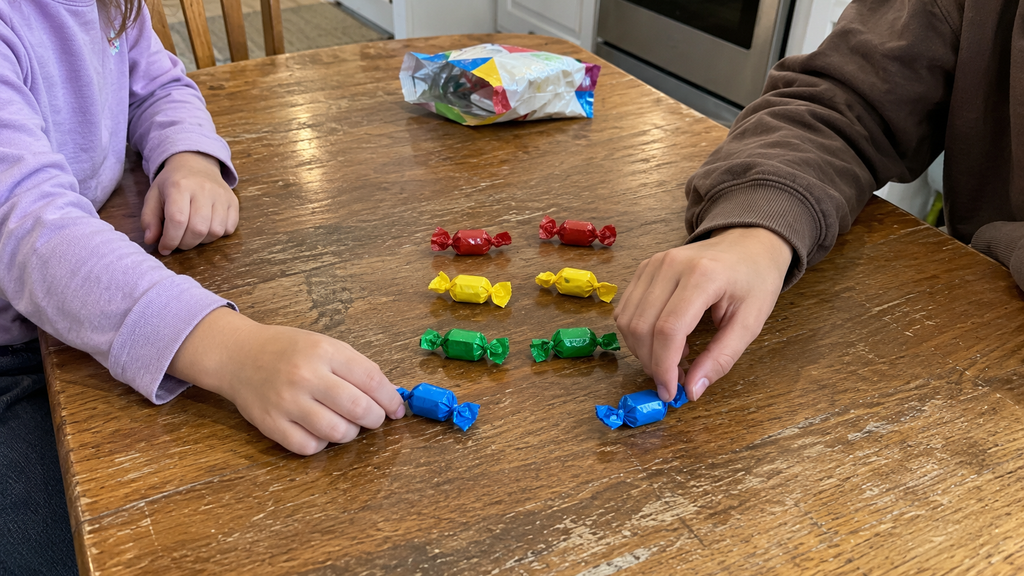
To an older brother or sister, especially if they often share candy at home. When the younger one shouts «unfair» when they see a long line, they might be thinking the same way as Don about Miriam’s coins, and the couple will figure it out faster than a fight.
The Russian club's educator. The box with the tokens and the teddy bear can be found in any group.
Carousel

Whether Don and Miriam went to the carousel that day is not mentioned in the book. After the ninety-third page, Don disappears from that chapter, and the last thing anyone knows about him is that he says «c’est serré: il y a beaucoup» and seven coins spread out evenly along the length of the sister’s row.
By the end of the evening, there are also two rows of five buttons on the kitchen table, and each button has two pairs of buttons.
The children learn to count with their hands, using buttons, pegs and cubes, and at the same time they learn to talk about it in Russian. At the «Mathematics in Russian» course at Palme School, children from the age of four learn online using the Russian school program, in small groups or individually.
You can start with free dating with the school. First, the methodologist determines the child's level and helps choose a program; then the family meets the teacher during a free lesson.
Book a Free TrialFrequently asked questions about the button rows
Is it necessary to insist that the child immediately answer «evenly»?
No. You need a game with a teddy bear to hear the child’s answer, not to get the correct answer. If you keep repeating the question until the child says «evenly,» they’ll more likely learn to guess what the adult expects. It’s more useful after the answer to divide the buttons into pairs together and see if any of them are missing.
Is it possible to play with coins or candy instead of buttons?
Yes, any small, similar items that are easy to move around the table will work: coins, tokens, dice, or candy. If a younger child is playing nearby, who still tends to swallow everything, it is better to replace the small buttons and coins with larger items and not leave them on the table after the game.
How to ask this question in English if the child is playing in English?
For example, this way: «Are there the same number of buttons in these two rows, or does one row have more?» This question is also asked only once, without «Are you sure?» after the answer. It is not necessary to compare the answers in two languages to find out the reason; the second question the child will hear after the first one.
What to do if the child still says that there are more in the long line after the game?
No arguing or explaining over again. You can leave the rows on the table and return to the pairs on another day, when you will be sharing something again, such as two candies or spoons for the plates. The pairs remain a way to test whether the child can come to the table on their own.