
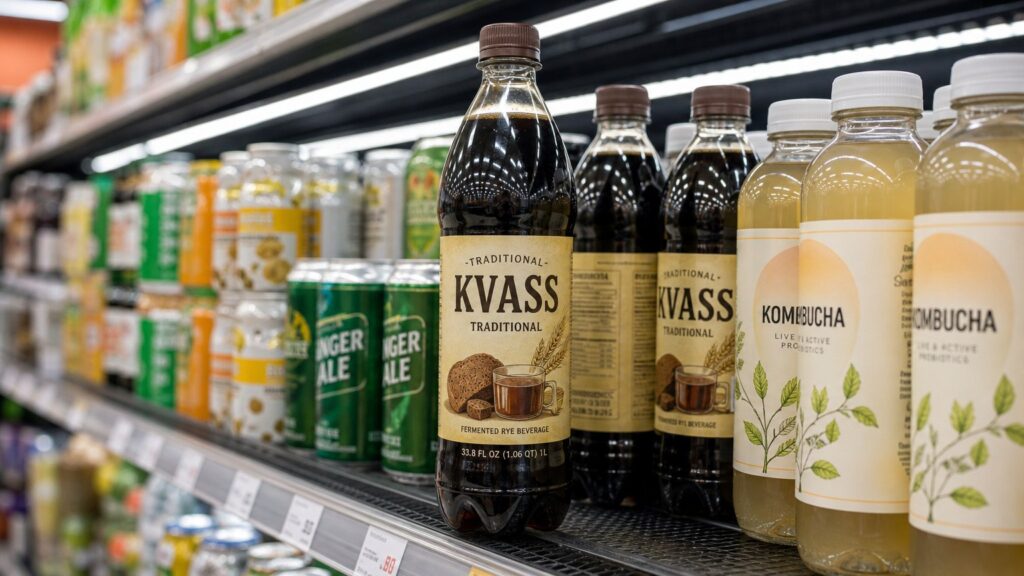

A beverage shelf in a supermarket somewhere near Boston. Kombucha in glass. Ginger ale. Between them, a dark plastic bottle with "kvass drink" on the label. A shopper picks it up, reads the ingredients, and gets to the word "bread." Puts it back. Bread in a beverage is baffling to him.
The drink in this bottle is a thousand years old. Russians turned its name into a curse word and still use it to this day. Gogol slipped it to the reader disguised as cabbage soup. And then kvass crossed the ocean with its families and ended up next to kombucha, and no one on that shelf knows what it is.
A drink older than Moscow
Kyiv, 996. Prince Vladimir consecrates the Church of the Tithes and orders food, mead, and kvass to be distributed around the city. This is recorded in the Tale of Bygone Years. The chronicler does not explain what kvass is. It never even crosses his mind. Moscow does not yet exist; it will be a century and a half before its first mention. Yet kvass is already present in the chronicle as a matter of course, just like water.
He was water. Or rather, a replacement for it. The city well could fail, but the fermented bread drink did not spoil for weeks. It was drunk every day and went unnoticed. In the sixteenth-century «Domostroy,» it is listed among the supplies that a master of the house is obliged to keep, between salted meat and cabbage. The entire history of kvass by dates, from chronicles to plastic bottles, is gathered on the timeline below. One thing is important here. Before Vyazemsky, the word «kvass» meant a drink and nothing more.
A thousand years of kvass in eleven dates
From chronicle to American shelf
- 996
First entry
In the Tale of Bygone Years, after the consecration of the Church of the Tithes, Prince Vladimir orders food, honey, and kvass to be distributed around Kiev. The word stands without explanation.
- 16th century
«Domostroy»
Kvass is listed among the mandatory home supplies, next to salted meat and sauerkraut.
- 17th century
Kvass for every taste
Historian Kostomarov, describing pre-Petrine daily life, lists rye kvass (made from rye and barley malt), honey kvass, and berry kvass.
- 1827
«Vyazemsky's »Letters from Paris"
The expression «kvass patriotism» appears.
- 1842
«Dead Souls»
A bottle of sour shchi at Chichikov's.
- 19th century
Kvasniks
In the cities, kvass is sold from stalls and barrels: pear, mint, honey, with horseradish, with raisins, and white kvass for okroshka.
- 1960s
Yellow barrel
In the summer, wheeled barrels stand by metro stations and markets. There is a queue with milk cans, one faceted mug for everyone, and a small fountain for rinsing.
- 1990s
Decline
Barrels are almost disappearing, being replaced by imported soda.
- The 2000s
Return in bottles
Factory-made fermented kvass is returning to shelves in plastic bottles. Its imitation, a non-fermented kvass beverage, is also appearing.
- 2012
GOST 31494-2012
The Russian standard establishes: kvass is an unfinished fermentation drink with an alcohol strength of no more than 1.2 percent.
- 2020s
Kvass drink
Small American breweries bottle kvass in glass and place it next to kombucha.
How kvass became a curse word
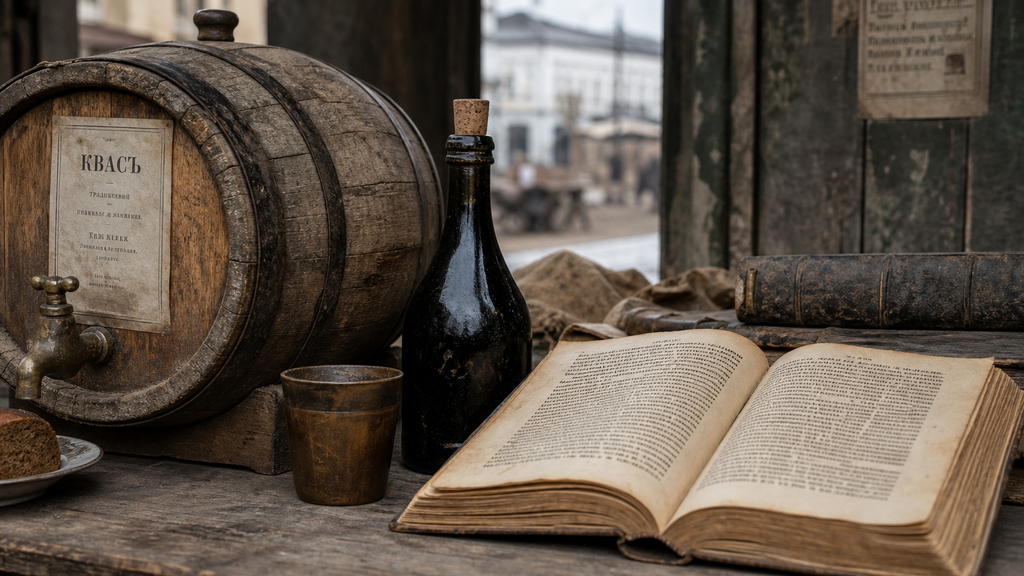
Paris, 1827. Pyotr Vyazemsky is writing letters home to the Moscow Telegraph magazine. He signs them not with his own name, but uses the initials of his friend, Grigory Rimsky-Korsakov, so that Moscow readers would guess who this clever person is. In one of his letters, he recalls a French witticism and refers to Turgot. The latter called blind praise of everything of one's own *patriotisme d’antichambre*, an antechamber patriotism. Lackey patriotism. Vyazemsky translates it into Russian daily life. Here, he writes, it could be called kvass patriotism.
Two words. He dropped them casually, in the middle of a conversation about French books. Afterwards, for the rest of his life, he made sure they weren't attributed to anyone else. In his collected works, he added a footnote: here, he said, this playful definition appeared for the first time. The magazine's readers actually considered the editor Polevoy to be the author of the joke.
Why kvass? Kvass in 1827 is sold on every corner. A kvass vendor stands by the market with a small barrel and a mug. He has pear, mint, with raisins, with horseradish. Only river water is cheaper. You couldn't explain that to a Parisian, but a Muscoviter doesn't need it explained. To attach kvass to the word «patriotism» meant to say: love your homeland the way you drink kvass, without thinking or analyzing the taste.
The word caught on for good. It has been repeated for almost two hundred years. Those who repeat it do not remember the drink. Kvass has nothing to do with it. The mockery came from the outside. That is how it goes with very simple things; they are easy to turn into labels.
Fifteen years later, kvass reached Gogol. The first chapter of Dead Souls, 1842. Chichikov arrived in the provincial town, walked around, read a playbill, and returned to the inn. Next is a quote: «The day, it seems, was concluded with a portion of cold veal, a bottle of sour shchi, and a sound sleep to the fullest pump-handle twist, as they express it in some parts of the vast Russian state.».
With a bottle of shchi. Today, the reader sees the word «shchi» and pictures cabbage in a bowl. Gogol had no such thing in mind. In his time, "sour shchi" referred to a beverage. A rye-based drink, similar to kvass, only more heavily carbonated. It was kept in bottles under cork and opened with a pop. Cheap tavern champagne. Chichikov did not eat soup before bed. He drank a bottle of the effervescent drink and went to sleep. Shchi as a soup is a separate topic.
So in Russian classics, kvass appears twice, and both times under a pseudonym. Once as a mockery, the second time as a trap for the reader. Meanwhile, the kvass itself sits quietly in the tub and ferments.
How to make kvass at home
Now comes the tub. In America, it turns into a three-liter glass jar from a Russian store, and the main difficulty begins before the jar.
Bread. The rye bread from a regular supermarket is light, half-wheat, with caraway seeds. Kvass made from it turns out pale, like tea from a tea bag used for the third time. You need dark. Dense, sour, on sourdough. Borodinsky or its relatives. People go to a Russian store for it; on maps, such places are labeled Russian grocery or European deli. The bread is by the cash register. Nearby on the shelf are bags of rye malt and jars of kvass wort concentrate; with them, even the first batch of kvass turns out dark. If there is no Russian store, people look for a German or Polish bakery. Pumpernickel from Whole Foods or Trader Joe’s will do; it bears little resemblance to Borodinsky, but it will work for a jar. Rye malt is sold by home-brewing supply stores, where it is called rye malt. What to buy and where, by city, is compiled in the cards below.
What to buy for kvass and where
| What | Why | Where |
|---|---|---|
| Black bread | Dense sourdough rye, Borodino, or similar | Russian store, German or Polish bakery; fallback pumpernickel from Whole Foods or Trader Joe’s |
| Rye malt | Dry, in bags; makes kvass dark and thick | Russian store; homebrew supply store (it's called rye malt there) |
| Kvass wort concentrate | Ready-made base in jars, for those who don't want to mess with breadcrumbs | Russian store online |
| Raisin | Only unwashed and without oil on the skin, it is the starter culture | Any supermarket, check the ingredients: no oil |
| Sugar, dry yeast | 100 grams of sugar per 2.5 liters of water, a pinch of yeast for reliability | Any supermarket |
| 3-liter jar, gauze | Wide-mouthed glass jar; cheesecloth instead of a lid | Russian store, hardware store, online |
Russian stores by city
New York and New Jersey
The NetCost Market chain in Brooklyn, Queens, and New Jersey. In Brooklyn, from Brighton Beach to Bensonhurst, there are dozens of Russian stores with dark bread, malt, and wort.
Boston
Berezka and Bazaar in Brookline. Bread at the checkout counter, malt and concentrate on the shelf.
Toronto
Yummy Market (North York and Maple), Bathurst Village Market on Bathurst Street, where they bake their own rye.
Online
RussianFoodUSA and GastronomUSA ship bread, malt, and wort nationwide, not next day, but reliably.
Without a Russian store
German and Polish bakeries, pumpernickel from a regular supermarket, rye malt from a brewing supply store. A search for Russian grocery or European deli on maps will outlive any specific address.
Stores open and close. The names were verified at the time of publication; if a location has disappeared, search for "Russian grocery" or "European deli" on the map.
It is simple after that. Cut the bread and dry it in the oven until it becomes dark croutons. Not black, black ones will make it bitter. Put the croutons in a jar. Boiling water on top. Sugar. Wait until you can keep your finger in the liquid. Then a handful of raisins. Unwashed. Wild yeast lives on the skin of the raisins, washing them will kill them, and the jar will stay dead for a week. For reliability, a pinch of dry yeast nearby. Cheesecloth instead of a lid. In a warm corner, out of the sun.
Morning. Foam under cheesecloth, the jar smells sour. A child peeks in and asks why it's moving. The honest answer: two teams of microbes, one makes gas, the other acid. An adult asks a different question that same morning. How much alcohol is in there. Not much, like in kefir. GOST 31494-2012 allows up to 1.2 percent. Anything on a regular American shelf is under half a percent, otherwise it would be sold as alcohol. Homemade kvass is close to factory-made after two days. Forgotten in the warmth for a week, it gets stronger up to one and a half to two percent. Pediatricians in North America don't allow alcohol for children at all; the family decides the rest. Figures by country and type are in the table below.
Third day. Taste. If sweet, another 24 hours. Strain into bottles, put a couple of raisins in each, close tightly. Half a day in a warm place to build up gas. The bottle swells and crackles. Now into the fridge, fermentation stops there. Drink for a week. Do not throw away the sediment from the bottom, this is the starter for the next time, the second batch of kvass is always better than the first. The remainder by the end of the week goes into Okroshka, it needs exactly that kind, sour and unsweetened, sweet store-bought kvass ruins it. A separate text will be dedicated to okroshka. Grams, minutes, and a timer for each step are in the recipe card below, along with six instances when the kvass didn't work out. The most frequent one: it doesn't fizz. Almost always because the bottle was put in the cold immediately, without letting it sit in the warmth. Or the raisins were coated in oil.
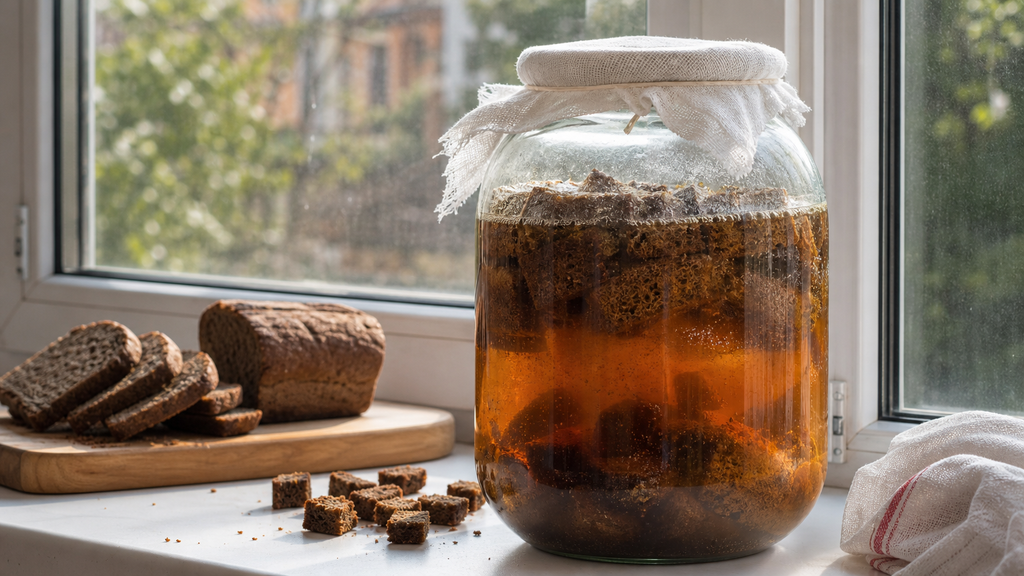
Homemade kvass in three days
Check off steps, start timers. Progress is saved in this browser.
Cut the bread into slices and dry in the oven at 160 °C until dark, hard croutons. Not black, black will make it bitter.
300 g of rye bread
Put the rusks in a jar, pour boiling water over them, and add sugar. Wait until the liquid is cool enough to comfortably hold your finger in it.
2,5 l of water, 100 g of sugar
A handful of unwashed raisins and a pinch of dry yeast. Cover with cheesecloth, not a lid. Place in a warm spot out of direct sunlight.
30 g of raisins, a pinch of dry yeast
In the morning, there is foam and a sour smell under the cheesecloth. Leave in the warmth for another 24 hours. If it is too sweet after that, give it another 24 hours.
Strain through cheesecloth into bottles, put a couple of raisins in each, and seal tightly. Leave in a warm place to carbonate. The bottles will swell and start to crackle.
6 raisins for bottles
Put it in the refrigerator, fermentation will stop. Drink within a week. Leave the sediment from the bottom of the jar for the next batch.
How much alcohol does it contain?
Pediatric guidelines in the US and Canada do not allow alcohol for children at all. The decision remains with the family.
| Where and what | Fortress | What does this mean |
|---|---|---|
| Russia, GOST 31494-2012 | no more than 1.2 % | Kvass is officially considered a non-alcoholic beverage of incomplete fermentation. |
| USA, a regular supermarket shelf | less than 0.5 % | Drinks stronger than 0.5 % are sold only as alcoholic beverages, so anything sold next to kombucha is weaker. |
| Canada | Federal labeling: 1.1 %; in most provinces, the sales limit is 0.5 % | Sales are regulated by the provinces; in most of them, the threshold is 0.5 %, while in some it is higher, up to 1 %. |
| Lithuania, Latvia (imports in Russian stores) | According to local standards, usually around 0.5–1 % | The Russian GOST does not apply to these bottles, check the label |
| Indoor, two days in the room | roughly the same as the Russian factory model, up to 1.2 % | Fresh, short-fermented, from the refrigerator |
| Home, a week in the warmth | 1.5–2 % | Fermented, like draft beer from a keg; not sold to kids |
| Draft from the keg | 1.5–2 % | Unpasteurized kvass, higher alcohol content than bottled |
The alcohol content of any fermented beverage increases with warm storage. Buy store-bought kvass from the refrigerated display case, and put homemade kvass in the refrigerator as soon as it has carbonated.
What went wrong
It doesn't hiss
Reason. The bottle was put in the cold right after bottling, or the raisins were treated with oil.
What to do. Take it out of the refrigerator, let it sit in a warm place for half a day with a couple of raisins. For the next batch, use unwashed raisins without oil and a pinch of dry yeast.
Too sweet
Reason. It didn't finish fermenting, the yeast didn't have time to eat the sugar.
What to do. Leave in a warm place for another day, then try again.
It tastes bitter
Reason. The rusks are overfried, the edges have turned black.
What to do. This batch cannot be saved. Next time, dry at 160 °C and take out while the edges are dark brown, not black.
It smells like home-brewed mash
Reason. It fermented too warm, and the alcohol content became noticeably higher.
What to do. Put it in the fridge, adults can drink it, or use it for okroshka. Take out the next batch on the third day.
Film or mold on top
Reason. Foreign fungi got into the jar, most often due to dirty gauze or a very warm place.
What to do. Pour it out. Wash the jar and cheesecloth with boiling water, and place it back in a cooler spot.
Too sour
Reason. Lactic acid bacteria outgrew the yeast, usually due to sitting for too long.
What to do. Dilute with cold boiled water with a spoon of sugar, then keep in the cold. Sour kvass is ideal for okroshka.
Kvass next to kombucha on an American shelf
Let's go back to the shelf. Kombucha in glass, with the word probiotic on the label. Nearby is kvass, in plastic, with bread in the ingredients. Inside, they have the same thing: fermentation. The difference is in the raw materials. Kombucha grows on sweetened tea, kvass on bread. One has a vinegary taste with fruit, the other has a bread-like, almost filling taste. Beer is a relative of kvass in terms of malt and yeast, except kvass fermentation is stopped right at the beginning, while beer is brought to the end. Root beer is similar to kvass in color and nothing else; inside it's soda with flavoring. All shelf neighbors are laid out in the table below.
Kvass and its shelf neighbors
| Drink | Raw materials | What is fermenting | Fortress | Taste | Where is it located in an American store |
|---|---|---|---|---|---|
| Kvass | Rye bread or malt, water, sugar | Yeast and lactic acid bacteria are removed at the very beginning | up to 1.2 % (in the U.S., on the shelf below 0.5 %) | Bread-like, sour, slightly sweet, almost filling | Russian store, occasionally a shelf with kombucha |
| Kombucha | Sweet tea | Kombucha (yeast and bacteria) | usually less than 0.5 % | Vinegar-fruity, light | Shelf with healthy drinks |
| Kefir | Milk | Kefir grain | up to 1 % | Fermented milk, thick | Dairy section |
| Ginger ale | Water, sugar, ginger | Typically, without fermentation, soda | 0 % | Spicy, sweet, ginger | Sodas |
| Root beer | Water, sugar, flavorings | Non-alcoholic, carbonated beverage | 0 % | Sweet, spicy, with vanilla | Sodas |
| Beer | Barley malt, hops, water | Yeast, fermentation is brought to completion | 4–6 % | Bittersweet, malty | Liquor department |
Real kvass is also on this shelf. Russian stores import fermented kvass from Russia, Lithuania, and Latvia. Lithuanian kvass is often closer to homemade than Russian kvass with a long shelf life. Look for the word «брожения» (fermentation) on the label. Without it, the bottle contains a kvass beverage—water with sugar and food coloring. Local ones have also appeared. Small American breweries bottle kvass drink in glass and place it next to kombucha. This is how people who have never heard a single Russian word try kvass for the first time.
Kombucha is trendy, kvass next to it looks like a poor country relation. Vyazemsky would have been pleased. Two hundred years have passed, and kvass is still kvass-like.
A word that cannot be translated
Attempts to translate «kvass» into English have been made many times. Bread soda. Fermented rye drink. Russian kvass with an explanation in parentheses. Each option explains something, and none of them translates it. Dictionaries have given up and written kvass in Latin script, alongside borscht and samovar.
A schoolboy from a Russian-speaking family gets an assignment in an American school about a «Russian traditional drink» and brings the word home. The teacher did not mean tea. He finds this out, then finds out that the word «kvass» shares a root with «sour» [kisly], starter culture [zakvaska], and sauerkraut [kvashenaya kapusta]. Then he learns about the verb "kvasit", which has a completely different meaning in colloquial speech, and the child is better off being warned about this before he calls his grandmother. All the words of this word family are collected in the glossary below.
Dictionary of a Single Family
- Kvasskvass
- Sour fermented bread drink. The word itself shares the same root as «sour» and «to ferment.» It entered English without translation, like borscht and samovar.
- fermentferment / booze
- According to the dictionary: to ferment cabbage, apples, rye-bread wort. In colloquial speech, it has long meant to drink alcohol. The second meaning should be explained to the child before grandma calls.
- sourdough starterstarter
- What triggers fermentation. In kvass, this role is played by a handful of unwashed raisins with wild yeast on their skins or the sediment from a previous batch.
- kvass wortkvass wort
- Sweet liquid made from rusks or malt before fermentation. Store-bought concentrate comes in cans, which makes dark kvass without the hassle of making rusks.
- kvass mugkvassman
- A street vendor of kvass in nineteenth-century cities, with a small barrel and a mug. The profession disappeared along with the trays, replaced by the yellow barrel.
- sour cabbage soupsour shchi, a fizzy drink (not the soup)
- In the nineteenth century, this was the name of a carbonated drink close to kvass, which was opened with a pop. It is precisely this drink that Chichikov drinks in the first chapter of Dead Souls.
- jingoismostentatious love of domesticity
- A mocking term for ostentatious love of everything domestic. An expression by Pyotr Vyazemsky, 1827. It has nothing to do with the beverage, other than the root.
- kvassgira / kwas chlebowy
- The neighbors have their own names for the drink: Lithuanian gira, Latvian kvass, Polish kwas chlebowy. Belarusians and Ukrainians call it the same way as in Russia.
And then a jar appears on the windowsill. For three days, the child peeks under the cheesecloth. Sees it move. Asks about raisins. Hears about Vyazemsky and doesn't understand what patriotism has to do with it. After that, the word «kvass» stops being just a line in a dictionary. It becomes a thing he held in his hands. A jar of bread on a windowsill in Boston doesn't convince anyone of anything. It just hisses.
Frequently asked questions about kvass
What is kvass in simple terms?
A fermented bread beverage. Rye bread rusks or malt are filled with water and sugar, raisins or yeast are added, and after two to three days the liquid sours and begins to bubble on its own. Served cold. The taste is sour and bready, with a color ranging from amber to dark brown.
Does kvass contain alcohol and is it safe for children?
A bit. The Russian standard allows up to 1.2 percent. What is sold in the US and most Canadian provinces as non-alcoholic is weaker than 0.5. Homemade kvass after two days of fermentation is close to factory-made; if left to ferment for a week in the warmth, it gets stronger up to one and a half to two percent. Pediatricians in North America do not allow alcohol for children in any form; the decision is left to the parents. If they pour it, it is fresh and from the fridge.
What is the difference between kvass and kombucha?
Raw materials. Kombucha lives on sweet tea, kvass on rye bread or malt. The fermentation principle is the same, the taste is different: kombucha is vinegar-fruity, kvass is bread-like and rich.
What kind of bread is needed for homemade kvass and where to buy it in the US and Canada?
Dense dark sourdough rye, Borodinsky is best. American rye bread is too light, kvass doesn't turn out well with it. Black bread, rye malt, and wort concentrate are sold by Russian stores (NetCost, Berezka, Yummy Market, and others), dark rye is baked by German and Polish bakeries, and pumpernickel from a regular supermarket works as a substitute.
Why doesn't homemade kvass fizz?
Either the bottle was put in the refrigerator immediately after bottling, without letting it sit for half a day in the warmth with the raisins, or the raisins were treated with oil and the wild yeast on them did not survive. For the first batch, a pinch of dry yeast helps.
What is jingoism and why is it called jingoism?
A mocking term for ostentatious love for everything native. It was coined by Pyotr Vyazemsky in his Letters from Paris in 1827. He chose kvass as the simplest and most ubiquitous element of Russian everyday life.