

A history project happens in the life of every child growing up between two languages. It is usually brought home in the evening, with the due date being tomorrow, and the topic in English: Catherine the Great. The parent glances at a found article, sees a neat lineup of achievements there, and catches themselves feeling awkward, because in Russian that woman is remembered quite differently, more complexly and darkly, and explaining the difference in fifteen minutes just doesn't work out.
There is a difference, and it is not about translation. The Russian memory of this reign holds two things side by side that fit poorly into the same head. The Empress corresponded with Paris philosophers about the equality of all before the law and in those same years distributed peasants to her favorites by whole villages. She collected paintings for the future Hermitage and sent the author who wrote about peasant hardship to Siberia. The textbook a child reads in English most often omits this second half.
It is better to analyze an era not in chronological order, but through the questions children actually ask. Let the dates stay on the timeline; you can always return to it.
Thirty-four years of reign by year
Click on any year to reveal what lies behind it. Read items are marked automatically.
The guard in the capital chose the sovereign's spouse, and the coup took place within a single summer day. The abdicated spouse survived his abdication by a week. The price of such a beginning remained with her forever: before Europe she looked like a usurper of someone else's crown and spent her whole life proving otherwise.
The state confiscated the monastery lands, and the clergy switched to government salaries. The treasury received a large income all at once and immediately set about spending it: that same year, a school for girls and an orphanage for foundlings opened.
A society for economic experiments and useful knowledge was established. In the same year, the landowner was given the opportunity to send his man to hard labor. Enlightenment and the lack of rights came from the same office.
Deputies elected from the estates gathered to discuss future laws according to a program written by the Empress. At the same time, a ban was issued prohibiting peasants from filing complaints against their masters, and the conversation about justice proceeded without the participation of the majority of the population.
The vaccination performed by the Empress first in the country was a desperately risky act, and the invited doctor was seriously preparing to flee Russia if the patient did not survive. In autumn, the war with the Turks began, which lasted for six years.
The Baltic squadron sailed around Europe and burned the Turkish fleet off the coast of Asia Minor, thousands of miles from the Russian borders. The Archipelago expedition turned the tide of the war, although things reached the Black Sea itself later.
The first partition of the Polish lands among the three monarchies. The second and third followed in 1793 and 1795, after which the Polish-Lithuanian Commonwealth ceased to exist, and along with the acquisitions, the empire inherited a long dispute over the fairness of these borders.
A Cossack who claimed to be the surviving emperor gathered stanizas and factories under his banner. Within a few months, a private deception turned into a war that required field armies to suppress.
Peace with Turkey removed the Crimean Khanate from the sultan's subordination and opened southern waters to Russian ships. That same summer, the rebels captured Kazan, and celebrations for the peace had to be combined with the state of martial law in the Volga region.
The leader of the uprising was executed in January, and the Yaik River was renamed the Urals to erase memory. At the same time, the empire was divided into provinces and districts, and this reform was born in many ways out of the fear of the past year.
Crimea joined the empire without a fight. A woman headed the Academy of Sciences, something Europe had not seen. The serfdom system was extended to Left-Bank Ukraine, and this alone crossed out half of what was said about enlightenment.
The nobles received recorded rights and exemption from corporal punishment, and the towns their own self-government. Those who worked on the noble land got nothing.
The statute for public schools was approved, and secular schools for children of various social estates began to open in the provinces. There was a catastrophic shortage of teachers across the country, and the first graduating classes were prepared in haste.
The journey of the Empress to the southern acquisitions in the retinue of foreign ambassadors gave birth to the legend of the painted villages. In autumn, the second war with the Turks began, and a year later it was joined by the Swedish one, which was fought almost at the capital's suburbs.
Suvorov captured Izmail by assault. In those same months, a work on peasant misery was published, the author of which was sentenced to death and taken to Siberian Ilimsk, with the execution commuted to exile.
The Treaty of Jassy secured the southern acquisitions and pushed the border back to the Dniester. In the autumn of the same year, Potemkin died in the steppe near Jassy, and the government lost the man who had single-handedly held the entire south.
An enlightener, whose magazines once argued with the empress almost on equal terms, was sent to a fortress for fifteen years by a single decree. The revolution in France made yesterday's interlocutors suspicious.
The Empress died in the Winter Palace in early November, and the throne passed to her son, whom she had kept away from affairs of state. Pavel's first act was to release imprisoned freethinkers and abolish many of his mother's policies.
The dates in the timeline are given in the Old Style, as is customary in Russian sources of that period.
Where to start if a child asks who she is

It is most convenient to start with language, because here your child and this woman find themselves in the same position. The fifteen-year-old German princess arrived in a country where she did not understand a single word. There was no Russian in her childhood at all; at home they spoke German, and at the courts of Europe, French.
Later in the biography, there is an episode for which it is worth retelling to children in its entirety. In her own memoirs, she recalled how she would get up at night and repeat Russian words, pacing barefoot across the cold bedroom until she collapsed with pneumonia. Doctors feared for her life. A rumor spread through St. Petersburg that the princess had fallen ill from her diligence with a foreign language, and the wary court began to thaw.
To a child who resists Saturday class, this story speaks louder than any persuasion. The woman who became a symbol of the Russian eighteenth century learned Russian as an adult, with an accent that never left her, and wrote with mistakes until the end of her life. Among our students, this twist brings noticeable relief, especially among teenagers convinced that their Russian is hopelessly ruined by English.
How to explain the rise to power without turning history into a detective story
Children ask the question about the crown second. The answer will have to be uncomfortable, but honest. She had no right to the throne whatsoever, and she seized power from her own husband in the summer of 1762, when the capital's guard regiments swore allegiance to her and the emperor signed an abdication. A week later he was gone under guard, and historians have been trying to figure out what happened there for three centuries.
There is much to learn here beyond the event itself. Many of its participants wrote about that night, and they all wrote differently because each of them, in hindsight, moved themselves closer to the main action. Catherine herself left several conflicting accounts. Princess Dashkova assigned herself a role in her memoirs that was almost that of the organizer. A historian pieces the picture together from documents, not from memories.
This is easy to explain to a teenager of twelve or older, and it is remembered for a long time. The witness is not lying intentionally; they remember themselves as a hero. Sources have to be checked even where all participants are honest, and a school project provides a good excuse to practice.
What is enlightenment, if explained without a textbook

The word for which the topic made it into the school curriculum sounds like enlightened absolutism. Its meaning is simpler than its phrasing. The ruler retains all power entirely, gives it to no one, but rules according to reasonable laws and ensures that subjects become more educated. The monarchs of Austria and Prussia were pursuing a similar course at the time, so the Russian enterprise was not alone in European company.
Catherine outlined her program in an essay entitled «Nakaz» [Instruction], which she wrote for about two years and in which, by her own admission, she took a lot from Montesquieu. It spoke of the equality of citizens before the law and of the fact that it is wiser to prevent crimes than to punish them. The commission assembled for the new legislation worked for a year and a half, quarreled over class privileges, and dispersed without writing a single law.
A separate story, which children usually like, is about the correspondence. The Empress wrote to Voltaire for about fifteen years; the letters took months to arrive, and they discussed everything from war to vaccinations. This worked in the exact same way that a cultivated online image does today: the most widely read author in Europe told his readers about the wise sovereign of the North, and this fame was worth more than any embassy. She gracefully bailed out Diderot, the publisher of the famous «Encyclopédie,» by buying the impoverished philosopher's library while leaving the books with him, and appointing him as her librarian with years of salary paid in advance. Upon arriving in St. Petersburg, he fervently urged her to instantly rebuild Russia according to the laws of reason. According to a story preserved in the memoirs of Count Ségur, the Empress remarked that the philosopher writes on paper, which tolerates anything, whereas she has to write on human skin, which is far more sensitive.
Affairs that outlived their mistress
Evaluating a ruler by their speeches is a futile endeavor, but by the institutions that have survived to subsequent generations, it is quite reliable. Catherine had an unusually large number of them, and almost all of them started from scratch.
Girls in Russia were not seriously educated anywhere before her. The Smolny Institute for Noble Maidens opened in 1764 and became the first school where girls were given a curriculum rather than home handicraft lessons. At the same time, a home for orphans and foundlings appeared in Moscow, for whom there was previously nowhere to go. Two decades later, the Academy of Sciences was headed by a woman, Yekaterina Dashkova, something Europe had never seen before. We have a separate discussion about the scientists who worked within these walls in an article about Russian mathematicians and scientists.
The most illustrative story for children is about smallpox. The disease was decimating Europe at the time, vaccination was considered a dangerous novelty, and people argued about it seriously. The Empress summoned a doctor from England and had herself vaccinated first, then the heir, reasoning that her subjects would fear the procedure only until the sovereign underwent it. Just in case, the doctor kept relay horses ready to flee the country if things went badly. It is convenient to start a conversation about the history of vaccination with this episode.
The remaining transformations, from the provincial reform to the charters, are laid out in the table, which also indicates what each of them meant in practice.
Which of this worked and for how long
The fate of Catherine's institutions after their creator was no more.
| Transformation | Year | What came of it |
|---|---|---|
| Secularization of church lands | 1764 | The clergy was finally transferred to state support and turned into a service estate. The established order lasted until the 1917 revolution. |
| Smolny Institute | 1764 | It graduated female students up until 1917 and became a model by which women's institutes were subsequently opened across the country. Russian women's secondary education grew out of this practice. |
| Moscow Orphanage | 1764 | He worked for a century and a half and gave rise to the city's welfare system. During his time, a maternity hospital and workshops appeared where graduates learned a trade. |
| Imperial Painting Assembly | 1764 | The collection grew under all the successors, and the public was only let in in 1852, when the New Hermitage opened. The core of today's museum was assembled precisely at that time. |
| Free Economic Society | 1765 | It existed until the revolution, published works on agriculture, and was the first in the country to organize a public contest on the fate of serf labor. |
| «The Nakaz and the Legislative Commission | 1767 | It did not yield a legislative result, and the country received a unified code of laws only under Nicholas I. The materials of the meetings served as a reference for the reforms of the next twenty years. |
| Variolation | 1768 | Through smallpox houses the practice spread across the provinces, and starting in 1801 it was replaced by the safer vaccination using Jenner's method. The habit of getting vaccinated had already developed among the educated class by that time. |
| Provincial reform | 1775 | The specified division into gubernias and uyezds survived until the Soviet regionalization of the twenties, and the borders of many regions still repeat it today. |
| The Academy of Sciences under Dashkova's administration | 1783 | During the eleven years of her leadership, the Russian Academy, founded in 1783 to study the native language, published the first explanatory dictionary of the Russian language in six parts, completed by 1794. It remained the main reference book for writers of Pushkin's generation. |
| Charters to the Nobility and Towns | 1785 | Noble privileges determined the structure of society until the Great Reforms of the sixties. Municipal self-government in its given form operated until the statute of 1870. |
| Statute of Public Schools | 1786 | By the end of the century, schools were operating in most provincial cities, educating tens of thousands of children. The newly created Ministry of Public Education reorganized this network at the beginning of the following century. |
About Crimea, Potemkin, and the villages that never were

Grigory Potemkin's name comes up in any conversation about this era, and most often because of an expression that now lives independently of him. Potemkin villages are known even by those who cannot name a single date. The English language has adopted the idiom entirely: a Potemkin village means an ornate facade behind which there is nothing. A child who hears the idiom in English is pleased to learn that there is Russian history behind it.
The story, however, goes like this. Potemkin was engaged in developing the steppe region by the Black Sea, and under him cities, shipyards, and a fleet that had never existed in the south before rose up there. In 1783, Crimea became part of the empire. When the empress traveled to see her new possessions, the road was tidied up for her arrival, houses were repainted, and the prince's ill-wishers started a rumor about painted scenery along the route. The rumor outlived all the participants. Researchers have not found any sham villages, while the cities and ships shown to the guests at the time turned out to be real, as the war that broke out soon after confirmed.
The main wars of the reign were fought against the Turks, and both times the same question was being decided: to whom does the northern coast of the Black Sea belong. In those years the empire also fought in other directions, against the Swedes near the capital itself and in the Polish campaigns, but the south remained the main stake. The dates of treaties and battles are laid out in a timeline, but the outcome is what matters here. Access to the sea, which Peter the Great managed to take and failed to hold, was secured permanently by the generation of his grandchildren and great-grandchildren.
How to talk about dark pages

Parents often ask whether it is worth bringing up the difficult part of the topic with a child at all. It is worth it, and better sooner than for them to stumble upon it themselves and decide they were being deceived.
This part is structured as follows. While correspondence with Paris regarding reasonable laws was ongoing, the landowner received the right to send his serf to penal servitude, and the peasants were forbidden to complain about their owners. Both decrees were issued precisely when the «Nakaz» (Instruction), with its discourse on the inadmissibility of torture, was being drafted. The response came from the peripheries. The Cossack Yemelyan Pugachev declared himself the miraculously surviving emperor and launched a war such as the empire had never known, complete with the siege of Orenburg and the capture of Kazan. Historians count several dozen pretenders under the same name, but he was the only one who managed to harness the peasants' belief in a benevolent tsar. Following the suppression of the uprising, talk at court about alleviating the plight of the peasants subsided for a long time.
Next was Radishchev, who wrote a book about peasant hardship and received a Siberian exile for it, and the publisher Novikov, sent to a fortress without any trial. The French Revolution frightened the aging empress so much that former free-thinking was no longer tolerated at court.
The formulation that works with children starting around the age of ten sounds something like this. The same person can build schools and keep millions of people in bondage, and the first does not redeem the second. History is almost always structured this way, and the habit of keeping both halves in mind will come in handy far beyond a school project.
Bridge to the school curriculum
The distant Empress becomes closer when she enters a familiar timeline. Catherine was a contemporary of the American Revolution. The Declaration of Independence was signed when Catherine had already been ruling for fourteen years, and George Washington became the first president seven years before her death. A child who studies this era in an American or Canadian school immediately sees that it is the same world.
The query catherine ii russia gives him hundreds of pages with the same set of facts. A conversation at home or in class provides what these pages lack: intonation, debate, a question without a ready-made answer. For older teenagers, it is a good idea to suggest The Captain's Daughter, where the Pugachev era is shown through the eyes of their peer, and the Russian text is surprisingly easy to read thanks to the plot.
Home
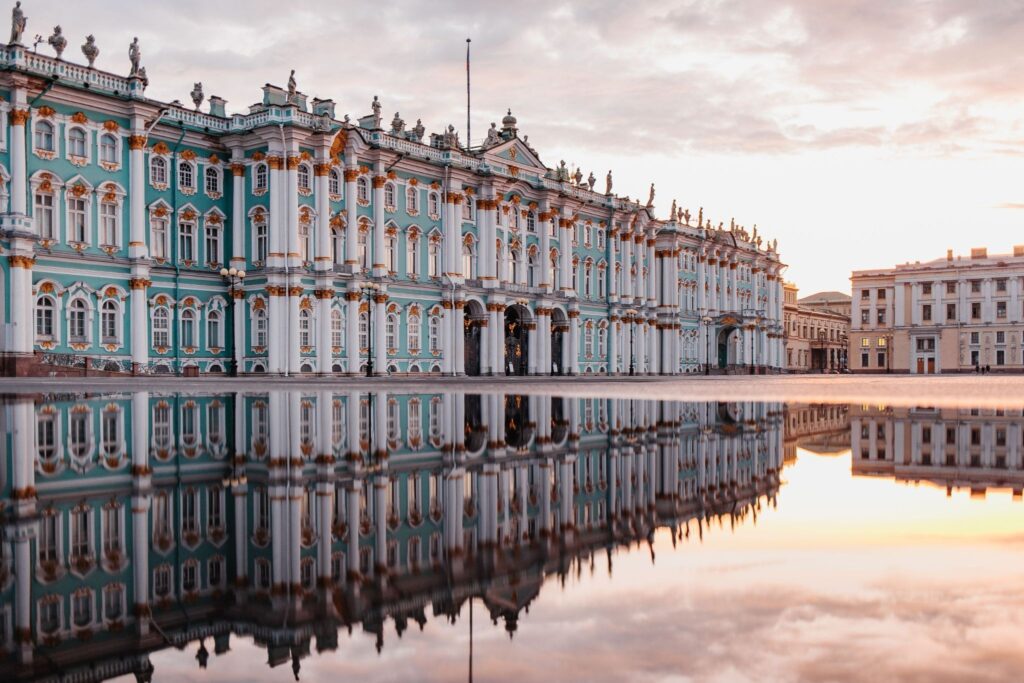
A German princess with no claim to the crown seized power in 1762, held it for thirty-four years, and mastered a foreign language and foreign culture so thoroughly that she became a symbol of the Russian eighteenth century. Her era gave Russia its first school for girls, the Hermitage, a fleet on the Black Sea, Crimea, and years of correspondence with Parisian philosophers. To the same era belong the Pugachev rebellion, serfdom in its most severe form, and Radishchev's exile. This exact combination is useful for a child because it shows a historical figure as living and contradictory, while dates and details can always be checked in the timeline and table accompanying the article.
Russian history for children growing up with two languages
A child can read about Catherine in English on their own. Hearing how that same story sounds in Russian—complete with the «Nakaz,» the Smolny Institute, and «The Captain's Daughter»—is only possible in a live conversation with a teacher who knows how to debate with a student rather than dictate dates. At Palme School, children from four to seventeen years old study Russian online in small groups, with history and culture naturally integrated into the conversation. You can start by two free lessons, where the methodologist will first meet the child and select a suitable group, and then the student will come to a trial lesson with the teacher. The family makes the decision about classes after that calmly and without rush.
Frequently Asked Questions
Why is Catherine the Great called Great?
No one officially conferred the title upon her. The Senate offered it back in 1767, the Empress avoided the grandiose naming, but the moniker stuck anyway, on the lips of later generations. Behind it lies the scale of change: the empire reached the Black Sea and gained Crimea, the population almost doubled, and dozens of cities and institutions appeared that the country had never known before. Of all Russian rulers, only Peter the Great shares the same word attached to his name.
Was Catherine the Great of Russian descent?
No. Father, a German prince in Prussian service; mother from the House of Holstein; birthplace Stettin; the first fifteen years of her life under the name of Sophie Auguste Frederike. She was named Ekaterina Alekseyevna in 1744 upon converting to Orthodoxy. A comparison with her husband is telling. Peter Fyodorovich was Peter the Great's own grandson, but he grew up in Holstein and struggled to accept Russian daily life until the end of his life, whereas his wife, without a single drop of Russian blood, thoroughly mastered the language, the faith, and the court customs.
How did Catherine come to power?
The guard became the support. On the morning of June 28, 1762, the capital's regiments swore allegiance to the emperor's wife, and the matter was decided in a few hours, since the sovereign himself was out of town and learned of what had happened belatedly. He signed his abdication the same day, and he had exactly seven days left to live after that, and versions of what happened still differ to this day. Catherine had neither a will nor kinship with the dynasty; the sole basis for her rule was the manifesto of accession, backed by the oath of the Senate and the Synod.
What is enlightened absolutism?
The concept itself was invented by nineteenth-century historians; monarchs did not call their policies that. It refers to rule by rational laws and with a concern for the enlightenment of subjects, but without conceding even a fraction of power. In practice, changes came exclusively from above, leaving the subject with the role of a grateful recipient, and everywhere such a policy ran into the same obstacle: the class interests of those upon whom the monarch relied.
Is it true that Potemkin villages existed?
Historians consider the account to be a gross exaggeration, and it persists due to several circumstances at once. The 1787 journey was a massive showpiece venture with foreign ambassadors in the retinue, and the ceremonial aspect did indeed predominate. The rumor about painted scenery was started by the prince's detractors and cemented by a pamphlet by the Saxon diplomat Helbig, published after Potemkin's death when there was no one left to object. The real towns and shipyards built in the south during those years passed the test in the war that began immediately after the journey.
Who was Yemelyan Pugachev and what did he want?
A Don Cossack who took the name of the murdered emperor in the autumn of 1773. The plan was based on a rumor circulating through the villages that the sovereign had survived and was hiding for the time being. Yaik Cossacks, factory workers of the Ural plants, Bashkirs, and Kalmyks rallied under his banner; the movement encompassed vast territories and required a real military campaign that ended only in 1775. It left more to literature than to archives: Pushkin traveled to the scenes of the events, gathering material from the last living witnesses.
How many years did Catherine the Great rule?
Thirty-four years, from June 1762 until her death in November 1796. Among women on the Russian throne, no one ruled longer, and overall it is one of the longest reigns in the country's history.
How to talk to a child about Catherine the Great if the topic seems difficult?
It is easiest to start with a single vivid detail rather than an overview of the era. A story about a German princess who learned a foreign language at night and spoke with an accent for the rest of her life, or an empress who was the first in the country to inoculate herself against smallpox so her subjects would stop being afraid, will do. From such a detail, a child starts asking questions on their own, and from then on, they guide the conversation. You should not hide the heavy part of the topic; children accept contradictions more calmly than adults expect.