

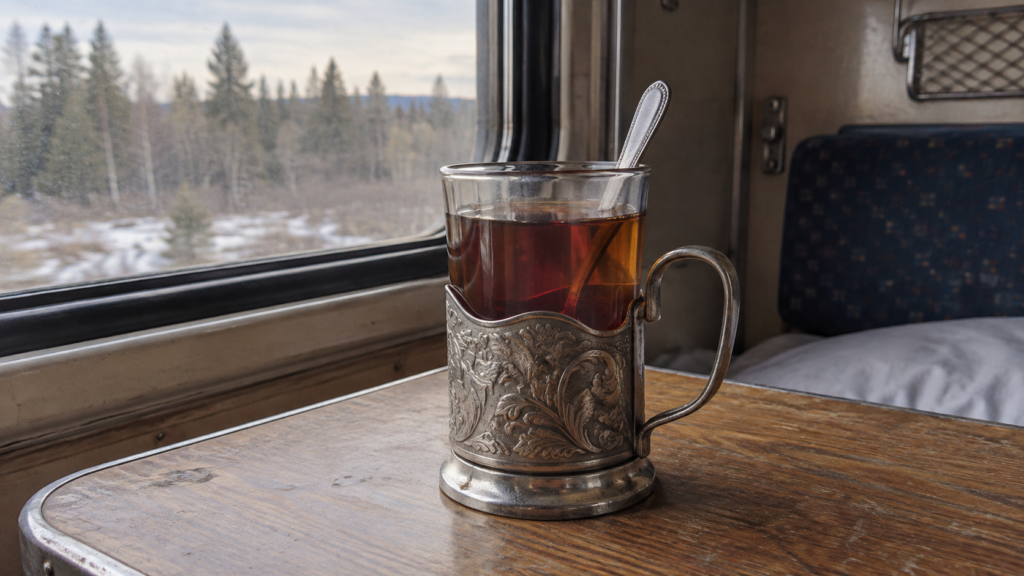

In the city of Kolchugino in the Vladimir region, they are still making a product that looks as if it was discontinued over seventy years ago.
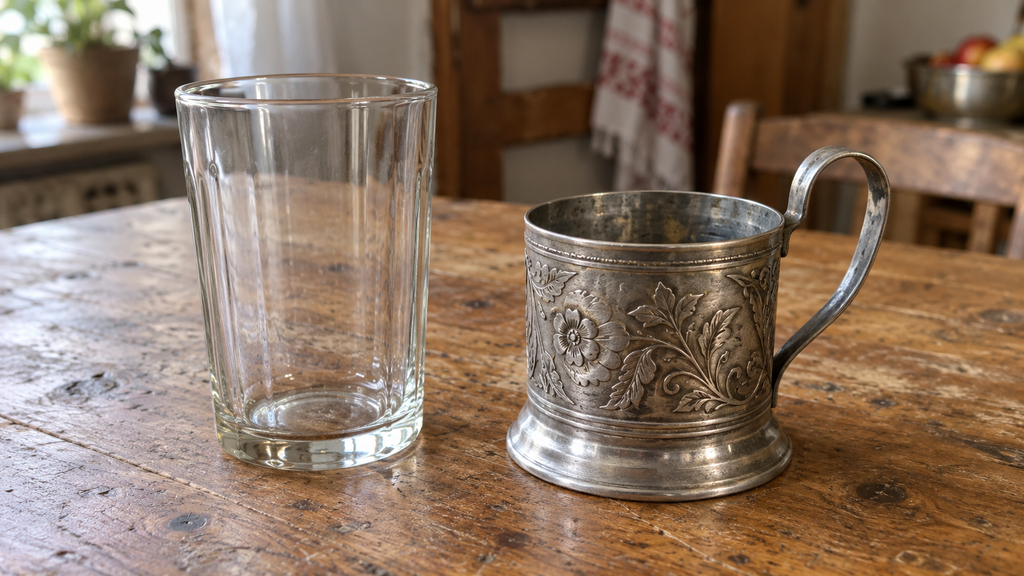
A metal basket with a handle. A regular glass cup is inserted into it. On the wall it can be a triangle, a steam locomotive, a satellite or the coat of arms of the city.
It’s called a coaster. And the weirdest thing about it isn’t that the factory makes it. The weirdest thing is that the buyer still has it.
The factory that started with copper
The story of the Kolchuginsky saucer usually begins with Kolchugin himself.
In 1871, the Moscow merchant Alexander Kolchugin took a loan from the trading house Vogau & Co. and began building factories near the village of Vasilyevsky. At first, they produced sheet red copper and fulfilled military orders. The pottery workshop only appeared in the mid-1890s, and the first products were pressed by hand. These were samovars.
That is, the pottery production here started with samovars, and the company that is today associated with all Russian tea on the road did not immediately develop the saucer.
In 1902, a new teapot factory was launched with stamping technology, and teapots, coffee pots, and teacups were added to the range; later, tableware was also added. Later, the range expanded even further, and coasters became one of the most recognizable products of the factory.
Why a frame for a glass cup
The cup was a common item in Russian life. Tea was brought to Moscow in the XVII century, first as a diplomatic gift, and it remained expensive and rare for a long time. Later, tea became part of everyday life, and it was served in cups in tea houses.
You can't hold a bare glass with boiling water in your hand for long. I kept the coaster with the glass open, but I gave it a metal handle. The glass itself could be changed; the rim remained the same.
In the homes of wealthy people, such railings appeared long before passengers saw them.
The wagon, the coaster and the version about Vitte
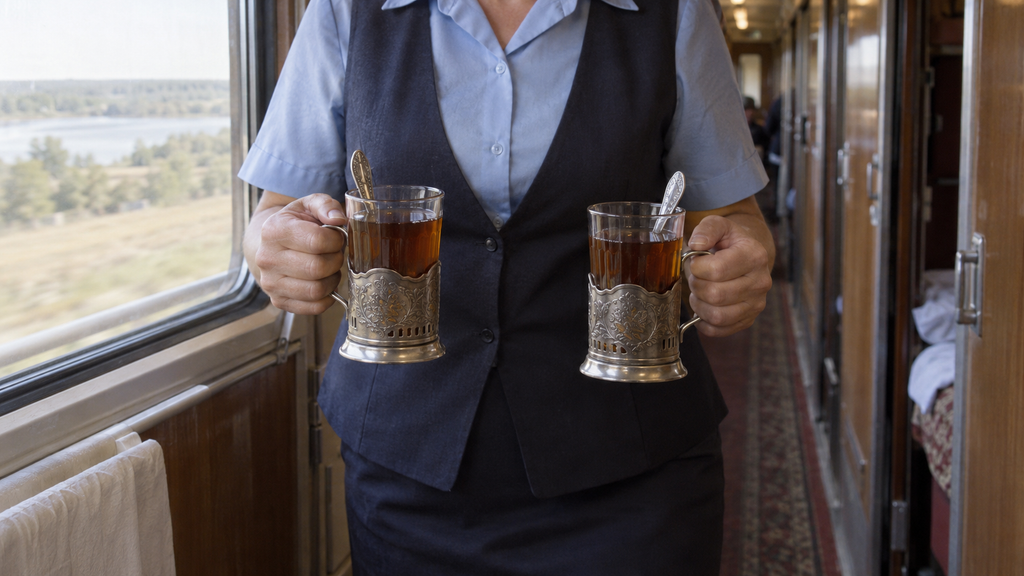
In this design, the structure found its own use. The carriage tilts, the cup is hot, and the frame allows you to hold it by the handle without touching the glass.
The distribution of coasters in Russian trains is often attributed to Sergei Vitte, who became Minister of Railways in 1892. The story of his personal involvement requires caution; no documentary evidence of this version has been found.
But there is another fact. It was these coasters from Kolchugino that became the very model that everyone who has ever traveled on a Russian train knows; even today, you can get them along with tea on long-distance trains.
Why glass, and not porcelain?
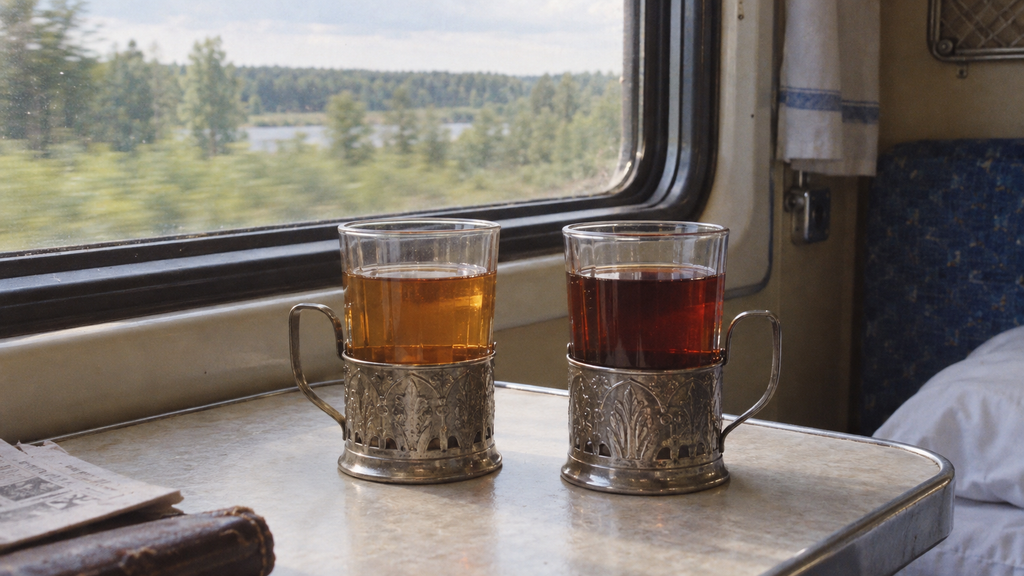
You pour the brewed coffee into the bottom of the cup, add boiling water and immediately see what results you get. One passenger’s tea is amber, the other’s almost black. The glass doesn’t hide anything.
Traditional brewing generally worked well with a cup, and this type of serving suited the wagon. The boiling water and strong tea are served separately, but each one has its own flavor.
Before the railway, a kettle was used to boil the tea for such a cup, and about the history of samovar and the traditions of tea drinking We have a separate article. In the carriage, the teapot was replaced with titanium, but the coaster remained.
What they painted on the wall
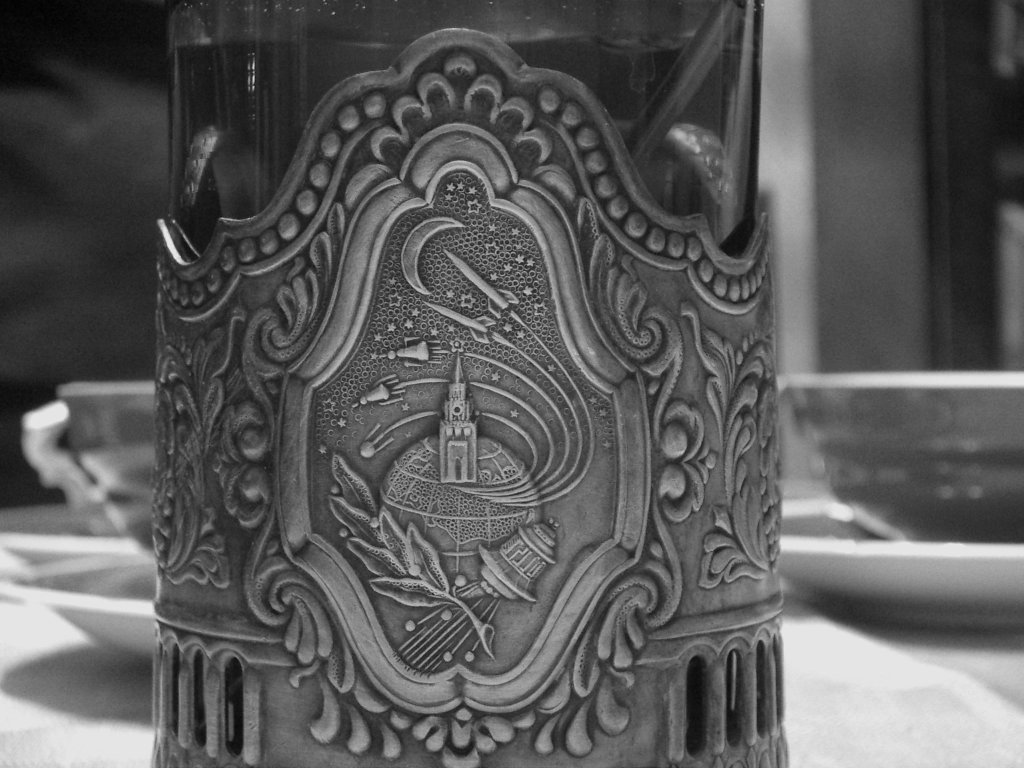
The most interesting part begins next. The coaster was a surface on which the country had been proud for seventy years.
The old trio with the revolution didn’t go away and lived through it. Monuments appeared alongside it, Red Moscow with fireworks, city coats of arms. There was also a souvenir cup called «Tractorist and Farmwife,» with a sculpture from the VDNKh.
For the 1957 World Festival of Youth and Students, coasters with the festival's symbols, the dove of peace, and a globe were produced. That same year, the fortieth anniversary of the revolution was celebrated. And in the autumn of 1957, the first satellite was launched, and the satellites traveled around the Earth on the coasters' sides.
Tatiana Tolstaya noticed this detail in the story «Limpopo,» where the hero takes away a commemorative cup with three silver companions flying over the Earth globe.
By 1965, the factory was producing a large range of silver-plated, nickel-plated, and chrome-plated tableware, and coasters were sold alongside teapots and trays. By the late 1970s, a new tableware production facility with a capacity of more than two thousand tons per year was opened, and a third of the products were exported.
Collections and stamps
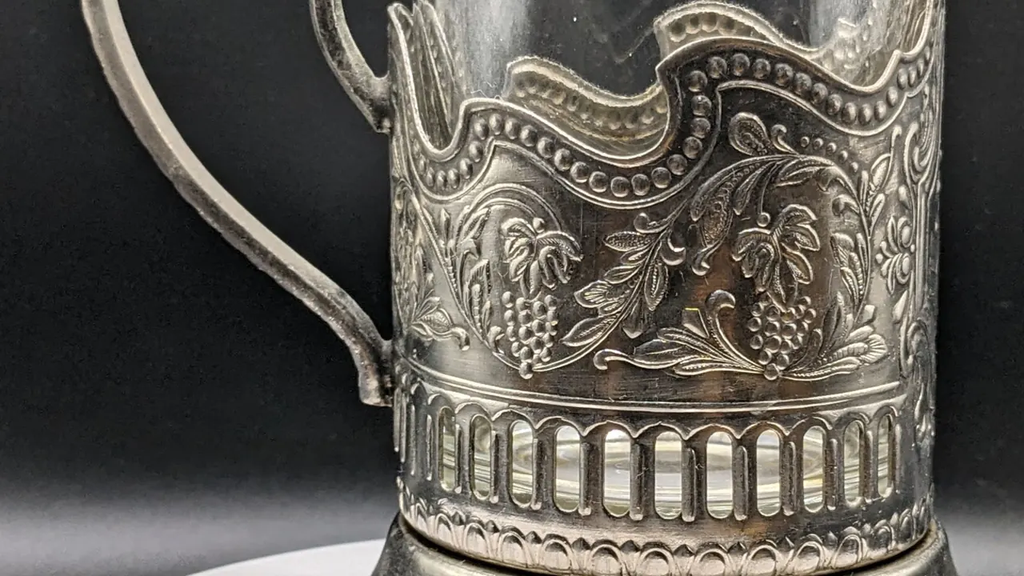
They collect coasters in batches, like stamps. Cities, monuments, flowers, anniversary dates, rockets and satellites.
The stamp helps identify the manufacturer and the material, and sometimes the approximate production date. Soviet-made items also often bear a price tag. Sometimes a defect is considered valuable. One collector from the Russian Railways has a souvenir cup commemorating the 40th anniversary of the revolution with a mirror-etched stamp on it.
That is why you can read the history of a country through someone else’s collection without opening a textbook. Flags, construction projects, festivals, space, Olympic rings. All of this was transported in trains by people who were simply drinking tea.
He survived the country
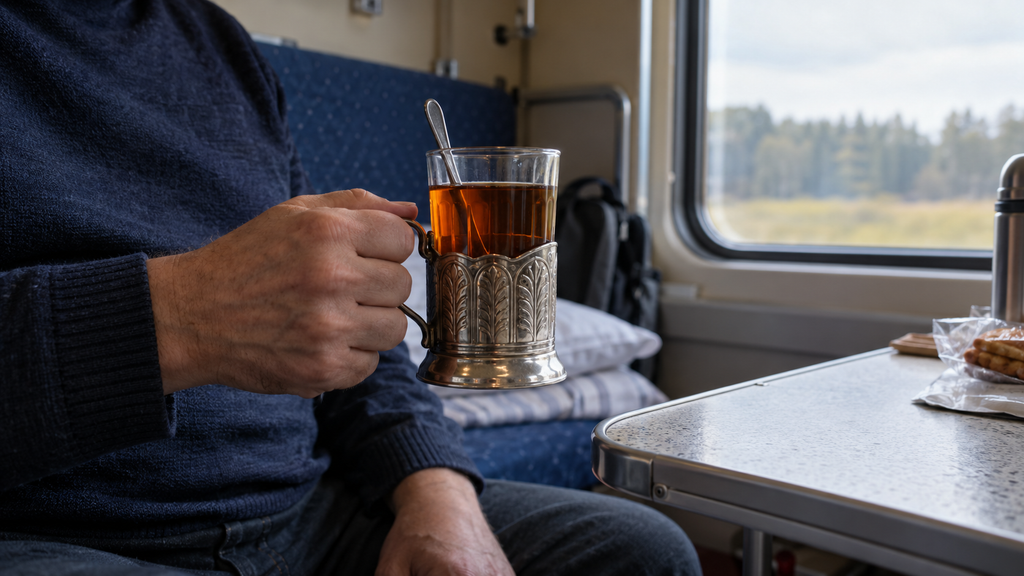
The USSR ended, but the subject remained.
The factory in Kolchugino still operates and calls itself the largest manufacturer of coasters. In addition to the old patterns, new ones have been added, including custom engravings.
Almost everything has changed in this story: the country, the carriages, the tea in packets instead of the brewed tea in a separate teapot. Only the object itself has not changed. A metal basket with a handle, a cup inside it, tea in the cup, and a spoon that rattles against the glass in time with the sounds of the cutlery.
Frequently asked questions about Russian tea drinking
How do they make tea in Russian?
In two ways. First, a strong brew is made in a separate teapot; then it is poured into the bottom of a cup or glass and topped up with boiling water until the desired strength is reached. At each table, everyone receives tea as they like it. This method of brewing is one of the characteristics of the Russian tea tradition, the russian tea tradition.
What is Russian tea?
One of the meanings of Russian tea, tea without milk, which is served with lemon. This is exactly the definition given by A Dictionary of Food and Nutrition. It describes a specific method of serving, not the entire Russian tea tradition. The term "russian tea ceremony" is also found in English-language texts.
When did tea appear in Russia?
In Russia, tea became popular in the 17th century. In the 19th century, its consumption expanded significantly, although access to the drink varied by region and family income. In English, this history is known as tea in russia.
Why do they serve tea in a cup with a saucer on the train?
The tradition dates back to the pre-revolutionary railways. The cup has no handle, and the metal frame allows you to hold hot tea without burning yourself. The cup can be replaced, and the saucer remains.
What do the stamps on the coasters mean?
The stamp identifies the factory; for Soviet-era models, the retail price is also printed next to it. For collectors, this is the first sign that identifies the item.
Russian language for children aged 4 to 17
Classes are held online in small groups. In the first lesson, the methodologist will determine the child's level, and the second will take place in a selected group with a teacher.
Sign up for two free lessons