
Онлайн-подготовка к ЕГЭ и ОГЭ
Индивидуальная подготовка к экзаменам с преподавателем
🎯 Запишись на бесплатный пробный урокПодробнее
Перейти к основному содержимому

Palme School

Онлайн-школа русского языка в США и Канаде​
Онлайн-школа на русском языке для билингвальных детей и подростков
💡 Получай бонусы с нами! Реферальная программа

Slow Cartoons and Sensory Overload. Why Umka Still Works

Оглавление

Names and identifying details of every student here are changed, as they are everywhere on the blog.

A mother told me her four-year-old came off twenty minutes of cartoons wound up like a spring, and that the same child could sit through forty minutes of something her grandmother had loved without moving. Names and identifying details of every student here are changed, as they are everywhere on the blog.

The problem is not the speed

She assumed the difference was speed, and I did too for a long time. It is not, or not exactly, and the distinction turns out to matter for what you do about it.
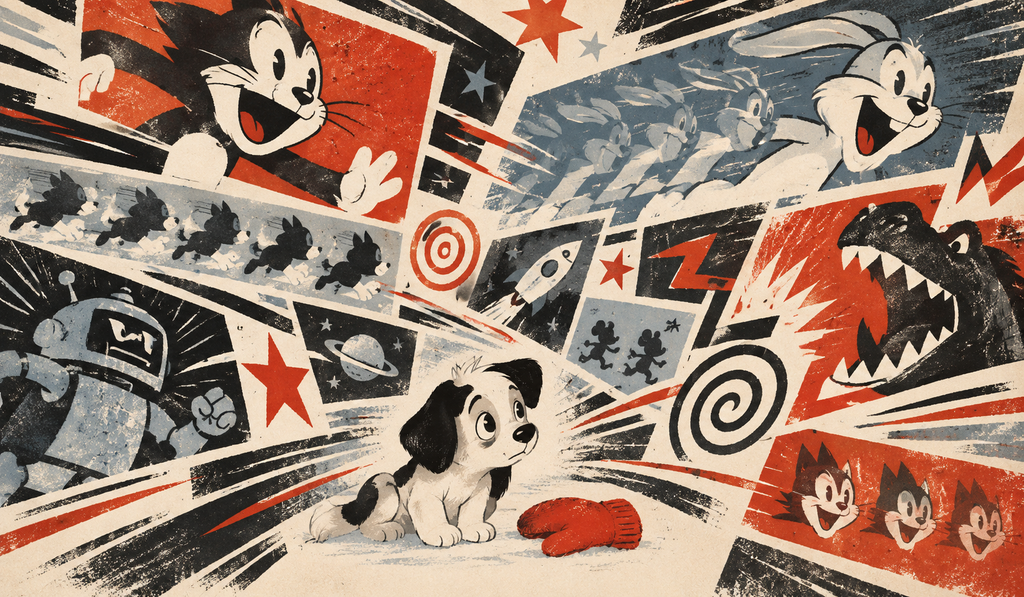
Editorial illustration exploring the problem of fast-paced modern cartoons through an abstract collage of rapid cuts, repeated characters, sharp movement and competing visual signals. The small puppy at the center contrasts with the surrounding chaos, making the sense of overstimulation immediately visible. The image keeps the article’s textured vintage poster aesthetic and restrained red, black, cream and blue palette.
Palme School AI generated
Watch a modern preschool cartoon with the sound off and count how often the picture changes. Then do the same with Umka. I did this properly once, with a stopwatch, on a friend’s sofa while her son watched something with a great many primary colors in it, and it changed how I think about the whole question. What you will notice is not that one is faster, but that one has already made every decision for the child. Where to look. What matters in the frame. When something is funny, which the laugh track announces in case anybody missed it.

What a held shot actually asks for

A cut every two seconds does the child’s noticing for them. A held shot hands the job back.

Four seconds on a falling snowflake is a long time when nobody tells you what to think about it. They keep looking. Somewhere in there they decide what the shot is for, and then they have to hold that decision until the film moves on, which is the part nobody sees happening. That is not an absence of stimulation. It is a small piece of work, and it is the same work a classroom asks for two years later when a teacher explains something that takes longer than a sentence.

Attention is not something a film gives a child. It is something a film either asks for or does without.

Varezhka runs almost entirely without dialogue. A child watching it has to read a face and guess a feeling, because nobody is going to say the feeling out loud. And yes, it is boring at first, in the way a quiet room is boring to somebody who has just walked out of a party, and for much the same reason. Parents rarely see this one coming, and it throws them, because the complaint sounds like a review. It isn’t. Give a child a year of being shown exactly where to look, then hand them a frame that declines to point at anything, and the first few minutes will feel to them like an empty screen. Nothing’s happening is the standard line, and the honest answer is that quite a lot is happening and none of it is happening to them. In what I see, that discomfort usually passes in about a week of short, regular attempts. It does not pass if the film is put on as a test while the adult leaves the room.

What a fast cut does

What a held shot does

Decides where to look

Leaves the choice to the viewer

Flags the joke as it happens

Lets a child find it, or miss it

Fills every second

Leaves seconds unfilled on purpose

What to do about it, without a fight

One thing changes the outcome more than any other, and it is an adult in the room saying something occasionally, which sounds too small to be the answer and is.

Not narrating, and not quizzing. A remark every few minutes, the kind you would make to another adult, is enough to convert a boring frame into a shared one. Children stay with slow films for the same reason they stay at a dinner table: somebody they like is there and something is being discussed. My own mother never once explained a film to me and never once left the room during one, and I didn’t figure out until I had my own classroom that the second part was the part that mattered.

Four things to try this week, in order

Start with ten minutes

Not a whole film. Ten minutes of something slow, at a time of day when nobody is tired or hungry.

Sit down with them

The room matters more than the film. A parent doing something else nearby is not the same thing.

Say one thing, then stop

A remark, not a question. Questions turn it into school and children can tell instantly.

Let them predict

Pause once and ask what happens next. This is the whole exercise: a film that can be predicted is a film being watched.

The prediction game is the one worth keeping past the first week. A child who guesses what a character will do has stopped receiving and started thinking, and you can hear the difference in what they say afterward without having to ask.

The experiment I ran on my own class

I teach Russian to bilingual children, and for one block of lessons I showed five minutes of slow animation at the start of each lesson, mostly because I wanted them to hear unhurried speech.
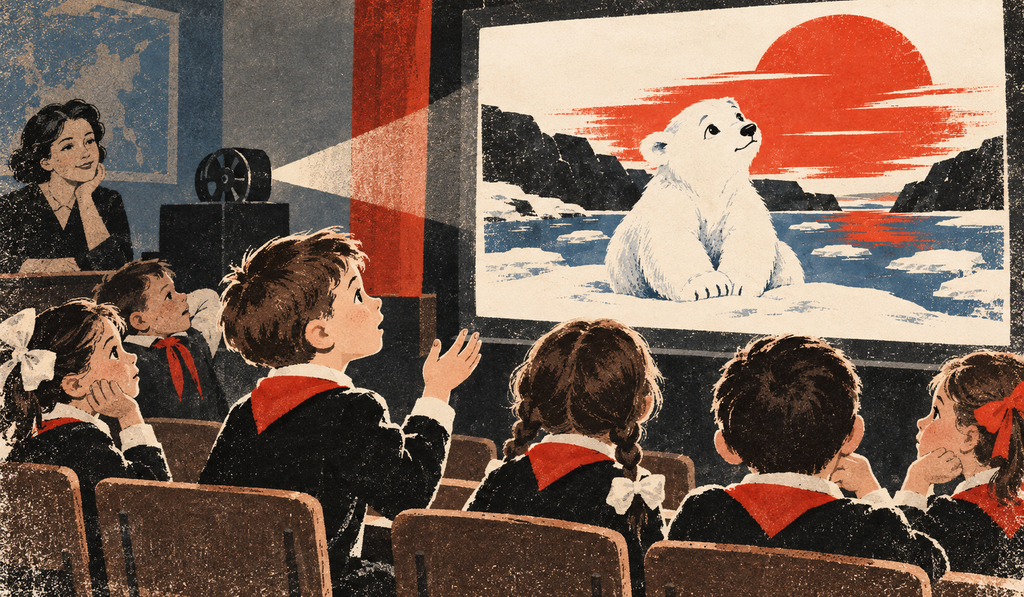
Editorial illustration of young children watching Umka on a classroom screen. One boy raises his hand with a question while the rest of the group grows increasingly calm and attentive, reflecting how repeated exposure to the cartoon’s slower pace reduced fidgeting over several weeks. The image uses the same textured vintage Soviet poster style as the article cover, without the Palme logo.
Palme School AI generated

The language part went about as expected. One boy asked me in week two why the bear was taking so long to say anything, and I said the bear was thinking, and he accepted that with the seriousness of somebody filing away a useful fact. What I did not expect was the fidgeting, which was considerable in week one and mostly gone by week four, without my having said a word about sitting still.

What I think happened is duller than it sounds. They were not being trained to concentrate. They were being given something that only works if you stay with it, often enough that staying with it stopped being unusual. Five minutes, twice a week, and none of it was a lesson about attention.

Editorial illustration inspired by the Soviet animated film Varezhka, showing the puppy alone in a snowy courtyard beside a vivid red mitten. The restrained composition, muted winter palette and textured vintage poster aesthetic emphasize quiet observation, visual storytelling and the unhurried rhythm of classic animation.
Palme School AI generated

Nobody in that room was taught to focus. They were given something worth focusing on, repeatedly, until it was normal.

I would not generalize from one class of eleven children, and I’m not going to tell you it will work on yours. I will say it cost nothing to try.

Five films worth starting with

Umka

Three to five years

A polar bear cub and his mother. Gentle, quiet, and short enough for a first attempt.

Varezhka

Four years and up

Almost no dialogue. A child has to read faces, which is exactly the point.

Hedgehog in the Fog

Five years and up

Slower and stranger than the others. Some children love it immediately; some need to be older.

Two more worth knowing. Try Strawberry Rain at bedtime, where winding down matters more than paying attention and its shortness helps. The Grey Neck asks more of everybody: it runs longer, it carries real sadness, and the questions it produces tend to arrive after the film has finished. If the question in your house is how much screen time rather than what is on the screen, that is a different problem with a different solution, and we wrote about it separately.

Courses at Palme School

Russian for bilingual children
When the language is at home and starting to slip

Conversation school
For children who understand more than they will say

Free materials
Printable activities for families to use at home

At Palme School we teach children online, in groups of up to eight, two forty-minute classes a week, and the first two lessons are free. Both courses above take bookings the same way, and the printable material is free whether or not you ever book anything.

Frequently asked questions

Why does my child get hyperactive after watching cartoons?

In what I see, it tracks with how much the film decides for them rather than with how long they watched. A film that changes the picture constantly leaves nothing for a child to do and a great deal to keep up with.

Are slow cartoons actually better for children?

Better is a strong word and the research is genuinely unsettled. What I can say is that slow films ask a child to do something, and films that ask nothing get nothing back.

What if my child says slow cartoons are boring?

Expect it, and do not treat it as the final answer. In what I see, the complaint fades within a week or two of short attempts, provided an adult is in the room rather than using the film as quiet time.

At what age can children watch Hedgehog in the Fog?

Around five for most, later for some. It is stranger than the others on this page and a child who finds it unsettling is not doing anything wrong.

Palme School: Conversation school · Russian for bilingual children · Free materials for learners

Lily Rozberg has been teaching for sixteen years, first English in Russia and now Russian to bilingual children across the US and Canada. She writes for Palme School about heritage language, reading, and the things report cards do not measure.
Хотите поддержать успехи ребёнка в учёбе?
Помогаем развивать знания, уверенность и любовь к обучению через современные занятия русским языком и не только.

Хотите, чтобы ребёнок полюбил учиться?

В Palme School занятия проходят онлайн — в живых группах с опытными педагогами. Выберите направление и запишитесь на бесплатный первый урок.

подпишитесь на рассылку — получайте полезные письма от нашей онлайн-школы

Оставьте заявку на бесплатный звонок

Запишитесь на бесплатное занятие​​
Оставьте заявку на бесплатное первое занятие, чтобы познакомиться, определить ваши цели и подобрать группу
Запишитесь на бесплатный урок​​
Оставьте заявку на бесплатное первое занятие с методистом, чтобы познакомиться, определить ваши цели и подобрать педагога вашему ребенку
Запишитесь на бесплатный урок​​
Оставьте заявку на бесплатное первое занятие с методистом, чтобы познакомиться, определить ваши цели и подобрать педагога вашему ребенку
Запишитесь на Русский Диктант
Запишитесь на бесплатный урок​​
Оставьте заявку на бесплатное первое занятие с методистом, чтобы познакомиться, определить ваши цели и подобрать педагога вашему ребенку
Запишитесь на бесплатный урок​​
Оставьте заявку на бесплатное первое занятие с методистом, чтобы познакомиться, определить ваши цели и подобрать педагога вашему ребенку
Запишитесь на бесплатный урок​​
Оставьте заявку на бесплатное первое занятие с методистом, чтобы познакомиться, определить ваши цели и подобрать педагога вашему ребенку
Запишитесь на бесплатный урок​​
Оставьте заявку на бесплатное первое занятие с методистом, чтобы познакомиться, определить ваши цели и подобрать педагога вашему ребенку
Запишитесь на бесплатный урок​​
Оставьте заявку на бесплатное первое занятие с методистом, чтобы познакомиться, определить ваши цели и подобрать педагога вашему ребенку
Запишитесь на бесплатный урок​​
Оставьте заявку на бесплатное первое занятие с методистом, чтобы познакомиться, определить ваши цели и подобрать педагога вашему ребенку
Запишитесь на бесплатный урок​​
Оставьте заявку на бесплатное первое занятие с методистом, чтобы познакомиться, определить ваши цели и подобрать педагога вашему ребенку
Запишитесь на бесплатный урок​​
Оставьте заявку на бесплатное первое занятие с методистом, чтобы познакомиться, определить ваши цели и подобрать педагога вашему ребенку
Запишитесь на бесплатный урок​​
Оставьте заявку на бесплатное первое занятие с методистом, чтобы познакомиться, определить ваши цели и подобрать педагога вашему ребенку