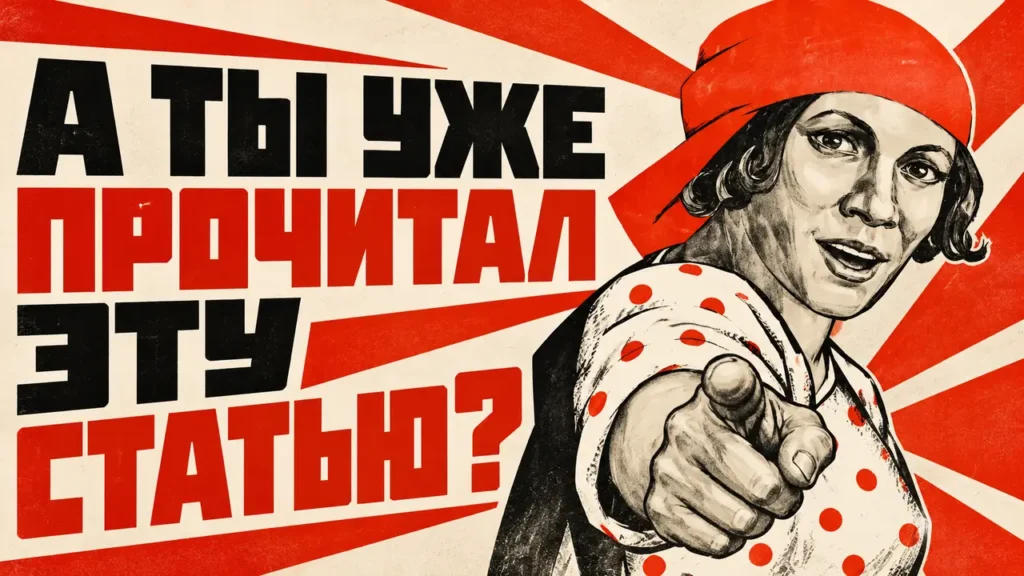
The first of two posters of this story was printed by the Whites in 1919 or, according to other sources, in 1918. An officer in a fedora looks at the passerby, his finger pointed directly at him, and the inscription asks: «Why aren’t you in the army?»
A year later, another poster appeared in Moscow. The Krasnoarmeechnik in a beret, the same finger pointed at the viewer, and the question «Have you signed up as a volunteer?».
One gesture. The difference is in one pronoun.
The first poster is mostly known to historians today. The second is remembered by almost everyone who grew up in the USSR; it is still parodied to this day. The Whites lost the war, and their poster was consigned to the archives along with the army. But the texts on the two posters are also noticeably different.
Who calls someone «you»

The author of the white poster is unknown. According to one version, he redrew the figure of the officer from an Italian poster from 1917, which called for people to sign up for a military loan. There, the polite approach was appropriate; people were asked for money. Here, the person was called up to the front, and for a modern reader this «you» creates a completely different distance.
Dmitry Moor, whose real surname is Orlov, drew his poster in June 1920, at a difficult time for the Red Army. «You» in his work is short and direct, as neighbors in the trench would say. Later, Moor recalled that he was collecting feedback on the poster. Some people admitted that they were ashamed of him for not signing up.
For the Russian-speaking reader, the difference is obvious from the first word. For a child who grows up speaking English, she has to be explained, because in English, there is only one you in this place. How the «you» and «you’re» are formed together with the rest of the pronouns, we have discussed in the article about Russian pronouns.
London, 1914
This gesture wasn’t made famous in Russia. In September 1914, the artist Alfred Lith drew the cover of the London Opinion magazine for Lord Kitchener, the War Minister. He stared straight ahead and pointed with his gloved finger at the reader, and the caption read: “Your Country Needs You.” Soon after, the same image was used on a recruitment poster. In 1917, James Flagg posed Uncle Sam in the same pose with the caption “I want you.”.
In English-language collections of Soviet propaganda posters, Moora usually places them next to one another. He has not seen any British or American posters; there is no direct evidence of this. But by 1920, this gesture was already understood in London, New York, and Rome.
The interesting part here is the grammar. Ketchner and Uncle Sam reveal what they want from the viewer: the country needs you, I want you. Moore instead asks a question. It’s easier to walk past the poster than to answer the question about yourself.
Windows instead of walls
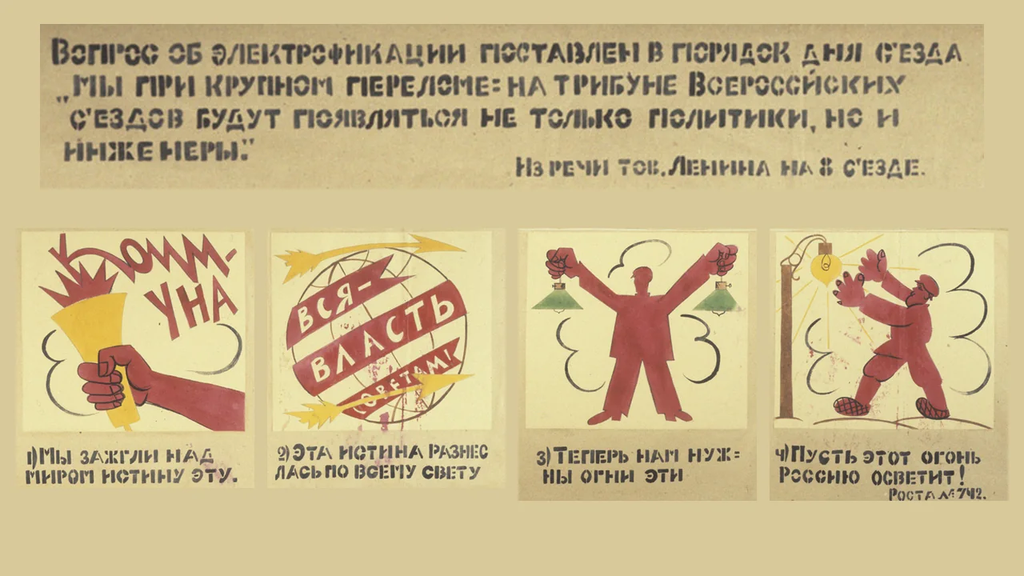
In the same years, in Moscow, a different approach to poster design was being adopted. Starting in the fall of 1919, the Russian Telegraph Agency, abbreviated as ROTA, displayed a series of short captions on the storefronts of empty shops. The pictures were numbered, like frames, and were read from left to right.
They were created by Mikhail Cheremnykh, Vladimir Mayakovsky, and several other artists; many of the signatures were written by Mayakovsky himself. The drawings were reproduced by hand using a stencil, and the news reached the public very quickly. There are no fingers involved here; the rhyming structure does the work for him. The line that rings out is carried away by passersby, even if they haven’t looked at the picture. On the Soviet art propaganda sites, Okno Rosta mostly shows the graphics, although they are just as worth reading as looking at them.
The slogans in those years were generally simple. We explained why the Bolsheviks managed to do this better than their opponents. in the article about the 1917 revolution.
Don't talk
In 1941, the finger returned, but only now to the lips.
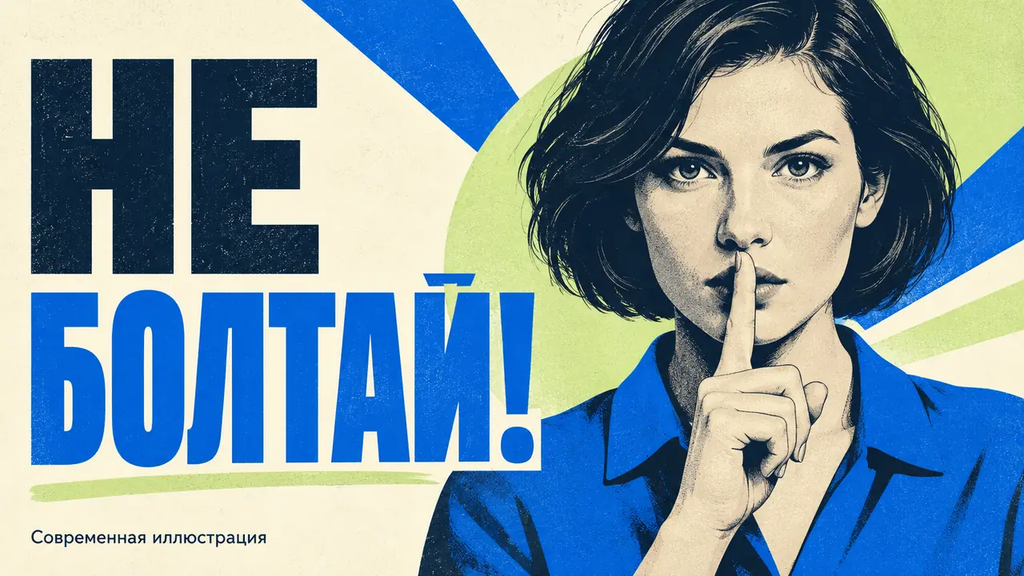
On Nina Vatolina and Nikolai Denisov's poster, a woman in a red coat presses a finger to her mouth. The two-word caption is «Don't talk!» and below is a poem by Samuel Marshak about how on days like these even the walls listen in, and it's not hard to imagine betrayal when you talk too much.
The poster no longer calls for going somewhere. It asks to be silent. The prohibition in Russian usually takes the form of an imperfect verb: «do not talk,» «do not open,» «do not touch.» With the perfect form, the nuance is different. «Do not forget» or «do not be late» sound more like a warning, and such a nuance wouldn’t be needed in a poster.
In the same 1941, the old finger returned. Moor revised his composition for the new war, and the Red Army soldier now asked, «What did you do for the front?» The gesture, the question, and the «you» remained the same; only what the audience expects has changed.
The hand that reached out
Irakli Toidze's family told this story this way. On Sunday, June 22, 1941, he was working on drawings for a poem by Rustaveli when his wife burst into the studio. Tamara had just heard on the radio about Germany's attack, and her first word was «War!» Toidze ordered her not to move and immediately grabbed a pencil. Toidze's son later recounted that the mother's raised hand kept itching.
Thus, the poster «Motherland calls!» appeared. The woman raises her hand, while holding another text of the military oath; behind her are the daggers.
There are no thumbs, and there is no direct address either. The poster does not say «you» or «you,» it reports in the third person that the mother is calling out. Who exactly, the viewer decides for himself, and almost always decides who it is.
A few seconds on the sidewalk
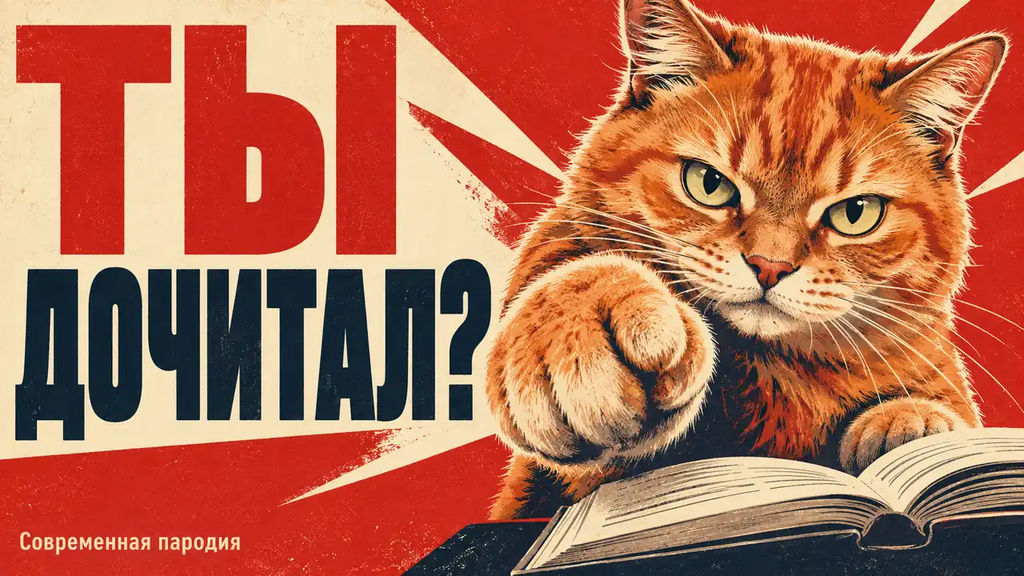
Over the twenty-odd years the hand on the poster changed jobs several times. At Moore’s it chose a person from the crowd; at Vatolina and Denisov it stopped at someone. And at Toydze it no longer pointed to anyone.
The poster had only a few seconds to work with while the person passed by. Therefore, the artist had enough expressive gesture and facial expression, and there were enough words in the captions that one cannot help but read them all.
Show the child two posters, for example «Have you signed up as a volunteer?» and «Don’t talk!» and close the captions. What do you think the person drawing is saying? Then open the text and compare it. With older children, you can swap the captions around and discuss why the picture starts to work worse right away.
At Palme School, we teach Russian online to children aged four to seventeen in small groups. You can start at two free lessons. The first step will be a meeting with a tutor; they will determine the level and select a group, and the second step will be a trial lesson in that group with a teacher.
Frequently asked questions about Soviet posters
Who is the author of the poster «You signed up as a volunteer?» and when was it published?
Dmitry Moor, whose real surname is Orlov. He adopted the pseudonym in 1907, when he was drawing for the satirical magazine «Budilnik». He released the poster in June 1920, during the Civil War, by the literary-publishing department of the Political Directorate of the Revenwovsovet. It is a color lithograph measuring slightly more than a meter in height.
Where did the sign with the index finger come from?
The first widely known example was the 1914 British poster, where Lord Kitchener pointed the viewer first at the London Opinion magazine cover and then at the recruitment poster. In 1917, the same technique was repeated in the United States with Uncle Sam, and in Italy on a military loan poster. In Russia, the first to use it were the Whites, and in 1920 Moor made his own version. Did he see Western examples, direct evidence of this is lacking.
What are the Windows of RUST?
The advertising posters of the Russian Telegraph Agency, which were published in 1919–1921 and responded to news very quickly. They were called windows because the posters were hung in the windows of mostly empty shops. Mikhail Cheremnykh, Vladimir Mayakovsky and other artists worked on them. During the Great Patriotic War, the Oknas TASS took up the same idea.
Who posed for the poster «Motherland Calls!»?
According to family memories, the wife of the artist, Iraklia Toidze Tamara, was the first to bring him the news of the war. The poster itself was ready in the early days of the war, and by the summer of 1941 it was being printed in huge quantities.
Why do Soviet posters address the viewer as «you»?
Not on all of them, but on the most famous ones. The short «you» makes the address personal; that’s what they say to their friends. The white poster from 1919 with the same gesture was addressed to a polite «you»; in Russian, however, they would rather address an unfamiliar person that way. Later, a third option emerged, like Toydze’s, where the poster doesn’t even include a reference to the addressee.