Russian dog breeds range from dogs as heavy as a grown man to dogs that fit in a coat pocket. Some were made to stand watch on the Soviet border. Others are small, curly lapdogs bred in Leningrad apartments, and the name of that breed means “colored.” You have probably met a few of them without knowing where they came from. A Samoyed smiling at you over a dog park fence is one. A Siberian Husky is another.
This guide covers ten of the best-known dog breeds from Russia, from the borzoi to the Russian Toy. A few others, like the Russo-European and East Siberian Laikas, the South Russian Shepherd and the Russian Hound, didn’t fit. For each dog we say where it comes from, how big it gets, what it’s like at home, and whether the American Kennel Club (AKC) accepts it. If the AKC doesn’t fully recognize a breed, we say that too. Near the end you’ll find Russian dog names with pronunciation, plus a few Russian words to try on your own dog. And if you’re more of a cat person, we have a guide to the Russian Blue cat too.
First, a quick look. Sizes come from the AKC when it lists the breed, and from the sources named in each breed’s section when it doesn’t. The “kids” column is our short reading of those sources, so please read the full section before you decide anything. AKC status is as we found it in October 2026.
| Breed | Size | Temperament | With kids? |
| Borzoi | 28–32 in (males), 75–105 lb | Calm, quiet, “catlike” | Yes, with supervision (AKC) |
| Caucasian Shepherd Dog | 99–170 lb | Serious guardian, fearless | AKC doesn’t say; for experienced owners |
| Black Russian Terrier | 80–130 lb | Intelligent, stable, courageous | The AKC doesn’t say; early training is needed |
| Samoyed | 19–23 in, 35–65 lb | Loyal, social, eager to please | Tends to be good with children (AKC) |
| Siberian Husky | 20–23.5 in, 35–60 lb | Friendly, energetic, escape artist | Usually yes, with exercise (AKC) |
| West Siberian Laika | 21.7–24.4 in (males), per FCI | Devoted, territorial, vocal | Sources don’t say; a working hunter |
| Yakutian Laika | 21.7–23.2 in (males), 20.9–22.4 in (females), per FCI | Working sled and hunting dog | Not enough information |
| Moscow Watchdog | At least 121 lb (males), 99 lb (females) | Gentle with family, protective | Sources don’t say |
| Russian Toy | Up to 6.5 lb | Lively, clever, can be possessive | Best without small children (breeder quoted by AKC) |
| Russian Tsvetnaya Bolonka | About 11 in (breeders’ goal), 6–9 lb (AKC chart) | Friendly, devoted, adaptable | The AKC page doesn’t say |
Large Russian Dog Breeds: Caucasian Shepherd, Black Russian Terrier and More
Type “large Russian dog breeds” into a search bar and two names come up first. They couldn’t be more different.
The Caucasian Shepherd Dog is a huge livestock guardian, weighing between 99 and 170 pounds according to the AKC’s weight chart. The AKC calls it “a serious guardian breed”: bold, fearless, and fierce when a threat is near, yet gentle and devoted to its own family and the other pets in the house. It is not fully recognized by the AKC. The AKC lists it on its Miscellaneous Class page, and breeds in that class are still enrolled in the Foundation Stock Service. The FCI, the international federation, does have a standard for it (number 328, Group 2). The FCI lists Russia as the country of origin and says the breed comes from ancient Caucasian dogs, shaped by the peoples of the Caucasus who used them to guard herds and homes, with systematic selection starting in the USSR in the 1920s. The AKC page doesn’t mention children. A dog like this needs an owner who knows what to do, so we wouldn’t suggest it as a first dog.
The Black Russian Terrier is the one the AKC knows well. It joined the Working Group on July 1, 2004, and the AKC’s weight chart puts it at 80 to 130 pounds. The name is a bit misleading, by the way. The AKC calls “terrier” a misnomer: there is some Airedale in the breed, but many other breeds went into it, and it was bred for guard work, not for chasing rats. What the breeders wanted, the AKC says, was an intelligent, stable, courageous dog. The story is Soviet, so we tell it in that section below. Children don’t come up on the AKC pages we read.
Borzoi: The Russian Wolfhound
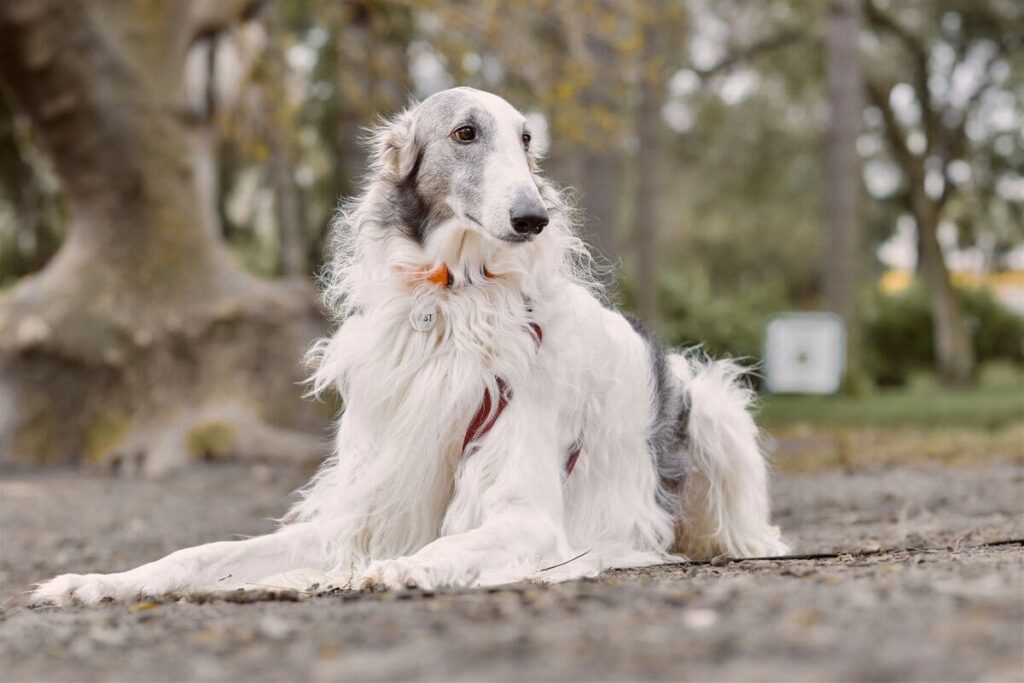
Picture the borzoi dog and you probably see it right away: tall, narrow, a bit like a greyhound that went to a fancy salon. It’s a sighthound, so the AKC puts it in the Hound Group, and for years it went by the name Russian Wolfhound. The name we use today, borzoi, only became official in 1936. It comes from a Russian word meaning “fast,” and the AKC says a borzoi at full stride can hit 35 to 40 miles per hour. Not a bad name to live up to.
The job was hunting. Russian nobles kept these dogs to hunt wolves, foxes, and hares in the open country, and some of them kept many dogs. The AKC tells the story of Grand Duke Nicholas Nikolaevich, whose kennel at Perchino, a long way outside Moscow (about 125 miles), once had 130 adult borzoi living there at the same time. Then the Revolution arrived. The kennel closed around 1917 (the AKC doesn’t give a more exact year), and many of the dogs were given away or killed, and in Russia the breed almost disappeared. Fortunately, a few had already crossed the ocean. In 1903 an American from Connecticut, Joseph Thomas Jr., traveled to Russia and came home with dogs from Perchino and from another famous kennel, Woronzova.
And at home? Surprisingly quiet. The AKC calls the borzoi “catlike”: calm, independent, sensitive, affectionate with the family and rarely a barker. It can be stubborn, and it needs 30 minutes or more of running every day in a fenced area, because it will chase whatever moves. Many do well with children they grew up with, but they don’t like rough handling, so an adult should supervise. A dog this size can knock over a small child without meaning to.
Northern Dogs: Samoyed, Siberian Husky and Laikas
The far north of Russia gave the world dogs that pull sleds, herd reindeer, and get through winters most of us can’t picture. Three groups matter here.
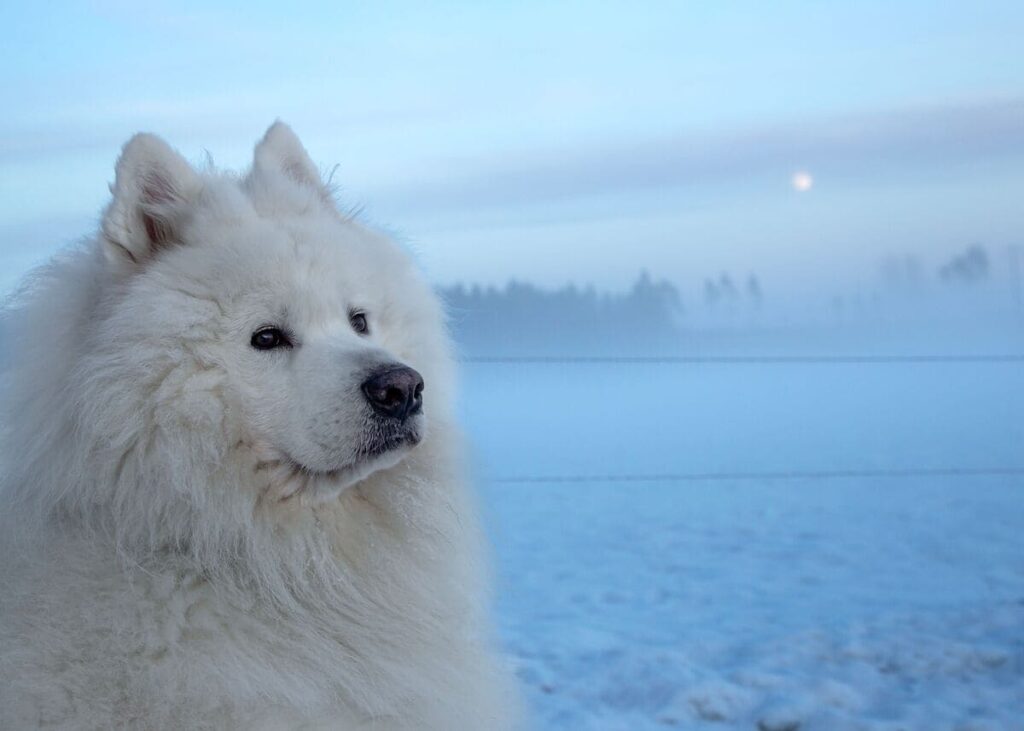
Samoyed. Start with the name, because it’s a bit awkward. “Samoyede” is what outsiders used to call the Nenets and some related peoples, reindeer herders living in Siberia above the Arctic Circle, and the AKC says their dogs did everything: hunting, herding reindeer, guarding the camp, pulling sleds. In the 1800s European explorers began carrying Samoyeds home, and a few were given to royalty as gifts. The AKC adds that Roald Amundsen took Samoyeds on his 1911 trip to the South Pole. Some other accounts say his teams were Greenland dogs, So that bit is the club’s version of events. The first Samoyed was registered with the AKC in 1906, and today the breed is in the Working Group. At home, says the AKC, Samoyeds “tend to be good with children,” and they really want to be with people. Leave them alone all day and you’ll hear about it. Be ready for the hair too: brushing daily, and a lot of exercise.
Siberian Husky. You may already know this one, at least in outline. According to the AKC, it began with the Chukchi people in far northeastern Siberia, who had been using dog teams for hunting, fishing, and getting around for thousands of years. In 1909, a Russian fur trader brought a team of Siberians to the All-Alaska Sweepstakes race. Then came January 1925, when diphtheria hit Nome, Alaska, and the nearest serum was more than 600 miles away. Leonhard Seppala and his Siberians ran their leg of the relay, and that’s how the dogs Togo and Balto ended up famous. The AKC recognized the breed in April 1930. Would a Husky make a good family dog? The AKC calls Huskies “excellent family dogs” for active households and says they usually get along well with children. But it also warns that they dig, they escape, and they have a strong prey drive. So you need a solid fence, and you need to walk the dog every single day.
Laikas. Then there are the Laikas. “Laika” is the name of a type of Russian hunting dog, not of one breed, and the FCI recognizes several. Take the West Siberian Laika, which has FCI standard number 306 (Group 5, Nordic hunting dogs). The standard lists Russia as the country of origin and gives males 55 to 62 cm (21.7 to 24.4 inches) and females 51 to 58 cm (20.1 to 22.8 inches). Wikipedia says the breed grew out of the hunting dogs of the Mansi and Khanty peoples in the Urals and West Siberia, and calls it a “bark pointer,” a dog that finds game and then tells the hunter with its voice. It also calls the breed protective, territorial and a poor kennel dog. We did not find the West Siberian Laika among the AKC’s fully recognized breeds.
The Yakutian Laika is a little closer to AKC recognition, but it isn’t there yet. It comes from Yakutia in northeastern Russia, where the Sakha people used it to hunt, herd reindeer and pull sleds, and the AKC says people and dogs have worked together like this for around 8,000 years. The AKC added it to its Foundation Stock Service in August 2017 and moved it to the Miscellaneous Class on July 1, 2024, though it still calls the breed “not yet AKC-recognized.” The FCI took it provisionally in 2019 with its own standard (number 365, Group 5, Nordic sled dogs, with Russia as the country of origin). Heights are in the table above. Either Laika would be a tough first dog.
Small Russian Dogs: Russian Toy and Tsvetnaya Bolonka
Not every Russian dog is big. Two small ones joined the AKC in the last few years, and both have a story.
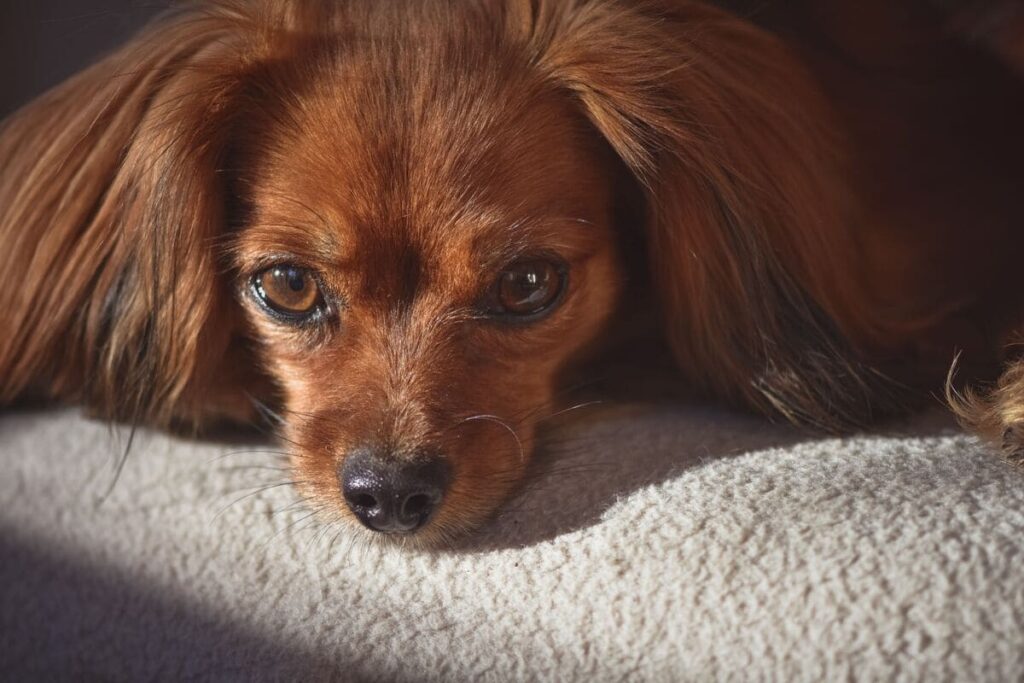
The Russian Toy has an old-money past. It was a companion dog for the Russian aristocracy, the AKC says, and it started out under the name English Toy Terrier. After the Revolution the numbers dropped hard. When breeders took stock of the dogs that were left, they didn’t match the old standard anymore, and that’s why the name became Russian Toy Terrier. The AKC gave it full recognition in 2022 in the Toy Group, after three years in the Miscellaneous Class. It weighs up to 6.5 pounds, yet the descriptions are big: athletic, smart, loyal, funny, and also possessive, sometimes territorial, and in need of more socialization than most owners expect. One breeder quoted in the same article says the ideal home has no large dogs and no small children. Those thin little bones make even a jump off the couch risky.
The Tsvetnaya Bolonka is a Soviet invention, and the name means “colored lapdog.” The AKC’s version goes like this: in Leningrad in 1951, breeders started with a white dog from Hungary and a coffee-colored dog from a traveling circus, then added Maltese, Bolognese, and Shih Tzu through the 1950s and 1960s. By the 1970s, there were only about 100 dogs left. The AKC took the breed into its Foundation Stock Service in 2015 and announced full recognition in the Toy Group on December 30, 2025, with January 1, 2026 as the effective date on its history page. As for the dog itself, the AKC calls it friendly, happy, and devoted to its owner, comfortable in a city apartment or a country house, and quiet unless there’s something worth saying. Brush that thick double coat a few times a week. Breeders initially aimed for about 11 inches and 7 to 9 pounds, and the AKC chart says 6 to 9. Kids aren’t mentioned on the AKC page, so we won’t guess.
Russian Dog Breeds from the Soviet Union
Some Russian dog breeds from the Soviet Union were not shaped by old hunting traditions or the Arctic. A government needed guard dogs, and one city wanted lapdogs. The Caucasian Shepherd, covered above, was standardized in the Soviet period too, and so was the Tsvetnaya Bolonka, which Leningrad breeders started in 1951 (see the small-dogs section).
The Black Russian Terrier came out of the Red Star Kennel, a military kennel in Moscow. The AKC says the Red Star program began in the 1930s and stalled due to a lack of purebred stock, and another AKC article adds that the Revolution had killed most of the purebred dogs, so breeding stock was hard to find. Things took off after World War II, partly with German breeds, and the FCI’s standard (number 327) puts the development in the late 1940s and early 1950s. All in all, the AKC counts about 17 breeds, among them the Caucasian Ovcharka and the Poodle. The dog was shown in Moscow in 1955, and the FCI accepted it in 1984. Soviet military police used the dogs as guards at border crossings, prisons, and military sites. The breed reached North America late in the 20th century, and the AKC recognized it in 2004. One AKC headline calls it the “Soviet superdog.”
The Moscow Watchdog (Московская сторожевая, Moskovskaya storozhevaya) is rarer. According to Wikipedia, the Central School of Military Dog Breeding, part of the USSR’s defense ministry, created it after World War II because the army wanted a guard dog that could handle the cold. The first standard came out in 1958. Males should weigh at least 121 pounds and females at least 99, and the ideal height for males is 30 to 31 inches. Wikipedia describes it as calm and gentle with its family, protective when there is danger, and in need of training and early socialization. We couldn’t find a Moscow Watchdog standard on the FCI’s website, and Wikipedia’s remark that the FCI only lists it as a “Special Show” breed is something we couldn’t confirm there. We also found no AKC status for it, and the sources we read disagree about the year it was officially recognized in Russia, so we leave that year out.
Russian Dog Names (with Pronunciation)
Maybe you already have a dog, or maybe you’re only picking a name for the day you get one. Russian dog names tend to describe the animal: its color, its character, or what it does. A Moscow Times column on the subject sorts them by kind of dog, from guard dogs (Клык, “Fang”) to small fluffy ones (Пушок, “Fluff”), and a lot of the most famous names come from books and films.
| Name | Say it | Means | Where it comes from |
| Bim | beem | A short pet name | The setter in the novel White Bim Black Ear (White Bim Black Ear), filmed in 1977 |
| Sharik | SHAH-rik | Little ball (шар means ball or globe) | Often given to round, fluffy puppies |
| Tuzik | TOO-zik | Ace | A classic dog name, according to the Moscow Times |
| Zhuchka | ZHOOCH-ka | Little beetle | For black dogs, because жук is a beetle |
| Belka (Belka) | BYEL-ka | Squirrel; as a dog name also “Whitey” (from белый, white) | One of the two space dogs of 1960 |
| Strelka | STREL-ka | Little Arrow | The other space dog |
| Mukhtar | mookh-TAR | Chosen (Arabic origin) | The police dog from the film Come to Me, Mukhtar! |
| Druzhok | droo-ZHOK | Little friend | Friendly name for a best-friend dog |
| Kashtanka | kash-TAN-ka | Chestnut | For brown dogs; also the dog in Chekhov’s story Kashtanka |
| Buran (Buran) | boo-RAN | Snowstorm | A “snowy” name for coloring or character, says the Moscow Times |
| Pushok | poo-SHOK | Fluff | For small fluffy dogs |
| Taiga (Taiga) | tie-GA | Taiga, the northern forest | For huskies and other northern dogs |
A few notes on the table. The Moscow Times columnist says Sharik may come from the Polish word for gray, but she isn’t sure about it herself, so we list the meaning of the “little ball.” Belka and Strelka flew on Sputnik 5 on August 19, 1960, and came back alive after 17 orbits, according to Star Walk. Belka is the plain Russian word for a squirrel, though both the Moscow Times and Star Walk translate the dog’s name as “Whitey.” Mukhtar is common in Central Asia and the Caucasus, says the Moscow Times, and Wikipedia says it means “chosen” in Arabic. The famous Mukhtar, per Russia Beyond, is a police dog who keeps saving the lieutenant who once saved him, in the film with Yuri Nikulin. And Bim was a setter in a book, so we won’t call it the Russian “Fido,” even if the Moscow Times columnist does.
Our other articles already cover human names, so we won’t repeat them here. If you want a human-style Russian name for your dog, see our guide to choosing a name for your dog. the most popular Russian names, and for sweet nicknames, Russian terms of endearment.
Dog Words in Russian
A few everyday words are handy when you meet a Russian dog, or want to teach yours something new. They are standard words, and the commands are the ones owners really use.
| Russian | Transliteration | English |
| dog | goat | dog |
| Puppy | shchenok | Puppy |
| paw | lapa | paw |
| tail | khvost | tail |
| wolf | people | wolf |
| to walk | gulyat’ | to go for a walk |
| to me | ko mne | come to me |
| сидеть | sidet’ | sit |
| фу | fu | no, bad (a command) |
Try it at the park. Say «Ко мне!» and see what happens. A borzoi will most likely look at you the way a cat would.
Free download
500 Russian Words for Kids Ages 5–12
A free PDF checklist to see which Russian words your child already knows and which ones to add next. Leave your contacts and we’ll send you the file.
Frequently Asked Questions About Russian Dog Breeds
Which Russian dog breeds are best known in the US?
The borzoi, the Samoyed and the Siberian Husky have been in the AKC for a long time. The first Samoyed was registered in 1906, the Husky was recognized in 1930, and Joseph Thomas Jr. brought borzoi from Perchino back in 1903. Their American stories matter as much as their Russian roots.
Is the Siberian Husky a Russian dog?
Partly. The AKC traces the breed to the Chukchi people of Siberia, and says that a team of Siberians reached Alaska in 1909. The AKC recognized the Husky in 1930.
Which Russian dog breeds are good with children?
According to the AKC, the Samoyed tends to be good with children, the Siberian Husky usually gets along with them, and the borzoi can be fine if an adult supervises. For the Russian Toy, a breeder quoted by the AKC suggests a home without small children. For several other breeds, the sources we read say nothing, so ask a breeder who knows the line.
Are all of these breeds recognized by the AKC?
No. The borzoi, Samoyed, Siberian Husky, Black Russian Terrier, Russian Toy and Russian Tsvetnaya Bolonka are. The Caucasian Shepherd and the Yakutian Laika are in the AKC’s Miscellaneous Class, and as far as we could tell the West Siberian Laika and the Moscow Watchdog are not fully recognized either, so check the AKC’s breed list before you plan on showing one. The FCI has standards for the Caucasian Shepherd, the West Siberian Laika and, provisionally, the Yakutian Laika.
What to Do Next
Dogs are a good way into a new language. Children learn собака and хвост quickly, and then they ask about everything else. At Palme School we teach Russian online. Our Russian as a foreign language course is for children who are learning Russian from zero. Kids who already speak Russian at home but find reading and writing hard can look at Russian for bilinguals. If your child wonders how a wolfhound and a tiny lapdog can be the same species, our biology course is a place to start.
Here is how a trial works. Palme School offers two free lessons: an intro session with a curriculum specialist and a trial lesson in a group. Everything is online. Lessons run 40 minutes, groups stay small, and the ages go from 4 to 17.
And if you do get a dog, give it a good Russian name.