


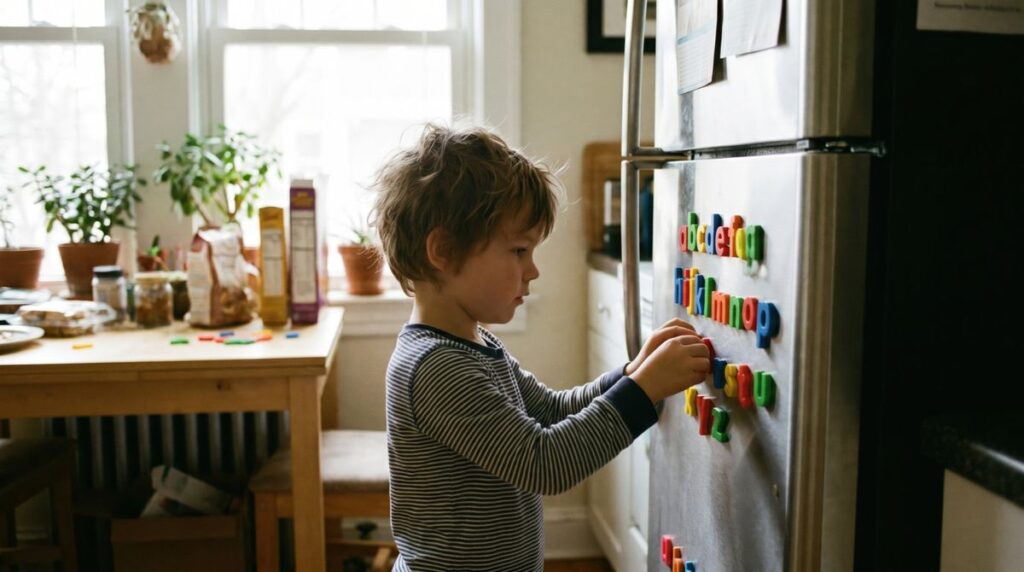
«I went for a walk with Sasha.» A child who lives with a Russian parent next to an English parent might leave such a note on the fridge. What's wrong with it? All the words are in place; the meaning is clear; and yet the sentence stutters. It's one detail that's the problem. The word «Sasha» has not changed its ending and remains in the form we use to refer to a person, not the form we use to go for a walk with them. The ending of the word seems like a minor detail until it breaks the sentence.
This note makes it easy to start a conversation with the child. The rule is read out in the textbook, and here you can immediately hear why it is necessary.
What is the ending of a word and why is it needed
The ending changes when the word form changes. «Sasha» becomes «Sashy», «Sasha», «Sasha», «Sasha», and the part before the ending, «Sashy», remains the same. Only the tail changes, and with it the role of the word in the phrase.
We go for a walk «with Sasha,» take the ball from «Sasha,» and call «Sasha.» The ending connects the words together and indicates who is doing what and with whom. At the end of the noun, the number and gender are indicated. The adjective in the singular adds the genus and number, «new,» «new,» and «new.» And with the verb, it’s most interesting. In the present tense, «I’m reading» and «You’re reading» are separated by a comma, and in the past tense, the gender and number switch, and «I was reading» becomes «You were reading.» There is a separate article for the gender of nouns., noun forms in the Russian language. The topic is given to verbs with their endings. verb conjugations.
One word, different endings
| Case | Question | Form | Example |
|---|---|---|---|
| Nominative | Who? | Sasha | Sasha came |
| Genitive | Who? | Sasha | The ball is with Sasha |
| Dative | To whom? | Sasha | Let's call Sasha |
| Accusative | Who? | Sasha | We are waiting for Sasha |
| Instrumental | By whom? With whom? | Sasha | We are taking a walk with Sasha |
| Prepositional | About whom? | about Sasha | We are thinking about Sasha |
The part of «Sash» remains the same; only the ending changes.
Not every word has an ending. It only exists in modified words, and that’s something to keep in mind from the very beginning.
Why words can be rearranged in Russian
Compare the two sentences. «Mom loves her daughter.» «Mom loves her daughter.» The words have been swapped, but who loves whom remains clear. Only the accent has changed; the second sentence answers the question «who loves her daughter?».
The endings hold the roles here. «Mother» with the ending «-a» works, «daughter» with the ending «-u» takes effect, and wherever these words are used, there will be no confusion. In English, that won't be the case. Swap the nouns in the phrase. The mom loves the daughter, And already the daughter will love her mother. Where there is no such system of inflectional endings, the meaning is based on the order of the words.
But even Russian endings don’t always help. Take the sentence «Mother loves her daughter.» Who loves whom? You certainly won’t be able to say. In «mother» and «daughter,» the nominative and accusative forms of the verb sound the same, and the ending remains silent. The order of the words and what we discussed earlier also help. It’s useful for a child to see both cases side by side.
Who is who?
How to find the ending in a word

The most obvious way to find the ending is to change the word. The word is changed according to the case or the number and we see which part has changed. «Book», «books», «book». The last letter changes, so the ending becomes «-a».
The trouble lies in the escaping vowels. In «son» and «sna» the «o» disappears; in «lev» and «levo» the «e» disappears. By comparing «son» and «sna», the child can decide that the ending here is «-on». But the escaping vowel remains part of the root, and The endings of «son» and «lev» are zero. This is evident in the very form of the nominative case, where nothing stands after the root. In other forms, sounds appear in place of the zero ending: «sna», «snun», «lev». The same applies to the word «dom» with its forms «doma» and «domu».
Sometimes the ending does not actually appear at the end of the word. In «umywaet» the «-et» ending is followed by the «-si». The same applies to «kafe» or «metro». These words do not change, and they have no endings at all.
What is the basis of the word

The basics in school are covered later in the course. According to the «School of Russia» program, the ending is studied as a variable part of the word in the second grade, and a separate topic about the ending appears in the third grade.
The base remains if the ending is removed from the variable word. In the word «book», the base will be «knig», in the word «Sasha» the base will be «Sasha». In the case of immutable words like «cafe», the entire word is considered the base.
The ending does not form the basis; it is two different parts. The ending carries a lexical meaning, that is, it determines what the word refers to. The ending expresses a grammatical meaning and indicates the form in which the word is currently used.
The end and the foundation
| Sign | Ending | The foundation |
|---|---|---|
| What is that | the variable part of a word | a part of a word without an ending |
| What significance does it carry? | grammatical | lexical |
| When the form of a word changes | is changing | remains the same, although the vowels are sometimes dropped at the root |
| Example | «-a» in the word «book» | «books» |
| With immutable words | No | the whole word, «cafe» |
| On verbs | «-a» in «read» | According to many textbooks, the word «чита» has no suffixes of the form «-л-» or «-ть».» |
With verbs, there is a caveat. In many textbooks, the base form of a verb does not include suffixes that serve only to form the form. According to this approach, in «read,» the ending is zero, «-l-,» indicates the past tense, and the base form is «read.» The same applies to «read,» where the «-ing» ending is not included; although different textbooks call this «-ing» differently. In other manuals, the base form is considered to be the entire word without the ending, «read.» Therefore, both «-l-» and «-ing» should be checked with the child’s textbook.
Finals in the bilingual speech and the game at home
In mixed speech, you might hear «with Sasha» or «not mom.» Perhaps this is influenced by English, where the word does not change in such combinations, but it's not easy to determine the reason from a single phrase. It's convenient not to correct such phrases right away but to turn them into a game.
The first game is called «The Broken Note.» An adult writes a short sentence with incorrect endings, for example, «The cat sits on the window and looks at the bird.» The child looks for words that are not in the correct form and corrects them. At the end, they can return to the note from the refrigerator and correct it together: «He went for a walk with Sasha.».
The second game, «Who sees whom?», is based on endings. You take a phrase like «The cat sees the dog» and ask who sees whom. Then you change the endings around and get «The cat sees the dog». Discuss what has changed. This way the child can hear that the meaning has moved along with the endings.

Free material
10 simple games in Russian
Free PDF for bilingual children from 4 years old. Games for home, walks, and the road, without preparation or special materials. Leave your contact information, and we will send you the file.
The final sounds are heard primarily in conversation, so much depends on how much Russian speech is heard around the child. At Palme School, there is an online course for this. «Russian for bilinguals», It is available for children from the age of four. There are no more than eight people in the group. The group class lasts 40 minutes. The school offers two free lessons for groups, during which the family gets acquainted with the program and the teacher, and the methodologist provides a free level assessment. Those who prefer a one-on-one format will be best suited. Private lessons, Where the first free lesson is dedicated to determining the level.
Frequently asked questions about the ending and the base of the word
Why the word "ending"?
The ending shows the form of the word and connects it with other words in the sentence. Thanks to it, it becomes clear that we are going for a walk «with Sasha,» and the ball was «taken by Sasha.».
Why can you rearrange words in a sentence in Russian?
The endings often indicate the roles of the words, so «Mom loves her daughter» and «Mom loves her daughter» are understood the same way; only the emphasis changes. But if the forms match, as in «Mother loves her daughter,» the order of the words and the context are decided upon.
How is the ending different from the base version?
The ending changes with the form of the word and conveys the grammatical meaning. The base remains if the ending is removed, and carries the lexical meaning of the word. In the word «book,» the ending is «-a,» and the base is «books.» In many textbooks, the base form of the verb is not included, for example, «-l-» in «read.».
How to help a child if they confuse endings?
It’s convenient to start with live sentences rather than tables. You can fix the «broken» notes together, rearrange the words in sentences, and ask who is doing what. This way, the child tries to hear for themselves how the meaning changes and to pick up the correct form.