


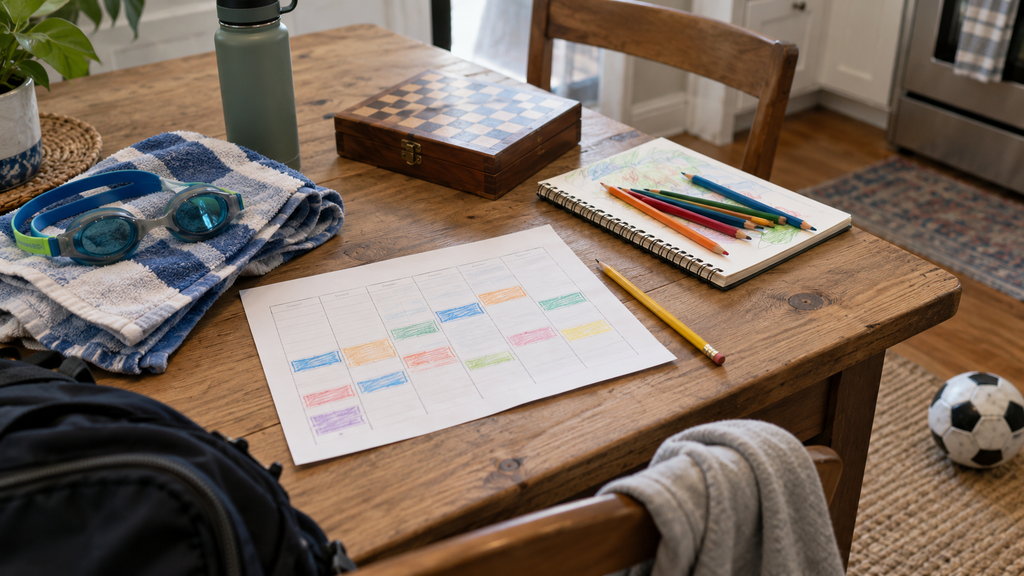
Evening, kitchen, on the fridge under the magnet is a sheet with circles. Monday swimming, Tuesday chess, Wednesday drawing, Thursday swimming again, Saturday football. The child finishes math at the table, but on the phone there is a website with the schedule of Russian classes; two lessons a week for forty minutes. Five sessions over seven days, and on the sheet everything fits. There are no hours on the sheet, but to check whether these forty minutes actually have room, you can do it in five minutes.
And where is the dinner on this sheet?
It seems to me that forty minutes are enough on their own; there’s no need to go anywhere. It’s not really necessary to go to class; just the road from the pool on Monday and math on Tuesday are not going to make up for that. In our practice, when the mentor sets the time for the lessons in the first conversation, they most often hear «I don’t know, I need to think about it, check the schedule, discuss it with my husband.».
Plan without a clock
A similar list, only for the next two years, was written by the eighteen-year-old Tolstoy on April 17, 1847. He was still in Kazan; the request to be dismissed from the university was submitted on April 12; he would leave Kazan on the 23rd; and the diary contains the question: «What will be the purpose of my life in the village for the next two years?» The answer took eleven points. Legal sciences for the final exam, medicine, agriculture, history with geography and statistics, mathematics, the dissertation, music and painting up to «intermediate level of perfection»; towards the end, a short «Write the rules»; the natural sciences and the last item of the composition for all the subjects he will study. Six languages, French, Russian, German, English, Italian and Latin, and all this between medicine and agriculture. Russian, by the way, second.
The deadline is set at two years, and the clock is running on it because there is no hour, no day of the week, not even a month in any of the eleven cases. On April 18, he admits that he has had too much to do and not enough time to do it all, and he sets himself a «single rule.».
To June 14
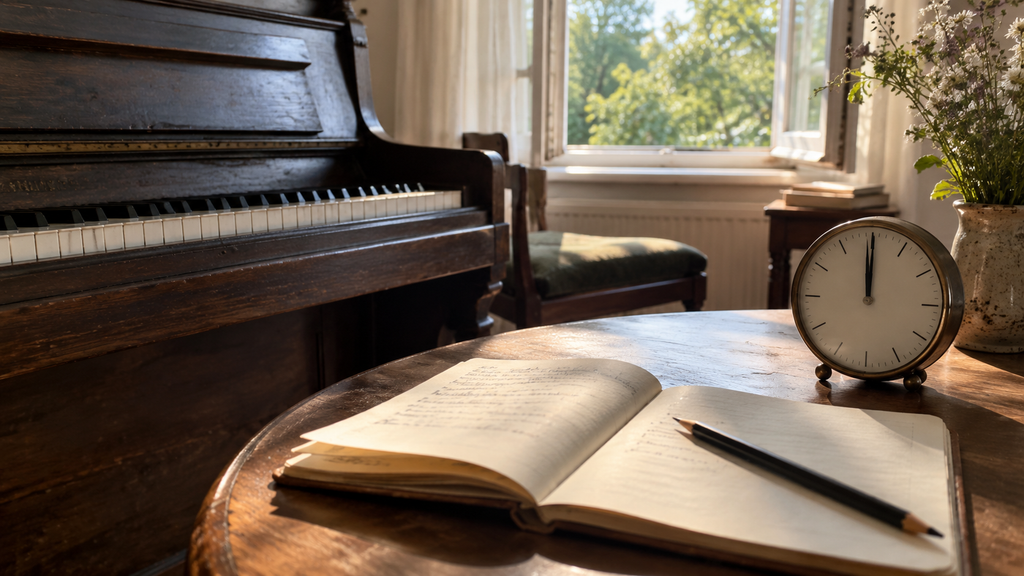
In June 1850, Tolstoy lived in Yasnaya Polyana; he was twenty-one years old. On June 14, the diary entry «For June 14» appeared; instead of two years, there was only one day written out in chronological order. From nine to ten, «swim and walk,» then music, letters, household chores, and business matters. The schedule for the 15th even stretched from half past five in the morning until ten at night, seventeen and a half hours without a break, like a day of excellence for which one has no time even to eat, if not for the paragraph from noon to six «breakfast, rest, and lunch.» On the piano that same day there were two hours, and for a meal break there were six.
Tolstoy calls his plans «appointed.» This word has the same root as the word «sign.» Here, to appoint sounds almost like placing a mark on a certain time, as when you schedule an appointment with a doctor or a meeting. On June 15, he notes that he «exactly did everything that was scheduled» yesterday. On June 16, he writes that yesterday he performed poorly, and he will explain why later. On the 17th, the entry begins with the fact that he got up at eight o’clock and «did nothing until 10,» followed by a sentence that anyone who has ever made a schedule could have written.
«The second day I'm lazy; I'm not fulfilling my duties. Why? I don't understand.».
On the 18th, nothing happens until eleven o'clock again; then there is an hour of music and chores. On June 19, he records that the day before went quite well; almost everything was performed. For June 20, again from noon to six, there is a break.
Six hours in the report

In a family from the suburbs of Washington, the son is eleven years old; he has hockey and scouts. There was no place for Russian activities on the family schedule. Then the family started using a weekly screen time report that the phone generates itself. At home it seemed that the son was on the phone all the time, no matter what time you peek into the room; the report showed about six hours a week, less than an hour a day. Two lessons of forty minutes is twenty minutes a week. Only six hours are spent in chunks; that’s not two windows of forty minutes each, and how much of that is his rest time the report won’t say; only the child can record that. The family had already decided whether to enroll the son in Russian lessons.
It happens the other way around too. The family registers according to the schedule, but on Tuesday, after the chess, dinner and math classes, there is no room left, and it is only discovered after the registration. Then the supervisor hears «There’s no time.» Or the class starts immediately after the training session, and the first question the supervisor is asked is «Is there another time?» Sometimes the classrooms are not available at all, or there is only one when there are two classes to be taken.
A notebook for five minutes

To start with, one day of the week is enough—the most dense day of the week—and a notebook in a binder. It is written together with the child, just as Tolstoy wrote the June days; for each line there is a start time and an end time. First, the child writes down their rest time by hand and with a clock, even if they are resting on their phone from eight to nine. Then there is school, a club with the route there and back, dinner, homework, and when they go to bed.
Let’s say the child looks at their Tuesday and asks, «When am I doing nothing?» It sounds like a lazy complaint, but Tolstoy also honestly wrote down his «until 10 I didn’t do anything,» and on the plans for June 15 and 20 he left time off for rest from noon until six. This question could mean that he needs an empty hour just as much as chess, and his place in the notebook is first. If there are no windows, the answer is «not yet.» If there is only one window, you should tell the supervisor before booking. The remaining days of the week can be marked in the block below; it finds the intervals on its own.
Place for the lesson
Choose a day and write it down in hours, with each line starting and ending with a time. First, the child enters the rest period; then, school, the club, including the way there and back, dinner, homework, and sleep. Block finds a gap where the lesson of 40 minutes fits in with the prep and recovery time, and no more than one window per day.
The found windows are candidates; they are checked against the school's class schedules. Block does not assess whether the child can handle the workload; the time for homework in Russian is clarified with the teacher. The records are stored only in this browser.
We wrote about whether additional Russian lessons are necessary for a child in general and how they fit into the Saturday school program in an article about the weekend school and the online group.
Who else knows about this week?

The notebook should be shown to the other parent who takes the child to the pool. He knows how long the drive actually takes on Thursday evening. Grandma picks up her grandson on Wednesdays and knows her schedule, and she also has better time to plan before looking for openings.
An older child can be given a pencil. The thick one was eighteen when he wrote a two-year plan, and twenty-one when he drew the June days by the hour. When the week is written down, the child can be asked.
And where in your week is there time for rest?
At the «Russian for Bilinguals» course at Palme School, children from the age of four take online classes twice a week for forty minutes. The time of the classes and the tutor are chosen based on the child's needs, so it's worth bringing the found times to the first meeting.
You can check how the lesson fits into a child's week on two free lessons. At the first session with a child, a methodologist gets acquainted with the child, determines the level and helps choose the program; at the second session, the educator leads the session.
Sign up for free lessonsFrequently asked questions about the Russian schedule and lessons
How much time per week do Russian lessons online take up?
At Palme School, there are two lessons a week of 40 minutes each, for a total of an hour and twenty minutes. There is no need to travel anywhere, but a little time should be added before each lesson to switch off, and after to breathe out.
How do you know if your child has room in their schedule for two lessons?
A window is considered the interval into which the lesson is placed, along with the rest period, that is, 40 minutes and approximately 10 minutes before and after, about an hour in total on one day. Such windows need to be two on different days. The found windows are compared with the school’s group schedule, and they can then be taken to the tutor.
Is it possible to take time out of screen time for Russian?
Only partially. The phone report shows the amount for a week, and it accumulates in chunks, which can include homework, correspondence with friends, and leisure time. It’s better to go through these hours together with the child and only take what they themselves consider unnecessary, if it’s an entire hour in one evening.
What to do if there is only one window available?
Tell the tutor about it before the recording. Two lessons a week require two sessions, and the tutor chooses the time and teacher based on the child's schedule.
Is it possible to give a lesson immediately after a workout?
It is possible if there is still enough time between them for the journey and a short break. If the lesson has already started unsuccessfully, the instructor can ask about a different time.
What to do if there is no free window at all?
An honest answer in this case is «not yet added». It’s worth planning again a week from now when the schedule of clubs or schools changes.