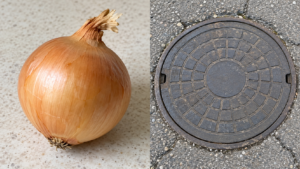

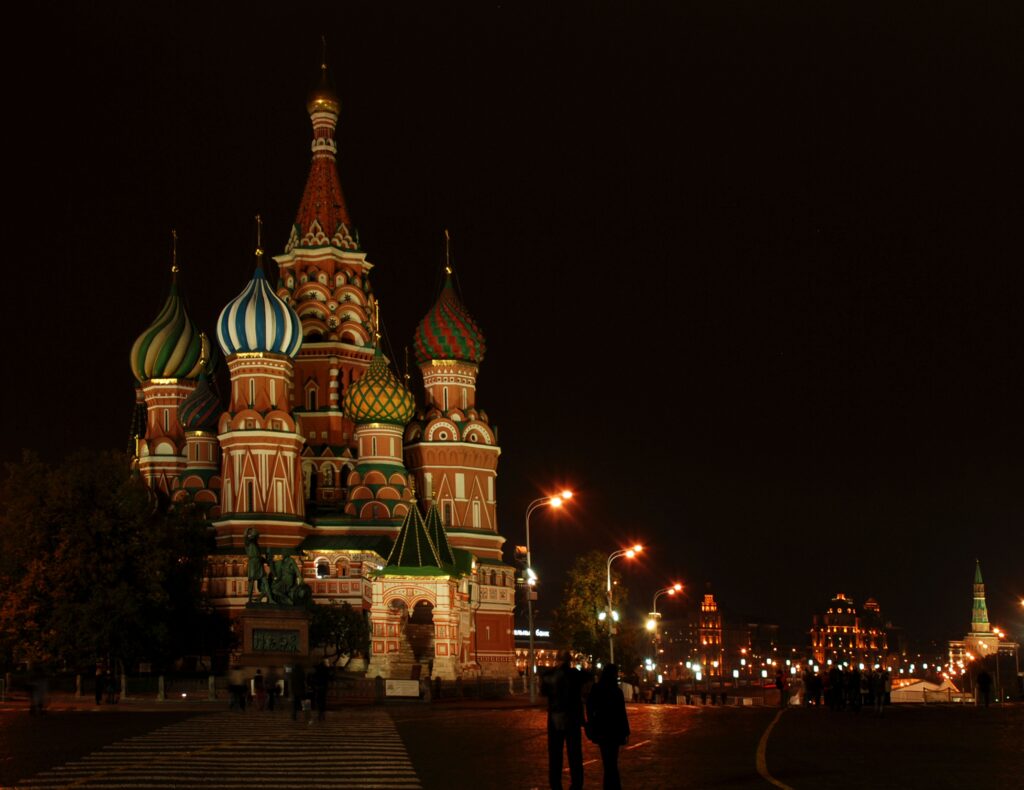

The child points at the screen and laughs. The loading screen in the game shows a building with bright, twisted turrets, and the child calls it an ice cream castle. Or a gingerbread palace. It's a familiar image; he's seen it a hundred times, on candy boxes, in emojis, on someone's postcard. Except it's not a palace or a castle. It's Saint Basil's Cathedral, the most famous Russian church, and for the child, it's somewhere on par with a Disney castle, a beautiful foreign marvel.
It's not his fault. A child who grew up among pointed Gothic spires sees round colored domes and honestly doesn't understand what they are or why they're there. It looks like a fairy tale, a celebration, anything but a familiar temple.
And these domes have not a single random detail. Not one. Their shape, number, and color combine into a language in which the church tells about itself. In this language, you can read who it is dedicated to and what the one who built it believed. A child who learns to read it will stop seeing a postcard. They will begin to see their own. Next, it's precisely about how to read the domes.
Bulb, helmet, and the flame of a candle

The form itself came to us from Byzantium, but there the domes were different, calm hemispheres, like an overturned bowl. A smooth, sleek, quiet dome. But the Russian one seemed to take a deep breath and rise like a bubble. The Russian onion, bulbous at the bottom and tapering to a point at the top, grew here. Historians still argue about exactly when. Such domes are not visible on ancient icons from the pre-Mongol era, so they most likely appeared later.
It was long believed that helmet-shaped domes, resembling a warrior's helmet, like those of the Dormition Cathedral in Vladimir, were the first to appear in Rus'. Later, this view was corrected. It appears that both onion-shaped and helmet-shaped domes coexisted for some time, and it's impossible to definitively say which came strictly first.
There is no single answer as to why it is specifically the onion, and it remains unclear to this day. There are several versions, and each is good in its own way.
The most beloved by believers speaks of the flame of a candle. The dome is read as a tongue of fire, reaching towards the sky and converging to a point under the cross, like a frozen prayer. Religious philosopher Evgeny Trubetskoy compared the dome to a fiery tongue striving upwards. If you show a child a lit candle next to a picture of a dome, they will see the resemblance themselves. The flame tapers upwards. And the dome tapers. The comparison is beautiful and understandable even to a small child.
There's a simpler version about the weather. Snow doesn't accumulate on a smooth, sloped onion dome, and rain flows off, unlike a flat roof. This explanation is appealing and often repeated, but architectural historians approach it with caution, considering it more of a pleasant afterthought than the true reason.
The third version is about the tree. Many early churches in Rus', especially in the north, were built from wood, and it's easier to form an elongated onion shape from planks than an ideal Byzantine sphere. The form of wooden architecture later transitioned into stone. Let's also recall the helmet-shaped dome; it also has its own interpretation, referring to the spiritual warfare that the church wages against the forces of darkness.
It's worth showing children that domes come in different shapes. There's the bulbous onion dome. There's the helmet dome, more stern and rounded. And there's the tent dome, tall and faceted, resembling a pointed hat. Distinguishing them is no harder than telling a maple leaf from an oak leaf. But then a child looks at a temple and sees not just a roof, but a shape with its own character. And whatever crowns the church, there is always a cross on top. The dome itself is read as the sky, and the cross above it as a sign of Christ's victory.
Domes that can count
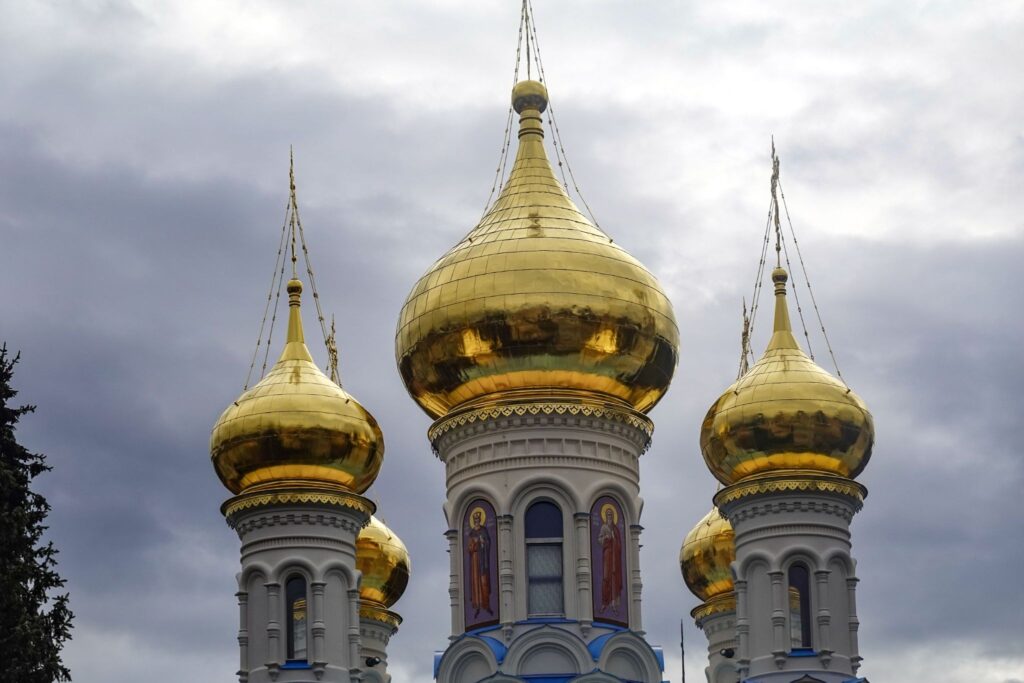
This is the first thing you should teach a child. The domes can be counted, and the number is not accidental.
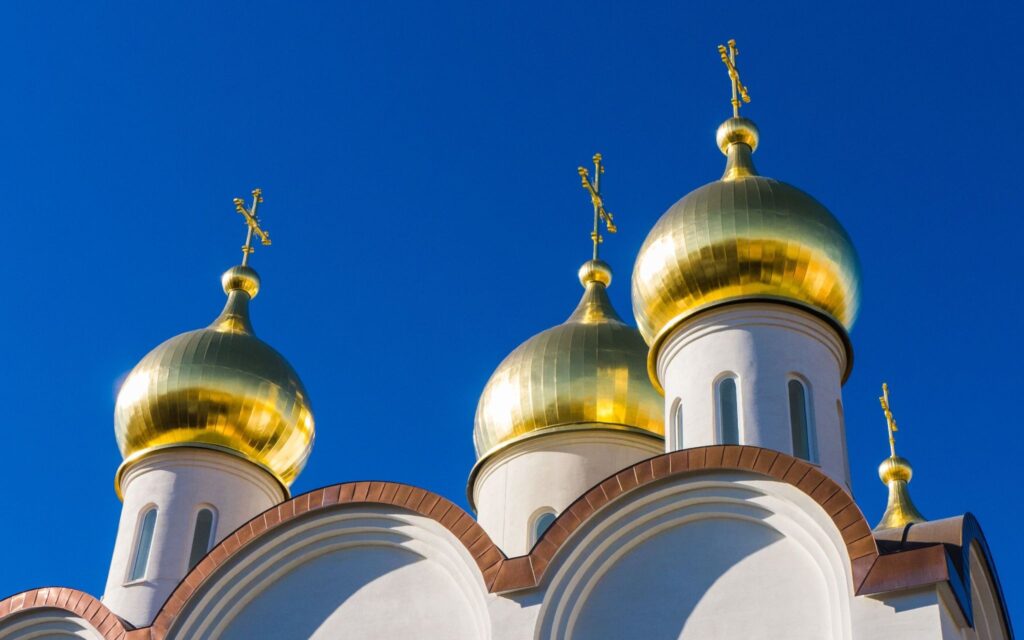
One dome signifies the one God. Three domes are consecrated in honor of the Holy Trinity. Five, with the middle one raised higher than the others, are read as Christ and the four evangelists surrounding him, and such churches are encountered most often. And if a child counts thirteen, it's Christ and the twelve apostles before him, a whole little congregation on the roof. Children gladly count domes. It's like finding a hidden number. One, two, three. And behind each number is its own story.
There are even bigger numbers, and this is when children's eyes light up. Some churches have twenty-five domes, or even thirty-three, corresponding to the Savior's earthly years. Counting the domes turns into a small game, and through this game, the child imperceptibly learns about the Trinity, the Evangelists, and the Apostles.
It's important to be honest right from the start. This is all a long-standing tradition, not a strict law. It wasn't always and everywhere followed, so the number of domes is more of a hint than a dictate. But the hint is beautiful, and it's interesting to decipher.
What does the dome color tell us?
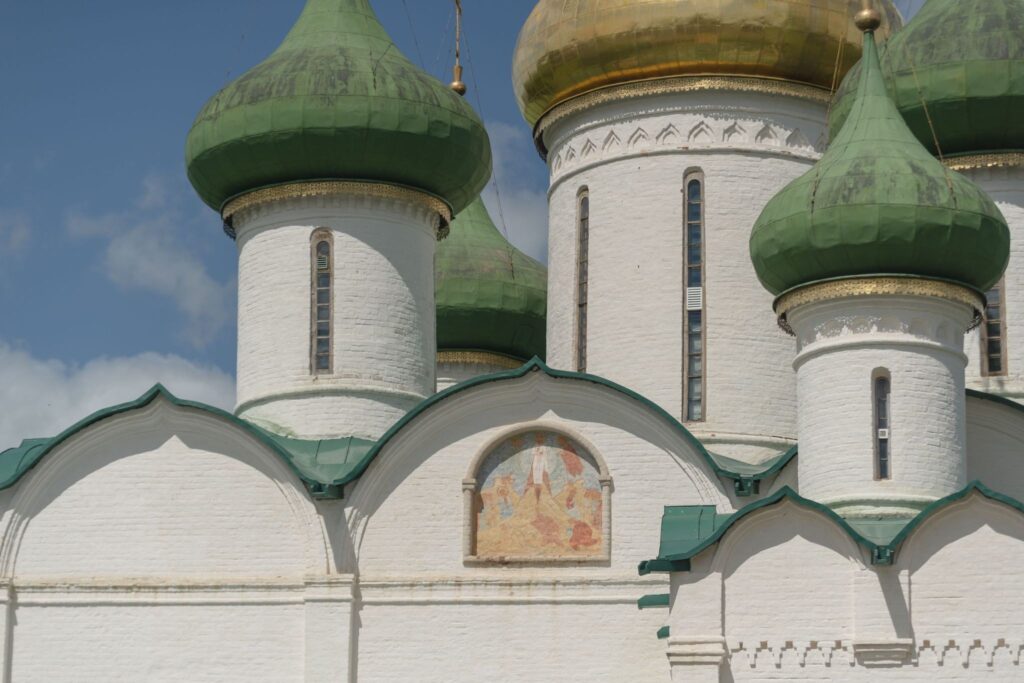
The color works the same way. It suggests who the church is dedicated to, and reads almost like a signature.
Gold signifies heavenly glory. Golden domes were erected on the most important churches and those dedicated to Christ and major holidays. The Kremlin cathedrals, Moscow's Cathedral of Christ the Saviour – they all shine with gold not for wealth, but for meaning. You walk by and read as you go. Gold means principal, Christ's.
Blue domes, studded with stars, almost always speak of the Virgin Mary. Blue here is read as heavenly purity, and the stars are a reminder of the very Star of Bethlehem that led the Magi to the newborn Christ. If you see a blue dome in golden stars, you can almost certainly tell your child that the church is dedicated to the Virgin Mary.
Green is dedicated to the Holy Spirit and the Holy Trinity, which is why Trinity churches often have green domes. Silver and gray domes are usually found on churches consecrated in honor of saints. Black domes, solemn and severe, are more commonly seen on monasteries. Black has long been the color of monasticism, a color of renunciation of worldly vanity.
And again, a frank disclaimer. This is an established tradition, not an ironclad rule. There are exceptions, and sometimes amusing ones. The domes of St. Isaac's Cathedral in St. Petersburg are blue not because of the Virgin Mary, but because the cathedral was built for a guard regiment whose officers wore blue uniforms. So, the color gives a hint, but sometimes it's a bit of trickery.
The main cathedral, which everyone mistakes for a palace
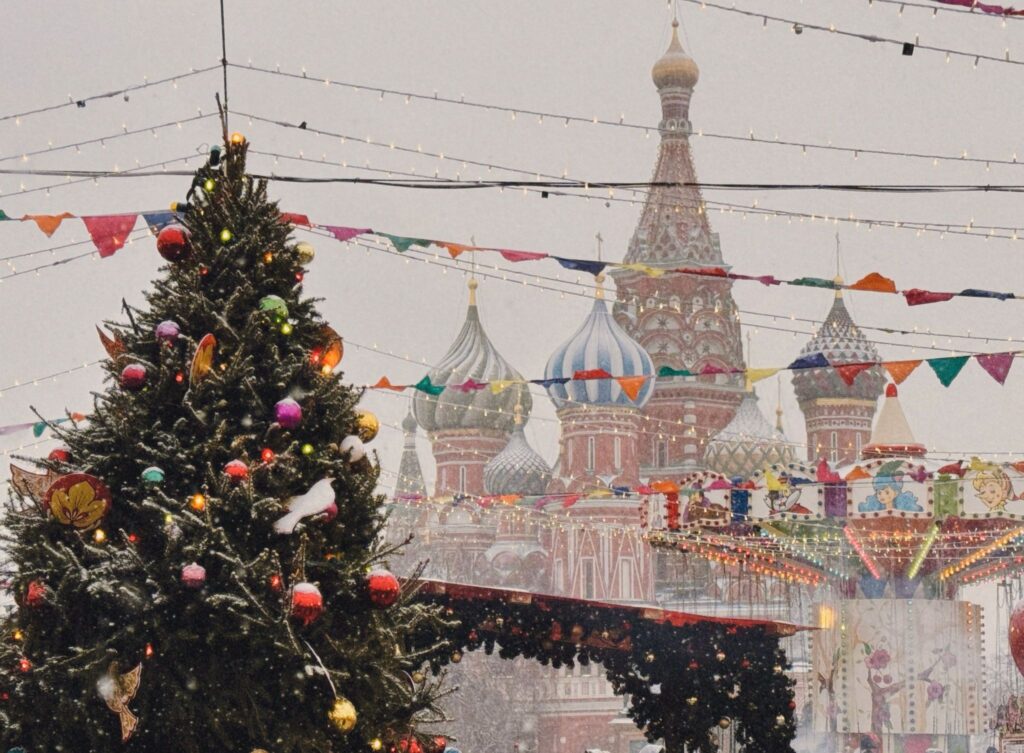
Now let's return to that gingerbread castle from the screen. It has a name, St. Basil's Cathedral, which stands on the Moat, although the whole world knows it as the Cathedral of St. Basil the Blessed. It was built over six years and completed in 1561, by order of Tsar Ivan the Terrible, in memory of the capture of Kazan. It is not one building, but eleven churches placed on a common foundation. Not a temple, but an entire town of temples under one roof. It was conceived as an image of Heavenly Jerusalem, a paradise city on earth.
There are two beautiful stories associated with this cathedral, and both are worth telling a child because both turn out to be not what they seem.
The first, the most famous, is about cruelty. It says that Ivan the Terrible, upon seeing the finished church, ordered the architects to be blinded so that they could not build such beauty anywhere else. It's a chilling story, and any child would remember it. However, historians have disproven it. It was told by a single foreigner many years later, and the master who was supposedly blinded later calmly built other buildings. So, no one deprived him of his sight; the legend turned out to be a fabrication.
The second story is even more interesting because it concerns those very same bright domes. The fact is, they weren't always multicolored. During the reign of Ivan the Terrible, the cathedral stood red and white, with much more modest domes. The colorful painting we are accustomed to, resembling a fairy-tale garden, appeared much later, a good century and a half to two centuries later. And most curiously, scientists still don't know for sure why exactly these colors were chosen. They associate it with the image of the Garden of Eden from the Heavenly Jerusalem, but there is no definitive answer. There is an ancient legend about a vision of a paradise city, where gardens stood simultaneously in bloom, in gold, and in ripe fruits. Perhaps the multicolor of the domes is an attempt to recreate that garden on earth. Or perhaps not. It turns out that the most recognizable Russian church holds a mystery right on its crown.
Famous Russian cathedrals and their domes
| Cathedral | City | Number of chapters | Color | Who is it dedicated to |
|---|---|---|---|---|
| Saint Basil's Cathedral (Pokrovsky Cathedral) | Moscow | Eleven | Colorful | Intercession of the Theotokos |
| Assumption Cathedral | Vladimir | Five | Gold | Dormition of the Theotokos |
| Cathedral of Christ the Saviour | Moscow | Five | Gold | Christmas |
| Trinity Izmailovsky Cathedral | St. Petersburg | Five | Blue with stars | Holy Trinity |
How to teach a child to read domes

This all turns into a simple and engaging game that can be played anywhere. On a walk at a real temple, in front of a photograph, at the movies, even over a souvenir magnet.
The rules are simple. First, count the domes, then look at their color, and then together guess who the church is dedicated to and what it tells. One golden dome most likely means the main temple in glory of Christ. Five cupolas, the central one higher, we have Christ with the Evangelists. Blue ones with stars, the church of the Mother of God. A child gets drawn in quickly because here they aren't memorizing, they're solving puzzles. Try it on your next trip or even with a photo on your phone. How many cupolas? What color? Who do you think the temple is for? The child argues, counts, makes mistakes, guesses. And remembers it better than from any textbook page. And then the best part happens. Somewhere in a museum, at the movies, or on vacation, they'll point themselves. Look, blue with stars, that's the temple of the Mother of God. At that moment, you can see that culture is no longer a visitor to them, but their own.
And here's what happens next. The building, which previously seemed like a gingerbread castle from a stranger's fairy tale, suddenly becomes understandable. The child no longer sees an exotic picture from a postcard, but a familiar text that they know how to read. Parents often search online for "onion dome" or "Russian church architecture" to somehow explain this beauty to their child. A ready-made article will be less helpful here than ten minutes of playing near a real dome, when the child counts the domes themselves and guesses the color themselves.
The ability to read domes hides a small key to big culture. Behind the form there is faith, behind the number there is theology, behind the color there is a whole system of meanings. A child who was once shown this key looks at familiar churches differently. Without the condescending smirk with which one usually looks at a foreign curiosity.
To make the picture feel at home

The hardest part of raising a bilingual child isn't the language itself, but this cultural layer. The very thing that turns an exotic postcard into something personal and understandable. It doesn't just accumulate on its own; a child won't learn the symbolism of domes from an English school or from cartoons. They can only get it from their own people.
At Palme School, children from Russian-speaking families aged four to seventeen are taught not only the language but also the culture from which it grew. Architecture, holidays, icons, history – everything that lies behind the words. Not dry facts, but living conversation, where St. Basil's Cathedral ceases to be a gingerbread castle and becomes part of its own history. To see how it works, you can attend two free classes. First, an introductory session and assessment with a methodologist, where you can see what the child is already good at and where they need support. Then, a trial class in a group, along with other children. No obligations, just to understand if this format is right for you.
The dome on the postcard will remain a beautiful picture until someone teaches the child to read it. And a read dome is no longer a strange curiosity, but own culture, which can be seen from a thousand miles away.
Home
The onion domes of Russian churches are not decoration, but an entire language. The shape most likely arose from several reasons at once, and it's most beautiful to interpret it as a candle flame reaching for the sky, although historians do not have a unified answer. The number of domes tells of faith, from a single God with one head to Christ with his apostles with thirteen. The color suggests who the church is dedicated to: gold for Christ, blue stars for the Mother of God, green for the Holy Spirit. And the most famous Cathedral of St. Basil the Blessed holds two corrections to common myths, as its architects were not blinded, and the colorful domes appeared a couple of centuries after Ivan the Terrible. It's worth showing a child how all this is read, and an outwardly unfamiliar postcard turns into an understandable and familiar culture.
Why do Russian churches have onion-shaped domes?
Historians have no single answer. The most popular version explains the shape symbolically, like a candle flame or a prayer reaching towards heaven. There are also more down-to-earth explanations, from the convenience of wooden construction to the fact that snow doesn't accumulate on a sloped onion. Most likely, several reasons converged at once, and the shape itself became established as a striking feature of Russian church architecture.
Is it true that the bulbous shape is needed so that snow doesn't accumulate on the dome?
This explanation is often repeated, but architectural historians approach it with caution. Snow and water are indeed retained less on a sloped roof, however, specialists consider this more of a convenient consequence than the main reason for choosing the shape. The symbolic interpretation, primarily the flame of a candle, is more important for temple architecture than practical benefit.
What does the number of domes on a church signify?
The number of domes carries symbolism. One signifies the one God, three refers to the Holy Trinity, five is read as Christ and the four evangelists, and thirteen as Christ and the twelve apostles. There are churches with a larger number of domes, up to thirty-three, signifying the earthly years of the Savior. It is important to remember that this is a long-standing tradition, not a strict law, and it was not always observed.
The color of the dome on an Orthodox church has symbolic meaning.
The color indicates who the church is dedicated to. Gold signifies heavenly glory and crowns the main cathedrals and churches dedicated to Christ. Blue domes with stars are for the Mother of God, green for the Holy Spirit and the Trinity, silver for saints, and black for monasticism, and are found on monasteries. This is an established tradition with exceptions, so the color is more of a hint than a definitive answer.
Is it true that Ivan the Terrible blinded the builders of St. Basil's Cathedral?
This is a well-known legend, but historians consider it a fabrication. It was told by only one foreign author many years later, and there is no such episode in Russian chronicles. The main objection is that the master, who was allegedly blinded, continued to build structures even after the cathedral was completed. So, the beautiful, scary story about the architects' punishment most likely has no basis in reality.
Why are the domes of St. Basil's Cathedral so colorful?
They did not become multicolored right away. During Ivan the Terrible's reign, the cathedral was red and white, and the familiar colorful painting appeared about a century and a half to two centuries later. Scientists do not know for sure why these particular colors were chosen, but it is usually associated with the image of the heavenly Jerusalem's paradise garden, which the cathedral was intended to embody. Thus, the bright domes were not the original design, but a later and not fully understood mystery.