



On Thursday evening, nine-year-old Sonya comes home from school and says a phrase to her mom that sounds the same in every emigrant family every April. "Mom, I need to do a project about Russian folk costume." A large album of Russian art immediately appears on the table. Sonya flips through it while her mom puts on the kettle. On one spread is a kokoshnik: a 17th-century noblewoman, a brocade dress, gold embroidery, and on her head, a tall headdress with a raised front brim.
"It's like a crown," says Sonya.
Not exactly a crown, Mom replies. It's a kokoshnik, a Russian traditional headdress.
At nine years old, a bilingual child's understanding develops precisely through these kinds of explanations in their Russian vocabulary. If mom explains it well, in a month at class, Sonya will confidently tell her classmates, «A kokoshnik is something women wore for weddings in Russia.» If she explains it poorly, the kokoshnik will remain somewhere between a Frozen crown and a magic hat from Harry Potter.
Explaining the kokoshnik is actually not simple. It has a long history, four main regional types, an entire system of meanings, and an amazing second life in emigration and pop culture. In this article, we break down all of this so that it creates a ready-made story that's sufficient for Sonya's project for her mom, and for an adult reader to understand one of the main Russian symbols.
The history of the kokoshnik and its origins in Russia
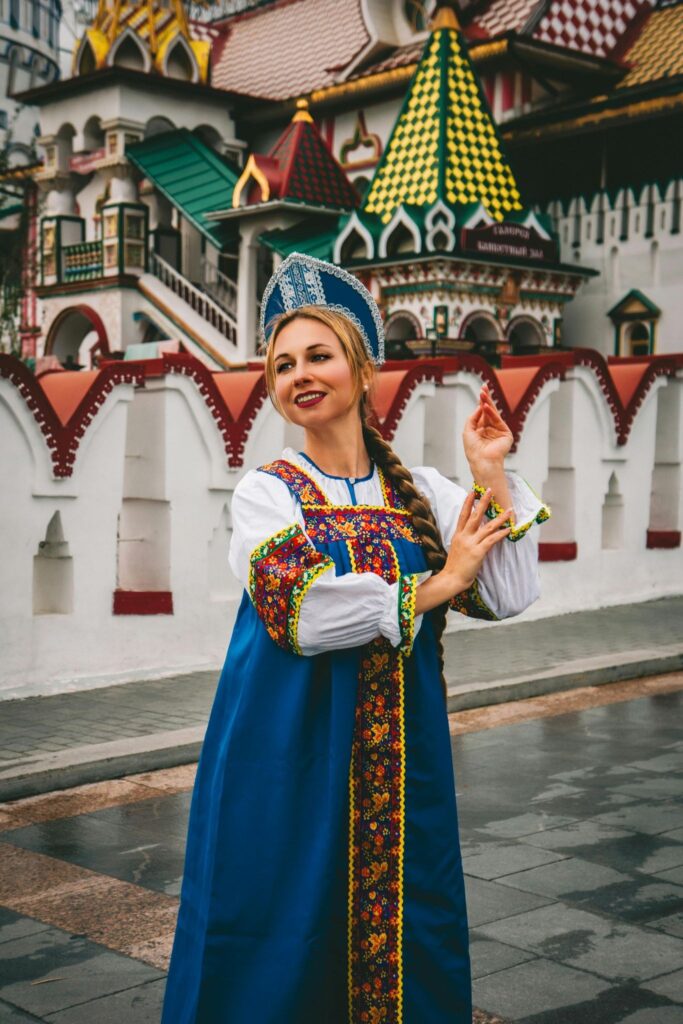
The word «kokoshnik» traces back to the Old Russian word «kokosh.» This is what a chicken or rooster was called in Rus', a bird with a lush comb. This is a rare case for the Russian vocabulary where the name of a household item directly refers to an animal through its resemblance in form. The raised front edge of the headdress resembles a crest, and the name stuck precisely because of this imagery.
At the same time, the headdress itself is much older than the word. In Novgorod excavations, remains of women's headdresses from the tenth and twelfth centuries are found, the shape of which is already similar to the familiar kokoshnik. The word «kokoshnik» only appears in written sources from the seventeenth century. This means that similar items were worn for centuries, but what exactly they were called before that is not precisely known. By the end of the seventeenth century, the shape and name were finally established. The kokoshnik became a headdress for married women throughout Rus', from the boyar chambers near Moscow to the village huts of the North.
Peter I dealt the first hard blow to the kokoshnik. His decrees on European clothing supplanted Russian dress from the lives of the aristocracy. Noblewomen changed into dresses in Parisian fashion. The kokoshnik became a symbol of the past for them. However, Peter's decrees did not directly affect the peasantry and merchant class, and the kokoshnik continued to live in these social strata for another two hundred years. It was through peasant women and merchants that the headdress reached the nineteenth century in a living form.
The return of the kokoshnik to the court is associated with Nicholas I. During his reign, ladies-in-waiting and the wives of dignitaries began to wear «Russian dress» with kokoshniks to official receptions again. The peak, however, occurred during the reign of Nicholas II. In February 1903, a famous costume ball was held at the Winter Palace. Guests appeared in stylized 17th-century boyar costumes with real kokoshniks. Princess Zinaida Yusupova, Empress Alexandra Feodorovna, grand duchesses, countesses, ladies-in-waiting. All in brocade, in pearls, in high headdresses. A series of photographs from this ball was taken by the court photographer; they were distributed worldwide, and it was from these pictures that 20th-century Europe envisioned the «classic» Russian princess.
Sergei Diaghilev later picked up the fate of the kokoshnik. Through the «Ballets Russes» in Paris, through the costumes of the ballets «The Firebird» and «Petrushka,» the kokoshnik entered the international stage. The artists of the entreprise, Léon Bakst, Alexander Benois, and Alexander Golovin, made it the centerpiece of women's costumes. The Parisian public was amazed. From that moment on, the kokoshnik became part of the Western visual language as one of the main Russian symbols.
The Soviet government's attitude towards the kokoshnik was contradictory. Officially, it was considered a symbol of peasant backwardness and tsarist way of life. But it was preserved in children's fairy tales. «The Snow Maiden,» «Father Frost,» «The Tale of Tsar Saltan,» and «The Scarlet Flower» – all these films gave Soviet children a visual image of the kokoshnik as something festive and magical. Sonya, by the way, already has «The Tale of Tsar Saltan» at home translated into English, and the tsarina there is naturally wearing a kokoshnik. Thus, the headdress survived the Soviet century through children's fairy tales.
The Russian kokoshnik symbolizes national identity, femininity, and status.
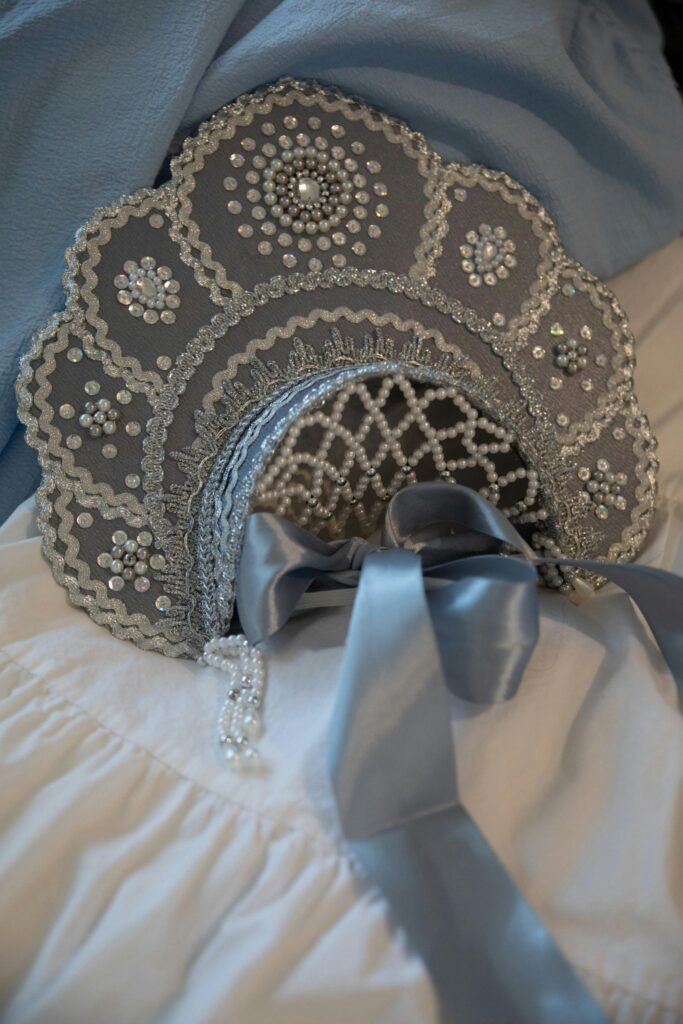
The main meaning of the kokoshnik is related to marriage. Before the wedding, a girl wore her braid uncovered, with a wreath or ribbon, and this braid was visible. An uncovered braid served as a sign of virginity and availability for matchmaking. After the wedding, everything changed. The hair was braided into two braids and hidden under the headdress so tightly that not a single strand escaped. According to folk beliefs, the uncovered hair of a married woman was vulnerable to outside eyes and to hexes, and it had to be hidden.
Sonia, who in Boston only sees pigtails on a teenage classmate, usually needs an additional picture to understand this part. In class, she has school for bilinguals The teacher draws two braids on the board and covers them with a kokoshnik. After this, everything becomes clear. Without physical experience, for a modern child, the kokoshnik remains a purely decorative item, and the cultural connection between it and marriage is lost.
The shape of the kokoshnik also contributed to its meaning. The raised crest resembled a solar disk, and in ethnography, the kokoshnik is often interpreted as a solar symbol. The upward-flaring silhouette was associated with sunrise, fertility, and the continuation of the family line. Wedding kokoshniks were decorated particularly lavishly. It was believed that they protected the young wife and helped her bear healthy children.
The kokoshnik also had an economic role. A pearl kokoshnik of Pskov craftsmanship cost as much as several cows or a good horse. It was a significant item in the family budget. The kokoshnik was passed down within the family, from mother to daughter, from mother-in-law to daughter-in-law. It was often the main jewel in a woman's dowry, and possessing such headwear distinguished a merchant's wife from a peasant woman, and a wealthy peasant woman from a poor one.
And finally, the kokoshnik has an international meaning. Through the emigration of the first wave, through the Parisian «Ballets Russes,» through Hollywood films about Russian princesses and czarinas, it entered the international visual vocabulary. Today, at any international fair or Halloween party, the kokoshnik is understood without translation, on par with samovar, balalaika and ushanka. This is a very Russian idea, by the way. That an item in which a married woman hid her hair from prying eyes became, a hundred years later, something a foreigner wears to a masquerade.
Types of Russian Kokoshniks by Region
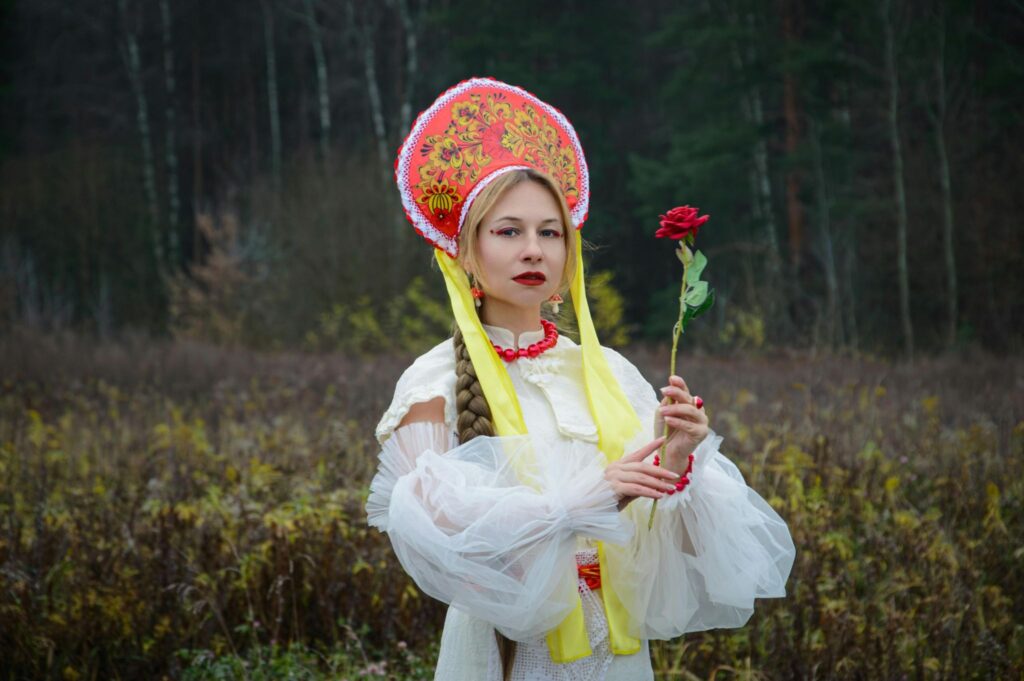
Kokoshniks developed differently in various Russian lands. The shape, material, and method of decoration depended on the province where it was made, its traditions, and available materials. A pearlescent kokoshnik from Pskov and a one-horned Moscow kokoshnik were as visually different as a ushanka and a fedora. Four major types emerged, by which kokoshniks are still distinguished today.
Moscow kokoshnik
A single horn, in the shape of a tall, stylized hat, widening smoothly towards the top. The forehead is covered by a rigid base, over which velvet or brocade fabric is stretched. Gold embroidery, in a dense pattern. The ornament often includes floral motifs, flowers, and grapevines. A silk scarf was often draped over the top, falling onto the shoulders and back.
Boyars, wealthy merchants« wives, and affluent townswomen wore it. A formal, expensive garment, it was worn for weddings, church holidays, and receptions. It is precisely the Moscow kokoshnik that is most often depicted in formal portraits of Russian princesses, and it was it that the participants of the 1903 ball reconstructed. If a »classical" kokoshnik is shown in a textbook or in a movie, nine times out of ten it will be a Moscow-made one. Sonya's album spread depicts just that.
Vladimir kokoshnik
Tall and pointed, immediately recognizable by its silhouette. Vladimir and Nizhny Novgorod work was distinguished by its dense pearl embellishment. Whole nets of small river pearls, collected from Russian rivers, were sewn onto a stiff base. Below the lower edge of the kokoshnik, podnizi descended – long strings of pearls or beads that hung on the forehead, temples, and along the cheeks. These podnizi further adorned the face and simultaneously partially concealed it from outside view. A dual function, and both worked simultaneously.
The Vladimir kokoshnik was worn for holidays, fairs, and church services. Such a heavy and expensive headdress was not worn in everyday life. For daily wear, a headband or scarf was used.
Pskov Kokoshnik
The most unusual of all. In northwestern Russia, in the Pskov, Novgorod, and Tver lands, a kokoshnik called «shishak» was made. It got its name from the cone-shaped protrusions that covered the entire surface of the headdress. Each shishak was embroidered with pearls, and sometimes there were up to fifty of them on one kokoshnik. This turned the headdress into almost a work of jewelry art.
According to one ethnographic interpretation, each protuberance on a wedding kokoshnik symbolized the desire to have a child. This means that by wearing a kokoshnik on her wedding day, the bride was essentially declaring how many children she wished to have in her future marriage. It's poetic, of course, but one can imagine the weight of such headwear and the difficulty of wearing it throughout the entire wedding day. Other researchers see solar symbols or amulets in these protuberances. There is no single, definitive interpretation, and each ethnographer adds their own arguments.
The Pskov shishak remains one of the most complex and expensive types. Modern workshops that reconstruct it work on one headdress for six months or more. This is not a tourist souvenir, but a unique piece on the border of art and archaeology.
Wedding kokoshnik
In each region, the bride had a special headdress that was worn at the wedding or in the first few days after. It was the most expensive and most ornately decorated of all women's headdresses. It was made or bought specifically for the wedding. The wedding kokoshnik was responsible not for the beauty of a photograph, but for a change in destiny. A girl who entered the church in the morning with her braid uncovered emerged from there a married woman with her hair tucked under the kokoshnik. And no one ever unbraided it again.
In ancient Rus«, a kokoshnik was not the only headdress for a married woman. Alongside it were others, similar in purpose but different in shape. These included the kika, soroka, and povoynik. Each of these words denotes a specific type of headwear, characteristic of a particular region. The kika was an ancient headdress with horns, the soroka in the southern governorates was assembled from several parts, and the povoynik was worn as an underlayer beneath other headdresses. Sonya, who after two years in school can already recognize a kokoshnik in a picture, invariably laughs at the words »kika« and »soroka." To her, soroka as a bird and soroka as a headdress are the same word, and this is a very characteristic reaction of an emigrant child to old Russian vocabulary.
Kokoshnik in the present day

In the 21st century, the kokoshnik is experiencing a strange fate. It has almost completely disappeared from everyday life. No one wears a kokoshnik as an everyday headdress. It is rarely seen even in folk village weddings. However, it lives on as a cultural symbol.
Russian fashion designers regularly include the kokoshnik in their collections, inspired by Slavic aesthetics. Yudashkin, Chapurin, Alena Akhmadullina—they all worked with the kokoshnik as a design element. Haute couture made it a stylized accessory for fashion shows, photo shoots, and theme parties.
Sports fans have also added the kokoshnik to their arsenal. At World Cups and Olympic Games, Russian female fans regularly appear in the stands wearing kokoshniks, sometimes real folk ones, sometimes simplified carnival versions. When the national team competes, kokoshniks in the stands look like an impromptu folk festival. The kokoshnik in the stands is read as a sign of a fan from Russia without any translation. Costume designers for historical films about Rus' and the Russian Empire also continue to dress actresses in kokoshniks, and through cinema, the aesthetic of the headdress reaches a new generation of viewers.
A separate story about Russian émigré brides. In the US and Canada, among second and third-generation girls, there's a growing trend for weddings with a stylized Russian theme. A kokoshnik, an embroidered scarf, elements of folk costume – all of this is reappearing in wedding photos as a way to declare its roots. Kokoshniks are made to order by workshops in Sergiyev Posad, Ivanovo, and Moscow, and are sent to Boston, Los Angeles, and Toronto. Sonya hasn't seen these weddings yet, but in a few years, when her older cousin has her graduation, a kokoshnik might well be among the options for her festive look.
And meanwhile, Sonya is working on her school project about the Russian folk costume. By Friday, she'll have a sheet with a picture of a boyarina in a kokoshnik, three phrases in English, and one Russian word that her American classmates will try to pronounce. It's a small, but real, cultural bridge, and it goes from an ancient Russian village, through a costume ball in 1903, through the emigration of the first wave, right into the third grade of a Boston school.
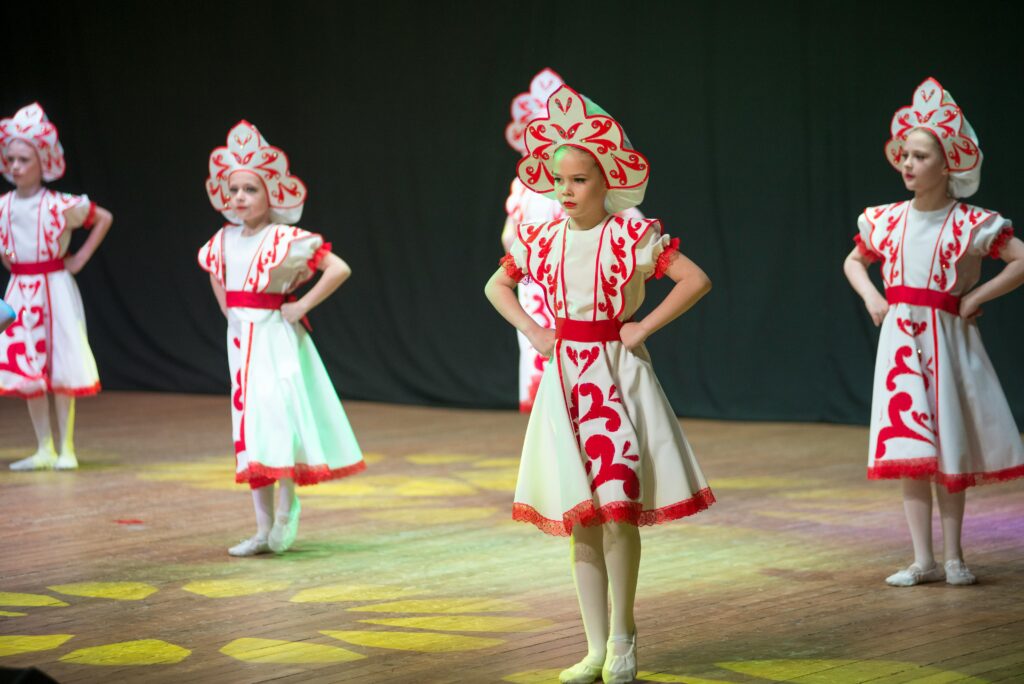
Sonia will finish her school project, tell her classmates about a 17th-century Russian noblewoman, and this time the kokoshnik will remain in her memory not as a Frozen crown, but as a real thing with its own name and its own biography. Explaining such things to a child whose Russian is a second language is always a bit harder than it seems. But it is through these things that culture is passed on. Not through loud words, but through albums on a shelf, school projects, and motherly explanations in the kitchen. At Palme School, we explore Russian culture not as a set of stereotypes, but as living objects with a history. In class, students get acquainted with the matryoshka doll, samovar, balalaika, kokoshnik, and other symbols of Russian daily life through texts, photographs, and personal family stories. This allows child and for an adult who is learning Russian from scratch, keep in mind not a flat postcard «Russia,» but a three-dimensional picture with regions, traditions, and generations of masters.
A kokoshnik is a traditional Russian headdress. It is typically made from fabric, often silk or velvet, and embroidered with beads, pearls, or sequins. The kokoshnik can also include elements like lace, feathers, or even precious stones depending on the occasion and the wearer's status.
A kokoshnik is a traditional Russian headdress worn by married women on holidays. The base was made of stiff material, glued fabric, bast, or cardboard. Velvet, brocade, or silk was stretched over it and embroidered with river pearls, gold embroidery, beads, and sometimes precious stones.
The kokoshnik was worn in Rus' by married women as part of their headdress. It was worn from the 10th century onwards and was particularly popular in the 16th and 17th centuries.
Kokoshniks were worn by married women. On weekdays, they wore a simple headband or scarf, but the kokoshnik was reserved for major holidays, church services, weddings, and formal receptions. In Rus', it was worn by both boyar women in Moscow, merchant wives in large cities, and wealthy peasant women in villages. A girl was not permitted to wear a kokoshnik before marriage. She would wear a wreath or a ribbon, allowing her braid to be visible.
A maiden's crown differs from a married woman's kokoshnik in that its defining characteristic is the presence of elements that signify virginity, and are often more delicate and ornate.
The maiden's crown was open at the top, like a hoop, leaving her braid visible as a sign of innocence. The married woman's kokoshnik was closed, completely hiding her hair and strands braided into two pigtails, as a sign of marital status. The transition occurred during the wedding ritual of «covering,» when the girl was literally moved to a new status through a change of headwear.
What types of kokoshniks exist?
There are several regional types. The Moscow kokoshnik, with a single horn and gold embroidery, was worn by boyars and merchant women. The Vladimir high, pointed kokoshnik with forehead pendants was distinguished by its dense pearl decoration. The Pskov «shishak» was the most unusual, with dozens of pearl bumps. Wedding headdresses from different regions stood apart, including the «kika,» «soroka,» and "povoynik," each with its own shape and function.
Can a kokoshnik be worn today
It is possible, and over the past twenty years it has become a fashion trend. Female sports fans wear kokoshniks to national team matches. Brides in Russia and among the Russian diaspora order stylized kokoshniks for their weddings. Fashion designers include them in their Russian-inspired collection shows. Traditionally, the kokoshnik was a headdress worn by married women, so strictly speaking, unmarried women do not wear them.
Where to buy a real Russian kokoshnik
In Russia, kokoshniks are made to order in Sergiev Posad, Ivanovo, Moscow, and Saint Petersburg. Some workshops take orders for weddings and photo shoots, while others are involved in serious historical reconstruction. In the US and Canada, kokoshniks are easiest to find in antique shops and Russian art galleries, especially in areas with large Russian-speaking communities. Another option is Western online marketplaces, where you can find both modern souvenirs and old family headdresses from émigré collections. A stylized kokoshnik costs from one hundred to several hundred dollars. A historical reconstruction of a pearl headdress costs from a thousand dollars and up.