Palme School

Online Russian Language School in the USA and Canada
Online school in Russian for bilingual children and teenagers
💡 Get bonuses with us! Referral program

One Palme Lesson: Typical 40-Minute Structure

Parents who carefully choose a Russian language school for their children often ask a key question: «What exactly happens in the lesson every 5 minutes?» Not general phrases like «play-based approach» or «communicative method,» but a real, vivid picture: how does the teacher manage to combine warm-up, main part, games, and reinforcement so that the child doesn't get tired, remains engaged, and actually learns to speak Russian in full phrases and sentences.

Palme School uses a time-tested cyclical program used by thousands of students. Each lesson lasts exactly 40 minutes, the optimal duration for a child's attention span. Classes are held online via Zoom, twice a week, in small groups of 4-6 children. Here's a typical lesson structure using Kids Elementary (ages 4-6, children with weak RKI skills) as an example.

0–5 minutes: Articulation warm-up + neurobics

The boy holds his index finger to his mouth
Freepik

The lesson begins with movement and sound. The teacher clearly commands, «Tongue up! Puff out our cheeks! Tickle the palate!» The children chorally repeat basic sounds: [a-a-a], [u-u-u], [m-m-m]. We move on to neurogymnastics: clapping to the rhythm of the famous rhyme «Mama washed Masha,» tapping fingers on the table, turning heads, touching ears.

At this moment, the child's mouth and tongue muscles are preparing for the Russian sounds [ы], [ш], [р], which are absent in English. Neurogymnastics quickly «speeds up» brain activity, increases blood flow, and activates memory and attention. The child is physically and mentally engaged in the process, with no sleepy eyes or «frozen» lips.

Result in 5 minutes: Class is ready to speak. Native-level articulation. Brain is working at 100%%.

5–15 minutes: Communicative warm-up (review of yesterday's material)
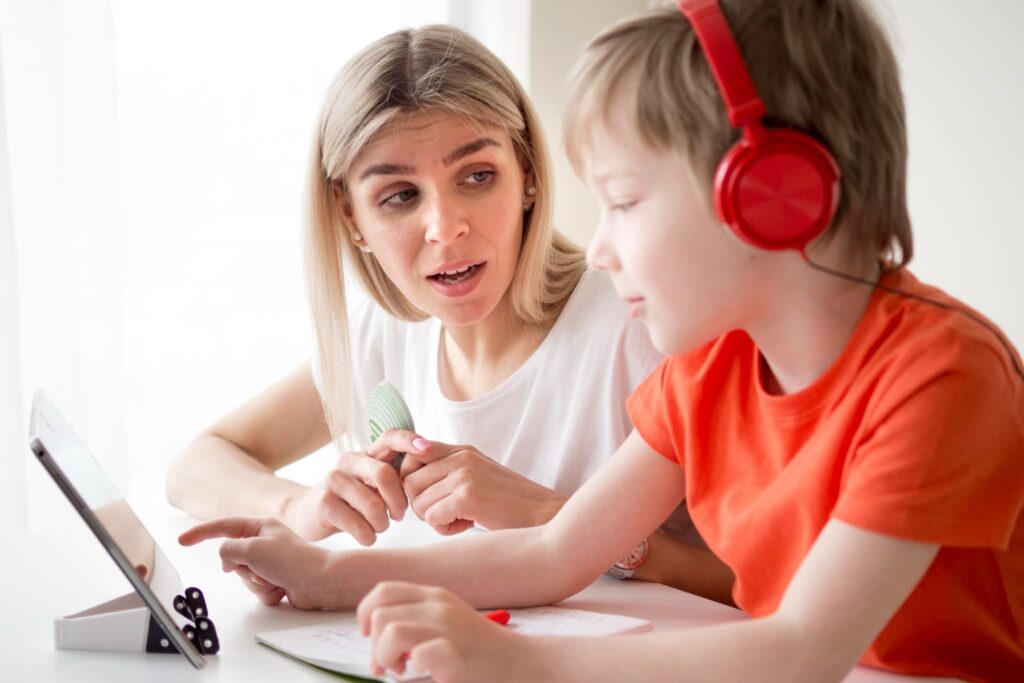
Mom and boy in headphones
Freepik

The teacher asks each child personal questions: «Who is your mother? What does she do at home? And your father?» The children answer with prepared phrases from the previous lesson: «My mother cooks. Father reads a book. I have a dog.» Flashcards with bright pictures help them remember instantly: mother with a pot, father with a book, dog with a toy.

Почему именно такая методика: Цикличная программа Palme построена на принципе «повторение — мать учения». За эти 10 минут ребенок вспоминает 80% лексики и конструкций из прошлого занятия. Лексический подход в действии: мы учим не изолированные слова («мама», «готовить»), а готовые устойчивые выражения носителей языка («мама варит суп», «папа моет машину», «собака играет с мячом»).

Result: The child feels successful and confident. No stress of «I don't remember anything.» Ready for new material.

15–25 minutes: New vocabulary in a live context (mini-project launch)

A girl is sitting on the sofa with a laptop on her lap.
Freepik

Current block topic: «My Family.» The teacher plays a short cartoon (1-2 minutes) about a mom who is a cook and makes soup for the whole family. New words of the day: «to cook, soup, tea, sweet, pot.» The children repeat entire phrases after the teacher: «Mom is cooking soup. I love sweet tea. Soup is in the pot.» An interactive illustration appears on the digital whiteboard, and the children «draw» their families, labeling each action.

Why is this approach genius: The Palme Project Method turns 5 lessons from one block into a single adventure with a plot. Today is the setup («mom is cooking»), and in subsequent lessons, children will «cook with mom» in a game, «have a family dinner,» and «celebrate a birthday» with soup and tea. Grammar is integrated naturally: plural nouns («moms are cooking»), present tense verbs («cooks, loves, prepares»), adjectives («sweet tea»).

Result: 5–7 new words and constructions are reinforced in a live context. The child doesn't cram; they live the language.

25–35 minutes: Communicative game + full language immersion

Two children are sitting in grocery carts, helmets
Freepik

We're moving on to the main activity, the «Grocery Store» role-play dialogue. The teacher transforms into a salesperson: «Hello! Welcome to our store! What do you need today?» The first child is our customer: «Give me soup and sweet tea!» The salesperson replies: «Here is your hot soup. Would you like your tea sweet or with lemon? How much is the pot?» Each child gets a role, and everyone gets a turn.

What's happening at this moment: Full language immersion without English. Children learn to listen to their interlocutor, react instantly, and have a full conversation. Mistakes become part of the game: «No soup? Then two teas!» or «Is the pot big or small?» The communicative method in its purest form. The main goal: to help the child master Russian for everyday communication, at the store, at home, with friends.

Result: The student uses ready-made expressions and sentences without fear. Language comes alive and becomes a tool for communication.

35-40 minutes: Individual praise + game homework

Mom and son wave at the laptop camera
Freepik

The final 5 minutes are dedicated to personal feedback and reinforcement. The teacher praises each person by name: «Masha said «soup» clearly and loudly! Sasha did a great job with «sweet tea»! Anya came up with «tea with lemon,» that's an excellent idea!» Parents receive a clear explanation of the homework: «Record a short voice message «My mom is making soup» and send it to our Telegram chat» (takes 5 minutes to complete).

Why this is critically important: Parents hear their child's progress in recordings with correct pronunciation. Short, playful homework reinforces vocabulary without rote memorization or pressure. Each child's success becomes visible to the entire group, which provides motivation.

Why does the Palme structure work like clockwork
The girl is sitting, wearing headphones
Freepik

Each stage of the lesson solves a specific task and flows smoothly into the next:

An articulation warm-up prepares your mouth and brain for the Russian language.
A communication warm-up brings back yesterday's knowledge and confidence.
Project terminology provides new material in a live narrative.
Game dialogue fosters real communication.
Homework cements success at home with parents.

Palme combines 6 proven methods in one lesson:
The cyclical program automatically adapts to each child's progress.
The communicative + lexical approach teaches ready-made phrases from native speakers + real-life interaction.
The project method transforms 14 blocks × 5 lessons into an outcome-driven system.
Full immersion excludes an intermediary language.
Neurogymnastics activates the brain by 100%.
Interactive Technologies: Multimedia, Digital Whiteboard, Telegram Chat.

Specific results for parents
Two girls with books
Freepik
PeriodAfter 1 lesson (40 min)After 1 block (5 lessons)After 1 month (8 lessons)
Words5 new wordsThe complete topic is «My Family.»+40–50 words
Phrases3 ready-made phrases15–20 everyday phrasesSpeak freely
Pronunciation[sɨ], [ʂɨ] correctlyListening dialoguesWithout English
MotivationConfidenceSuccess in the groupAsks for «another lesson»
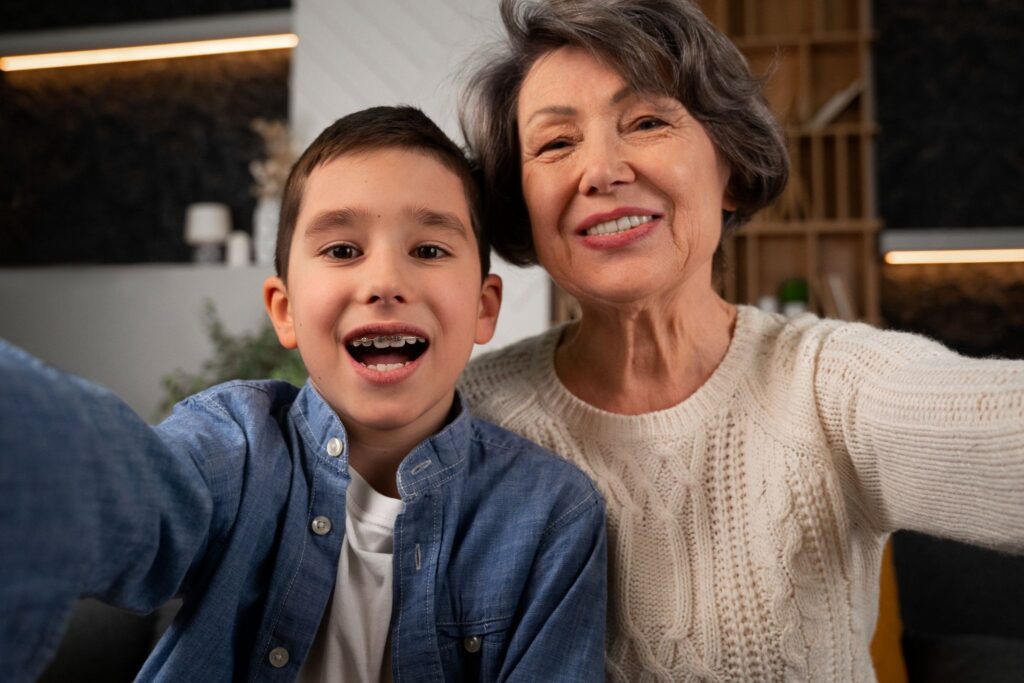
The boy and the grandmother smile for the camera
Freepik

Real parent story: «My son used to be silent with his grandmother. After 2 weeks of Palme, he started telling her himself that «Mom is cooking soup, Dad is washing the car.» Grandmother cried with happiness!»
A girl is smiling, a laptop is nearby
Freepik

Sign up for Introductory lesson and watch the lesson «live». In just 40 minutes, you'll understand why Palme School delivers real results. You'll see firsthand how the teacher masterfully combines conversation, reading, and games without a single word of English. Your child will fall in love with the Russian language and begin speaking Russian fluently.
Do you want to support child's successes In studies?
Helping to develop knowledge, confidence, and a love for learning through modern Russian language classes and beyond.
Ukrainian differs from Russian in several key ways, including pronunciation, vocabulary, and grammar. Despite these differences, they are often confused because they are both East Slavic languages and share a common ancestor, Old East Slavic. This shared heritage means they have a significant degree of mutual intelligibility, particularly in spoken form. **Key Differences:** * **Pronunciation:** * **"Г" sound:** In Ukrainian, the letter "г" is typically pronounced as a voiced velar fricative, similar to the "g" in "go" but softer, almost like a gentle breath. In Russian, "г" is usually a hard "g" sound. * **"И" and "Ы" sounds:** Ukrainian has distinct "и" (pronounced like the "i" in "bit") and "i" (pronounced like the "ee" in "see"). Russian has "и" (similar to Ukrainian's "и") and "ы" (a harder, more guttural sound not present in Ukrainian). * **Vowel reduction:** Russian has significant vowel reduction, where unstressed vowels change their sound (e.g., "o" can sound like "a"). Ukrainian generally pronounces vowels more clearly, regardless of stress. * **"Є" and "Ї" sounds:** Ukrainian has specific letters like "є" (pronounced like "ye" in "yes") and "ї" (pronounced like "yi" in "yield") which are not found in Russian. * **Vocabulary:** * While many words are similar or identical, Ukrainian has a richer influence from Polish, and also incorporates words from Turkic languages and other European languages to a greater extent than Russian. * Examples: * Thank you: Ukrainian - дякую (dyakuyu), Russian - спасибо (spasibo) * To speak: Ukrainian - говорити (hovoryty), Russian - говорить (govorit') * Yes: Ukrainian - так (tak), Russian - да (da) * No: Ukrainian - ні (ni), Russian - нет (net) * **Grammar:** * **Vocative case:** Ukrainian retains and actively uses the vocative case for direct address, which has largely disappeared from modern Russian except in very specific or archaic contexts. * **Verb conjugations:** There are differences in verb endings and some verb forms. * **Grammatical genders and noun declensions:** While largely similar, there are minor variations in how nouns change form based on case and gender. **Why They Are Confused:** 1. **Shared Ancestry:** Both languages descend from Old East Slavic, the language spoken in Kyivan Rus'. This common origin means they have a large base of shared vocabulary and grammatical structures. 2. **Geographic Proximity and Historical Interaction:** For centuries, the territories where Ukrainian and Russian are spoken have been in close contact, often under the same political empires (like the Russian Empire and the Soviet Union). This led to significant linguistic borrowing and influence in both directions. 3. **Mutual Intelligibility:** Due to the shared roots and similarities, speakers of Ukrainian and Russian can often understand a significant portion of what the other language is saying, especially in simpler conversations or written texts. This superficial understanding can lead to the misconception that they are dialects of the same language. 4. **Political and Historical Context:** During periods of Russian imperial and Soviet rule, the Ukrainian language was often suppressed or discouraged, and there was a promotion of Russian as the dominant language. This historical context sometimes led to the view, particularly among those outside Ukraine, that Ukrainian was merely a dialect of Russian. However, linguistic analysis clearly shows they are distinct languages.
Ordinal numerals in Russian are formed by taking the root of the cardinal numeral and adding the appropriate ordinal suffix. These suffixes agree in gender, number, and case with the noun they modify. Here's a breakdown: **1. Basic Structure:** * **Cardinal Numeral + Ordinal Suffix** **2. Ordinal Suffixes:** The suffixes are generally based on the endings of adjectives. * **Masculine:** -ый (e.g., первый - first) * **Feminine:** -ая (e.g., первая - first) * **Neuter:** -ое (e.g., первое - first) * **Plural:** -ые (e.g., первые - first) **3. Examples:** Let's look at the first few numbers: * **Один (one):** * Masculine: первый (pervyy) * Feminine: первая (pervaya) * Neuter: первое (pervoye) * Plural: первые (pervyye) * **Два (two):** * Masculine: второй (vtoroy) * Feminine: вторая (vtoraya) * Neuter: второе (vtoroye) * Plural: вторые (vtoryye) * **Три (three):** * Masculine: третий (tretiy) * Feminine: третья (tret'ya) * Neuter: третье (tret'ye) * Plural: третьи (tret'i) * **Четыре (four):** * Masculine: четвёртый (chetvyortyy) * Feminine: четвёртая (chetvyortaya) * Neuter: четвёртое (chetvyortoye) * Plural: четвёртые (chetvyortyye) **4. Numbers 5 and above:** For numbers five and higher, the formation is more straightforward. You take the root of the cardinal numeral and add the standard adjectival endings. * **Пять (five):** * Masculine: пятый (pyatyy) * Feminine: пятая (pyataya) * Neuter: пятое (pyatoye) * Plural: пятые (pyatyye) * **Десять (ten):** * Masculine: десятый (desyatyy) * Feminine: десятая (desyataya) * Neuter: десятое (desyatoye) * Plural: десятые (desjatyye) * **Сто (one hundred):** * Masculine: сотый (sotyy) * Feminine: сотая (sotaya) * Neuter: сотое (sotoye) * Plural: сотые (sotyye) **5. Compound Numbers:** When forming ordinal numerals for compound numbers (e.g., twenty-first), only the last part of the cardinal number changes to an ordinal. * **Двадцать один (twenty-one):** * Masculine: двадцать первый (dvadtsat' pervyy) * Feminine: двадцать первая (dvadtsat' pervaya) * **Сто двадцать три (one hundred twenty-three):** * Masculine: сто двадцать третий (sto dvadtsat' tretiy) * Feminine: сто двадцать третья (sto dvadtsat' tret'ya) **6. Pronunciation and Spelling Changes:** You might notice some spelling and pronunciation shifts, especially with the softer vowels and consonant changes in the first few numbers. These are typical sound changes in Russian. **7. Case Agreement:** Like all adjectives, ordinal numerals must agree with the noun they modify in case. * **Nominative:** первая страница (the first page) * **Genitive:** первой страницы (of the first page) * **Dative:** первой странице (to the first page) * **Accusative:** первую страницу (the first page - direct object) * **Instrumental:** первой страницей (by the first page) * **Prepositional:** о первой странице (about the first page) **Key Takeaways:** * Ordinals are formed from cardinals with specific suffixes. * They agree in gender, number, and case with the noun. * The first few ordinals (первый, второй, третий) are irregular and have unique forms. * For compound numbers, only the last numeral becomes ordinal.

Do you want your child to love learning?

At Palme School, classes are held online in live groups with experienced teachers. Choose a subject and sign up for a free first lesson.

Sign up for the newsletter
We at Palme Online School fall in love with the Russian language and Russian culture

Leave a request for a free call

Sign up for a free lesson.
Apply for a free introductory lesson to get acquainted, determine your goals, and find a suitable group.
Sign up for a free lesson
Submit a request for a free first session with a guidance counselor to get to know each other, determine your goals, and match your child with an educator
Sign up for a free lesson
Submit a request for a free first session with a guidance counselor to get to know each other, determine your goals, and match your child with an educator
Sign up for Russian Dictation
Sign up for a free lesson
Submit a request for a free first session with a guidance counselor to get to know each other, determine your goals, and match your child with an educator
Sign up for a free lesson
Submit a request for a free first session with a guidance counselor to get to know each other, determine your goals, and match your child with an educator
Sign up for a free lesson
Submit a request for a free first session with a guidance counselor to get to know each other, determine your goals, and match your child with an educator
Sign up for a free lesson
Submit a request for a free first session with a guidance counselor to get to know each other, determine your goals, and match your child with an educator
Sign up for a free lesson
Submit a request for a free first session with a guidance counselor to get to know each other, determine your goals, and match your child with an educator
Sign up for a free lesson
Submit a request for a free first session with a guidance counselor to get to know each other, determine your goals, and match your child with an educator
Sign up for a free lesson
Submit a request for a free first session with a guidance counselor to get to know each other, determine your goals, and match your child with an educator
Sign up for a free lesson
Submit a request for a free first session with a guidance counselor to get to know each other, determine your goals, and match your child with an educator
Sign up for a free lesson
Submit a request for a free first session with a guidance counselor to get to know each other, determine your goals, and match your child with an educator