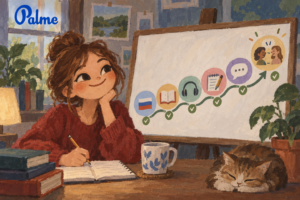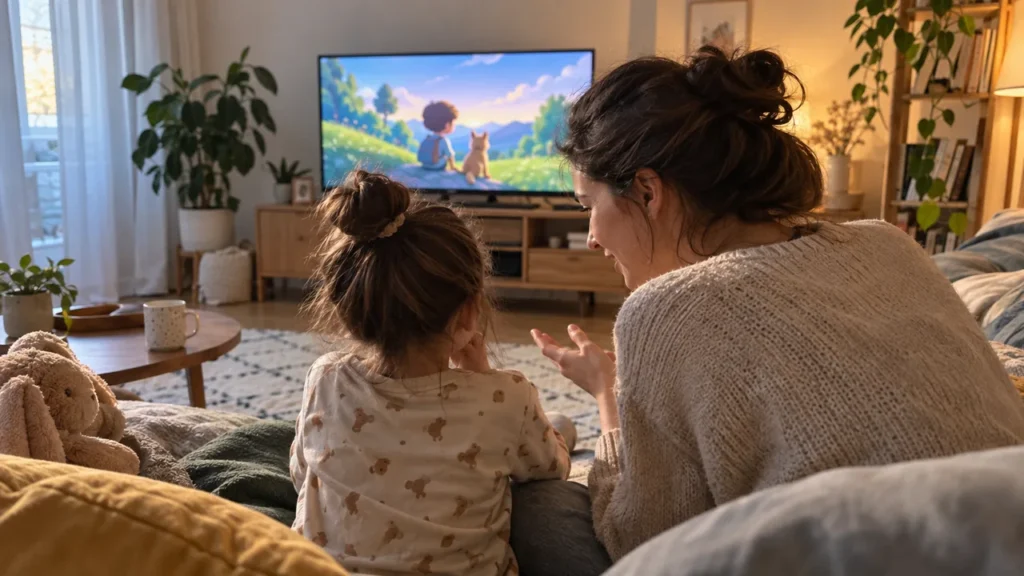

In school, we use a simple scheme. Three minutes before the viewing, a short segment and a discussion after, and the usual cartoon becomes a full-fledged material for Russian lessons. That’s the whole point; the rest are just details. It takes from fifteen to thirty minutes, depending on which package of questions you choose. The middle of the article contains a constructor with ready-made sets of questions, which you can print out and use right away.
Why one viewing is usually not enough
Watching a movie by itself is beneficial, and quite a bit. The child hears the spoken words and the intonation in a natural way. He encounters the words in a context that makes sense and gradually learns to pick out the familiar from the general flow. All of this works without any specific tasks.
But for active speech, this is usually not enough. Active speech appears where there is a reason to use the words and phrases heard themselves, and there is no such reason in front of the screen. Hence the discrepancy many families are familiar with. There is a lot of Russian in the house, but as soon as you need to explain something more complex than a household request, the child still switches to English. Parents who are looking for learn russian through cartoons or russian cartoons for kids usually receive a selection of titles in response. The titles matter less than what happens after the final credits.
What to do before turning on

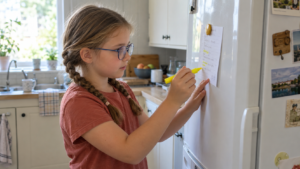
The preparation takes three minutes and changes the whole viewing experience. Choose a few key words, enough to keep the child interested given their age and level of Russian. To start, you can take two or three words, and give the child five or six for the series «The Well-Hidden Sausage» from «Kotenka Po Imieniu Gav». For the «Kotenka Po Imieniu Gav» series, these are «sausage,» «hide,» «reliable,» and “belly.”.
Take the vocabulary that drives the action and don’t limit yourself to words that are spoken literally. Some of the words should be left for future conversation: if after watching the movie you’re going to ask about the character’s feelings, say «frightened,» «thought it was real,» «lost,» or «trusted.» In the movie itself, these words may not be used, but they’ll be necessary for the child to gather an answer.
Then name the topic with one sentence and give a specific task. Not a request to watch closely, but observation that can be followed up. Note where the kitten has hidden the sausage, remember in what order the hedgehog greets the animals in the fog, hear Matroskin explain that the sandwich is eaten incorrectly. The task turns passive viewing into observation, and the child watches in a completely different way, knowing that they will be asked questions later.
How not to overload the viewing experience

Usually, one main task per series is enough. The younger the child and the weaker the Russian, the more important it is not to overload them with additional questions, because several tasks at once easily distract from the main plot.
With explanations along the way, a similar principle works. Stopping the movie after every confusing line and trying to translate everything isn’t necessary; it’s useful for the child to learn to extract meaning from the context, and the part that’s unclear can calmly wait until the conversation starts after the viewing. But if the entire scene falls apart without one key word, briefly point out the problem and continue. The viewing shouldn’t turn into a series of stops; that’s the whole point.
Ready-made sets of questions
Below are ready-made sets for three ages. Choose a cartoon, get the word-analysis, a viewing task, and questions after, and if you wish, you can print the set and put it next to it. If the desired name is not in the list, choose any of the other ones. collections of Soviet classics and assemble the kit using the same principle.
Watching the show itself helps the child hear and understand Russian speech more easily. And to get them to start speaking, they need a reason to use the words they hear themselves. Choose a cartoon, and we’ll put together the complete set: Before watching the video, there is one task for the duration of the viewing time, and questions after. The age determines the content, and the level of Russian determines the language accessibility, so on each card there is both of these things marked. You can decrease or increase the number of words according to the child. The whole set takes from fifteen to thirty minutes, depending on which tape to choose.
Choose the child's age
«The Kitten Named Gav», a novella from «The Well-Hidden Sausage»
4–6 years. One of the three stories from the second issue; another one begins later. Short, with clear diction and a clear situation.
Words that will help you understand and discuss
Before watching, three minutes. That's as many words a child can hold on to, and that's enough for a beginner to understand two or three of them.
- cutlet
- hide
- reliable
- belly
- Puppy
Watch without getting distracted
About three minutes
Don't translate every line. But if the entire scene falls apart without a single word, briefly suggest what happened and continue.
Talk
After watching it, nine minutes
- What did the puppy ask Gav to do?
- Where did the cutlet end up? Tell us in your own words.
- What came first, and what came after: the cat smelled the stew, the puppy left the stew, and Gav started looking for a safe place?
- Which kitten? Name three words about it.
- The puppy entrusted Gava with a kitten. What would you have said to Gava if he had been there?
- Think of what the puppy will say when he comes back for the stew.
- Come up with something the kitten will do tomorrow.
- Did Gav find a way out of the situation or was he being clever? Explain.
Little Ant
4–6 years old. A simple story about fear and the first conversation about feelings.
Words that will help you understand and discuss
Before watching, three minutes. That's as many words a child can hold on to, and that's enough for a beginner to understand two or three of them.
- pond
- reflection
- scar
- to smile
- to be afraid
Watch without getting distracted
Nine minutes
It is possible to watch the children while sitting next to them and to stare at them in scary places. There is no need to comment out loud.
Talk
After watching it, eight minutes
- Who did Little Ant see in the pond?
- What did his mother advise him to do?
- Arrange them in order: I grabbed the stick, got scared, went after the bear, smiled.
- Why was the duck in the pond angry when the duck itself was angry?
- Have you ever been afraid to go somewhere alone? What helped?
- What would you advise Eno to do if you were his friend?
- Come up with something he'll tell his mom about when he gets home.
Mom for the baby mammoth
4–6 years. Strong emotions and a clear sequence of events, convenient for the first retelling using props.
Words that will help you understand and discuss
Before watching, three minutes. That's as many words a child can hold on to, and that's enough for a beginner to understand two or three of them.
- ice
- melt
- North
- to search
- hug
Watch without getting distracted
Eight minutes
The cartoon is touching, and tears at the end are a normal reaction. It would be better to start the conversation a minute later, not right away.
Talk
After watching it, eight minutes
- Who was the little mammoth looking for?
- Who helped him? Name everyone you can remember.
- List them in order: I woke up in the ice, met a moose, swam on the ice, and met a polar bear.
- The baby mammoth was drifting alone for a long time. How do you think he felt?
- Have you ever helped someone who was lost or didn’t know what to do?
- Why did the elephant agree to be his mother?
- What did the baby mammoth say to his mom when they met? Come up with his words.
- Come up with another ending to this story.
«Three from Prostokvashino»: from leaving home to the village
7–9 years old. See from the beginning to the move to the village; all the questions below are about this piece.
Words that will help you understand and discuss
Before the show, three minutes. That's as many words as a child can hold, so if you're weak in Russian, take three.
- sandwich
- farm
- independent
- None
- note
Watch without getting distracted
Nine minutes, until the moment when the heroes settle into the house
It is more convenient to take a short fragment rather than the entire cartoon for a detailed conversation.
Talk
After watching, twelve minutes
- Tell me again how Uncle Fyodor met the cat.
- In order: I wrote a note to my parents, met a cat on the stairs, left my house, found a house in the village.
- Describe Matrosov. What kind of person is he? Give an example from the cartoon.
- Uncle Fyodor left the house. Who was right, he or his parents? Why do you think that way?
- How would you act in his place?
- What could have happened if the parents hadn’t found the note?
- Kot says: a beard, paws and a tail—here are my documents. What does he mean and why is that funny?
- Tell the story of any scene in your own words, as if to a friend who has not seen it.
«Winny-Puch», the first film from 1969
7–9 years old. Rich dialogue, humor, and a character that’s interesting to discuss.
Words that will help you understand and discuss
Before the show, three minutes. That's as many words as a child can hold, so if you're weak in Russian, take three.
- chips
- airball
- cannon
- suspicious
- incorrect
Watch without getting distracted
Ten minutes
There’s a lot of wordplay here. If a child laughs, that’s already an understanding; there’s no need to figure out the joke on the fly.
Talk
After watching, twelve minutes
- Why did Winnie-the-Pooh need a balloon?
- In order: I got covered in mud, asked Piatak for a rifle, went up to the tree, and fell.
- Why did the bees still not believe that it was a cloud?
- Was Winnie-the-Pooh's plan good or bad? What did he come up with that was successful, and what didn't he take into account?
- What would you come up with to get the honey?
- Petyach hardly argues with Winnie-the-Pooh. Why do you think that is?
- Winnie-the-Pooh sings that he has sawdust in his head. Is he criticizing himself or praising himself?
- Come up with a new line for his song.
38 parrots, measurement of the beak
7–9 years old. A logical puzzle within the plot is a good fit for children who love counting.
Words that will help you understand and discuss
Before the show, three minutes. That's as many words as a child can hold, so if you're weak in Russian, take three.
- measure
- length
- merka
- step
- tail
Watch without getting distracted
Nine minutes
If the child starts counting out loud along with the characters, don't stop; that's exactly what they need.
Talk
After watching it, ten minutes
- Who proposed measuring the length of the udav and why?
- How much is there in the parrots, and how much in the marmosets and squirrels?
- Why did the parrots end up with the most if the beak is the same?
- Was Udav happy with the result or upset? How did you understand that?
- Measure something at home with your own steps, and then with Papa's, and then tell me what you found out.
- Who do you think is the smartest person in this company? Explain why.
- What else can be measured in parrots? Come up with three things.
- Tell the story of the series as if you were telling about a math lesson.
Squirrel in the fog
10–14 years old. There are few words, but there is a lot of meaning. Some of the words below in the cartoon won't be heard: they are needed for the conversation after.
Words that will help you understand and discuss
Before watching, three minutes. All five words are key words; analyze each one.
- mist
- birch
- to stare
- to lose one's temper
- to trust
Watch without getting distracted
Ten minutes
There are almost no repetitions here, and that doesn't bother me. The meaning is read by the intonation and pauses, and I'll have to put it in words.
Talk
After watching it, fifteen minutes
- Tell me in a minute what happened to the hedgehog.
- What was the spider afraid of in the fog? Name three things.
- Why do you think the hedgehog kept walking through the fog?
- Is the little bear upset that his friend was late? How did you know that if he didn't say so?
- Have you ever feared something that wasn't scary? Tell me about it.
- There are almost no words in the cartoon. How did you figure out what the hedgehog feels?
- Which is more important in this story—the horse in the fog or the meeting with a friend? Explain your answer.
- Come up with what the hedgehog and the little bear were talking about after the shot faded out.
There once lived a dog
10–14 years old. A grown-up story about old age and survival. Based on a Ukrainian folk tale, it features Ukrainian folk songs.
Words that will help you understand and discuss
Before watching, three minutes. All five words are key words; analyze each one.
- expel
- Grow old
- village
- Wedding
- to retaliate
Watch without getting distracted
Ten minutes
The characters' speech contains words and forms that are unfamiliar to a modern child. It is better not to translate them on the fly, but to discuss them later.
Talk
After watching it, fifteen minutes
- Tell me in a minute what happened to the dog.
- Why did the owners kick him out of the yard?
- Is the wolf helping out out of a sense of duty or is he waiting for a reward? Find the proof in the cartoon.
- At the end, the phrase: "You can come by if you need anything." What does it really mean here?
- Have you ever been helped without asking for it? How did a person know that you needed help?
- Which unusual words and forms did you notice in the speech of the characters? How do you think they came about?
- Which is more important in this story—the food or the friendship? Argue your point.
- Imagine what would happen if the wolf refused to help.
Last year's snow fell
10–14 years old, confident Russian speaker. Absurdity, broken norms and cultural references are difficult for a weak language.
Words that will help you understand and discuss
Before watching, three minutes. All five words are key words; analyze each one.
- greed
- to become
- a hut
- not enough
- Christmas tree
Watch without getting distracted
Seven minutes
The cartoon is absurd, and the first impression may be confusion. This is a normal starting point for a conversation.
Talk
After watching it, fifteen minutes
- Why did the man go into the forest?
- Why didn't he bring the Christmas tree anyway?
- The hero keeps repeating: it won't be enough. What does this say about him as a human being?
- Is the cartoon funny or sad? Argue your answer.
- The hero speaks out of character, swallows words, and twists them. Why do you think the author did this?
- Recite any scene in neutral literary language. What has disappeared and what has changed?
- Imagine what would happen if the hero weren't greedy.
- Find a phrase in the cartoon that can be said in real life, and explain when it is used.
The main work begins when the screen goes off.

Next comes what all this was about. Let’s start with the retelling. This exercise is useful and very demanding. To tell a story in your own words, the child needs to simultaneously keep the plot and choose the main point. And immediately find the words and put them together into a correct sentence. If Russian already allows you to construct several connected sentences, simply ask them to tell what happened, as if in front of a friend who hasn’t seen the series. If it’s still difficult, use props: ask them who the main character was, what happened first, what happened next, and how everything ended. The child will put together the same retelling, only in parts, and that’s a full-fledged result.
Next, reconstruct the events in order. Name the four scenes in turn and have them arrange them correctly. The exercise looks like a children’s one, but it also trains your fluency and at the same time introduces the words about time: first, then, after that, at the end.
Then move on to the heroes. Ask them to describe Matroskin’s cat and confirm the description with an example from the cartoon. Ask them why the little weasel didn’t turn back and whether the little bear was angry at his friend for being late, even though he didn’t say a word about it out loud. Questions like these require you to put together the sentence yourself, without relying on a ready-made response from the cartoon.
And finally, the most valuable thing. Ask who was right and why; how they would have acted in the hero’s place; what might have happened next. Here the child enters into argumentation, and that’s a completely different level of language. There is no correct answer to such questions, and it’s best to speak out loud about them; otherwise the conversation will turn into a quiz with evaluation. The only important thing is that the explanation comes across clearly.
How to choose questions based on age and level of Russian
Age sets the limits, but the level of language determines everything within that framework. A seven-year-old with almost native Russian skills and a seven-year-old who understands only basic requests receive different tasks, even though the cartoon may be the same.
For younger children, ages four to six, the questions should be kept short and specific: who has become friends with whom, where the cookie went, what came first and what came later, what three words would suit the character. Behavior at this age is also discussed, just at an accessible level. Ask why the character cried, whether he did well or poorly, and how a child would act in the same situation. Asking them to come up with what the character will do tomorrow works very well as well.
For children from seven to nine, questions can already be made more complex if the Russian-speaking child allows it. Ask them to consider both sides of the conflict and explain their position. The child can say, for example, that Uncle Fedor acted incorrectly because the parents were worried. Questions about the funny things, such as why «ears, paws, and tail» are documents, and what's the joke here, work well here as well. Others Phrases from Soviet cartoons that have become popular as quotes, They are suitable for the same game.
The teenager needs a different approach. A straightforward interview will take him two minutes, but he readily disputes it if the argument is genuine. Ask him what is more important in this story—the horse in the fog or the encounter with a friend—and how he understood the character's feelings, when there are almost no words in the cartoon. «Ezhika in the Fog» The story of the creation of the film is well-developed; it usually grips the teenagers more than the plot itself. And answer your own questions, at least sometimes. Then the conversation stops being a test.
How to react to a child's answers

The article about questions is incomplete without the second half of the story, that is, without the ability to listen to the answer. Here, two habits decide everything, and both are more difficult for an adult to master than they seem.
When talking about a cartoon, it’s better not to catch mistakes one by one. The child says, «He hid the cutlet there,» and the hand immediately goes to fix the sentence. First, respond to the meaning, and then return the correct form with your own remark. «Yes, he hid the cutlet there; why exactly there?» The child gets the correct model and continues speaking, and the conversation about the cartoon doesn’t turn into a grammar lesson after which there’s no point in responding at all.
And give him/her time to answer. A pause after a question usually means that the child is looking for a Russian word and putting together a sentence, not that he/she doesn’t understand. It just drags on for a long time, feels endless, and you want to suggest an answer almost immediately. Bear it out and don’t answer for the child.
Why we take the originals, not translations

The question arises almost always. If the goal is for the child to hear Russian speech, wouldn’t a modern foreign animated film with Russian voiceover be suitable? It would be suitable, and that’s an honest answer. High-quality dubbing provides both vocabulary and live speech patterns, so the material works quite well for language learning. The difference isn’t that translation yields fewer words; it’s the additional layer that isn’t conveyed by translation.
In Soviet and Russian cartoons, the language was originally created in Russian. The dialogues, intonations, and humor grew out of this culture and remain a part of it. The same goes for the characters of the heroes and the logic of their conversations. In a dubbed film, the Russian language is superimposed on another linguistic environment. The child hears the speech, and the cultural context comes from a foreign plot, foreign characters, and foreign realities.
For us at school, this difference is fundamental because families come to transmit not only the language but also the general cultural context to their children. At home, a child may understand basic Russian quite well but not know the expressions, characters, storylines, and references on which their parents, grandparents, and great-grandparents grew up. Through original videos, he gradually acquires the general cultural baggage of the family, and he has more topics to discuss with loved ones. Knowing Cheburashka and the cat Matroskin works as a common language between generations, and no textbook can replace it. For the same reason, it is advisable to keep the following items alongside the cartoons: Russian folk tales, They give the child the same layer of references, only through text.
At the same time, it’s not necessary to watch all the old stuff in a row. It’s worth choosing a tape based on the child’s age, their interests, and whether it will provide good material for conversation. A beautiful, but wordless piece is suitable for talking about feelings, but is completely unsuitable for building vocabulary.
Home
The Russian-language cartoon gives the child a lot in itself, but it will be more interesting to talk about what happens around the time of watching. A few words before watching, one task during the viewing time, and a real conversation after, where the child recounts, describes the characters, explains their actions, and argues. Questions are adapted to the age and language level, from simple «who has become friends with whom» at five years old to discussing the motives of the characters at twelve. And it is best to choose original Russian films because, along with the language, they convey the cultural context that makes the child feel at ease when talking to grandparents.
One conversation around one fragment, and the child can learn a lot at once. He trains his hearing, builds vocabulary in a real context, learns to speak coherently and to support his opinion with arguments. At Palme School, we collect such fragments directly into the lessons and work with them as with regular teaching material, alongside the text. The teacher prepares the vocabulary in advance, sets a viewing task, and then leads the discussion afterwards. We work with children from four to seventeen years old, online, in small groups; the lesson lasts forty minutes. You can start at two free lessons. First, the methodist will get to know the child, determine the level, and select a group; then they will have a real class with a teacher.
Frequently Asked Questions
What should I do if my child answers in English?
Don't switch back and forth between languages and don't require them to repeat in Russian. Ask the same question more simply, suggest the beginning of the sentence, and give the missing word. The goal here is for the child to say something in Russian and see that they're succeeding.
Is this method suitable for a child who hardly speaks Russian?
It’s fine to cut down the requirements. Take a five-minute segment, break down two or three words, and ask about the facts first: who, where, and what they did. A retelling at this stage is also possible, but only on a basis of supporting evidence; the detailed argument will come later.
Is it necessary to watch it together with the child?
It would be advisable to discuss otherwise; if you can’t work it out together, at least ask about the task you were given before watching the episode and ask to be told the story again. The story is also better when the adult hasn’t seen the episode; sometimes it’s even better because you have to actually tell the story.
Is it possible to watch the same series several times?
It's worth it. The plot is familiar, and it's easier for the child to understand the words and replics that they missed the first time. It's worth giving the child another task for the second time.