
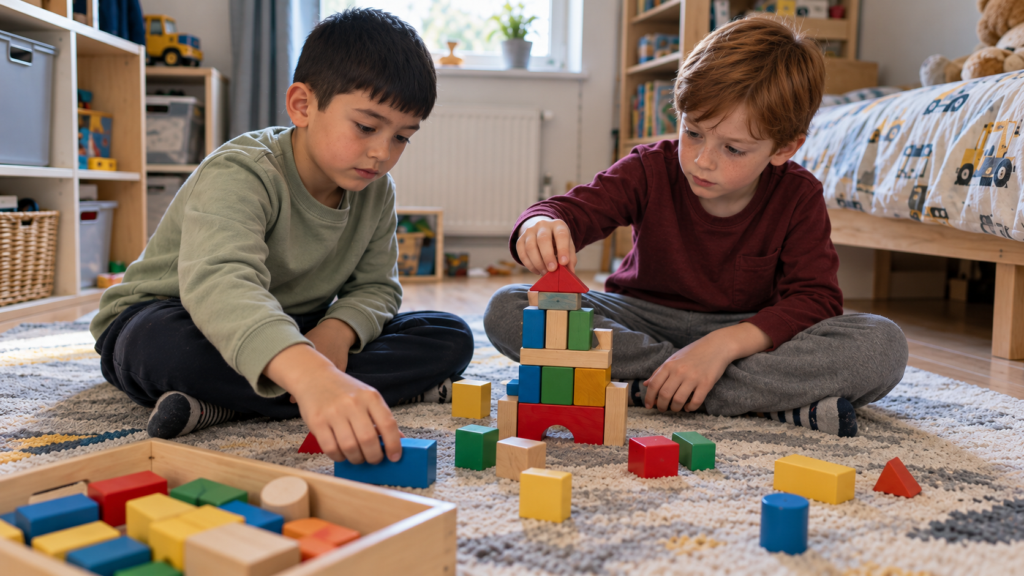

In the morning, Grandma asked about school on video, and the grandson answered, briefly but in Russian. In the afternoon, my mom’s friend came with her son, also from a Russian family. The mothers went into the kitchen, the boys stayed in the room with the construction box, and within an hour, not a single Russian word had been heard from there. English words were heard, and then they too stopped, the tower grew silently. This is what we will talk about when Russian is part of the conversation with an adult and disappears between the children.
Morning and daytime conversations should be compared. Who started the conversation with the grandmother, and who addressed the child first? Did the grandmother help the boy with words? Did the boys help each other? How well does the grandson know each of his interlocutors? Why wasn’t Russian included in the conversation? These questions won’t explain everything, but they will show how the two situations differ.
The Tower with a Book
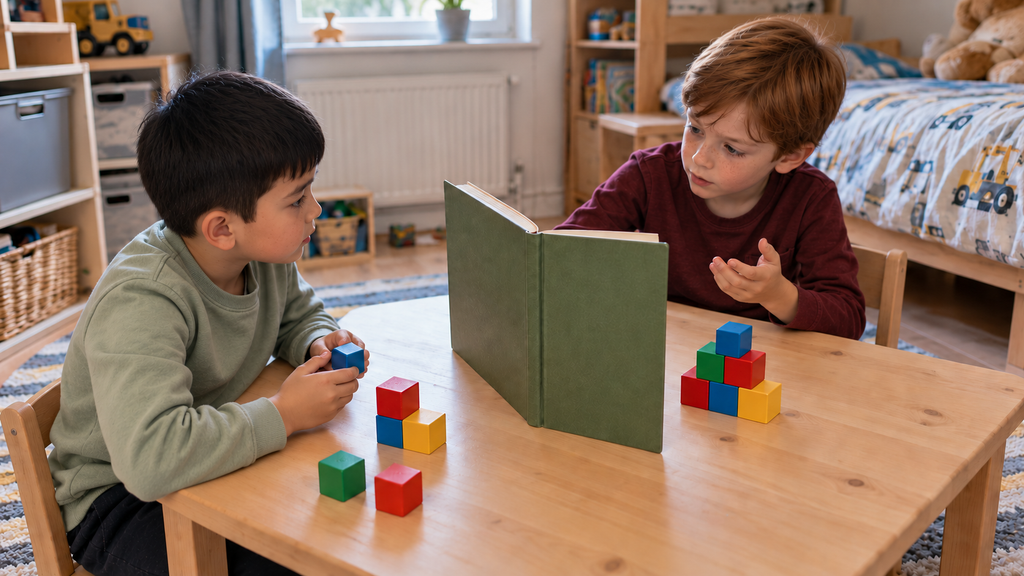
The same construction set, the same two boys, but now there is an open book between them. Behind the book is a small structure made of six cubes, assembled by someone adult in a minute. The person assembling the cubes has the same ones. The book covers the model from the person assembling it, and the child who is helping by pointing out sees both the model and the new structure.
Before the book, the boys also had a common project; they built it next to each other, quietly. The book changed one thing. The builder has no information about the construction, but the other has it, and there’s no other place to get it from. Which cube is next? Red. Where to put it? On the blue one. Like this? No, next to it. The builder has a reason to ask the other child for help.
If the gatherer points with his finger instead of asking a question, and the other nods instead of saying «yes,» the construction will still move forward. If someone asks in English, too. There’s no reward for the next cube here if they don’t say a Russian response.
Who is driving
In Russian children's games, the word «lead» has its own meaning. To lead means to be the one leading the way, for example, to find the hidden ones or to catch up with the rest. In Ozhegov's dictionary, this is a separate meaning of the verb. In the game, children say «You lead» or «Oh dear, I'm not the one leading the way.».
The one who sits behind the book answers briefly: «red», «higher», «no». The one who is collecting asks «Which one?» or «Here?» The short answers do not make the role behind the book easy. The one who is prompting needs to understand the question, compare the two structures and explain where to place the cube that the one who is collecting holds in his hand. The boy decides which of the two roles to take first, and they can switch roles on the next structure, or they can stay the same.
The book and the cubes are just an example here. The same pair of roles are present in «Who Am I?», where one asks «Am I an animal?» and the other gets «yes» and «no»; and in our «Hot, Cold» version, where the leader is looking and can ask «Here?» or «Am I close?» and the other answers «cold» or «warmer». You can find a game that suits two specific children below.
Choose a game for two children
Two questions, and a game will appear below whose rules include the interaction between one child and another and the answer. The child should be offered both roles, and they can be switched at will and not necessarily immediately: one successful round of «yes» and «no» does not mean that the next time the child has to ask questions himself. If the child answers with a gesture, a nod, or in English, his participation continues. A Russian response does not become a payment for a hint, for the next cube, or for the next move. An answer from a single word is not always as simple as it seems: the answerer must understand the question and know whether they are answering correctly.
What phrase would be comfortable for your child to say right now?
What do both of them like?
«Here?» «It’s cold.».
«And here?» «Warmer».
«Am I close? »Hot!«
«Am I an animal? »Yes«.
«Do I live at home?» «Yes.».
«Am I a cat?» «No.».
«Apple!» «Edible.».
«Chair!» «Unpalatable».
«Soap!» «Unappetizing!»
«Which cube is next?» «The red one.».
«Where to put it?» «On the blue one.».
«Like this?» «No, next to it.».
At the Palme School’s Conversation Club, children aged four to fourteen are grouped into teams of six to eight: they act out scenes, learn poems and folk tales, and communicate with each other in Russian in a playful manner.
You can get acquainted with the club at free trial lesson.
Sign up for the Conversation ClubFrequently asked questions about Russian among children
Why does a child speak Russian with adults but not with other children?
In one situation, the cause cannot be determined. It is useful to compare two conversations: who starts the conversation with an adult and who talks between the children; whether the adult speaks the words and whether the children help each other; how well the child knows each of the interlocutors. This way, it is possible to see how the situations differ.
Is it enough to give children a common language so that they can speak Russian?
No. A common matter provides a reason to approach one another, but children can build on silence or agree in English. It is worth looking at the specific exchange within the matter: what one wants to learn from the other and how the other can respond.
What to do if the child responds with a gesture or in English?
The game continues. The child's participation is not dependent on the answer language, and the Russian response does not become payment for a hint, the next cube or the next move.
What role should be offered to the child in the game?
Offer both roles. Depending on the game, one child asks a question or names an object, while the other answers or provides a clue. The child decides which role to take first. The short answer is not always simple: you need to understand the question and choose the answer. You can switch roles at will.
What does it mean to «lead» in children’s games?
Driving means being a leader; for example, finding those who have hidden themselves or catching up with the others. According to Oezgov, this is a separate meaning of the verb. In the game, children say «You’re driving» or «Oh, it’s not me driving.».
How does the Conversation Club help if a child is shy about speaking in front of other children?
In the club, children aged four to fourteen are grouped into teams of six to eight people, performing plays, learning poems and folk tales, and interacting with each other in a playful manner. This does not promise that the child will immediately start speaking with peers, but it gives him or her a place where Russian is regularly spoken among the children.
We wrote about why a child might feel shy around other children and how to support them in the article. about the feeling of not being «sufficiently Russian».