



In ours. a collection of poems about love There are eight lines by Pushkin that are there without a single word of explanation. They are not even needed for a postcard. They are needed for a conversation with a teenager because the entire plot of these eight lines is hidden in a single pronoun.
Read them together. But start with the end.
The last two lines
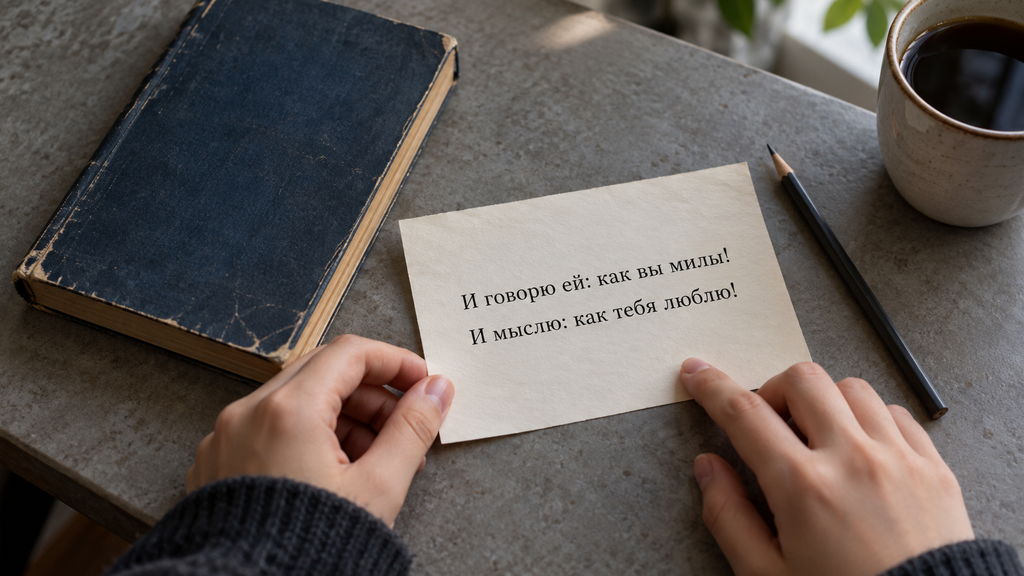
Close the poem and only show this to the teenager.
And I say to her: how sweet you are!
And I'm thinking: I love you so much!
Ask what the two lines differ from each other in.
Don't tell me. There are several differences here, and a teenager can notice any of them. I say and think. I like you and you like me. You too.
If the word «you» is not used, one sentence is enough. In this form, it is the word «you». He says «you» out loud to her, and «you» to himself.
Second question. Which of the two phrases does she hear?
Only the first one. He doesn't say the second one out loud.
Now from the beginning
Read the poem in its entirety. It is called «You and You,» and was written in 1828.
Empty you of your heart
She, in passing, substituted
And all the happy dreams
In the soul of a lover stirred.
I stand pensively before her,
I can't take my eyes off her;
And I say to her: how sweet you are!
And I'm thinking: I love you so much!
A few words that might be unfamiliar to a teenager. I think the same thing I think. Eyes, eyes. In front of her, in front of her.
Now the question is: What happened before those two lines we started with?
She called him «you».
Begging
The most important word in the poem is in the second line and it slips right by.
By hesitating. That is, by saying something unintentionally.
She didn't decide to switch to "you." It came out of her. Maybe she got better right away; we don't know that.
But we do know what he did. From a random word he came up with «all happy dreams». He then continued to call her «you» out loud.
Here it is worth asking the main question to a teenager.
Did we learn anything about her feelings or about his hope?
Let him think. Different answers are possible. The only important thing is that he can distinguish what is said in the text and what is imagined. The text says that she made a promise and that he had dreams. It does not say whether he loves her or wants to confess.
Who she is
In the poem, she has no name. Only «she».
It’s worth noting this for teenagers, because when talking about poems, they often start with who they’re dedicated to and then read not the text but the biography. Here you can do the opposite. First, the eight lines and what’s in them. Then, if you’re interested in who Pushkin wrote them for, briefly mention that in the questions under the article.
What matters in the lines themselves is something else. She said one word, he made it into a whole story, and we only read her side of it.
Why didn't he answer her the same way?

She said «you». He could have said «you» and seen what would happen.
Instead, he says «how nice of you» and keeps quiet about the rest.
Ask a teenager why. There are several possible explanations, none of which are proven by text. He is afraid of being embarrassed. He is not sure that the remark meant anything. He is not ready to take the first step and address the other person as «you».
It is worth discussing exactly as a version. The poem ends with his thoughts, and what happened next, Pushkin did not tell.
Empty and heartfelt
The first line calls «you» empty, and «you» is heart-shaped.
This is not a rule of the Russian language. It is how a lover hears these words at that moment. «You» in Russian can mean both warm and respectful, and also rude and indifferent. Here the contrast is colored by the person's state of mind, and it is useful for a teenager to notice this.
If he asks how it is translated into English, the answer is short. The modern you itself does not convey this difference. The interpreters have to find other means. In Translated by Sergei Rybin «you» is conveyed through you, and «you» and «you» through thou and thee. But there is also some variation there, because a single pronoun is not the only thing involved.
What is said remains in the mind
Below you can go through the poem again. Mark the line that she hears and the line that she doesn’t hear. Find the word that makes it clear that «you» was a coincidence. And analyze the three statements that are easy to confuse. She said «you.» He had happy dreams. She confessed her love to him. Two of them are in the text; the third is not there.
There will be no scoring. This is a reading, not an exam.
And then you can return to selection, where the poem stands without commentary, and to read it again in a different way.
Three short steps from the poem. Mark the lines, find the word, and check the three statements. There are no points for this.
1. Which line does she hear, and which one remains in her mind? First, click on the one that is spoken aloud, then on the one that is not.
Empty you of your heart
She, in passing, substituted
And all the happy dreams
In the soul of a lover stirred.
I stand pensively before her,
I can't take my eyes off her;
And I say to her: how sweet you are!
And I'm thinking: I love you so much!
2. From what word can it be understood that «you» was a coincidence? Click on it.
She, after a moment of hesitation, replaced
3. Three statements. Open each one and see if it is present in the text.
She said «you».
It's in the text. The first two lines say it directly: «You are empty inside, and when you speak, she replaces you.».
He had happy dreams.
It's in the text. The third and fourth lines: «All the happy dreams in the heart of the in love one were aroused.».
She confessed her love to him.
There is no mention of that in the text. There is only her hesitation and his dream. Pushkin did not say what she feels; any answer here would be a guess.
The clues are based solely on the words of the poem. What is not there remains a guess, and it is normal to discuss that as a guess.
In the «Literary Reading» course at the Palme School, children and teenagers who already know how to read in Russian analyze stories, novels, and poems, discuss what they have read, and learn to support their opinions with the author’s words. Groups of up to eight people are selected based on age and language level; classes take place online one or two times a week for forty minutes.
It all starts with free 30-minute meeting with a methodologist, which will determine the level of the child's Russian language, and a free trial lesson.
Register for the Literary ReadingFrequently asked questions about the poem «You and You»
What does «muttering» mean in the poem «You and You»?
To stammer is to preface something unintentionally. She wasn’t going to address the hero as «you,» the word came out of her mouth by accident. The entire poem rests on this coincidence, because the hero attached great importance to one inadvertent word.
To whom did Pushkin dedicate the poem «You and You»?
There is no name in the text. In T. G. Zviylovskaya’s commentary to the collection of works, the poem is associated with Anna Olenina, and her entry is given under her own copy of the poem. The poem was written in 1828 and published in the 1829 issue of the «Northern Flowers» almanac. For a conversation with a teenager, the addressee is not important; the eight lines are read without him.
Does her «you» mean that she confessed her love to him?
There is no mention of this in the text. It is stated that she made a promise and that this caused the hero to have happy dreams. Pushkin does not say anything about her feelings; any answer here remains a guess. It is this that should be discussed with the teenager, distinguishing what is written in the poem from what one might want to imagine.
The poem itself is entirely in our possession. a collection of poems about love, And we wrote about the poet's life in Biographies of Pushkin.