
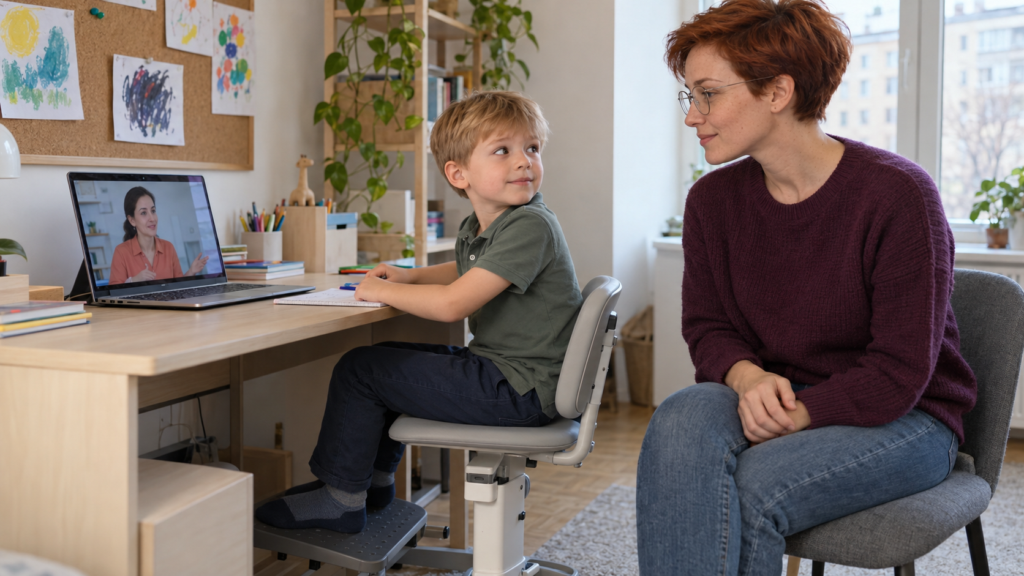

Next to the children's chair by the computer is a second chair. Mamin.
He was assigned to the first lesson to help with the buttons, and he has been there ever since. A child of four, five, or six years old sits down at the screen only when his mother sits next to him. The lesson begins, and the teacher asks the child to turn to his mother’s chair. Sometimes the mother starts giving instructions, and then answers them for him.
It’s not necessary to remove the chair completely. But you can move it. One step at a time, after agreeing on it with the teacher.
Below is one possible scenario. Discuss it with your teacher and together you can choose where to start.
Why does the child need this chair?
First, find out what the purpose of the mother being present in the class is. There are many reasons for this.
He does not understand what the teacher is saying and is waiting for a translation.
He can't operate the mouse and microphone button.
He is used to having the correct answer whispered into his ear.
He is just more comfortable when his mom is in the room.
If it’s about buttons, talk to the teacher beforehand with an adult nearby, and don’t touch the chair yet. If it’s about speech, the teacher will choose a simpler instruction and another response method, either through a gesture or by showing. If the child is waiting for guidance or feels more comfortable near his mother, discuss with the teacher what step to try.
To understand what kind of situation you're in, look at the moment when the child turns to you during a lesson. Before the question, after the question, or when something isn't being pressed.
The chair remains; the assignment goes to the teacher.
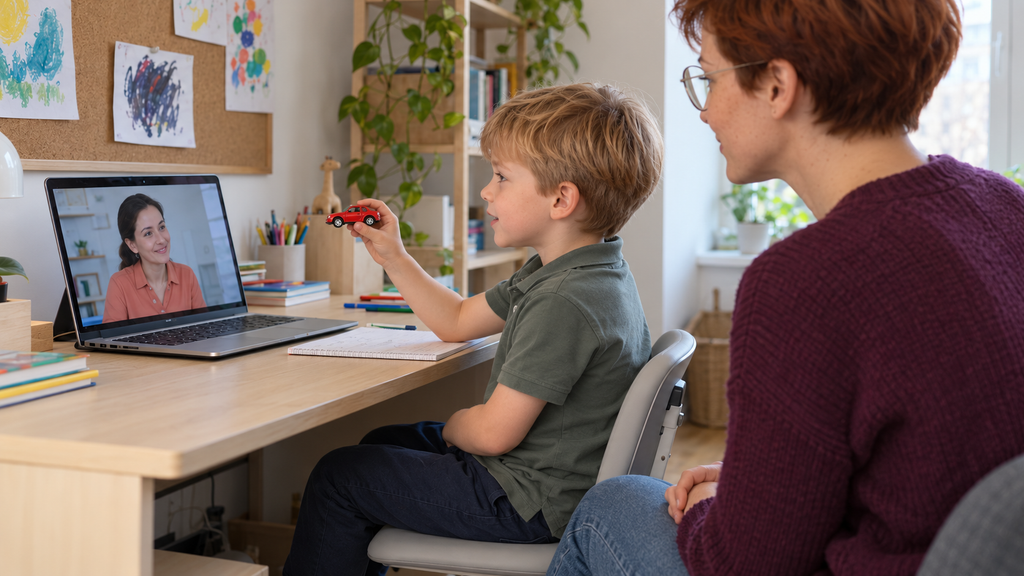
The first step isn't about the chair. Mom is sitting where she was sitting.
One thing is changing. One short task the child does directly with the teacher, without mom's help.
The assignment is chosen before the lesson, together with the teacher and the mother. It is familiar and simple in terms of words and buttons. Show the subject. Move the piece. Choose one of the two pictures, for example, where there is a cat and where there is a dog.
You can't take your hand off the screen. You can still see your mom, and you can still hear her voice. There's one thing that's different here: the child answers the teacher himself.
Two phrases before the assignment
The agreement is spoken out loud to the child, briefly, before the teacher asks a question.
Teacher.
Now we'll choose a picture together. Mom is nearby. If it's difficult, I'll help.
Mom.
I'll sit here. You're playing with the teacher now.
If the child does not understand these phrases in Russian yet, explain the agreement in advance in the language he knows. The rules of the game should not become another Russian assignment.
What Mom is doing in her chair
He is sitting.
It does not repeat the question. It does not translate automatically. It does not point its eyes at the correct image. If the child turns around, you can nod towards the screen.
The pause after the question is the teacher's turn. He will give time, repeat it more simply, and suggest answering with a gesture.
When the step is taken
The step was taken when the child answered the teacher, but his mother did not respond to him.
In a word, through a gesture and a displayed image. You made a mistake; that's okay. The teacher helped; that's okay too. The main thing is that the answer was addressed to the right person.
How many lessons to repeat is not known in advance. One successful attempt does not mean that the chair can be removed the next time. See if this kind of participation occurs in several familiar tasks and whether the child is calm.
Where the chair is moving
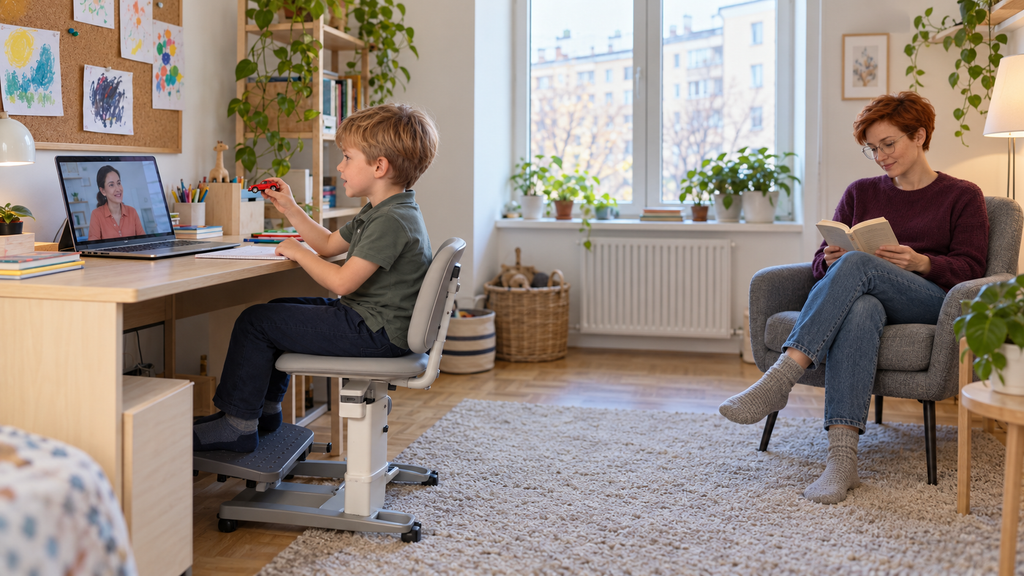
Next, they change one condition at a time.
The chair is still there, but I have already had several lessons with the teacher, and my mom is working on her own at home.
The chair is pushed against the wall. Mom can be seen, but the child continues to do the assignment with the teacher.
The chair is empty. Mom will be out for a short time. They arrange in advance when she will return and how to call her earlier.
There is no need to move the chair, complicate the Russian language, or introduce a new game during one lesson. Just one thing.
Leaving the room is not mandatory as a result. Mom can stay nearby while the child answers the teacher himself.
If the child stopped talking or cried
These are two different cases.
Silence. The teacher first gives time, checks the sound, repeats the task more simply, offers a choice of two, or gives a gesture as an answer. The pause itself does not yet indicate that it is about the mother.
Tears or «mama.» If the child calls you or cries after you leave, you return. No conditions. There are no «mama will come when you answer» phrases in this scenario.
Then you can return the chair to its original place and continue with the familiar task, or pause. The adults discuss the next attempt separately and take one step less.
One rule for all situations. Mom doesn't disappear without a trace and returns at the moment she promised.
The agreement document
Below you can compile a short list of one step and send it to the teacher before the lesson. Four lines. What the child will try to do with the teacher. Where is Mom’s chair and how does Mom help. What does the teacher do if it’s difficult, and how to call Mom. By what criteria do we decide what to do in the next lesson.
Under the line is a caveat that is more important than all the other four lines. If the child is having a hard time, the teacher helps. If the child is upset, we provide the usual support.
Four lines per step. In each one you can choose a ready-made option or write your own, up to 120 characters long. To the right, a sheet is assembled; you can print it on one page or send it to the teacher before the lesson. The lines are filled in together with the teacher; nothing is checked or evaluated here.
1. What the child will try to do with the teacher
2. Where is Mom’s chair and how does Mom help
3. What does the teacher do if it's difficult, and how to call mom
4. By what criteria do we decide what to do in the next lesson
The first step from this article can be discussed with any teacher. If a child is learning Russian from the very beginning, Palme School has a course called «Russian as a Foreign Language»: children from the age of four, groups from 4 to 6 years old, from 7 to 9 years old, and from 10 to 14 years old, or individual lessons, two lessons a week of 40 minutes each.
You can start with free 30-minute meeting with a methodologist, It's a place where you can talk about your mom in class and also take two free lessons with a teacher.
Sign up for free classesFrequently asked questions about mom in an online lesson
Is it mandatory for mom to sit next to her during the first online classes?
It depends on the child and on the agreement with the teacher. In the first few sessions, a preschooler often needs an adult nearby to help with the buttons and get them settled in. The scenario in the article doesn’t require leaving the room; it simply suggests leaving the mom in place and giving the child one short assignment directly with the teacher. We wrote about when a parent’s presence is helpful and when it hinders, in a separate article.
How many lessons are needed for a child to start studying without a mother?
It is not known in advance, and there is no need to count the lessons. They are looking at something else. Does the child answer the teacher himself in several familiar tasks in a row and is he calm during that time? If the child is calm but still needs help, the step can be repeated. If he finds it difficult or he gets upset, the agreement is reviewed and the step is reduced. One successful attempt is not a reason to change the conditions.
What should I do if the child does not understand the teacher's instructions in Russian?
This is no reason to take away a mom's time. The teacher chooses a simpler instruction and a response method that the child can understand with a gesture, a demonstration, or a choice from two pictures. The parent explains the step agreement in advance in the language the child understands so that the rules do not become another Russian homework assignment.
Is it possible to leave the room immediately if the child is already old enough?
It is possible if the child is ready for it and you have agreed with the teacher when you return and how he can call you earlier. The scenario from the article is designed for preschoolers who need support in an online format. For a schoolchild, the first step may be more, but the rule is the same; they change one condition at a time.
How can you explain to a child that mom will just sit there and you have to answer yourself?
Shortly before the teacher asks the question. The teacher says that they will now choose a picture together; his mother is nearby and if it is difficult, he will help. The mother says that she will sit here while the child plays with the teacher. If the child does not understand this yet in Russian, explain it in a language they are familiar with beforehand.
What to do if the child cried when the mother left?
Return immediately and without conditions. There are no phrases like «Mom will come when you answer» in this scenario. Then you can return the chair to its original place and continue with the familiar task or pause. The next attempt is discussed separately by the adults and made one step less, for example, the mother stays in the room but sits further away.
In the article we discussed when the presence of a parent in an online lesson helps and when it hinders. Is it necessary for parents to be present during online classes?.