

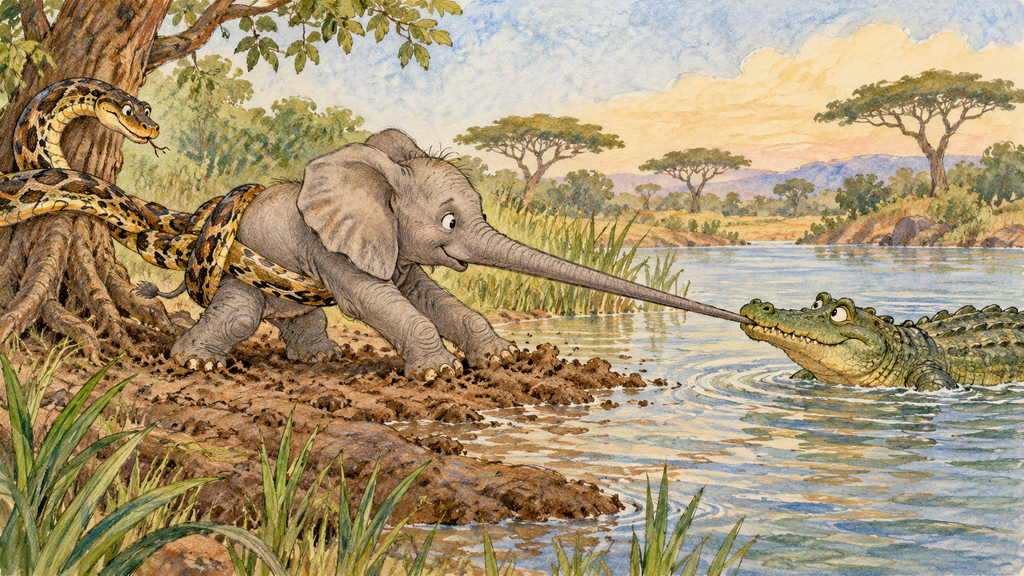
Ciplin has a story about a sloth who always wanted to know. He asked the ostrich why it grew feathers on its tail, asked the giraffe why it had a spotted coat, and asked the hippopotamus why it had red eyes. Instead of answers, all his relatives slapped him. The elephant’s nose was then short, about the size of a boot, and the sloth could only turn it from side to side. One day he asked a question that no one in the family answered: “What does a crocodile eat for lunch?” and set off to find the answer on the banks of the Limpopo River.
What happened is well known to many. The crocodile grabbed the antelope by the nose and pulled it; the antelope stuck and pulled back; a python came to its aid, and they pulled for so long that the nose stretched out and became long. The whole story, if you think about it, is the answer to the question «where did the elephant get its trunk from?». This answer is fictional; it only works within the story, but it is structured the same way as the actual explanation. It names the event, and it shows how that event affected the nose.
Immediately after «The Donkey», Kipling placed a poem about the six faithful servants, whose names are questions of when, why, how, where, and who. There is a line about «seven million Whys», seven million why's, and who lived next to a little child; arguing with that number won't be an issue. Usually the child asks «why,» and the adult explains. Sometimes it's the other way around, and then it becomes clear that explaining is more difficult than asking.
When an adult asks «why»
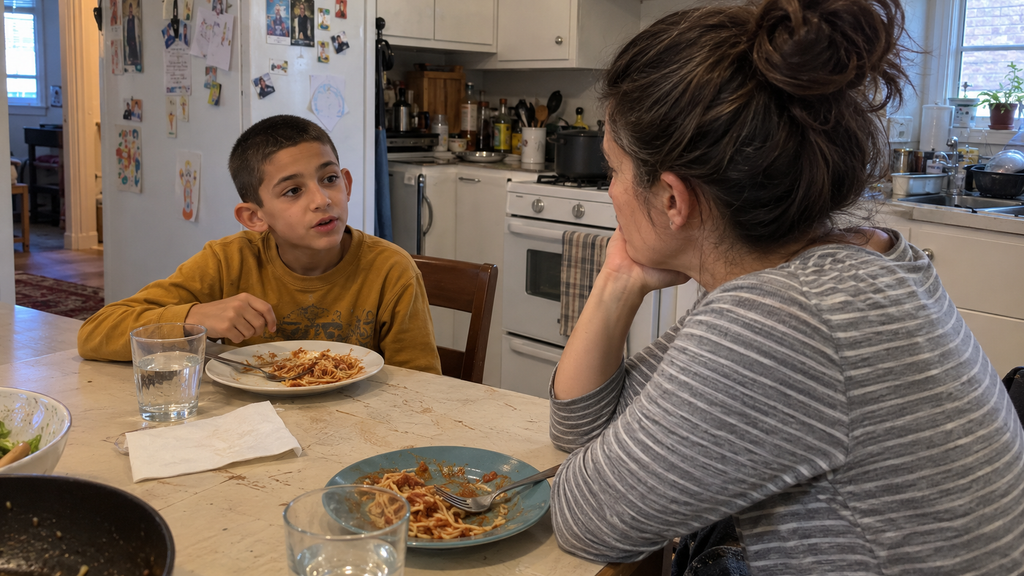
At dinner, the adult asks how the day went and hears a detailed account in response, who said what, where they went, and how it all ended. Then a simple question is asked.
«Why are you late from school?»
«Because I came later.
The «because» phrase is in place, but there are no explanations in the answer. It is not possible to say one such answer, whether the child understands why he is late. Here we will discuss how to help the child express an explanation in Russian.
The adult asks about what happened to the child themselves. The child may remember details that the adult did not see, who held them back at the gate, where they had to go back for their coat, how long they waited for the bus. They can clarify these together without implying a pre-determined reason. Sometimes after the second question, the answer sounds different: «Because we went to get the coat afterwards.» This is not an explanation; it’s the next event that happened nearby. There may be a reason behind such an answer, but the connection still needs to be clarified, and you can ask directly, like how the coat influenced what happened. Then the pieces connect themselves: «I was late because I went back for the coat, and everyone had already left.» Or a candid «I don’t know»; that’s also an answer; there’s no need to invent a reason for a beautiful phrase.
The question «what if this hadn’t happened, would you have managed to do it?» also sometimes helps, but it’s better to have it on hand. There are several possible reasons for an event, and the child doesn’t have to know what would have happened otherwise.
One such sentence is enough for the evening. How to structure the story itself in terms of time, beginning, background, and event—we discussed this in the article. about how to tell a story coherently about the past. Here we are talking about the connection within the already narrated episode.
Where does the fairy tale end?
Kipling could have made up a reason, and that’s the whole beauty of a fairy tale. In the story about one’s own day, you don’t have to invent it; you just remember it or find out about it, and if you don’t have enough information, you just say so.
Below are a few short answers with «because». For each one, you can decide whether it explains why, repeats something already known, or names another event whose connection has not yet been explained.
Does that explain why?
Read the question and the answer. Decide whether the answer mentions a reason, repeats something that is already known, or mentions another event whose connection is not yet explained.
01«Why did the soup remain in the bowl?»
«Because he stayed.»
02«Why did the soup remain in the bowl?»
«Because the soup was hot, and everyone had already gotten up from their tables.»
03«Why take a backpack home?»
«Because then a bus arrived.»
04«Why take a backpack home?»
«Because in the morning he wasn’t in the hallway, and in a hurry no one noticed him.»
05«Why is the ball on the roof?»
«Because he's there.»
06«Why is the ball on the roof?»
«Because after the change there was a music lesson.»
07«Why is the ball on the roof?»
«Because it was hit too hard from the bottom up.»
If the answer mentions another event, you can ask how it influenced what happened. An answer of «I don’t know» is also honest.
And you should reread «The Elephant» together. After the last page, you can ask why the elephant has a long nose and listen to the child retell the story about the crocodile. If the child has difficulty putting the explanation into one sentence, you can suggest a beginning. «The nose has stretched because…»
At the «Speech Development» course at Palme School, children aged four to eighteen years engage in online learning for 40 minutes twice a week. Telling about their day in a way that makes it clear not only what happened but also why, is also part of clear communication.
You can start with free lesson.
Book a Free TrialFrequently asked questions about how to explain the reasons to a child
Why does a child answer «because» and repeat the question?
With one such response, it is impossible to tell whether the child understands the reason. The connection is already there, but the explanation has not yet been given. We can clarify the details together, without predetermining the reason.
How to teach a child to explain reasons in Russian?
Take a real-life situation from his day and ask why it turned out that way. If another event was mentioned in response, ask how it influenced what happened. One such sentence in the evening is enough.
What to do if a child says «I don’t know»?
Accept this answer. There’s no need to invent a reason for a beautiful phrase; you just remember it or find out about it, and if you don’t have enough information, you just say so.
How does an explanation of the cause differ from a coherent narrative about the past?
The narrative of the past builds the events chronologically. The explanation shows how one event influenced another within the already narrated episode.
What does Kipling's story about the elephant have to do with it?
In «The Elephant,» Kipling invents a story about where the elephant's trunk comes from. The reason is fictional, but it is presented as a real explanation; it mentions an event that influenced the nose.