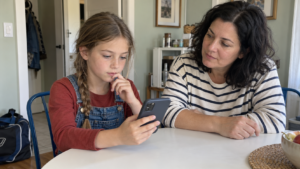


Sometimes when packing a gift, one more hand is sorely lacking. The paper, just folded neatly, gets crooked; you have to remove your hand from it; the tape clings to your fingers; the corner of the box stubbornly sticks out from under the edge. On the third try, the child either throws everything away, or turns to his mother with «Can you hold this?» or quietly pushes the box towards her. He knows the word «help.» Maybe he knows «hold it.» Only in that moment when his hands are busy and his head is completely in the paper, the Russian phrase doesn’t come, and the English one is right there.
Why does a particular child react in this way? It’s impossible to understand why one child behaves this way, and the reasons for different children are different. Here we’re talking about the request itself. It arises within the context of a larger situation, and this situation can be arranged so that the Russian request is first voiced by an adult.
Two hands and one piece of paper
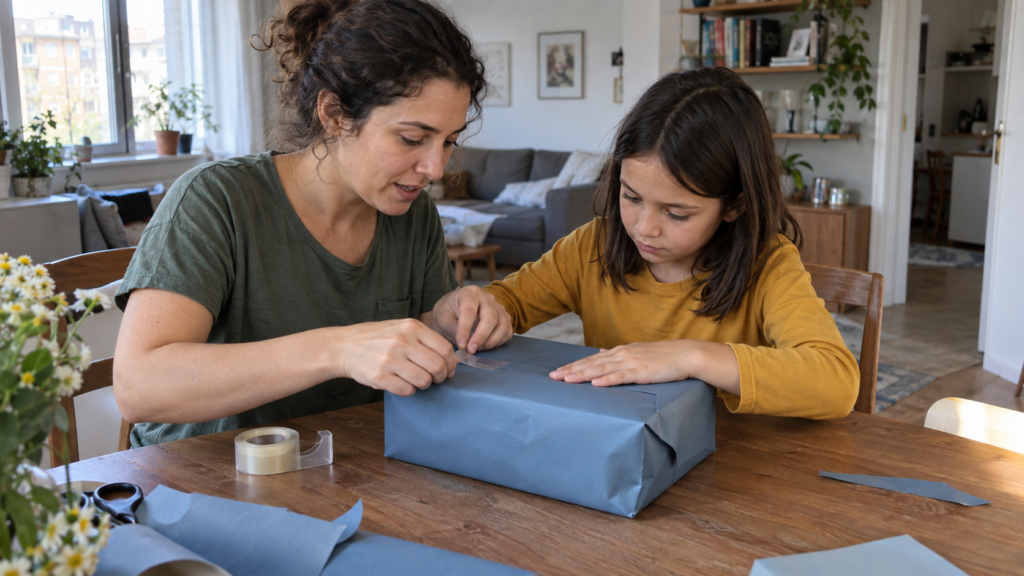
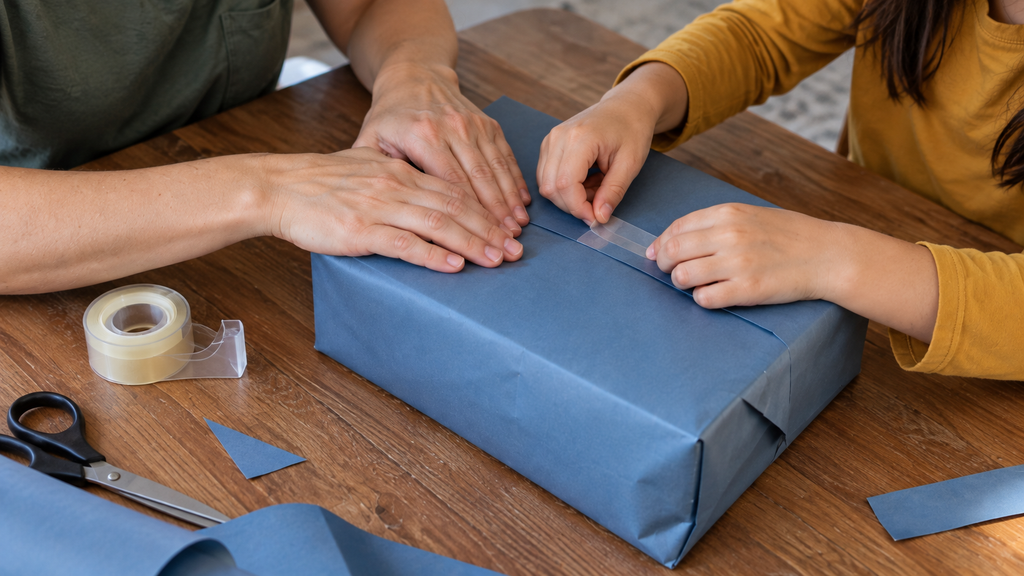
When the two of them are together, the gift is packaged in a completely different way. One presses the edge of the paper against the box, the other tears off a piece of tape and sticks it on. It’s more convenient at the next corner if the person sitting on the left holds it and they switch roles. There’s no need to come up with anything; the work itself is divided into two pairs of hands, and each pair has to do something with the other one in turn.
Requests in such work are short. Instead of a long request, sometimes just one word and a gesture are enough. Hold on. Here. Just a little more.
What does the word "hold" do?
Philology is a couple of paragraphs long here, but it explains why the word is so appropriate for the task. In the word «to hold,» the prefix «po-» limits the action in time. To hold means to hold for a certain period of time. «To sit» and «to play» are similarly constructed. The word does not specify how long that period of time lasts. The packaging of a gift usually contains exactly enough to stick the tape.
There is also a «hold» word nearby that can be heard behind this table. When handing a child a roll of tape, an adult can say «Hold it.» And when it’s time to secure the paper, «Please hold this edge while I stick the tape.» The root is the same, but the actions are different. In these two replays, the adult first hands over the tape, then asks for the paper to be held.
First asks an adult for help
The adult himself says «Hold on, please» and shows where to hold it. The child holds it, the tape is attached, the edge can be released. In fact, this is more convenient for packing, and the Russian request is heard where it is really needed.
Roles change after a few turns, if that’s natural for the situation. Now the child is holding the paper, and the adult is holding it. Sometimes the adult already holds the paper, and the child doesn’t have to ask for anything; then there’s no need to do so. If the child is able to do it himself, no one creates any difficulties for him.
When help is needed for a child
The paper is falling again, and the child needs a second pair of hands. He can say this in English, he can pull on a sleeve, he can remember «hold on,» which he heard five minutes ago. An adult will help anyway. Already by holding the edge, an adult can suggest: «You could ask, „Hold on, please.“» And continue packing.
The child is not required to repeat the phrase to get help. A complete phrase and a «please» are also not a requirement. They help immediately, and the Russian word simply remains nearby, just in case of the next turn of events.
Whether the child will start asking in Russian after receiving two gifts and whether he will take the «hold» from the package to the kitchen and the garage, you won't know in advance. What you can say for sure is that the child heard the Russian request in the case in which he himself participated.
How to run a joint business for two
A few tips for situations where asking to be «held» may be necessary. This is not a mandatory program. If the child is able to handle it on their own, there is no need to intervene. If they ask for help, help is provided regardless of the language of the request.
Choose a case for two
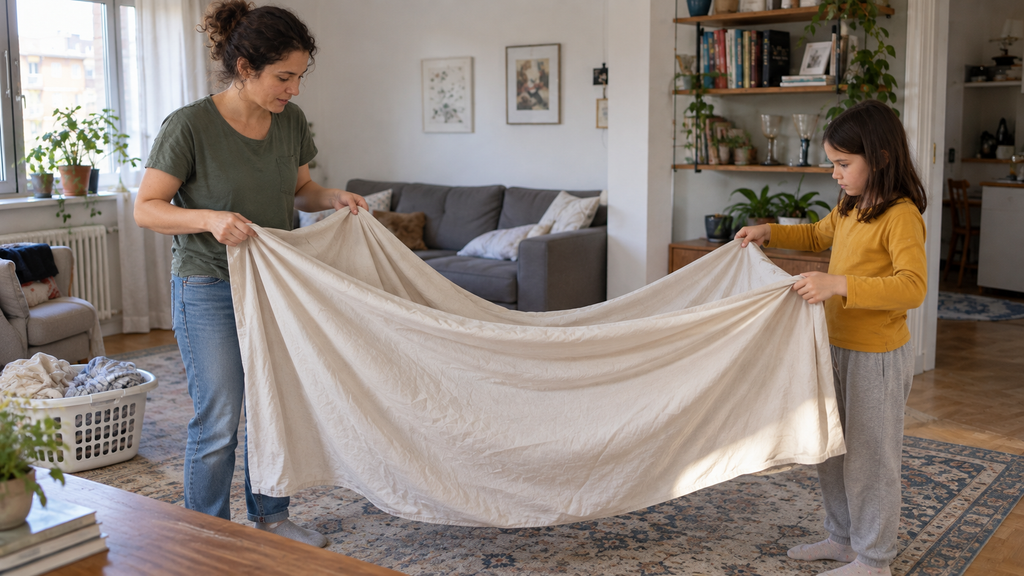
Any real-life task that is more convenient to do together will work: packing a gift, hanging a painting, folding a large bedsheet, putting together a shelf. There’s no need to specifically come up with an assignment for the lesson.
The adult asks first
The adult himself says «Hold on, please» and shows where to hold it. The child holds it, the tape is attached, the edge can be released. The Russian request sounds where it is really needed.
Roles are changing
After a few turns, you can switch roles if it’s natural for the situation: now the child is doing the gluing, and the adult is holding it. If the child is able to do it on his own, there’s no difficulty for him.
When help is needed for a child
They help immediately, regardless of whether the child asks in Russian, English, or simply tugs on the adult’s sleeve. Already while holding the edge, the adult can suggest: «You can ask: „Please hold it.“» The child is not required to repeat the phrase, speak it completely, and add «please.»”.
Hold and hold on
By stretching a roll of duct tape to the child, an adult can say «Hold it.» And when it’s time to secure the paper, «Please hold this edge while I stick the duct tape.» Both words sound the same in their respective situations, without explanation.
Not just a gift
The gift is convenient because it’s easier to do it together than alone, and that’s immediately apparent. There are plenty of similar tasks in the home. Hanging a picture while one holds it and the other watches to make sure it’s all right. Folding a large blanket, which is easier to fold together. Putting together a shelf where one has to hold the wall while the other screws the screw. In each of these tasks, a «hold» request may be needed.
The gift ends up being a bit crooked, like almost all gifts packaged in four hands. The tape has come off, there’s more tape in one corner than paper. And «hold on» was said several times during this time, and not once as a task.
The «Russian for Bilinguals» course at Palme School is for children from the age of four. The lessons use games and discussions that give the child a chance to speak for themselves.
Classes can be tried at two free lessons. There they will determine the child’s level of Russian and suggest which program is best suited for them.
Sign up for free lessonsFrequently asked questions about requests for help in Russian
Why doesn’t a child ask for help in Russian if they know the words?
In one situation, the reason is not clear; for different children it is different. Sometimes, when the hands are busy with something else, the Russian phrase doesn’t come in time, and the English one is available.
What to do if a child asks for help in English?
Help immediately. As soon as they help, an adult can suggest the Russian equivalent, for example, «You can ask: „Hold on, please.“» The child is not required to repeat it.
Is it necessary to ask a child for a «please» and a full sentence?
No. The help does not depend on how the request is phrased. The full phrase and the «please» remain the model that the child hears from an adult.
How is «hold» different from «hold»?
These are two verbs with the same root, «hold» and «hold on.» The prefix «po-» in the word «hold» limits the action to time; to hold means to hold something for a certain period of time. When handing over a piece of tape, an adult might say «Hold on,» and when asking someone to hold a piece of paper, «Hold this edge.».
What household chores are suitable for such a practice?
Those that are easier to do together: packing a gift, hanging a picture, folding a large bedsheet, putting together a shelf. There’s no need to specifically come up with a task; ordinary household chores will do.
Will the child start asking in Russian after that?
You can't tell in advance. In general, in this case the child hears an adult asking for help in Russian and can use the same phrase when help is needed.