


In the autumn of 1966, subscribers to the magazine Moskva received the eleventh issue, which began the publication of a novel that had sat in a desk for twenty-six years after the author's death. The issue was passed from hand to hand for a single night, read until morning by entire families, and the pieces cut by censorship—which soon circulated across the country in typewritten copies—were pasted into the magazine and copied out by hand by readers, because the cuts amounted to almost an eighth of the text.
What follows seems incredible even by the standards of Russian literature, where posthumous fame is a common occurrence. A book written for the drawer by a man whose plays were pulled from the repertoire and whose prose was not published, over half a century became the most widely read Russian novel of the twentieth century, broke down into proverbs used by people who had never read it, and was published in dozens of languages, while the English-speaking world knows it as «Master and Margarita».
Twelve years of work and a stove in a Moscow apartment
Bulgakov began in 1928, conceiving a comparatively small work about the devil appearing in Soviet Moscow, and neither the Master nor Margarita were in those first notebooks at all. In the spring of 1930, after all his plays were banned and no hope of publication remained, he burned the draft of the novel in the stove, which he later wrote about in a letter to the government sent at the end of March of that same year.
This story had an unexpected continuation, because a few weeks later Stalin called the writer, and the conversation ended with Bulgakov being hired as a director's assistant at the Moscow Art Theater. Work on the burned novel resumed two years later and continued until the last days of his life. Eight revisions, completely rewritten plotlines, new characters, and in the end, having already lost his sight, the author dictated edits to his wife Elena Sergeevna, and work stopped a month before his death in March 1940.
The novel never received a final polished edition, and the text that millions read today was assembled by the writer's widow from manuscripts and typescripts. In the Soviet Union, it was published completely and without omissions only in 1973, and abroad a few years earlier.
Three books bound in a single cover

To someone opening the novel for the first time, it seems like a collection of incompatible texts, and this impression is not far from the truth. Inside, there really live three different books, written in three different ways.
Everything begins at Patriarch's Ponds, where two writers meet a foreign professor who explains to them that a man is not in control of his own life and that the meeting scheduled for the evening will not take place. Next, merry and cruel devilry unfolds across Moscow, featuring a black magic show at the Variety Theatre, disappearances of people, money turning into scraps of paper, and outfits dissolving right on the street.
After a few chapters, the style changes beyond recognition. From the hubbub of Moscow, the reader is plunged without warning into Yershalaim, where everything is written in a dry, almost documentary manner, and the procurator of Judea, Pontius Pilate, suffering from a headache and his own cowardice, interrogates the wandering philosopher Yeshua and sends him to his execution, knowing that he is entirely innocent.
The line that gave the novel its title appears when the reader has already stopped expecting a connection between the first two. The Master, the unnamed author of the book about Pilate, which he burned after being crushed in the press, lies in a psychiatric clinic, while Margarita, another man's house she left behind for his sake, agrees to become the queen at Satan's ball in order to get her lover back. All three lines come together in the finale, and it is precisely the structure of this connection that is usually called the main reason why the book is considered a masterpiece.
Who is who in the novel
Nine heroes without whom the plot cannot be understood.
Woland
Professor of Black Magic
Right eye black, left green, a limp is noticeable when walking, and he talks about events from two thousand years ago as an eyewitness. Almost all the time he stays apart and observes, delegating the work to his retinue.
Koroviev
Bassoon, choirmaster, translator
A jester in cracked pince-nez and a plaid jacket who orchestrates most of the scandals. In the final chapter, it turns out that behind the buffoonery was a knight paying for a poor joke made a very long time ago.
Hippopotamus
Cat, page, favorite jester
A huge black cat that rides on the footboard of a tram, pays the conductor a ten-kopeck coin, shoots a Browning, and at the decisive moment declares that he is merely fixing the primus stove.
Azazello
Errand runner
Red-haired, short, with a protruding fang, he is responsible for everything that requires direct action. It is he who brings Margarita the cream after which her transformation begins.
Hella
Maid of honor
A red-haired witch with a crimson scar on her neck, greeting visitors to the bad apartment. She is absent from the final flight, and researchers are still looking for an explanation for this.
Master
Historian, author of the novel about Pilate
Winning a hundred thousand on a bond allowed him to quit his job at the museum, rent two basement rooms, and write a book for a whole year. Later he said that the book brought him nothing but misery, and he refused to return to it.
Margarita
Wife of a prominent specialist
A thirty-year-old woman who has everything except meaning. To bring the Master back, she agrees to be the queen at Satan's ball, knowing how such deals usually end.
Ivan Bezdomny
Poet, witness of the first scene
The only character who truly changes. From a writer of antireligious poems, he turns into a history professor and every full moon remembers what he witnessed at Patriarch's Ponds.
Pontius Pilate
The Fifth Procurator of Judea
Golden Spear Rider, exhausted by bouts of headaches and loneliness so severe that the only creature he is attached to is his dog. He signs the death warrant after the prosecution turns the case into one of high treason against the Caesar, and arguing any further would mean risking his own head.
The entourage that restores order in the city
Woland, as the devil who appears in Moscow is named in the novel, is constructed contrary to the entire tradition to which the European reader is accustomed. He does not tempt anyone, offers no contracts for the soul, and generally behaves like a weary inspector who has come to see whether the townspeople have changed internally. He punishes exclusively those who have punished themselves, and the bribe-taker, the denouncer, and the thieving administrator receive precisely what they have earned.
His retinue makes up half the book's charm. The lanky Koroviev in a cracked pince-nez, the huge talking cat Behemoth with a primus stove, the red-haired Azazello with a protruding fang, and the witch Hella behave like marketplace jesters, yet their jokes invariably turn into a sentence. It is precisely these four that turned the novel into a source of endless quotes, stage plays, and screen adaptations, and they are also the ones that gave it the reputation of a funny book, though there is just enough humor in it to make the terrifying readable.
Moscow, where people disappear at night
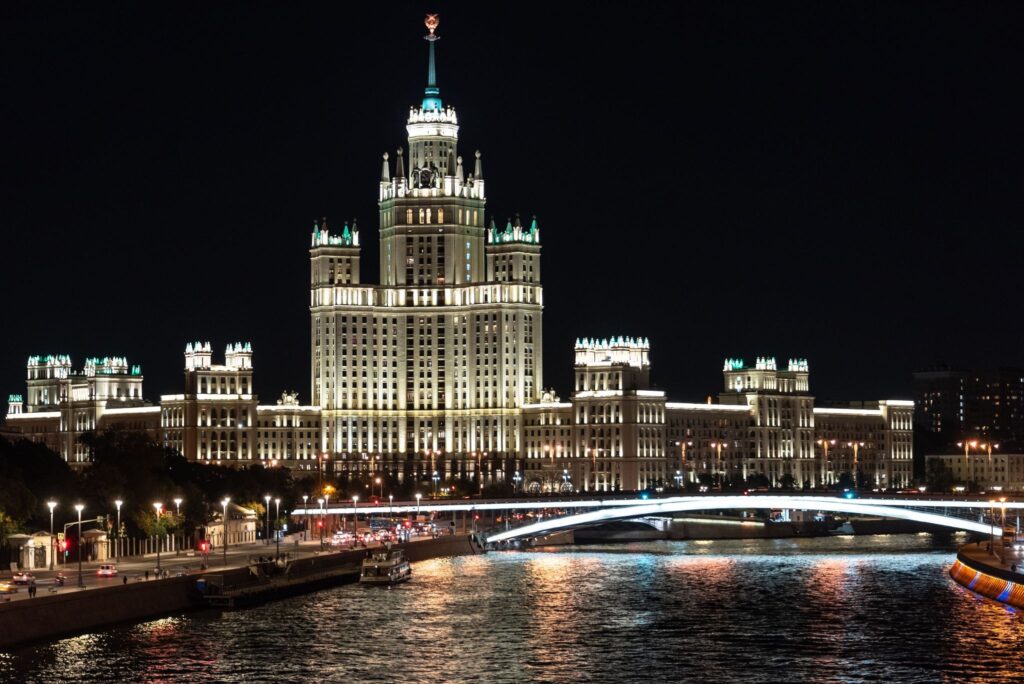
It is impossible to understand the satirical part without the historical background, and this background is never explicitly named in the novel, since the text was written in the very years it describes. Moscow of the late 1920s and 1930s in Bulgakov's work lives in a state of constant housing shortages—hence the famous phrase about Muscovites being spoiled by the housing question—and communal brawls over rooms occupy no less space in the book than broomstick flights.
People in this city literally vanish: the residents of the haunted apartment on Sadovaya Street are carried away to an unknown destination, and the neighbors attribute this to evil spirits, even though the author's contemporaries understood such disappearances without any mysticism. The literary milieu is depicted through Massolit with its restaurant, country houses, and travel vouchers, where belonging to the organization matters more than what one has written, and scathing newspaper articles ruin a life in a matter of days, something Bulgakov experienced firsthand.
Why this book outlived its time
The main thing about it is the structure, because before Bulgakov, no one had managed to seamlessly combine an evangelical parable, urban satire, and a love story into a single text. Each storyline is written in its own language, the transition between them works like a change of lens, and the final chapter brings them together in such a way that, in hindsight, the entire construction looks like the only possible one.
From this device also grows the novel's famous intonation. The book speaks of denunciations, fear, execution, and betrayal while remaining light and fast-paced, since the shifting perspectives prevent the reader from getting stuck in horror, and the phrase about manuscripts not burning sounds like a consolation to anyone who has ever lost their work.
The composition, combined with the intonation, produced a third consequence, this time a linguistic one. The book was broken down into dozens of expressions that are used today without remembering the source, much like what happened with nineteenth-century Russian classics, which is discussed in a separate review in the collection. quotes of Russian writers.
Six expressions that passed from the novel into the language
They are used even by those who haven't read the book. Here is where they come from and what they mean now.
Manuscripts don't burn
It is spoken when Woland returns the destroyed book to the Master. Today the phrase is said about any text or endeavor that someone tried to destroy and which survived, and it sounds hopeful rather than certain.
Never ask for anything
Woland's advice to Margarita, which grew into a whole life philosophy. It is used regarding dignity in conversations with those who are stronger, and, as a rule, half-jokingly.
Sturgeon of the second freshness
Objection to the buffet waiter who is being told that there is only one kind of freshness. It has stuck to everything they try to pass off as decent, from store goods to someone else's work.
Housing issue
The verdict that Woland passes on the Muscovites right during the show at the Variety Theatre, looking from his armchair at the audience that had just been catching chervonets. People talk this way both about cramped living conditions and about what it does to people, most often with a smirk, when analyzing another family feud over square meters.
Annushka has already spilled the oil
From the first chapter, where the future is sealed by a mundane trifle. People say this when the deed is already done and there is no turning back, even though outwardly nothing has happened yet.
Follow me, reader
The narrator's address with which he calls the Master along into the story. It became widespread as an invitation to follow a train of thought and is even found in article headlines.
The motifs that hold the novel together
Eight cross-cutting themes through which the book is analyzed at school and university.
| Motive | How it works in the novel |
|---|---|
| Light and peace | In the finale, the Master receives peace rather than light, and the difference between these rewards is still debated by scholars. Peace means rest and quiet for one who has exhausted himself completely, but not an ascent. |
| Fire | There is a constant fire in the novel: the manuscript in the stove, the house on Sadovaya, the writers' restaurant. Fire acts as a line beyond which the former life ends, and yet it cannot destroy anything truly important. |
| The moon and the sun | The Jerusalem chapters are flooded with a merciless sun, while the Moscow ones almost always take place under the moon. In Bulgakov's work, moonlight reveals the truth about a person, which is why it is precisely during the full moon that memory returns to those who would prefer to forget. |
| Thunderstorm | Both parts of the novel end with a thunderstorm, and it arrives right when the decision has already been made and cannot be undone. The sky in this text reacts to human choices faster than people do. |
| Cowardice | Named in the novel as the chief of vices, and the punishment for it is the longest. The procurator pays with two thousand years, the writer shows a lesser cowardice, but the mechanism of the act is the same. |
| The mirror image of two cities | Moscow and Yershalaim are built as reflections: the hill of execution and the Vorobyovy Gors, betrayal for money and a denunciation for the sake of an apartment, washing of hands and a signature under a devastating article. |
| Water | Patriarch's Ponds, where the action begins, the Moskva River, where the naked Ivan ends up, the downpour in the finale. Water accompanies the transitions between states and is often present near the moment when the protagonist loses his former life. |
| Name and Namelessness | The Master renounces his name, Ivan changes his pseudonym to his surname, and the retinue bears names from demonological lists. Who is named what in this novel tells us more about a character than their actions. |
How to approach a novel if Russian is not your native language
A reader who takes up a book in Russian should know a few things about it in advance. The Moscow chapters are written in the colloquial language of the thirties and are full of Soviet realities that are not in the dictionary, so it is more convenient to start with an annotated edition or simultaneously keep a translation at hand, fortunately there are several versions of varying quality in English.
The Jerusalem chapters, by contrast, are written transparently and slowly, so if you encounter difficulties, it is wise to start with them. The query «master and margarita plot» brings up a summary that removes the fear of the first hundred pages, and using such a summary before reading is not shameful, but useful, because the plot is not the main thing here.
In the search bar, the author's name is typed as «bulgakov», and in Western lists of Russian classics it ranks noticeably lower than Tolstoy and Dostoevsky, yet the novel has accumulated so many translations that debating the best one has turned into a separate pastime for philologists. The book began to be translated into English immediately after its first publication in 1967, and is still being translated to this day; each generation of translators decides anew what to do with Soviet realities and Koroviev's endless wordplay.
It is not necessary to start getting acquainted with Russian prose with this novel. For those who feel more comfortable starting from the familiar, it is suitable Leo Tolstoy, and Anna Karenina is analyzed in a separate article, and after it, Bulgakov's Moscow is noticeably easier to grasp.
Home
The novel was written for twelve years, was once burned by the author, was completed by dictation until the last weeks of his life, and reached the reader twenty-six years after Bulgakov's death, initially with censorship cuts, and in full only in 1973. Inside, it combines three books: a satirical Moscow one, a Gospel Yershalaim one, and the love story of the Master and Margarita. The devil here acts as an inspector who punishes people with their own vices, and the terrifying era of the late twenties and thirties is shown in such a way that the reader is left to laugh. The novel secured its place in world literature thanks to its compositional structure, a rare combination of horror and lightness, and a language that has become a source of proverbs.
Russian Literature in Conversation and Dispute

People usually grow up to appreciate Bulgakov if by the age of twelve they were already arguing about books in Russian, and this habit is formed long before high school, specifically through live discussion. At Palme School, children from four to seventeen years old study Russian online in small groups where books are analyzed through questions and disagreement, without textbook summaries, and for adults who have taken up reading on their own, there are separate conversation practice groups. You can see how it works at two free lessons, the first of which is an introduction with a methodologist who selects a group based on age and level, and the second is a trial lesson with a teacher and other students.
Frequently Asked Questions
What is the novel «The Master and Margarita» about, in short?
The devil and his retinue arrive in 1930s Moscow, test the townspeople, and along the way reunite two lovers. Woven into the narrative is a second book about the trial of Pontius Pilate.
What happened to the novel after Bulgakov's death?
Everything remained with the widow. Elena Sergeyevna assembled a coherent text from the torn edits and went around publishing houses for twenty-six years until she achieved publication.
Why do different editions of the novel differ from each other?
There is no final authorial fair copy; some of the corrections are in notebooks, and some in the typewritten text. Textologists choose their sources differently, which accounts for discrepancies in words and entire paragraphs.
Why does the cat Behemoth walk around with a primus stove?
In old demonology, Behemoth is the name of one of the spirits, while a primus stove stood in every communal kitchen. From this combination the whole book grows.
Why are there chapters about Pontius Pilate in the book?
Without them, the Moscow part would have remained a feuilleton. The cowardice of a writer and the cowardice of a procurator are constructed in the same way, the only difference is the price.
Is it true that the novel describes real places in Moscow?
Almost all the addresses are authentic. Patriarch's Ponds, the building on Bolshaya Sadovaya where Bulgakov lived for three years in a communal apartment, Herzen House on Tverskoy, the hard-currency store on Smolenskaya. Tours are conducted to these locations, and a museum operates in the former apartment.
At what age is it appropriate to read this novel?
Satire is not read before the age of fifteen or so. For those who are eager to start right away, it is better to give them «Heart of a Dog».